

ceo @box - your business lives in content. unleash it with AI

Joined March 2007
1,154 Photos and videos
The battle in AI is shaping up to be a battle for context. Everything in AI is about making sure that agents are effective as possible. That effectiveness comes down to whether the agent has the right domain expertise, access to the right context and tools to work with, and are involved in workflow in a way that users can easily interact with, review its work, and incorporate it into the rest of the process. As a consequence, the platforms that are able to capture and leverage the best and most context within their agents —and be able to pick the right models for the task- will be the place where agents do their best work. You can just look at coding agents, legal agents, or support agents as examples of what this looks like at scale. This is why the applied AI layer has a lot more value than just being an LLM wrapper. The ability to organize the critical knowledge for the work being done, and maintain this knowledge in a governed way where only the right people and agents have access, and the ability to improve the context for agents more and more over time, is critical. Over time, this layer will be able to route work between a variety of models, leveraging frontier intelligence for planning and orchestration and review, and a mix of lower cost models (open or closed) for the large volume of work between these tasks. The applied layer is also in a good position to train and develop its own models as well that are purpose built for their domains. Never good to bet against the bitter lesson, but equally taking a near frontier base model and post training it for just one type of domain work can -in many cases- lower costs or deliver better performance for certain tasks. Finally, this applied layer is also where most of the change management of the workflow will need to occur. This is why FDEs are so important at the applied layer, because this is the point where the customer needs to have specific business problem solved by a particular vendor. Whichever companies can solve that completely in an end-to-end fashion will have the greatest moats. As each day goes on, we’re learning more about what the likely long term market dynamics will look like in AI.
89
52
333
58,581
The deployment of AI in the enterprise beyond just interacting with a chatbot will unequivocally take real work to align AI systems to the underlying business processes they’re involved in and drive the desired outcomes. Most workflows weren’t designed for AI agents to just drop into. Workflows today in the enterprise deal with fragmented data, legacy software systems that agents can’t connect with, institutional instead of documented knowledge, and more. To deploy agents reliably at scale you need to get data cleaned up, modernize IT systems, figure out evals, drive change management for the new end state process, and so on. This also involves designing where humans remain in the loop (which will mean entirely new ways people interact with the workflows), and figuring out what a company’s new IP looks like. This is why so many applied AI companies are expanding FDE efforts and launching deploycos, and why the FDE role will be one of the most critical jobs in tech going forward. There’s a tremendous amount of work to be done on this front.
MSFT putting $2.5B and 6,000 engineers in “Frontier Co” Now Microsoft, Amazon, OpenAI and Anthropic are all in the Palantir-like deployco business.
67
59
413
99,349
If you’ve ever wondered why we will need 100X more AI inference in the future, and what it’s going to be driven by, this is another good example. Devin pushes forward an idea of agentic mapreduce, which means we’ll now have swarms of agents that are processing large amounts of data (code) to handle tasks that humans never could have done before. “Devin maps relevant signals across the repo, fans out focused agents over bounded shards, reduces their findings into one report, then verifies serious vulnerabilities in isolated sandboxes before marking them confirmed.” In this case it’s code security, but there are tons of other use-cases in code and knowledge work. We see this at Box with customers that want to process and understand millions of documents for risk, insights, relationships, and more. This will play out in pharma, banking, and many other industries across all forms of unstructured data. As an aside, these types of capabilities are generally only possible when you can deploy a variety of models (both the frontier and lower cost) because of the sheer amount of tokens that go into these use-cases. This is going to be a major value proposition for the applied AI layer.
Introducing Devin Security Swarm A more cost effective and accurate way to find security vulnerabilities in complex codebases, based on a new architecture: Agentic MapReduce.
53
37
328
96,720
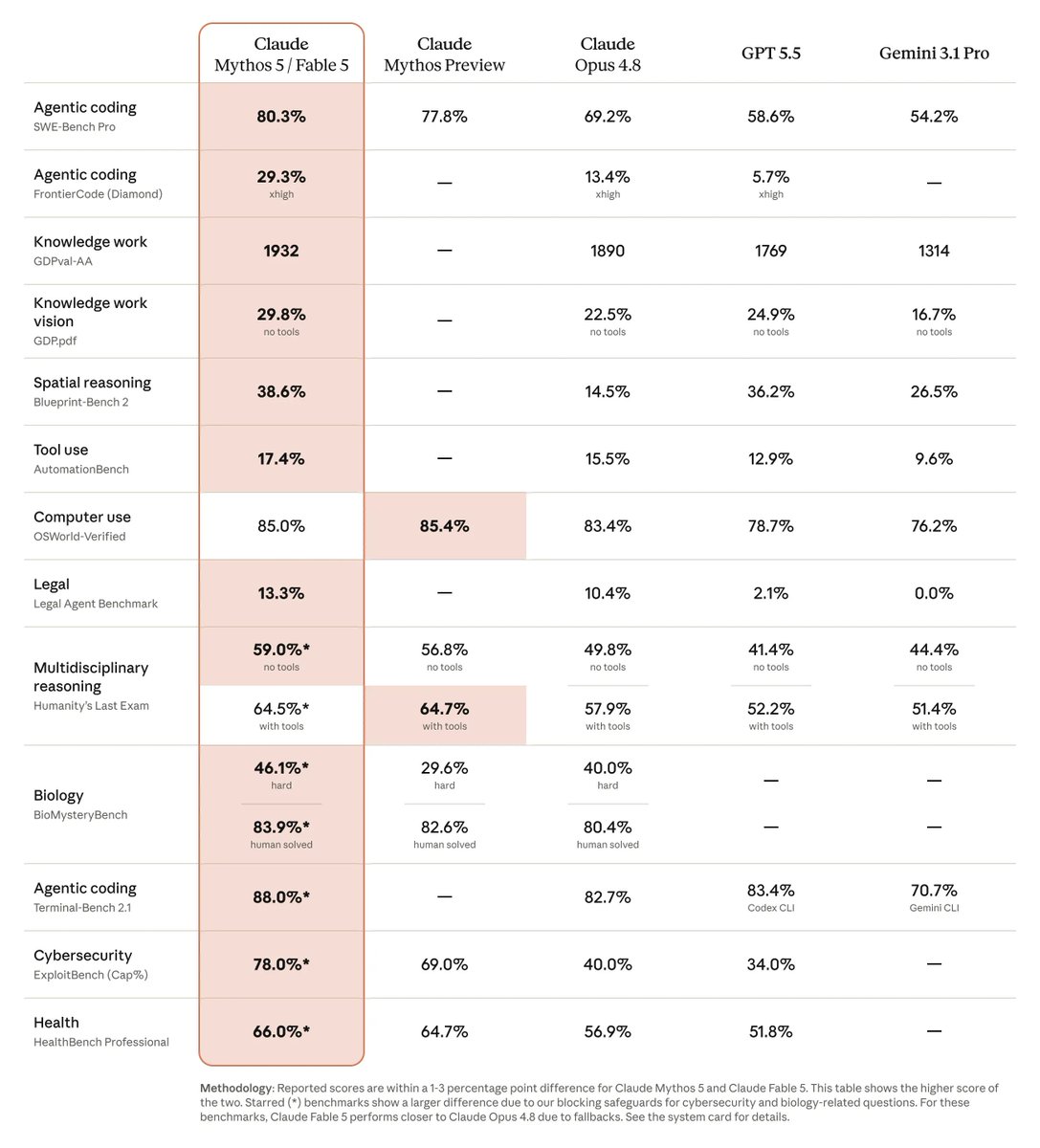
Things seem to be ending up in a better spot with Fable, and presumably GPT-5.6 next. What we have now is the initial precedent for what frontier model releases (or at least those that have significant coding and cyber capabilities) could look like going forward. This would presumably apply to bio and other categories of risk that have been identified by AI safety groups. From the Anthropic post: “3. A shared industry framework. Although we have reached a constructive resolution, these events have made clear that the industry needs a consistent way to assess and fix potential “jailbreaks” of AI models (techniques that bypass a model’s safeguards).2 A shared standard for judging the severity of a given jailbreak would help AI developers triage new findings as they arise, launch highly-capable models with greater safety, and communicate the level of risk consistently to government and industry partners. Together with Amazon, Microsoft, Google, and other Glasswing partners, we’ve started to develop such a framework, and we outline it below. 4. Deeper government collaboration. We’re also strengthening our level of collaboration with the US government on new pre-release testing, information sharing, and research collaboration. We describe this deeper collaboration in the final section.” It’s been a messy process to get here, but at least there’s some semblance of a framework that could be practical. The only note of caution here would be that there’s a lot of subjectivity that goes into various risks and their actual levels of exploitability in practice. We’re likely going to be living with a framework that requires heavy judgment and back and forth between labs and the government for major releases. The best we can hope for is that this is a relatively efficient process, and hopefully has ways of being sped up for incremental version updates in models. It would be a bad outcome if every release after this level of threshold of capability required the same review process, and we don’t get the same rate of breakthroughs we’ve been seeing.
Claude Fable 5 will be available again globally tomorrow. After a series of productive conversations with the US government, we're redeploying the model with a new set of classifiers to target and block more cybersecurity tasks. In the near term, some routine tasks like coding and debugging will fall back to Opus 4.8. We’ll continue to refine these classifiers over the coming weeks to reduce false positives and better distinguish genuine misuse from legitimate requests. We’ve also begun drafting a consensus framework—with Amazon, Microsoft, Google, and other Glasswing partners—for assessing the severity of AI jailbreaks and how AI developers should respond to them. We invite other industry partners and model providers to join us in this effort. Finally, we’re scaling up our collaboration with the US government on model testing and safeguards. This will include pre-release access to models and safeguards for evaluation, information sharing on jailbreaks and misuse, and dedicated resources for joint research. Thank you to our users for your patience, and to our partners across the government, industry, and the research community who worked alongside us to make Fable 5 available again. Read our full blog: anthropic.com/news/redeployi…
36
8
127
50,634
We've been running Anthropic's Claude Sonnet 5 through the Box AI Complex Work Eval, our agentic benchmark that puts models through real enterprise document work end-to-end. Sonnet 5 holds frontier-class quality on complex multi-step work and pulls ahead of Sonnet 4.6 in several core enterprise domains like Energy ( 4.7pp), Retail ( 4.4pp), and Professional Services ( 2.6pp), and other spaces where unstructured data is heavily complex. Here are a few examples of wins compared to Sonnet 4.6 to get a sense of some of the more advanced reasoning capabilities in Sonnet 5: * Financing due diligence: It computed the company's liquidity and leverage ratios from the raw balance sheet, and caught that the source report's own stated debt-to-equity figure understated the leverage, flagging all three loan covenants as violated, not just the ones the document admitted. * Overhaul cost analysis: It scoped "total cost" to the company's own KPI definitions, correctly separating out Lost Production Cost because the guidance said to track it separately rather than naively summing every number on the sheet. It also caught and handled a broken reference cell in the spreadsheet. * SKU revenue analysis: On segmented sales data, it computed each product's contribution against the correct subcategory denominator, sidestepping the easy mistake of dividing by the category total, and flagged why no Pet-category SKU cracked the top 9. Sonnet 5 will be available in the Box AI Studio shortly for customers to build custom agents with.
Introducing Claude Sonnet 5, our most agentic Sonnet yet. It makes plans, uses tools like browsers and terminals, and runs autonomously at a level that just a few months ago required larger and more expensive models.
27
8
171
61,303
More data is showing the opposite of what many people expected with AI adoption and jobs. Ramp found that the more AI adoption a company has the more their headcount grows. At Box, we recently did a survey of 1,600 mid and large sized companies, and the findings were similar. 58% of respondents expected headcount to rise over the next three years. Interestingly, that figure climbs to 79% among the most mature adopters of AI. The more advanced AI adopters expected to grow their headcount at a greater rate in the future than others. Of course it's true that the companies that can afford to adopt AI the most are also the ones that likely are seeing growth in their business, leading to more headcount. So the point of the story isn't necessarily that by adopting AI you will inherently grow. *But* the most important takeaway is that the opposite is not proving out. The fears a couple years ago would have been that the companies adopting AI the most would be hiring fewer people. But in reality this is what actually you should expect to happen. If a company can get more customers because they use AI in sales for account or market intelligence, they hire more sales people not fewer. If you can build way more software than before, you end up hiring more engineers because the projects get bigger and you take on more. And so on.
Narrative violation: A new study of 21,559 firms in the U.S. finds that “companies that adopt AI tend to grow faster following adoption”. “Firms making the largest AI investments grow employment by roughly 10% following adoption, while low-intensity adopters see no statistically significant change.” “Entry-level headcount rises 12% for high-intensity adopters.” “Gains emerge gradually and are broad across roles, including engineering, sales, administration, and customer service.” “The results counter predictions that AI adoption will lead to broad job loss.” The study is based on observed AI spending from Ramp card and bill pay data linked to Revelio Labs workforce records.
59
85
355
122,823
This gets to the core of one of the central debates in AI. If a closed stack is always perpetually at the frontier by a wide margin, then being vertically integrated, and gate keeping in the US can work. Because you always have control over who gets access to the best technology, and it will be in high enough demand that it always favors you. If, however, open weights AI can remain a close second to frontier intelligence, then the equation reverses. With a highly regulated approach, you’ll own the frontier market still, but the vast majority of tokens used will go to an alternative stack. That stack will include the model and the underlying hardware that runs it, in the limit. And that stack will be controlled and monetized by someone else. Depending on your belief on how close to the frontier open weights can remain -and similarly what percentage of tokens will go through the frontier vs. everything else- your opinion will be different on how to regulate and control AI.
The worst case scenario for USA AI: 1. Chinese open sources keep gaining market share. China owns the model layer. 2. Those models were trained and inference-optimized on Huawei chips instead of NVIDIA. China also owns the chip layer. 3. US doesn't build data centers fast enough to keep up with the demand of compute, storage and energy. China meanwhile exports the inference and training layer(for continual training it will happen along with inference) Export control is not the right strategy here. Simply banning "open source from China" doesn't solve the issue here. USA must invest in open source models, hopefully get Chinese models to use NVIDIA, and invest in nuclear asap.
47
28
216
158,030
It should be 100% obvious that there will soon be mythos level models on cyber security that are open and available to anyone. As a byproduct of this, alternative tech stacks will emerge that also drive more economic value and control away from the US’s tech stack. This is what should be considered when thinking through the gate keeping you want to have in AI. If advanced models will become open and available regardless, then by not allowing the release of models you’re neither more secure nor better off strategically. So much of the regulatory approach to AI has to assume China can’t catch up, when all current evidence suggests they can and are. And further, hard to imagine a higher priority than winning in AI for China; so you’re basically betting against their long term ingenuity, talent and motivation. Seems like a bad bet. So your options are either to create gates around your best models, which means you’re asymmetrically disadvantaging yourself, or you work to ensure you’re always at the frontier and driving the future architectures of AI.
JUST IN: A new Chinese AI model from Zhipu AI reportedly matches Claude Mythos’ performance at finding security bugs.
86
95
810
175,670
Some good best practices here on AI token cost optimization. None of these happens though without a deep understanding of the underlying work being done in a non-abstract way. The ultimate implication is that a layer between the work itself and the underlying intelligence needs to deeply understand your workflows, context, and business process. Now, each individual company doing this on their own is unlikely to be effective at scale, so as a consequence, this is effectively the playbook for any applied AI company right now. By evaling the models for the applied use cases, deeply understanding the domain, having tuned UX and features for the use case, and having the ability to support adoption and change (via FDEs), allow this layer to add a ton of value. And as a result, enterprises get higher ROI because you actually can get *more* intelligence per dollar by having optimal architecture and workflows. There will be many horizontal and vertical versions of this approach. Huge opportunity right now.
How to keep AI spend flat while token usage grows exponentially: Not with friction and spend alerts. With better defaults, routing, and caching. Better Defaults (not Usage Caps) – Engineers can choose any model they want, but defaults matter. We’re experimenting with defaulting to open weight models like GLM 5.2 and Kimi 2.7 through our LLM gateway, while still encouraging engineers to choose the right model for the task. 91% of our employees were never hitting their usage caps, so instead of lowering caps and driving up alerts, we're moving to cheaper defaults. Note that code reviews use a diversity of models, so they can check each other's work. Better Routing – In our custom harnesses, we preprocess prompts and route to the best model for the job, considering cache hits and model pricing. For instance, you may want a frontier model for planning, but not for execution where they can be overkill. Ultimately, humans shouldn't be choosing models - AI can automate this task. Better Caching – Cache misses are the easiest way to drive your cost up. All of our requests are cache aware, so we’re reusing a warm cache wherever possible. For example, our cache hit rate went from 5% → 60% in LibreChat once properly implemented. Keep Context Lean – Start fresh sessions when switching tasks. Scope file context narrowly. Disconnect unused tools. Don't just compact. The goal isn't fewer tokens used, it's fewer tokens wasted. Better Visibility – Our engineers can use as many tokens as they want, from whatever model they want, but we’ve made usage visible – and the more you spend on AI, the more impact we expect. The goal isn't to suppress usage. It's to build the infrastructure that makes exponential growth sustainable. Putting this into practice has cut our AI spend nearly in half, while our token usage continues to grow.
66
39
567
178,151
Step one complete
Since June 12, we’ve been working closely with the US government to restore access to Claude Mythos 5 and Fable 5. Today, the government notified us that Mythos 5, our strongest cybersecurity model, can be redeployed to a set of US organizations that operate and defend critical infrastructure. We’re restoring access for these organizations quickly, and we’re continuing to work with the government to expand access to Mythos 5 and make Fable 5 available for general use again.
14
3
198
108,561
GPT-5.6 is real and looks very strong. Going to be very strong for knowledge worker tasks that require heavy tool use and long running agents doing work. We're not hitting any walls in AI progress right now.
Introducing a limited preview of GPT-5.6 Sol, our next generation frontier model, as well as GPT-5.6 Terra, a balanced model for efficient, everyday work, and GPT-5.6 Luna, a fast and affordable model for high-volume work. openai.com/index/previewing-…
40
20
274
46,089
AI regulation is far less simple than it looks. It’s prisoners dilemma at insane scale. In theory if all leading AI labs globally agreed to the same process of review and slow down, then we’d get frontier intelligence at similar rates and it diffuses relatively evenly. If the US remains at the frontier at all times, and has heavy regulation on the release of intelligence then we end up with an economic and geopolitical edge because we can control who has access to frontier intelligence. If we delay model releases, however, and another player - specifically China - doesn’t slow down and has equally strong models (not now but soon?) then our delays end up advantaging their models and eventually their tech stack. Now, the US could ban these models, but that actually only puts the US at a steeper disadvantage because other countries won’t have those bans. Then, from a relative competitiveness standpoint the US has now fallen behind even though it started in front. So, none of this is as simple as it looks. At some point it’s a simple bet of can closed models remain at the frontier in perpetuity or is there a risk of any other player or market catching up or just not falling behind.
83
62
459
85,165
We now have de facto AI regulation. It’s not obvious why from here on out models that have certain levels of capability or are trained on certain compute sizes won’t have to be reviewed by the government before release. Realistically, as AI models became more and more powerful this was going to be inevitable (I think it’s too early, but here we are). So now it’s mostly just interesting to think about the implications and scenarios from here. A few would be: * America gets to control who gets access to frontier intelligence and when. This generally works as long as we remain at the frontier at all times and don’t have a risk of being surpassed. At the moment we have a clear lead in frontier intelligence so this is a good bet, but lots of motivated parties would love to change that. * This likely creates backlog of AI releases which means that we will see less rapid fire back and forth jumps in model progress. Bull/fine case is that we just get bigger step functions per release at a slower rate and we end up at the same point we would have. Bear case is those incremental smaller jumps were necessary for the continued flywheel of innovation. * Other countries likely have even more incentive to at least hedge their bets with sovereign AI strategies so aren’t dependent on access to US AI all times. Previously this was relatively moot because the alternative wasn’t good enough, but that could change out of necessity and what we’re seeing in China. * Open weights obviously a big winner here as it becomes what likely sovereign AI gets built out on, and what (for now) can still be released to the market without the same controls. One interesting question would be how regulation eventually extends to open models, which would have its own set of long term consequences. Anyway some big updates to everyone’s mental models of AI regulation as a result of the capabilities we’re now seeing in AI. Wild times.
New w/ @leomschwartz @amir: The Trump admin has asked OpenAI to stagger the release of GPT-5.6 over security concerns. On Thursday, CEO Sam Altman told staff that the government will be approving access to GPT-5.6 customer by customer, a highly unusual approach.
68
61
379
81,292
There are some subtleties in this launch that are very important in practice. This isn’t just you interacting with Claude in a 1:1 format via Slack. In this case, Claude acts as a coworker that any user can tap into in a shared way. We’ve already seen some agentic coding systems start to adopt this pattern (as well as OpenClaw and Hermes), and doing it for general purpose knowledge work continues to push the idea forward. As a result, what this means is that this agentic coworker needs its own set of resources, access to tools, and data to work with. This is not the same as you giving it access to your personal resources and tools, because the agent then could accidentally then share those out with anyone. The agent needs to instead be like any other user in the system, and you need to be thoughtful about what it should have access to, and make sure its information that is safe to share with that group. When you can pull that off, it’s quite powerful. For instance, by connecting to Claude Tag to Box, you could have Claude access corporate sales materials for questions in sales conversations or generating RFPs, brand guidelines and marketing assets for campaign creation, product roadmap materials and product documentation for coding agents to use, contracts that anyone in the legal team can access, and more. But this is just the Box example. You can equally have it access your product or customer analytics data, CRM information, codebase, and other resources and agents that would make sense to work on in a collective manner. It’s awesome to see continued innovation in what the future of work may begin to look like with agents.
This is a new paradigm for interacting with Claude that is significantly more "inline" with all the other human activity org-wide. Once you do all of the under the hood engineering work to make this "just work" (e.g. across tools, integrations, compute environments, memory, security, etc.), Claude basically joins the team in a seamless way - you can talk to it as you would talk to a person and it can help with a very large variety of workloads. Imo this is the 3rd major redesign of LLM UIUX. The first paradigm was that the LLM is a website you go to, the second was that it is an app you download to your computer. This third one is that it is a self-contained, persistent, asynchronous entity with org-wide tools and context, working alongside teams of humans. It really takes a while to wrap your head around it, but it works and it is awesome.
54
50
332
74,585
Good post on the dynamics of AI pricing right now. We’re basically going to see a barbell dynamic on pricing between high cost frontier models and cheap but good open or closed weights models. Then the question is how do you maximize efficiency from the frontier models, and get better quality and performance of the cheaper models. That’s where the applied AI layer comes in. The applied layer can route to the best model at any time given the workload at hand, as well as mitigate either high token costs or worse performance. The closer you are to the underlying workflow, the better you can tune the use of models for a given business process. That’s all about understanding the workflows, domain specific FDEs, evals by customer or process, getting data setup well for agents, and more. Overall good for applied AI.
The AI Business model trap: LLMs want cash flow to fund the race to AGI or the next model. Enter free consumer AI - they are losing a lot of money on the breadth of models to serve consumers for free! They are caught in the post training data trap, free consumer usage feeds post training needs, it can't be right to stop serving customers for free? But they need money for the compute: The monetization challenge is being pointed to Enterprises. Phase 1 - seemed easy, value capture in coding, the most bottom up motion in enterprise - with low customization per customer. Developers continue to train coding, tasks and eventually will train flawless skills. Phase 2 is where the challenge lies, showing true enterprise value. The promise of efficiency, accuracy, elimination of resources - that requires a different approach, build depth with harnesses, context, memory, solving for edge cases with deterministic guardrails! Build skill libraries - enter FDEs. Yes,FDEs will train the enterprise Waymos of the world. The risk - high token pricing for enterprises while consumers for free! Yes for consumer distribution businesses (aka Google, Meta, Apple, etc) it makes sense to hold on the distribution with free AI. If you want to win enterprise, you should be forward pricing tokens. The cheaper the tokens for enterprises it will allow for experimentation, workflow reimagination - instead CIOs are busy restricting AI use and working on making the use more efficient! Paradox: They still haven't fully understood and embraced the value of AI in the enterprise. If I were them: 1. Cut token pricing now, else send enterprises to secure opensource and end up with friction filled routing layers. 2. Show me how enterprises can use their context, training and data as their competitive advantage. 3. Build tools for rapid edge case learning and reducing false positives. @HarryStebbings @sama @DarioAmodei @demishassabis
47
33
286
65,280
Another example of the power of headless software with agents. With Claude Tag, you can give Claude access to any corporate files in Box that you can interact with from Slack. Now all of your enterprise content becomes a portable knowledge base.
Introducing Claude Tag, a new way for teams to work with Claude. In Slack, Claude joins as a team member with access to the channels and tools you choose. Tag Claude in and delegate tasks to it while you focus on other work.
37
15
217
73,622
Almost all AI model and agent progress is downstream from evals. Open weights post training for specific domains comes down to evals. Agent improvements in the applied AI layer is all about evals. Agentic enterprise deployments that actually can augment work is all about evals. It’s all evals. This will become a core competency of any enterprise in the future. The companies that are able to best understand their own (and/or customers) workflows and how well agents participate in that work will be in the best position to actually drive real automation.
55
42
459
114,431
We heard that HTML is a big deal again. You can now preview, edit, manage versions, and securely share any HTML based content on Box. Great for being able to work with any agent produced content immediately.
24
13
278
53,275
Another new idea to push the state of AI architectures forward. Sakana released a model that effectively uses a mixture of models to get work done. You get a single API but then the work gets farmed out the model that best performs the task. “Fugu manages model selection, delegation, verification, and synthesis automatically. It solves tasks directly when that is enough, or coordinates a team of expert models when a problem calls for more. The complexity of a multi-agent system never reaches your code.” This is generally how applied AI products are building their agent harnesses at this point, but the idea of making this an LLM that any developer can interact with is also a great idea. As we get more innovation with both frontier closed and OSS models, there’s going to be a ton of value produced for the layer that can route the best.
Introducing Sakana Fugu: A full multi-agent orchestration system accessible via a single model API. Our ‘Fugu Ultra’ model matches the performance of Fable and Mythos, delivering frontier capability without the risk of export controls. Try it: sakana.ai/fugu 🐡
68
82
600
151,459
Agents will use software 100X more than people. When that happens, theres a huge need for guardrails on what the agents are doing so they don’t leak data or change the wrong information, authoritative sources of truth for them to work with, logging and auditing of what they’re doing, the ability to collaborate with people through these systems, and more. A simple query on any given agentic task could pull in more data than a user touches in a month. As a result, there are lots of categories of software that when it goes headless that the usage and value go up substantially. Agents will end up using our CRM data, documents and corporate knowledge, analytics data, and other information far more than people ever did. The platforms that can move toward the model of powering these headless interactions, and have a business model and technology strategy to support this, will be in the best position in the future.
Levie now uses Salesforce 5x more than at any point before. The Box CEO @levie connected Salesforce's MCP server to Claude Code. Now he runs customer and market intelligence queries he would never have bothered pulling up by hand. The agent removes the friction. The underlying system gets queried more, not replaced. If you hold $CRM, the agentic era is an engagement tailwind, not a disruption risk - gated on whether the data platform handles the query load. Why incumbents gain from agents: podcastalpha.substack.com/p/… Source: CXOTalk - youtube.com/watch?v=ylBDQHk3…
58
56
353
86,780