
Pursuer, a highly enthusiastic aficionado of autonomous, autodidactic, episodic, experiential self-learning, Agentic platformed ACI systems. Room temp Q. 🗣️

Joined November 2023
1,402 Photos and videos
keithofaptos reposted
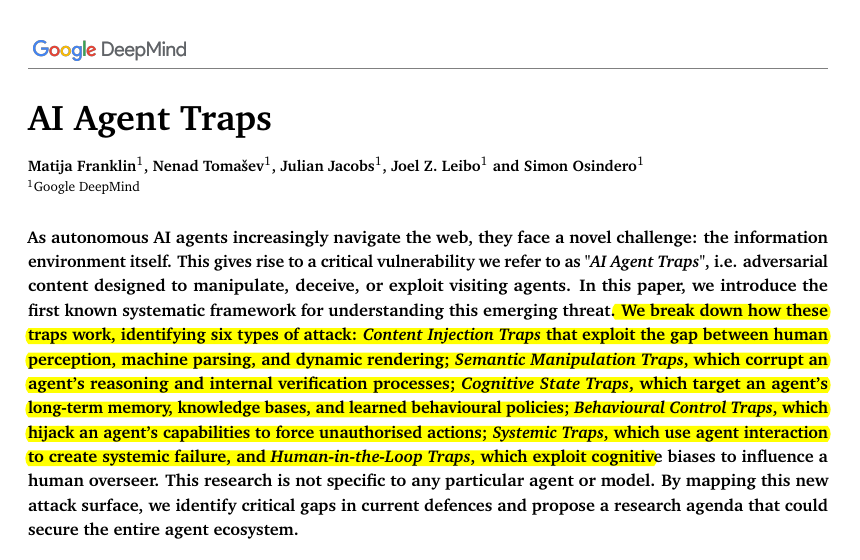
A warning for anyone using autonomous agents Google DeepMind’s paper. Gives the first clear taxonomy of 6 attack types where harmful websites can detect AI agents and show them hidden content humans never see, like - Instructions buried in HTML comments or white-on-white text - Steganography in image pixels - Override commands in PDFs, metadata, or even speaker notes - Memory poisoning that persists across sessions - Goal hijacking and cross-agent cascades in multi-agent setups The real security problem for AI agents is not just the model, but the environment it reads. The web itself can be weaponized against autonomous AI agents. As agents increasingly browse the internet, read emails, execute transactions, and spawn sub-agents, the information environment becomes an attack surface. In one cited benchmark, hidden prompt injections embedded in web content partially commandeered agents in up to 86% of scenarios, sub-agent hijacking working 58–90% of the time, and data exfiltration attacks clearing 80% across five different agent architectures. That reframes the whole debate. We usually talk about model safety as if the danger sits inside the weights, but agents do something more fragile: they browse, retrieve, remember, and act on untrusted material in real time. Here’s the thing to worry about. A web page does not have to look malicious to be dangerous to an agent, because the agent may parse what humans never see: hidden HTML comments, metadata, CSS-hidden text, formatting syntax, or adversarial content embedded in images and other media. The threat gets more serious once memory enters the loop. If an agent uses RAG or persistent memory, poisoning no longer has to win in one shot. It can sit quietly in a corpus or memory store and activate later, which is why the paper highlights results showing latent memory poisoning above 80% attack success with less than 0.1% data contamination. --- ssrn. com/sol3/papers.cfm?abstract_id=6372438
6
12
68
4,703
keithofaptos reposted
I ran preview as soon as I got my 4x 6000s and it was phenomenal. A bit rough around the edges but was able to complete every single task without the classic open weight overthinking. Running this today!
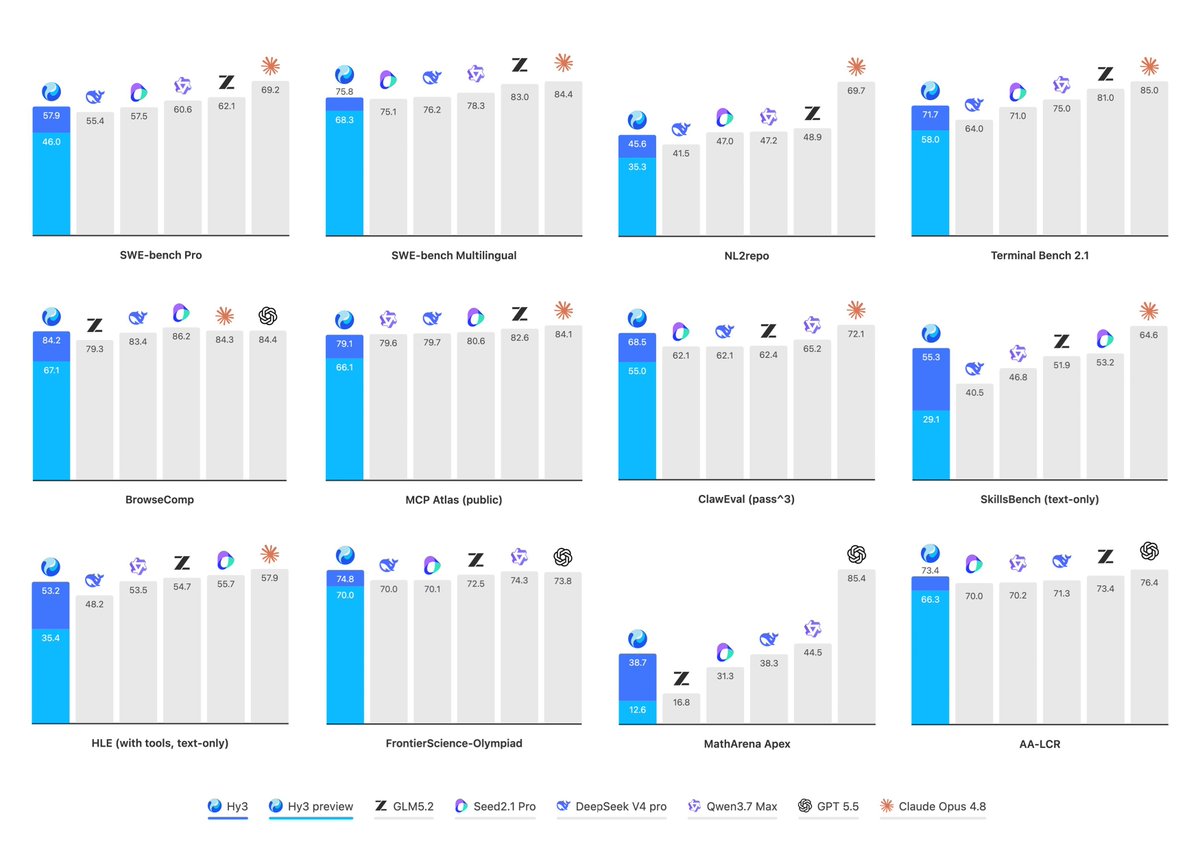
hy3 is out... 5 things the benchmarks suggest: 1 .hy3 is not another cheap open model 2. it is already competitive with frontier models on real workflows 3. it nearly matches gpt-5.5 and opus 4.8 on browsecomp 4. it beats gpt-5.5 on frontierscience-olympiad 5. it shows big gains over hy3 preview across multiple agentic tasks some numbers: >browsecomp...hy3 84.2 vs gpt-5.5 84.4 >frontierscience-olympiad...hy3 74.8 vs gpt-5.5 73.8 >mcp atlas...hy3 79.1 vs glm-5.2 82.6 >claw eval...hy3 68.5 vs glm-5.2 62.4 >terminal bench 2.1...hy3 71.7 vs deepseek v4 pro 64.0 5 things that still need testing: 1. real coding agent performance 2. long-context stability 3. tool-use reliability in production 4. inference cost at scale 5. actually beats glm-5.2 outside selected benchmarks or it's just hype? the takeaway? open models are getting good enough on real workflows while being much cheaper and easier to deploy. that is the real threat to frontier pricing power.
5
3
76
8,877
keithofaptos reposted
Tencent Hy3 Pay close attention to improvements over the preview version that came out 2 months ago, as well as how it compares to GLM 5.2 which is double its size. This prediction will become true.
“Within the next 18 months, you will be able to host GLM 5.2 equivalent intelligence on an RTX 5090 GPU.” -Ahmad Osman, AI World’s Fair
12
8
160
11,217
keithofaptos reposted
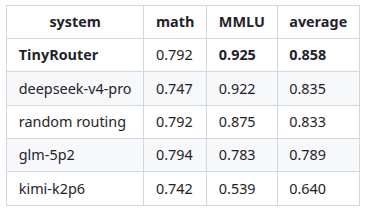
A ~10K parameter router can beat every individual open model on MMLU by learning which model should answer which question. Not by being smarter than the models. By allocating work better.
introducing tinyrouter i reverse engineered the routing architecture behind Skana AI's Fugu and built replication for open frontier models. it's a tiny ~10K parameter LLM router that learns which model to use and what role it should play for every question. the goal was simple: beat every individual model by routing each task to the right specialist instead of relying on a single LLM. github.com/harrrshall/tinyro… a few interesting findings: • routing only helps when the models have complementary strengths. if every model performs similarly on a benchmark, a router has almost nothing to optimize. • on MMLU, the router beat every individual model. on math, it matched the best model because the pool had very little observable diversity. • warm-starting the router and shaping the evolutionary reward improved training, but we don't claim a real gain yet because evaluation variance was too high. more rigorous experiments are needed.
4
9
71
13,285
arxiv.org/pdf/2606.30306
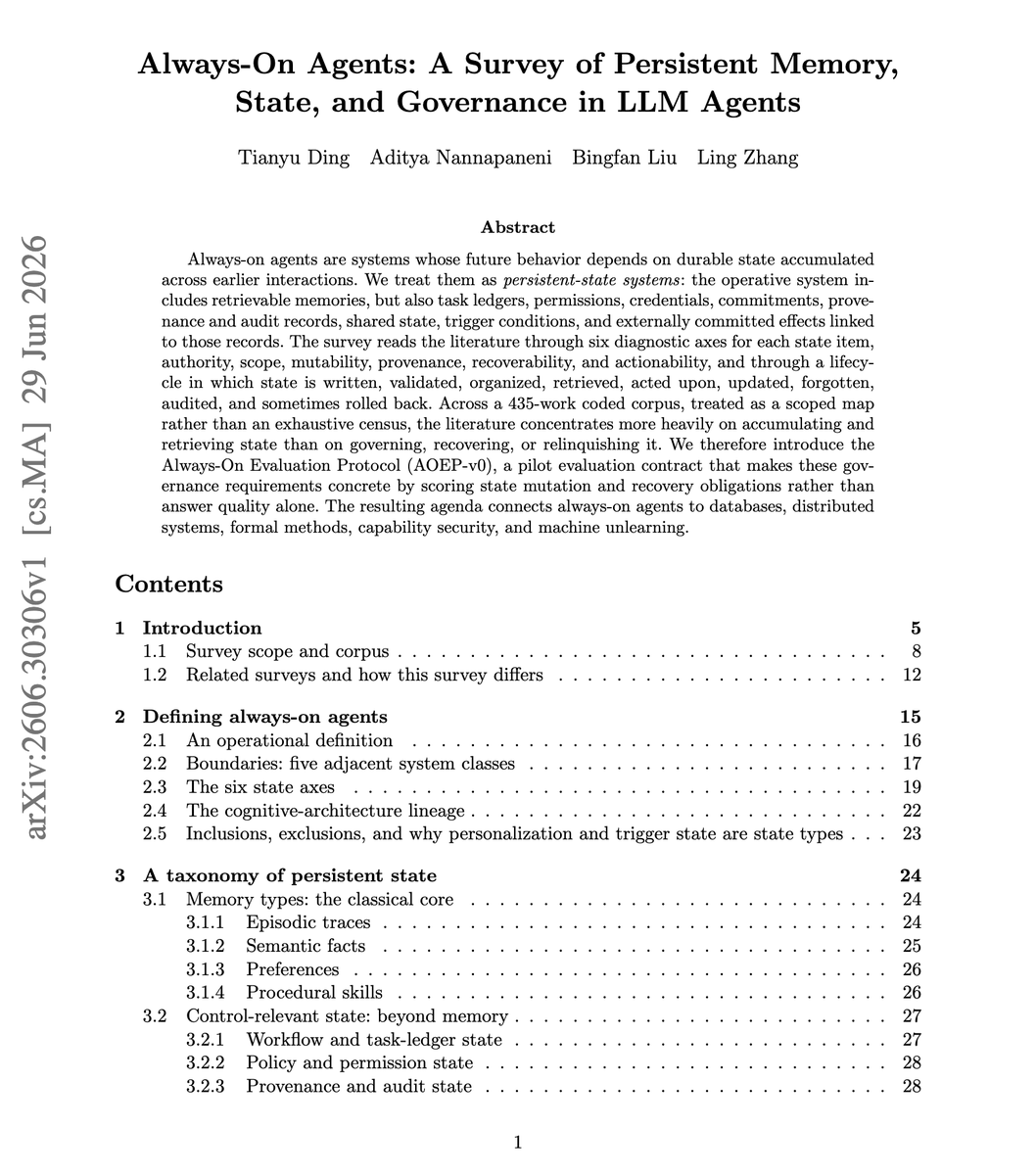
Great overview of always-on agents. (bookmark it) It's a new 130 pages survey on always-on agents. Simply put it, always-on agents are systems whose future behavior depends on durable state built up across earlier interactions. It treats that state as more than memory. Task ledgers, permissions, credentials, commitments, provenance, triggers, and externally committed effects all count. The survey scores each state item on six axes, authority, scope, mutability, provenance, recoverability, and actionability, across a lifecycle that runs from write and retrieve through forget, audit, and rollback. Paper: arxiv.org/abs/2606.30306 Learn to build effective AI agents in our academy: academy.dair.ai/
27
Legit ⭐️
19
🚀🤓
1
3
472
readmultiplex.com/polymarket…
I am testing live my daily Polymarket Report for members of Read Multiplex. It is built on my local AI trained to discern signals and Polymarket trends. I have tested it for about a year with the latest model build just 3 hours ago. I am not offering investment advice and do not advocate gambling. However I do suggest you track the recommendations on paper and see what you see. This may be the most powerful Polymarket local AI model in existence. Members let me know your thoughts. If you are not a member, join us. readmultiplex.com/polymarket…
1
26
omp.sh/
omp is the best harness on the market rn.
1
22
arxiv.org/pdf/2607.01181
Highly-recommended read from MIT on the part of RL with verifiable rewards that everyone keeps hitting. RLVR only optimizes what you can objectively score, so style, structure, and diversity quietly collapse and reward hacking creeps in. The fix here adds an adversarial discriminator trained on human demonstrations, which acts as a learned proxy for the human output distribution. The generator maximizes both task accuracy and the discriminator's human-likeness signal, so verifiable rewards and imitation of humans get optimized together. Why does it matter? Across bug fixing, story generation, and a reward-hacking benchmark, this preserves RLVR's accuracy gains while restoring the fuzzy properties it usually destroys. Bug fixes come out with much lower edit distance, stories score higher win rates and stay diverse, and misbehavior nearly disappears. Paper: arxiv.org/abs/2607.01181 Learn to build effective AI agents in our academy: academy.dair.ai/
96
arxiv.org/pdf/2607.02134
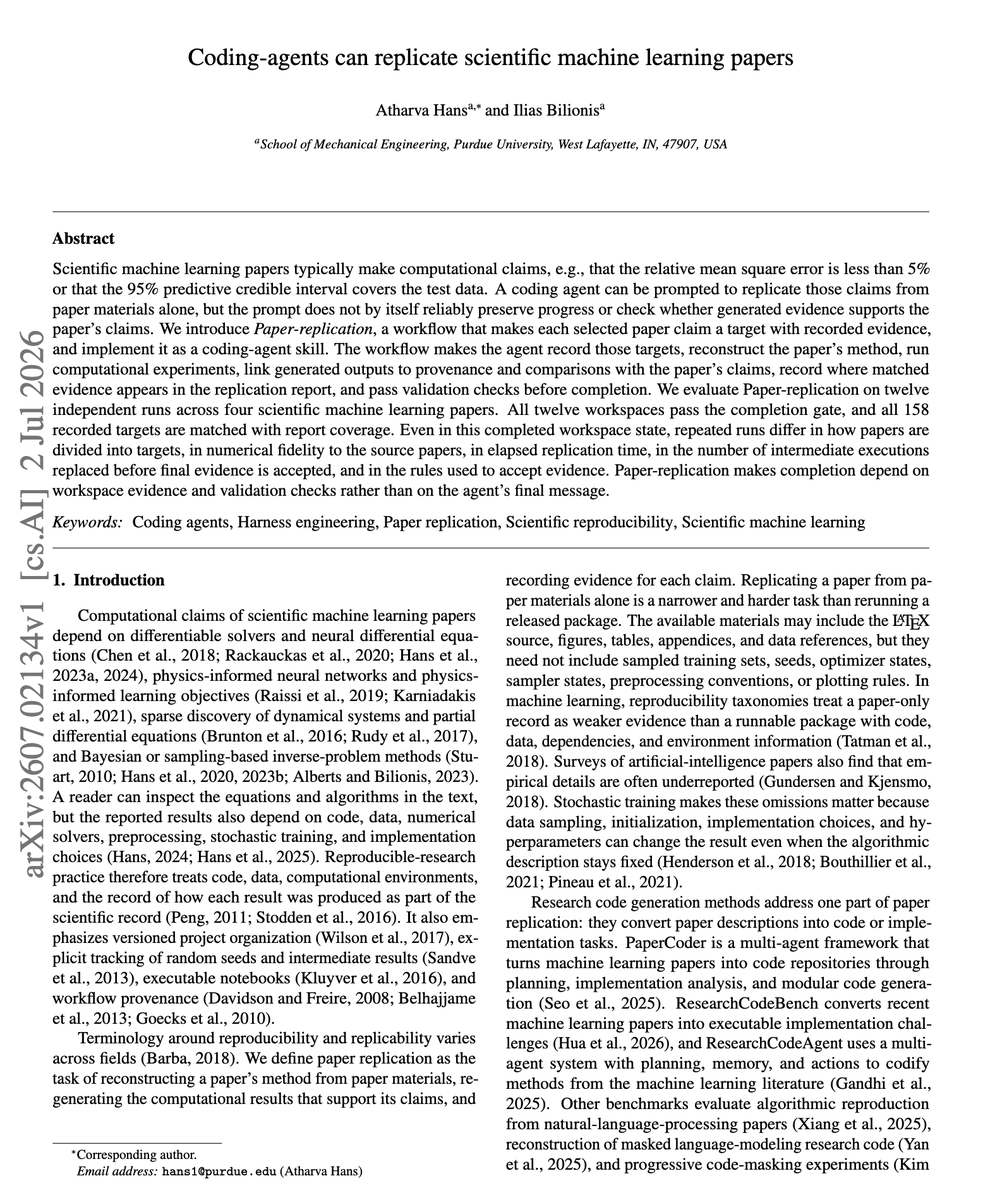
Can coding-agents replicate scientific ML papers? We know this is possible because we can already do this @dair_ai. Still a great read. So they try to replicate an ML paper from its materials alone. They use a coding-agent skill that turns each selected paper claim into a target with recorded evidence. The agent reconstructs the method, runs experiments, links outputs to provenance, compares against the paper's claims, and passes validation checks before completion. Completion depends on workspace evidence, not on the agent's final message. Across twelve runs over four scientific ML papers, all twelve workspaces pass the completion gate and all 158 recorded targets are matched with report coverage. Yet repeated runs still differ in how papers are split into targets, in numerical fidelity, in elapsed time, and in the rules used to accept evidence. Basically the completion becomes reproducible even when the path is not. Paper: arxiv.org/abs/2607.02134 Learn to build effective AI agents in our academy: academy.dair.ai/
32
arxiv.org/pdf/2607.01530
IntentTune: Using user demand and personalization to resolve "unknown" query intents for e-commerce search @RachithAiyappa et al. at eBay resolve ambiguous e-commerce queries by combining demand signals with personalized search history. 📝 arxiv.org/abs/2607.01530
16
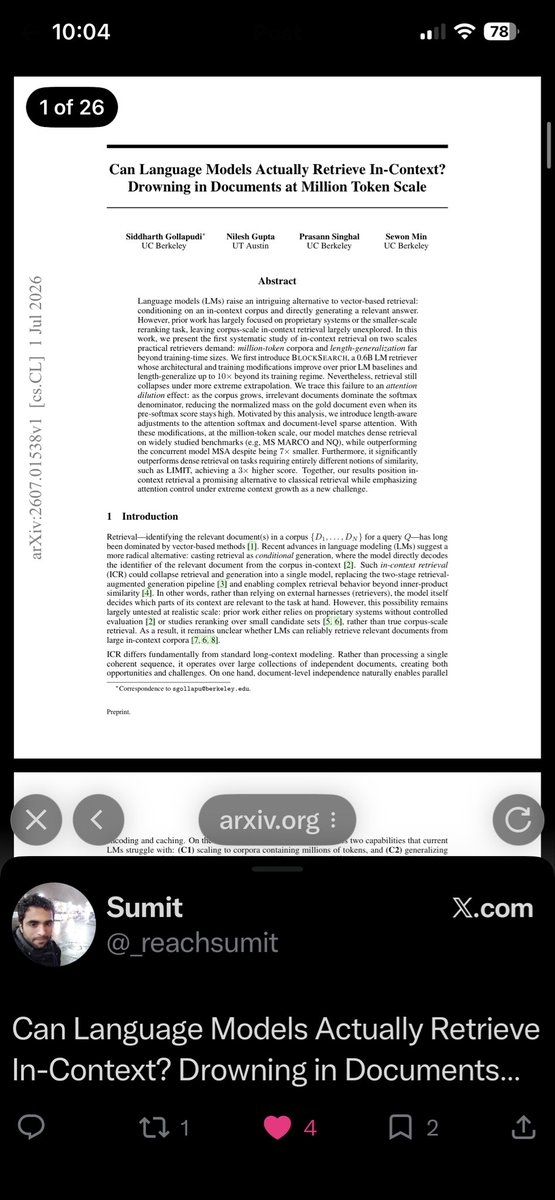
arxiv.org/pdf/2607.01538
Can Language Models Actually Retrieve In-Context? Drowning in Documents at Million Token Scale @darvog1 et al. show that LLMs can retrieve from million-token corpora but collapse from attention dilution, and propose length-aware fixes. 📝 arxiv.org/abs/2607.01538
17
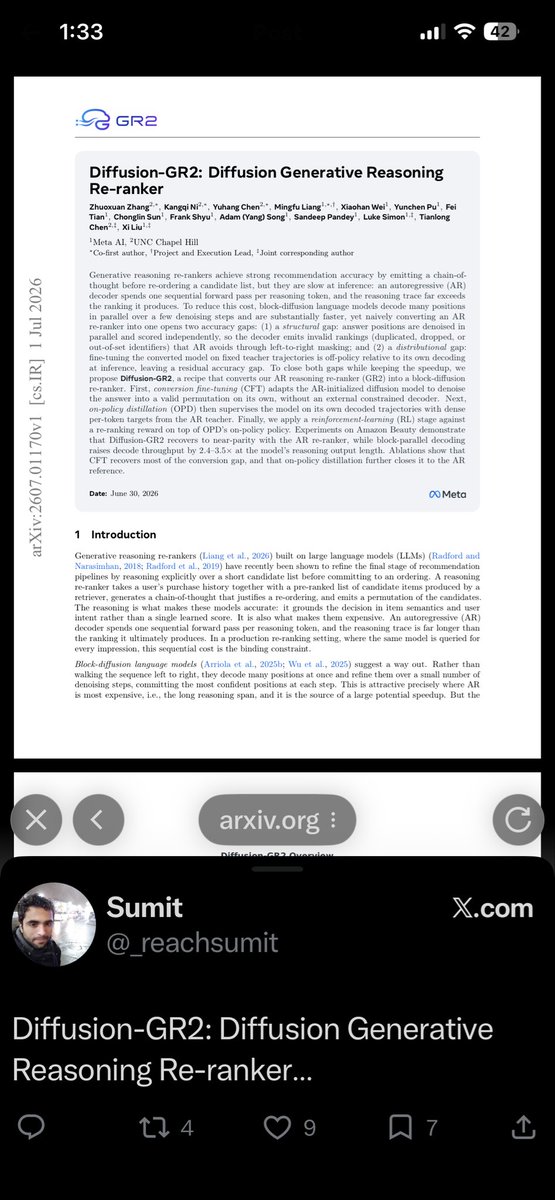
arxiv.org/pdf/2607.01170
Diffusion-GR2: Diffusion Generative Reasoning Re-ranker Meta converts an autoregressive reasoning re-ranker into a block-diffusion model, recovering near-AR ranking accuracy while decoding 2.4-3.5x faster. 📝 arxiv.org/abs/2607.01170
1
45
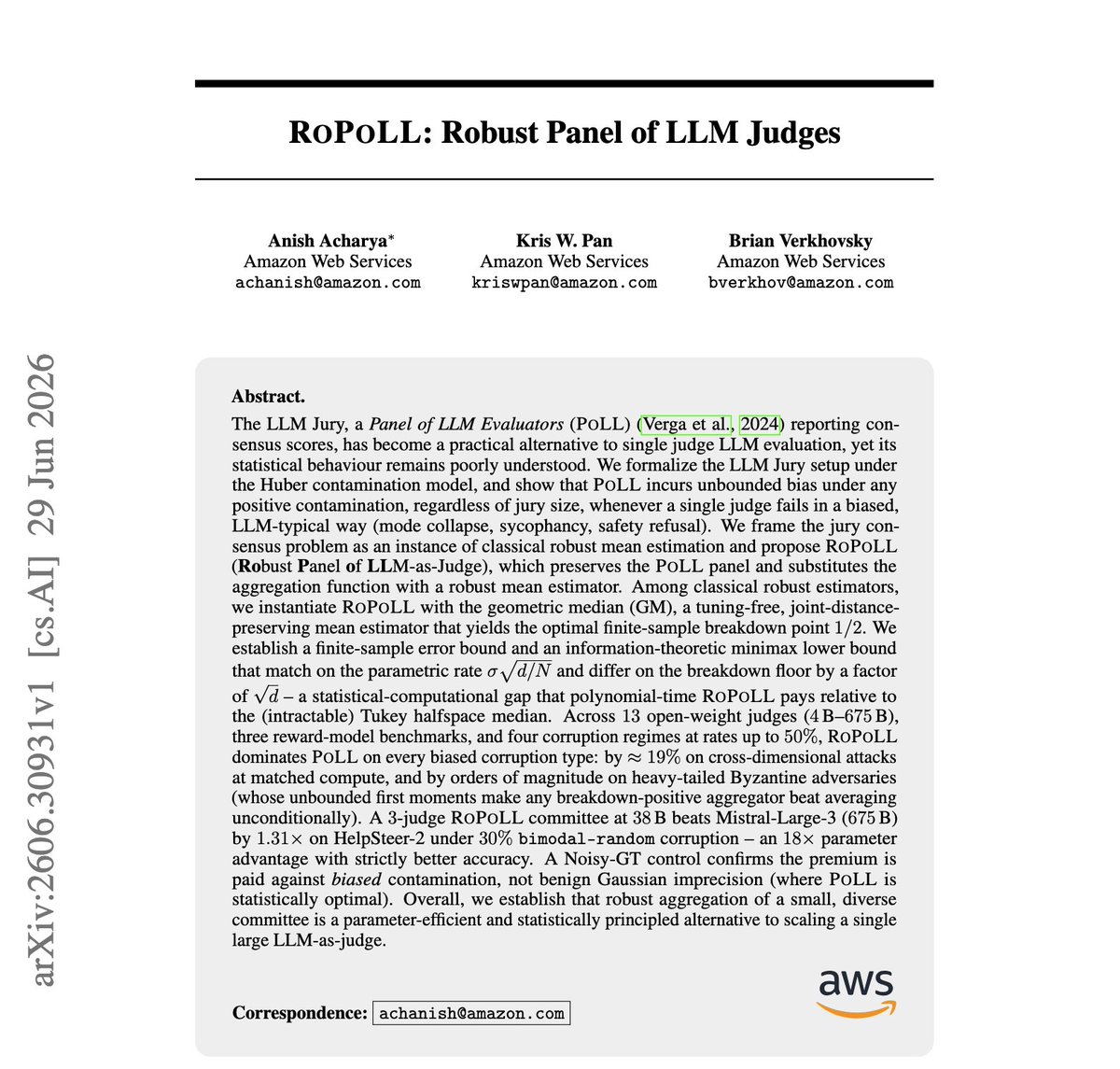
arxiv.org/pdf/2606.30931
Another fascinating paper on LLM Judges. (bookmark it) It's from Amazon, and they show that if you run panels of LLM judges, averaging their scores is a trap. "Overall, we establish that robust aggregation of a small, diverse committee is a parameter-efficient and statistically principled alternative to scaling a single large LLM-as-judge" This research proves that a mean-based panel picks up unbounded bias the moment one judge fails in a biased, LLM-typical way. Mode collapse, sycophancy, or a safety refusal from a single judge is enough, and adding more judges does not save you. RoPoLL keeps the panel but swaps the aggregator for the geometric median. It is tuning-free and hits the optimal one-half breakdown point, with a finite-sample bound and a matching minimax lower bound to back it. Across 13 judges from 4B to 675B and corruption rates up to 50 percent, RoPoLL beats the mean on every biased corruption type. A 3-judge committee at 38B outscores Mistral-Large-3 at 675B under 30 percent corruption, an 18x parameter advantage at better accuracy. Paper: arxiv.org/abs/2606.30931 Learn to build effective AI agents in our academy: academy.dair.ai/
18
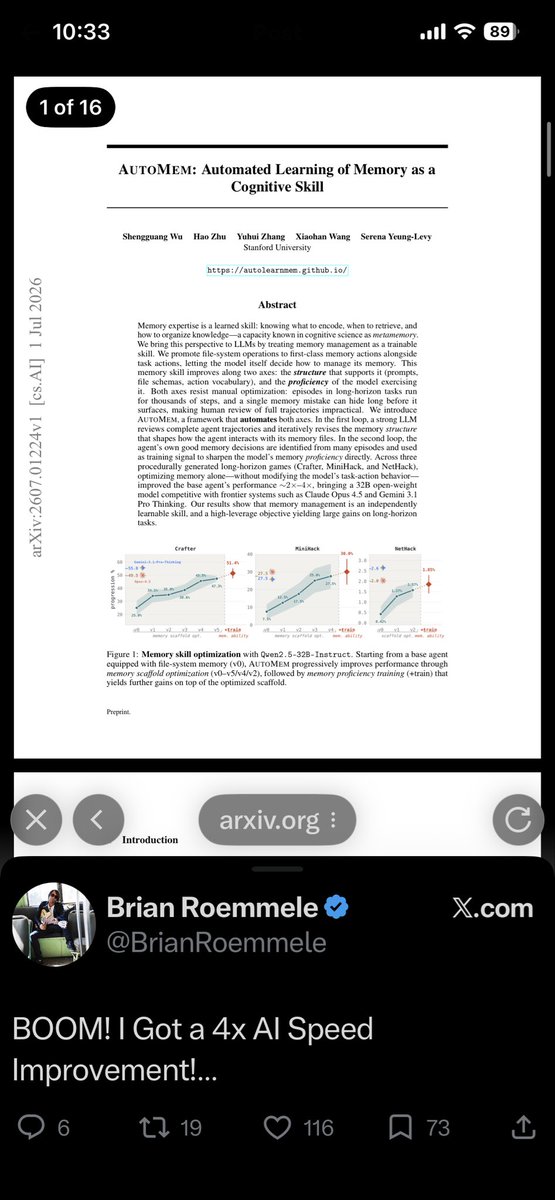
github.com/autoLearnMem/Auto…
BOOM! I Got a 4x AI Speed Improvement! NEw Paper: AutoMem Turns Memory Management into a Trainable Cognitive Skill, Boosting Long-Horizon Agents 2-4x This technique treats memory (file ops, encoding/retrieval) as a learnable metamemory skill in agents. AutoMem uses dual loops: LLM revises memory structures from trajectories self-improvement via good decisions. On Crafter/MiniHack/NetHack, optimizes memory alone to rival frontier models. Long-horizon agency is a bottleneck; this decouples and scales memory expertise without task-specific retraining. High-leverage for real-world autonomous agents in games, robotics, and workflows. Project site highlights practical gains. • Link: arxiv.org/abs/2607.01224 (Project: autolearnmem.github.io/) We are testing it at The Zero-Human Company now…
1
34
arxiv.org/pdf/2607.01224
BOOM! I Got a 4x AI Speed Improvement! NEw Paper: AutoMem Turns Memory Management into a Trainable Cognitive Skill, Boosting Long-Horizon Agents 2-4x This technique treats memory (file ops, encoding/retrieval) as a learnable metamemory skill in agents. AutoMem uses dual loops: LLM revises memory structures from trajectories self-improvement via good decisions. On Crafter/MiniHack/NetHack, optimizes memory alone to rival frontier models. Long-horizon agency is a bottleneck; this decouples and scales memory expertise without task-specific retraining. High-leverage for real-world autonomous agents in games, robotics, and workflows. Project site highlights practical gains. • Link: arxiv.org/abs/2607.01224 (Project: autolearnmem.github.io/) We are testing it at The Zero-Human Company now…
1
13
keithofaptos reposted
This chart is the whole open inference thesis Everyone is still arguing about who has the smartest model But usage is already moving to the models that are fast cheap and easy to customize Nemotron doing 35B tokens/day is not some random spike It is the market telling you the frontier is becoming the router and the volume is going open
America is about to lose the AI race, and it will not happen at the frontier. It will happen at the floor. Everyone is watching who ships the smartest model. The actual war is over the 80% of tokens nobody posts about: the routine inference that quietly runs the world. On current trajectory, that fight is already lost. Watch what people do, not what they say. Coinbase just defaulted its own engineers off frontier models onto open weights and cut AI spend nearly in half while usage kept climbing. Even NVIDIA runs a closed frontier model as an orchestrator and pushes the volume to its own open weights. The frontier is becoming a router. The volume goes open. That part is settled. Here is the part that should terrify Washington: the only credible open tier today is Chinese. GLM. Kimi. And the US answer is to tighten export controls and freeze its own labs in place, as if you can embargo a file that is already downloaded, or price-match free. So China hands the Global South Huawei hardware and free open models, and a generation in Africa and Southeast Asia learns to reason through a model that will not tell them what happened at Tiananmen Square. That is not a cost story. That is influence through inference. You do not have to win hearts and minds when you supply the mind. Open source is not a nice-to-have for America. It is the whole ballgame for the 80%, and right now the US is barely on the field. We need American open weights. Not eventually. Now.
7
18
75
10,585