The term "continual learning" has become overloaded if you see it as an ML problem.
One classic thread is about memorization: regularization-based continual learning methods, such as EWC, MAS, and SI, estimate which parameters mattered for previous tasks and resist changing them too much.
One modern thread is about adaptation: test-time training and inference-time learning methods, such as TTT, adapt part of the model on the incoming test stream before making predictions.
These are sometimes discussed as separate threads. But in modern scalable architectures, I think they are better seen as complementary constraints: a model that learns quickly at test time also benefits from a mechanism for deciding what not to forget.
In our
#ECCV2026 paper, we study this in large-scale 4D reconstruction: how to build fast spatial memory that can adapt over long observation streams while reducing collapse and forgetting.
Instead of using fully plastic test-time updates, we stabilize fast-weight adaptation with an elastic prior that balances adaptation and memory.
Key ideas:
- Elastic Test-Time Training: Fisher-weighted consolidation for fast-weight updates
- EMA anchor weights that provide a moving reference for stability
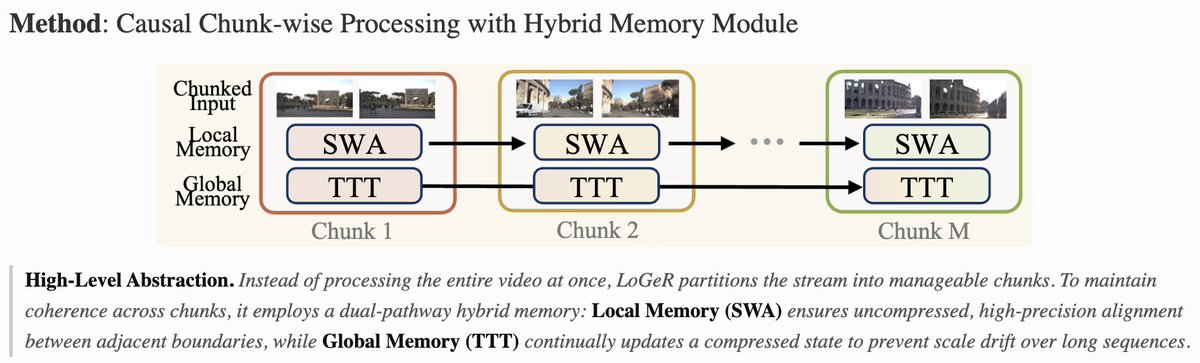
- Chunk-by-chunk inference for long 3D/4D observation streams
We show that this scales across large 3D/4D pretraining settings, including both LRM-style and LVSM-style models, and improves reconstruction across benchmarks including Stereo4D, NVIDIA, and DL3DV-140.
We release model checkpoints across different design choices: resolution, post-training curriculum, and whether the model uses an explicit 4DGS intermediate representation.
- Homepage:
fast-spatial-memory.github.i…
- Paper:
arxiv.org/abs/2604.07350
- Code:
github.com/Mars-tin/fast-spa…
- Models:
huggingface.co/marstin/fast-…
This work is co-led with
@Xueyang_Y, contributed by
@zhnhoy5 @YuncongYY, and advised by
@SLED_AI @gan_chuang.