Humanoid robots look simple from the outside.
Inside, they are a dense stack of machining, bearings, electronics, sensors, cables and thermal constraints.
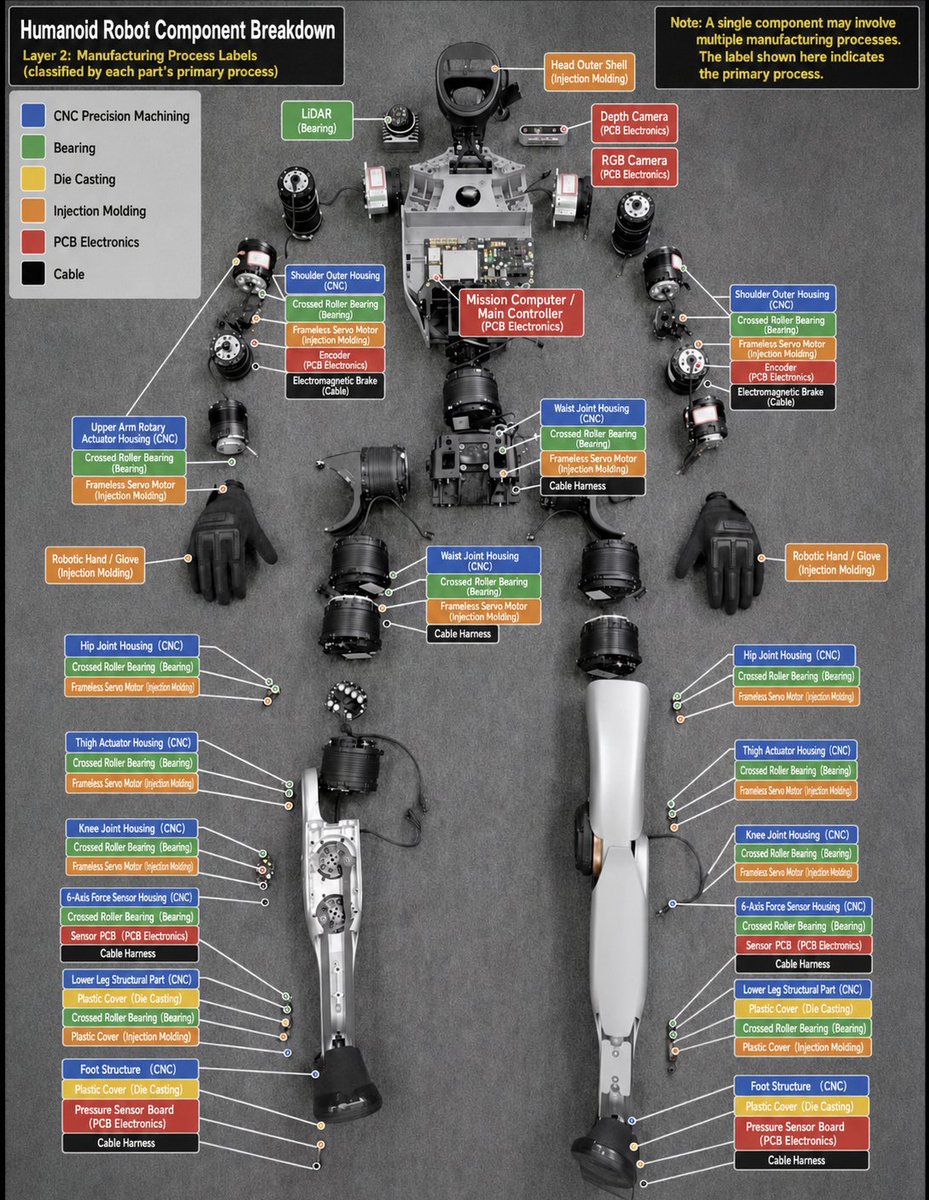
This breakdown shows why humanoid robotics is hard before the robot even starts walking.
• CNC precision machining
Used for rigid structures where tolerance matters
Shoulder housings
Waist joints
Hip joints
Knee housings
Lower leg frames
Foot structures
A small alignment error can affect balance, actuator wear and repeatability.
• Bearings
Used across almost every rotating joint
Shoulders
Waist
Hips
Thigh actuators
Knees
Force sensor modules
Crossed roller bearings are critical because humanoid joints carry radial, axial and moment loads during motion.
• Injection molding
Used for shells, covers, gloves and outer body parts.
These components reduce weight, protect internal hardware and give the robot a clean exterior.
• PCB electronics
Used for the sensing and control layer
RGB camera
Depth camera
Encoder boards
Mission computer
Sensor PCB
Pressure sensor board
This is where perception, feedback and low-level control begin.
• Cable harnesses
The hidden failure point.
Cables pass through moving joints.
They bend thousands of times.
They must survive vibration, heat and repeated walking cycles.
Key components shown here:
• LiDAR
• RGB camera
• Depth camera
• Mission computer
• Shoulder actuator
• Encoder
• Electromagnetic brake
• Upper arm rotary actuator
• Robotic hand
• Waist joint
• Hip joint
• Thigh actuator
• Knee joint
• 6-axis force sensor
• Lower leg structure
• Foot pressure sensor
• Cable harness
AI gets the attention.
But the physical stack decides whether the robot can work for hours without broken joints, overheated electronics, loose cables or damaged sensors.
Physical AI needs a physical supply chain.
The fastest Physical AI growth may be inside labs, not factories.
IFR World Robotics 2025 shows medical robots had one of the sharpest jumps in 2024:
• Medical robots overall: 16,700 units sold
• Growth: 91% over 2023
• Surgery robots: 41%
• Rehabilitation and non-invasive therapy: 106%
• Diagnostics and medical laboratory analysis: 610%
That last number is the real signal.
Labs are controlled environments. The workflows are repetitive. The value is measurable. The need is rising because hospitals and medical labs face labor pressure and growing demand from aging populations.
This is Physical AI with fewer distractions than humanoid demos.
No factory floor hype.
No vague autonomy claim.
Just robots handling structured medical workflows where precision and throughput matter.
Source: IFR World Robotics 2025



 Bearly AI


 ELON CLIPS


