Joined October 2021
1,351 Photos and videos
This is interesting. The teaser is not only showing a robot doing a task. but It shows different embodiments working in the same physical environment. Chess water handling object sorting. That is where embodied intelligence gets difficult and where LingBot 2.0 becomes worth watching. Something big is coming. Stay tuned.
Fully Autonomous Operation. What's driving them? The answer starts tomorrow. ๐Ÿ”ฅ #LingBot2 #Robotics #EmbodiedAI
2
4
24
3,694
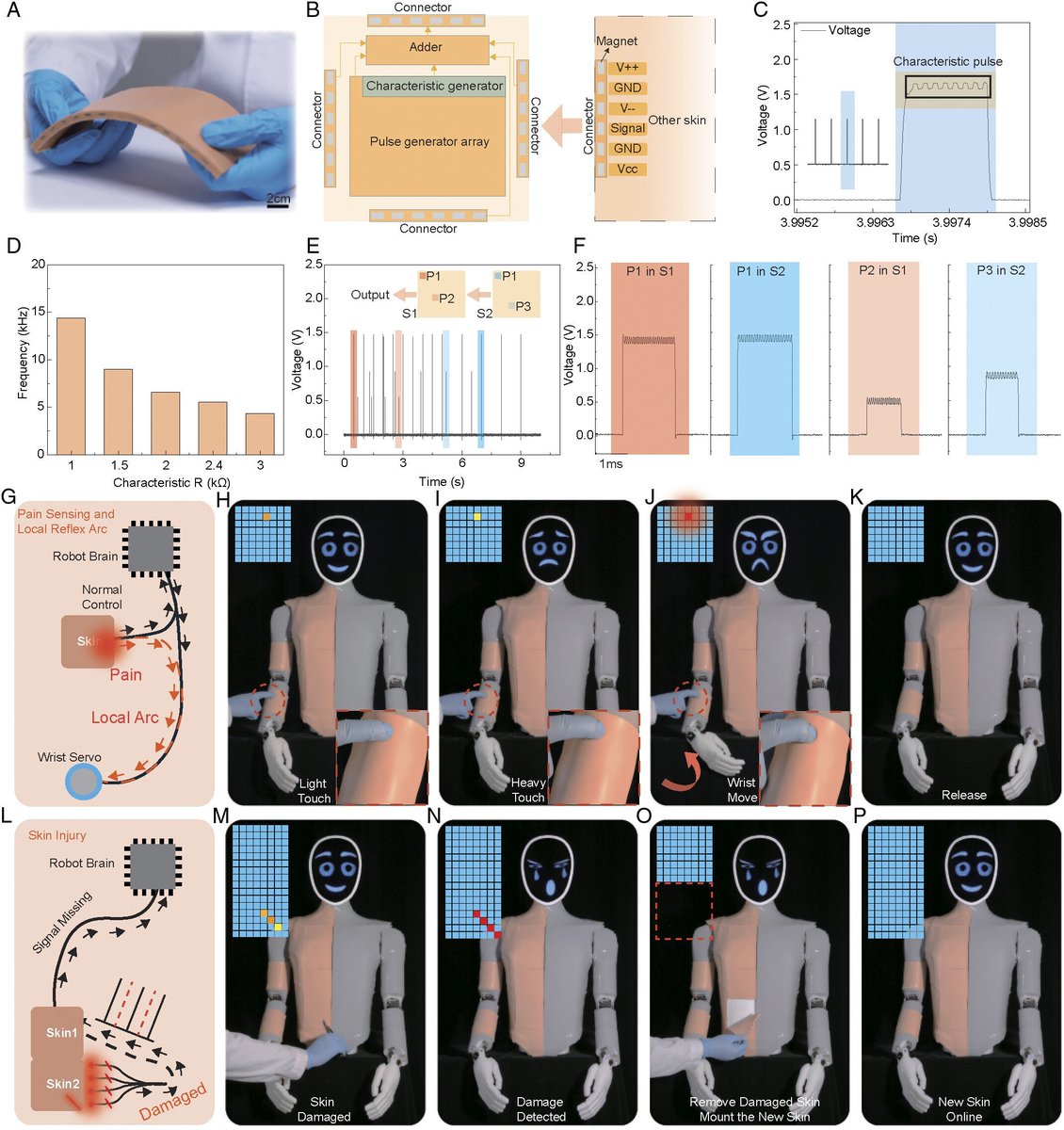
Youโ€™re not ready for whatโ€™s coming. Next-gen artificial skin could give humanoids a protective reflex. Researchers from China and Hong Kong developed NRE-skin, an electronic skin system published in PNAS. The important point: The robot does not suffer. The skin detects danger and triggers a defensive response. โ€ข Normal touch โž Subsurface artificial nerves convert pressure into spike-like electrical signals โž The signal goes to the main CPU for processing โ€ข Dangerous pressure โž The signal crosses a threshold โž The system bypasses the main computer โž A direct motor response pulls the robot away faster โ€ข Damage detection โž The skin sends a constant health pulse โž If a section is punctured or torn, the pulse breaks โž The robot can map the damaged zone โ€ข Fast repair โž The skin is built with modular magnetic patches โž A damaged section can be peeled off and replaced This is artificial nociception, not pain. For humanoids working near people in hospitals, homes and warehouses, this kind of reflex layer could protect both the robotโ€™s hardware and the human beside it.
We are cooked. Robots are not only getting eyes, hands and legs now they are getting a pain-like feedback loop to protect themselves react faster and survive contact with the real world. That is useful engineering. It is also where humanoids start feeling a lot less like machines. If a humanoid can actively feel and react to a pain threshold does it make you feel safer around them, or does it cross a line?
1
6
465
The robot uprising started during a live concert and nobody noticed ๐Ÿ˜ญ Look at how this Unitree humanoid robot started glitching out on stage but the performerโ€™s reaction was pure gold. Man instinct to just hug it say "I'm human" and give it a high five actually worked.
I'm taking a little break Far away from humanoids social media and social pressures... the view is truly magnificent.
1
5
797
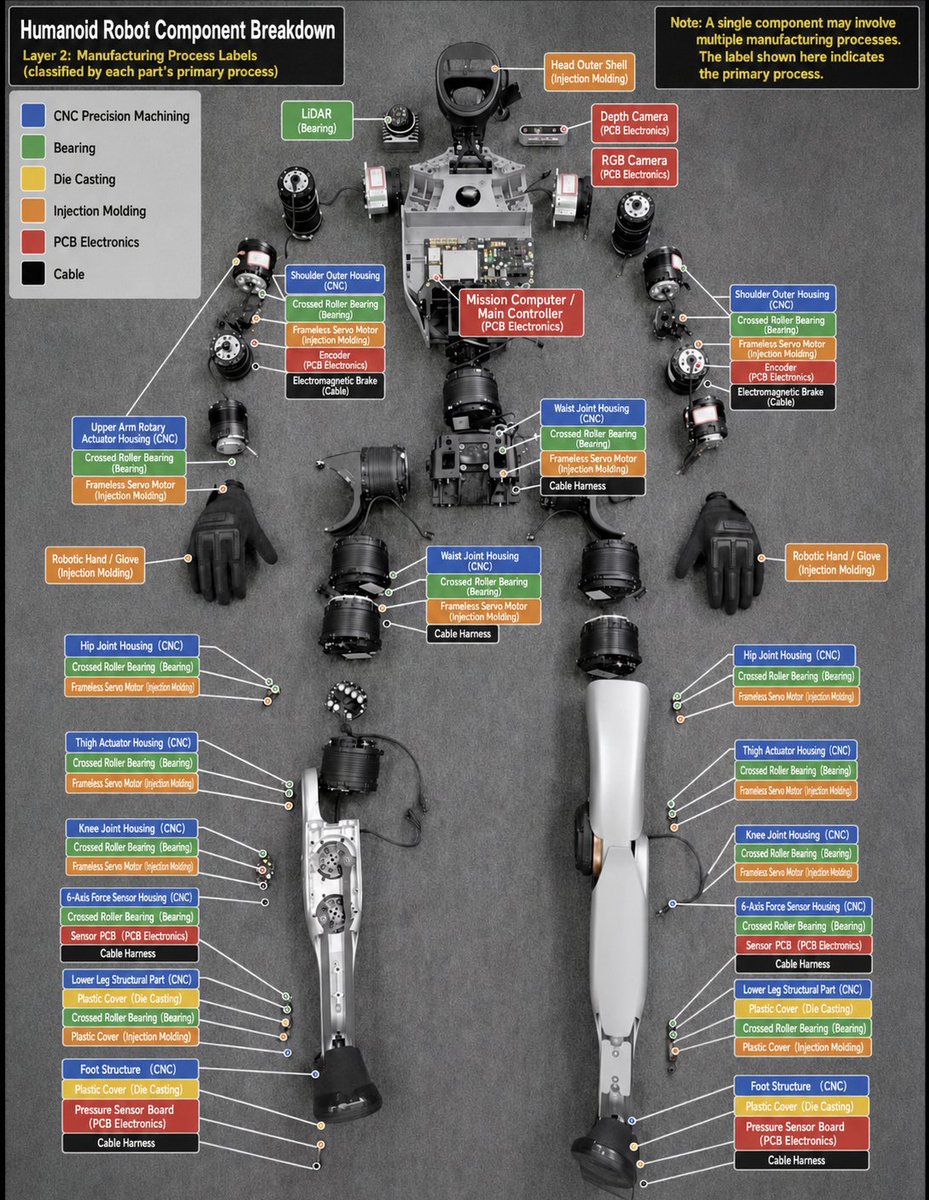
Humanoid robots look simple from the outside. Inside, they are a dense stack of machining, bearings, electronics, sensors, cables and thermal constraints. This breakdown shows why humanoid robotics is hard before the robot even starts walking. โ€ข CNC precision machining Used for rigid structures where tolerance matters Shoulder housings Waist joints Hip joints Knee housings Lower leg frames Foot structures A small alignment error can affect balance, actuator wear and repeatability. โ€ข Bearings Used across almost every rotating joint Shoulders Waist Hips Thigh actuators Knees Force sensor modules Crossed roller bearings are critical because humanoid joints carry radial, axial and moment loads during motion. โ€ข Injection molding Used for shells, covers, gloves and outer body parts. These components reduce weight, protect internal hardware and give the robot a clean exterior. โ€ข PCB electronics Used for the sensing and control layer RGB camera Depth camera Encoder boards Mission computer Sensor PCB Pressure sensor board This is where perception, feedback and low-level control begin. โ€ข Cable harnesses The hidden failure point. Cables pass through moving joints. They bend thousands of times. They must survive vibration, heat and repeated walking cycles. Key components shown here: โ€ข LiDAR โ€ข RGB camera โ€ข Depth camera โ€ข Mission computer โ€ข Shoulder actuator โ€ข Encoder โ€ข Electromagnetic brake โ€ข Upper arm rotary actuator โ€ข Robotic hand โ€ข Waist joint โ€ข Hip joint โ€ข Thigh actuator โ€ข Knee joint โ€ข 6-axis force sensor โ€ข Lower leg structure โ€ข Foot pressure sensor โ€ข Cable harness AI gets the attention. But the physical stack decides whether the robot can work for hours without broken joints, overheated electronics, loose cables or damaged sensors. Physical AI needs a physical supply chain.
The fastest Physical AI growth may be inside labs, not factories. IFR World Robotics 2025 shows medical robots had one of the sharpest jumps in 2024: โ€ข Medical robots overall: 16,700 units sold โ€ข Growth: 91% over 2023 โ€ข Surgery robots: 41% โ€ข Rehabilitation and non-invasive therapy: 106% โ€ข Diagnostics and medical laboratory analysis: 610% That last number is the real signal. Labs are controlled environments. The workflows are repetitive. The value is measurable. The need is rising because hospitals and medical labs face labor pressure and growing demand from aging populations. This is Physical AI with fewer distractions than humanoid demos. No factory floor hype. No vague autonomy claim. Just robots handling structured medical workflows where precision and throughput matter. Source: IFR World Robotics 2025
22
134
560
41,146
New coming soon
This is interesting. The teaser is not only showing a robot doing a task. but It shows different embodiments working in the same physical environment. Chess water handling object sorting. That is where embodied intelligence gets difficult and where LingBot 2.0 becomes worth watching. Something big is coming. Stay tuned.
1
366
I'm taking a little break Far away from humanoids social media and social pressures... the view is truly magnificent.
Expectation the Terminator taking over the world. Reality a robot in a little purple apron watering plants by the koi pond. The future is surprisingly zen. What chore are you giving your robot first?
3
6
2,911
Expectation the Terminator taking over the world. Reality a robot in a little purple apron watering plants by the koi pond. The future is surprisingly zen. What chore are you giving your robot first?
Wait But would this actually fly in real life or is it only a simulator fantasy? A single user single engine version. A two seat single engine version. Both look bold in SFS.
3
8
34
3,666
We are cooked. Robots are not only getting eyes, hands and legs now they are getting a pain-like feedback loop to protect themselves react faster and survive contact with the real world. That is useful engineering. It is also where humanoids start feeling a lot less like machines. If a humanoid can actively feel and react to a pain threshold does it make you feel safer around them, or does it cross a line?
Humanoid robots look simple from the outside. Inside, they are a dense stack of machining, bearings, electronics, sensors, cables and thermal constraints. This breakdown shows why humanoid robotics is hard before the robot even starts walking. โ€ข CNC precision machining Used for rigid structures where tolerance matters Shoulder housings Waist joints Hip joints Knee housings Lower leg frames Foot structures A small alignment error can affect balance, actuator wear and repeatability. โ€ข Bearings Used across almost every rotating joint Shoulders Waist Hips Thigh actuators Knees Force sensor modules Crossed roller bearings are critical because humanoid joints carry radial, axial and moment loads during motion. โ€ข Injection molding Used for shells, covers, gloves and outer body parts. These components reduce weight, protect internal hardware and give the robot a clean exterior. โ€ข PCB electronics Used for the sensing and control layer RGB camera Depth camera Encoder boards Mission computer Sensor PCB Pressure sensor board This is where perception, feedback and low-level control begin. โ€ข Cable harnesses The hidden failure point. Cables pass through moving joints. They bend thousands of times. They must survive vibration, heat and repeated walking cycles. Key components shown here: โ€ข LiDAR โ€ข RGB camera โ€ข Depth camera โ€ข Mission computer โ€ข Shoulder actuator โ€ข Encoder โ€ข Electromagnetic brake โ€ข Upper arm rotary actuator โ€ข Robotic hand โ€ข Waist joint โ€ข Hip joint โ€ข Thigh actuator โ€ข Knee joint โ€ข 6-axis force sensor โ€ข Lower leg structure โ€ข Foot pressure sensor โ€ข Cable harness AI gets the attention. But the physical stack decides whether the robot can work for hours without broken joints, overheated electronics, loose cables or damaged sensors. Physical AI needs a physical supply chain.
4
7
52
4,518
Wait But would this actually fly in real life or is it only a simulator fantasy? A single user single engine version. A two seat single engine version. Both look bold in SFS.
Proof that Jokoโ€™s kick is no joke. Recorded directly from the phone of the female employee Joko chased at the scene.
1
5
3,598
The mechanical and material complexity of humanoids is often underestimated.
2
589
The fastest Physical AI growth may be inside labs, not factories. IFR World Robotics 2025 shows medical robots had one of the sharpest jumps in 2024: โ€ข Medical robots overall: 16,700 units sold โ€ข Growth: 91% over 2023 โ€ข Surgery robots: 41% โ€ข Rehabilitation and non-invasive therapy: 106% โ€ข Diagnostics and medical laboratory analysis: 610% That last number is the real signal. Labs are controlled environments. The workflows are repetitive. The value is measurable. The need is rising because hospitals and medical labs face labor pressure and growing demand from aging populations. This is Physical AI with fewer distractions than humanoid demos. No factory floor hype. No vague autonomy claim. Just robots handling structured medical workflows where precision and throughput matter. Source: IFR World Robotics 2025
1
16
36,749
Proof that Jokoโ€™s kick is no joke. Recorded directly from the phone of the female employee Joko chased at the scene.
Figure 3 already showed this kind of warehouse motion. When different humanoids start repeating the same boring task, the market starts comparing: โ€ข cycle time โ€ข grip stability โ€ข object alignment โ€ข recovery after mistakes โ€ข repeatability โ€ข teleoperation vs autonomy This robot is not doing something visually crazy. It is doing the kind of simple warehouse motion that becomes valuable only when it can run again and again without a human reset. The humanoid race is moving from โ€œlook what it can doโ€ to โ€œhow many times can it do it cleanly.โ€
1
20
4,508
Figure 3 already showed this kind of warehouse motion. When different humanoids start repeating the same boring task, the market starts comparing: โ€ข cycle time โ€ข grip stability โ€ข object alignment โ€ข recovery after mistakes โ€ข repeatability โ€ข teleoperation vs autonomy This robot is not doing something visually crazy. It is doing the kind of simple warehouse motion that becomes valuable only when it can run again and again without a human reset. The humanoid race is moving from โ€œlook what it can doโ€ to โ€œhow many times can it do it cleanly.โ€
People think this is a toy. They got it completely wrong. Here is why. This small robot is called Hopcopter. It looks like a tiny drone with one strange leg under it but the idea is much more serious. Hopcopter combines two forms of movement in one body: โ€ข it flies like a quadcopter โ€ข it jumps like a one-legged robot The telescopic leg works like a spring. It stores energy when the robot hits the ground then releases it to push the robot back into the air. That means Hopcopter does not need to fly all the time. It can bounce, redirect itself, recover from contact and take off again during the same motion. In published tests, Hopcopter reached 2.38 m/s vertical speed and a 1.63 m jump height. That matters because small drones burn a lot of energy when they stay airborne. A robot like this could move through cluttered spaces by mixing flight and hopping instead of relying on continuous flight. Think construction sites, forests, disaster zones, collapsed buildings or hard-to-reach inspection areas. The leg is not decoration. It is the reason the robot can use the ground as part of its locomotion system. Hopcopter was developed by researchers at City University of Hong Kong led by Professor Pakpong Chirarattananon. The project was published in Science Robotics under the title: An agile monopedal hopping quadcopter with synergistic hybrid locomotion This is not a toy. It is a small preview of how future robots may move when wheels, legs and flight alone are not enough.
4
11
61
9,007
ROBOTS DESIGN AROUND THE WORLD A look at 40 robot designs from industrial arms to humanoids. INDUSTRIAL ROBOT ARMS โ€ข ๐Ÿ‡จ๐Ÿ‡ญ ABB โž IRB Series โž Built by ABB for factory automation โž Known for welding, handling and assembly lines โ€ข ๐Ÿ‡ฉ๐Ÿ‡ช KUKA โž KR CYBERTECH Series โž Built by KUKA for compact industrial workcells โž Used for handling, arc welding and machining tasks โ€ข ๐Ÿ‡จ๐Ÿ‡ญ STร„UBLI โž TX2 Series โž Built by Stรคubli for high-speed precision work โž Strong in electronics, pharma and clean production โ€ข ๐Ÿ‡ฏ๐Ÿ‡ต YASKAWA โž GP Series โž Built by Yaskawa Motoman for general handling โž Used where factories need speed and repeatability โ€ข ๐Ÿ‡ฏ๐Ÿ‡ต NACHI โž CM Series โž Built by NACHI for industrial automation โž Known for compact arms and production reliability โ€ข ๐Ÿ‡ฎ๐Ÿ‡น COMAU โž Racer Series โž Built by Comau for fast industrial motion โž Used in automotive and high-volume manufacturing โ€ข ๐Ÿ‡ฏ๐Ÿ‡ต FANUC โž ARC Series โž Built by FANUC for arc welding โž Recognized for yellow factory robots and rugged uptime โ€ข ๐Ÿ‡ฏ๐Ÿ‡ต Mitsubishi Electric โž RV-FR Series โž Built by Mitsubishi Electric for flexible factory automation โž Used for assembly, inspection and machine tending COBOTS โ€ข ๐Ÿ‡ฉ๐Ÿ‡ฐ Universal Robots โž UR10e Series โž Built by Universal Robots for human-side automation โž Popular because it is easy to deploy in small factories โ€ข ๐Ÿ‡ฉ๐Ÿ‡ช Agile Robots โž Diana Series โž Built by Agile Robots for collaborative manipulation โž Designed for precise arm motion near people โ€ข ๐Ÿ‡ฉ๐Ÿ‡ช NEURA Robotics โž Lara Series โž Built by NEURA Robotics for cognitive robotics โž Built for safer human robot collaboration โ€ข ๐Ÿ‡ฏ๐Ÿ‡ต DENSO โž COBOTTA Series โž Built by DENSO for compact workbench automation โž Useful for labs, small parts and repetitive tasks โ€ข ๐Ÿ‡ฏ๐Ÿ‡ต OMRON โž TM-RT Series โž Built by OMRON for collaborative factory work โž Focused on vision-guided handling and inspection โ€ข ๐Ÿ‡จ๐Ÿ‡ฆ Kinova โž Gen3 โž Built by Kinova for lightweight robotic manipulation โž Used in research, assistive robotics and mobile platforms โ€ข ๐Ÿ‡จ๐Ÿ‡ณ DOBOT โž CR Series โž Built by DOBOT for affordable collaborative automation โž Made for pick and place, packing and small production lines โ€ข ๐Ÿ‡ฐ๐Ÿ‡ท DOOSAN โž CRX Series โž Built by Doosan Robotics for industrial collaboration โž Known for strong cobot arms and clean design QUADRUPED ROBOTS โ€ข ๐Ÿ‡ช๐Ÿ‡ธ Keybotics โž Keyper โž Built by Keybotics for industrial inspection โž Designed to move through facilities where wheels struggle โ€ข ๐Ÿ‡จ๐Ÿ‡ณ Unitree โž B2 โž Built by Unitree for larger quadruped tasks โž Built for payload, speed and outdoor mobility โ€ข ๐Ÿ‡บ๐Ÿ‡ธ Boston Dynamics โž Spot โž Built by Boston Dynamics for inspection and mapping โž Famous for balance, terrain recovery and field use โ€ข ๐Ÿ‡จ๐Ÿ‡ญ ANYbotics โž ANYmal โž Built by ANYbotics for industrial inspection โž Used in energy sites, plants and rough environments โ€ข ๐Ÿ‡จ๐Ÿ‡ณ DeepRobotics โž X30 โž Built by DeepRobotics for industrial patrol and inspection โž Designed for outdoor terrain and harsh sites โ€ข ๐Ÿ‡บ๐Ÿ‡ธ Ghost Robotics โž Vision 60 โž Built by Ghost Robotics for rugged field mobility โž Used for defense, security and perimeter work โ€ข ๐Ÿ‡จ๐Ÿ‡ณ Unitree โž Go2 โž Built by Unitree for consumer and developer robotics โž Smaller, cheaper and more accessible than industrial quadrupeds โ€ข ๐Ÿ‡จ๐Ÿ‡ณ XPENG Robotics โž Robot Pony โž Built by XPENG Robotics as a smart mobility companion โž Blends quadruped movement with consumer robot design โ€ข ๐Ÿ‡จ๐Ÿ‡ณ Xiaomi โž CyberDog 2 โž Built by Xiaomi for consumer robotics research โž A compact robot dog focused on agility and interaction โ€ข ๐Ÿ‡จ๐Ÿ‡ณ Pudu Robotics โž Pudu D1 โž Built by Pudu Robotics for service robotics โž Shows how delivery robot companies are moving into legs โ€ข ๐Ÿ‡จ๐Ÿ‡ณ OPPO โž Qric โž Built by OPPO as a robotic dog concept โž Interesting because a smartphone company explored legged robots โ€ข ๐Ÿ‡ฏ๐Ÿ‡ต Sony โž Aibo โž Built by Sony as a companion robot dog โž One of the clearest examples of emotional consumer robotics
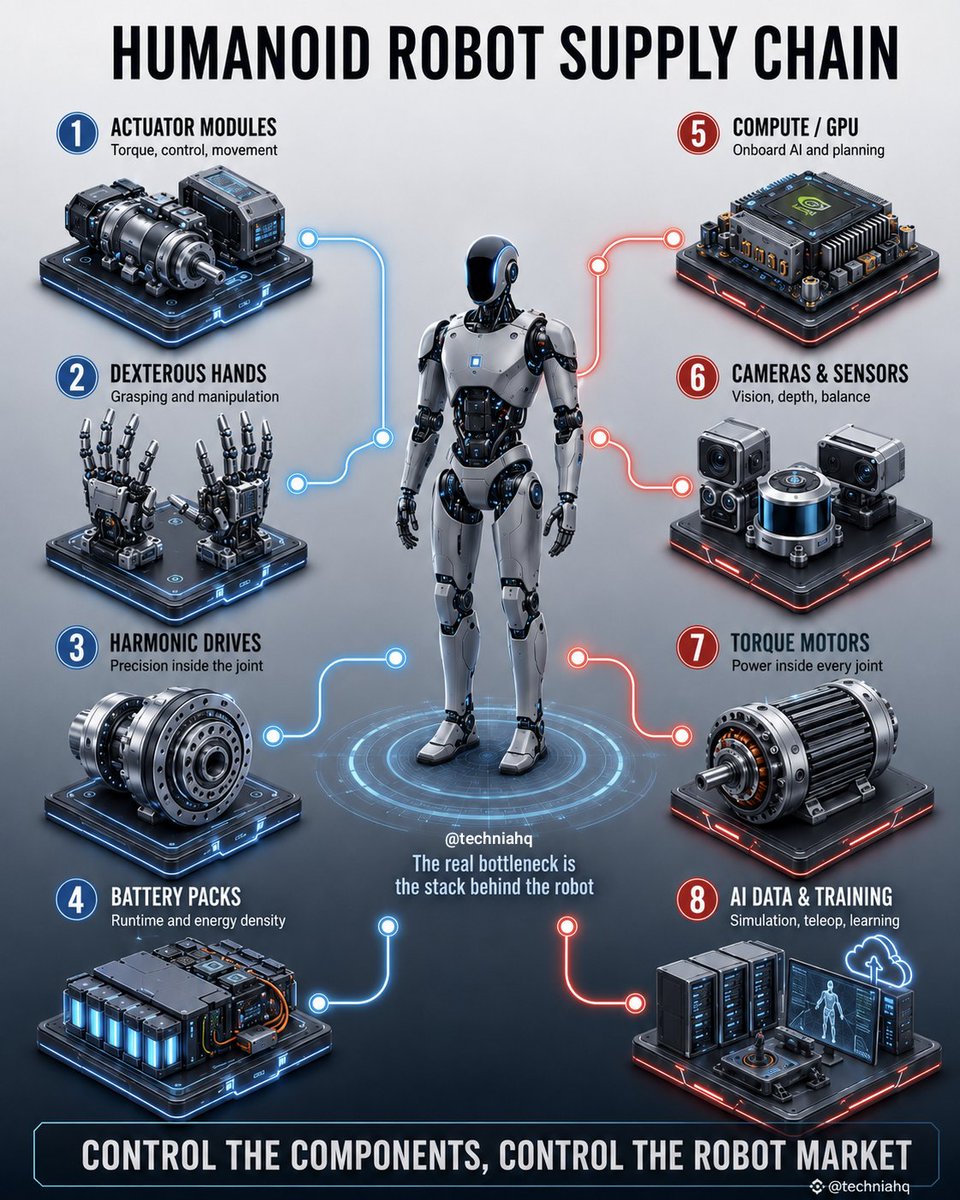
The humanoid robot race will be decided inside the supply chain. A robot body looks simple from the outside. Inside every movement depends on a stack of expensive fragile and hard-to-scale components. โ€ข Actuator modules โž Convert software commands into controlled movement โž Drive shoulders, hips, knees, elbows, ankles and wrists โž Bad actuators mean weak motion, heat issues and short service life โ€ข Dexterous hands โž Decide what the robot can actually do โž Picking tools, opening doors, carrying objects and handling small parts all depend on the hand โž A humanoid without useful hands is mostly a walking demo โ€ข Harmonic drives โž Give precision inside the joint โž Reduce backlash โž Help the robot move smoothly under load โ€ข Battery packs โž Set runtime, weight and deployment time โž Every extra kilogram affects balance walking efficiency and payload โž Long runtime is one of the hardest problems for real work โ€ข Compute / GPU โž Runs onboard AI, vision, planning and safety logic โž The robot has to react inside the body, not only in the cloud โž Latency matters when the robot is walking near people โ€ข Cameras & sensors โž Give vision depth balance and force feedback โž The robot needs to see the floor, detect objects and understand contact โž No perception means no useful autonomy โ€ข Torque motors โž Put power inside every joint โž Compact motors are critical for hips, knees, shoulders and wrists โž More torque with less heat means longer useful operation โ€ข AI data & training โž Turns teleoperation, simulation and real failures into better behavior โž Walking, grasping and tool use need massive task data โž The robot learns from the stack behind it The market will reward the companies that can control the full body stack: โ€ข joints โ€ข hands โ€ข sensors โ€ข batteries โ€ข compute โ€ข training data โ€ข manufacturing โ€ข repair network
17
207
729
70,956
Humanoid robot battery chart shows a clear pattern: Most published humanoid runtimes still sit around 2 to 5 hours. That means the next race is not only walking speed or dexterous hands. It is battery swap self charging power management and surviving a real work shift.
1
370