A physicist in drug discovery land. On a mission to significantly extend human lifespan | Founder of Gero.ai @hacking_aging) | WEF Tech Convergence group

Joined April 2009
291 Photos and videos
Pinned Post
thank you, @EleanorSheekey for your questions and @agingdoc1 for spreading the link. Here lifespan.io/news/playing-the… and here biorxiv.org/content/10.1101/… are the popular and academic versions of the narrative discussed on the podcast. Friends, help please, as usual, spread the story with your likes and reposts. It's a lot better having a bad theory than none at all - let's get to the core of this.
How We Should Target Aging | Peter Fedichev Love what @EleanorSheekey is doing with @SheekeyScience. One of the sharpest geroscience #scicomm channels around, and @fedichev always brings the fire 🧪 youtube.com/watch?v=buEPyBiK…
1
9
35
8,985
See full response: peterfedichev.substack.com/p… <-- Please subscribe, like, and repost
4
520
Read Yuri's reply: x.com/ydeigin/status/2067230… to my Substack piece: peterfedichev.substack.com/p…
Shots fired against my beloved partial reprogramming! 🙂 But it’s a complete misunderstanding of the serial cloning paper on Peter’s part… It actually SUPPORTS partial reprogramming as a means of extending lifespan, because it shows that somatic mutations are a remarkably minor constraint on normal lifespan. I mean, remember what their experiment put cells through. Each generation began from a single somatic cell, which then expanded into the TRILLIONS of cells making up an entire mouse. The next generation was bottlenecked back down to one cell, fixing that cell’s accumulated mutations into the founder genome of the next animal. They repeated this 57 times: from one cell to a whole organism, then back to one cell, over and over. That is a mutational stress test orders of magnitude beyond anything an adult organism would ever experience. Even if you lived for thousands of years, your tissues would accumulate only a fraction of the mutational burden these mice carried. And yet the mice continued to have normal lifespans across generations. Also, 58 generations was not some fundamental biological ceiling. It was one unscreened lineage (one path through the mutational landscape) that likely failed because of just a couple of major chromosome-scale lesions: the near-whole-chromosome 4 loss of heterozygosity, followed in one late branch by a Chr4–Chr11 translocation. That methodology had none of the quality control built into sexual reproduction: no recombination, no competition between gametes, no embryo selection, and no systematic screening to advance the cleanest lineage. If they had used PGT-like genomic screening at each generation and advanced only the cleanest nuclei, I strongly suspect serial cloning could have continued far beyond 58 generations. So yes, epigenetic reprogramming does not repair DNA mutations. But the remarkable finding here is that mice tolerated an enormous inherited mutational burden while continuing to age at a normal rate. That weakens, rather than supports, the claim that unrepaired somatic mutations impose a low ceiling on epigenetic rejuvenation. And invoking the second law of thermodynamics does not rescue the argument. Living organisms are open systems that continuously expend energy to repair DNA, replace proteins, heal tissues and maintain local order while exporting entropy into the environment. Thermodynamics just tells us that repair has an energetic cost, not that repair is impossible. Whether a particular age-associated lesion can be reversed is an empirical and engineering question. Calling it “entropy” does not make it irreversible. PS: people have been dissing partial reprogramming for close to a decade because the earliest OSKM studies did not produce dramatic lifespan extension. But that is a strange standard to apply to the first generation of an entirely new therapeutic paradigm. OSKM was discovered to create pluripotent stem cells, not as the optimal combination for safely rejuvenating every cell type. Partial reprogramming is ultimately much broader than OSKM: the goal is to shift old or dysfunctional cells toward younger, more functional gene-expression patterns without erasing their identity. That will likely require cell- and tissue-specific factors, doses and delivery systems, as I’ve been saying forever. BUT despite all the naysaying, the field has continued making steady progress toward the clinic! Life Bio has now dosed the first patient, NewLimit is advancing a liver-targeted, cell-specific reprogramming therapy toward human trials, and at YouthBio we are advancing our neuron-targeted, inducible partial reprogramming therapy for Alzheimer’s following our FDA INTERACT meeting. None of this guarantees clinical success, but it makes one thing clear: partial reprogramming is NOT a failed idea. Its first therapeutic generation is already reaching patients while a more precise, cell-specific second generation is being built.
1
955
A reply to @ydeigin regarding my take on why epigenetic rejuvenation won't give us radical life extension: Yuri argues that serial cloning (one cell → trillions → one cell, repeated 57 times) is an extraordinarily harsh mutational stress-test — far tougher than a normal lifetime — yet the cloned mice maintained normal lifespans for decades of generations. This, he says, suggests somatic mutation load isn’t the primary limit on lifespan and weakens the idea that unrepaired damage caps what epigenetic rejuvenation can achieve. Fair point on the severity of the bottleneck. But let’s look at what the experiment actually falsifies. The stronger claim (often bundled with “information theory of aging”) is that a full epigenetic reset — complete nuclear reprogramming embryogenesis — returns biological age to zero with essentially no irreversible residue. Serial cloning is about as rigorous a real-world test of that exact claim as exists: every single generation receives a total reset, repeated across 57 generations, with full developmental selection. Yet the damage accumulated monotonically anyway, until the lineage failed at generation 58. One clear counter-example is sufficient to reject the universal “reset erases everything, zero leftover” assertion. I’m not claiming mutation load is the dominant driver of normal mouse lifespan, nor that 58 generations is a hard biological ceiling. Only that even the most powerful reset conceivable left a residue it could not eliminate. This fits a broader pattern. Dose-ramped in vivo OSKM plateaued far short of top longevity interventions and raised cancer risk. Caloric restriction and heterochronic parabiosis both improve the reversible (regulatory noise) component but leave the entropic/irreversible trajectory flat. Four structurally unrelated interventions — full genetic reset, transcription-factor overexpression, dietary, and circulatory — all hit a similar floor. That convergence points toward a thermodynamic flavor: stress drives regulatory noise, which over time seeds irreversible entropic drift. We can slow the process. We cannot simply rewind it.
6
17
5,106
Just dropped a deep dive with @MHealthspan on why aging is more physics than biology — and how we're turning that into real drugs. Aging isn't a bug we can "reprogram" away with fancy epigenetics. It's entropic drift in a complex system: stress hits, regulatory noise builds, and irreversible damage accumulates. Thermodynamics sets the rules — we can slow the clock, not rewind it. That's the path past the ~120-150 year resilience limit. Key highlights: GLP-1s are the proof-of-concept the field needed: one mechanism, massive multi-disease impact. Imagine better versions that also touch core aging processes. Our 3-layer model (Stress → Regulatory Noise → Irreversible Damage) physics-informed AI for target identification and design experimental therapeutics. Watch here: youtube.com/watch?v=NU8RAZhQ… If you want to understand why we focus on slowing rather than reversing, and how we're building the next class of medicines, this is worth your time. What we do now matters — resilience is everything. Let's push the limits. #Longevity #Gerophysics #GeroAI
2
2
30
2,015
We have just reached $34M in total funding, with new money coming to advance our preclinical pipeline. Now, we’re accelerating our transition from science and discovery engine to a preclinical-stage drug developer, on track to pioneer a new class of medicines targeting aging and chronic diseases in humans. Our theories and models can now be put to a test and see translation into therapeutics that could dramatically affect lifespan in our species. Read more on this news: businesswire.com/news/home/2…
21
17
125
22,397
Just published on Substack: Why Epigenetic Rejuvenation Won’t Give Us Radical Life Extension — Lessons from 58 Generations of Cloned Mice. This is my take at the results of a landmark Nature Communications paper (20 years, 1,200 mice, 58 generations of serial cloning with full epigenetic reset) shows it still collapses. Mutations accumulated 3× faster. Epigenetic reprogramming works… until it doesn’t. There is an irreducible level of damage that cannot be undone. To my taste, this is a very important study. Popular literature claims cloning erases aging signatures. In short-lived species it may look that way — the entropic damage simply doesn’t have time to kill. In longer-lived animals we expect the picture be very different (and there is an anecdotal evidence for that with a lot fewer generation before the collapse). This is also why I dislike the language of “information theory of aging.” Flipping the sign on entropy and calling that "information" (changing from the Boltzmann to Shannon equation) doesn’t repeal thermodynamics. Of course, you can still hope for better Yamanaka factors or else. My interpretation of the experiment is not yet a proof of anything - certainly not. However, the experiment removes a lot of ground under proponents of epigenetic rejuvenation. If you want to keep your identity, better to stop aging than try to reverse it. Challenge me. Subscribe, Like & repost. Link: peterfedichev.substack.com/p…
29
27
146
31,122
Gero has just been selected as a 2026 Technology Pioneer by the World Economic Forum (@wef). For over a decade I've approached #aging as a physicist: not as a collection of isolated diseases to treat after they appear, but as a macroscopic process driven by the accumulation of entropic damage and the loss of resilience in a complex system. That framework is what led us to found @hacking_aging. At Gero, we use physics-informed models on large-scale clinical data to separate aging itself from specific disease trajectories. Our goal is straightforward: identify ways to slow the underlying rate of functional decline before reversible stress turns into irreversible collapse. Stop the clock where it matters most — on the processes that erode healthspan. This recognition from the WEF is a strong validation of that direction. Looking forward to connecting with the other pioneers and pushing these ideas further. ➡️Read the full announcement: businesswire.com/news/home/2…
5
3
21
2,608
congrats @lex_sviridov - it's a monumental work!
Over the past few months, I've been collaborating with @socialcapital (@chamath's investment vehicle) on a two-part deep dive into the current state of Longevity Biotech and Aging Research. This deep dive aims to be a solid introduction to the field. It assumes no background in biology, medicine, or biotech. If you've been wondering what science knows about aging, what makes us believe aging can be slowed or reversed, or which companies are making real progress toward developing therapies against aging, this is for you! Part 1 is out now. It's a foundation for understanding the biology of aging and the current state of longevity biotech. Part 2 follows shortly, covering the strategies researchers, companies, and investors are pursuing to slow or reverse aging. Thank you, @chamath and @socialcapital team, for the opportunity to work with you on it. And thank you to all contributors who helped to make this deep dive objective and engaging, and who are making anti-aging interventions a reality: @Andrei_Tarkhov, @elimohamad, @fedichev, @KarlPfleger, @MarkHamalainen, @MartinBJensen, @MaxUnfried, @mkaeberlein, @omri_drory, @RaianyRomanni, @realnathancheng, @sebastiangiwa, @shappiron, @shoylev, @statto, @strygah, @ydeigin If any errors are to be found in this deep dive, I own them.
11
1,296
Learn more about the role physics plays in aging on my Substack: peterfedichev.substack.com/p…
2
6
810
When most people think about aging, they think biology. Cells, genes, proteins, damage. That's not wrong — but it may be missing the level at which the problem actually lives. I'm a physicist working on aging. The question I get most often: why physics? Biology is chemistry, chemistry is physics — but chemists don't need quantum mechanics, and biologists don't need to revisit Schrödinger. Fair point. Except it misses something deep. P. W. Anderson said it in 1972: more is different. Complex systems are hierarchically organized, and at each scale, genuinely new laws emerge — laws that are largely indifferent to what's happening below. Temperature. Superconductivity. Turbulence. None visible in any single particle. All real, all governed by rules that only exist at scale. The corollary is uncomfortable: information does not flow upward. Macro behavior is insensitive to micro details. This is why drugs mostly fail — not bad chemistry, but a structural mismatch between the scale of intervention and the scale of the outcome you care about. You pull a molecular lever; the organism-level trajectory shrugs. It also means there is no unified molecular theory of aging. And there never will be — not because we haven't found it yet, but because physics tells us it can't exist. Yeast ages through extrachromosomal DNA circles; mammals through telomere attrition and proteostatic collapse. Completely different mechanisms, convergent macroscopic phenomenology. Different species have different microscopic theories of aging. Physics has seen this before: Landau-Ginzburg theory describes superconductivity without caring about atomic details; BCS and Anderson give microscopic accounts for their own material classes, but no unified microscopic theory exists or is expected to. The universal law lives at the macro level. Always. Darwin and Boltzmann were contemporaries, and together they produced the deepest tension in 19th-century science. Darwin showed complexity increasing over time. Boltzmann proved that disorder must increase. Two giants, pulling in opposite directions — and resolving that tension took another century. Aging sits right at the intersection: a macroscopic arrow of time in biology, driven by thermodynamic drift that repair mechanisms, themselves finite, cannot indefinitely offset. Hayflick saw it from inside biology: aging is not a disease. It is the second law operating on living matter. Physics and biology have been circling the arrow of time together for 150 years. Aging is where they finally have to converge. More on this in my Substack post. 👇
10
6
39
2,871
Read a piece I contributed to on this topic: nature.com/articles/s41467-0…
3
903
Check out more I shared about #longevity on my Substack: peterfedichev.substack.com/p…
1
2
1,045
Most of human aging is thermodynamically irreversible. While it's a much disliked phrase. However, I think it's one of the most important and actionable statements in the field, because it means the goal is not rejuvenation. The goal is to stop the clock. And now let me tell you how. At @hacking_aging, we feed medical histories across tens of millions of people into physics-based machine learning models, which: • Use patients medical histories to predict how a person's health evolves over the full arc of their life • Pull aging out as a distinct process from specific disease trajectories This happens not because we told the models to, but because the signal is there in the data. Through this analysis, we identify genetic targets that control the rate of aging itself—not a particular disease predisposition or progression, but the underlying aging process closely related to configurational entropy of the aging organism. These genetic factors do not tell stories about treating particular diseases; they're about shifting the fundamental rate at which aging occurs. In 2021 we were the first estimate the maximum human lifespan from clinical data. What's gets measured - get optimized. Today, that estimate is approximately 120 years. This is how aging biology can be framed as a data problem, and the data analysis can reveal what no amount of experimentation alone cannot. Think of this post as a imminent new preprint announcement - please like, share and follow to know more, check and subscribe to my Substack using the link in the first comment.
32
7
68
9,970
Some ask whether the gerophysics view is too pessimistic. Shouldn’t there be more hope? As one gentleman put it in the Q&A: not everyone has twenty years to wait and see if the theories work — shouldn’t we chase something that can deliver spectacular results sooner? Gerophysics is, first and foremost, physics - a science about how the universe works. The universe does not negotiate with our feelings. You don’t need a PhD to see what is reversible in aging and what is not. Just look at faces. Our brains are wired with an evolved neural network that instantly reads age. When you’re sick or exhausted, you look older; when you rest and recover, you look younger. This health-related fluctuation — roughly five years around your chronological age — is the reversible part. But then there is the irreversible part. Look at the size of a person’s nose or ears. No diet, no exercise, no supplement will shrink them. These are the slow, progressive changes driven by the accumulation of molecular damage across the body. They only go one way. That is, by the way, how the Second Law of Thermodynamics is written on your face. The old debates about open versus closed systems are long gone. Today, we understand the second law through the lens of controlling large chaotic systems — a framing that fits complex biology perfectly and is unlikely to be overturned. Reversing the arrow of time in such systems demands not just computation (which may become cheap), but Maxwell-demon-level control over molecular noise. That technology does not exist and will not enter widespread medical practice anytime soon (10-20 time horizon - remember how long typical drug development takes?). This is why going against the second law is such a hard proposition. Here, I find Nassim Taleb’s via negativa especially powerful. We gain far more clarity by ruthlessly identifying what is impossible than by chasing what is merely hopeful. By rejecting the fantasy of total age reversal, we stop wasting resources on ghosts. Instead, we focus on what is physically realistic: slowing the rate of aging itself so that people can live very long, vigorous lives without the functional collapse we now call “old age.” Enjoy the video fragment from @jpmorgan 2026. If it resonates, please share, like, and follow. Full video and more insights from our science group are on Substack (link in first comment).
7
1
34
3,873
Check out my less heavy Substack piece: peterfedichev.substack.com/p…
1
7
907
Read the academic paper: biorxiv.org/content/10.64898…
2
1
11
985
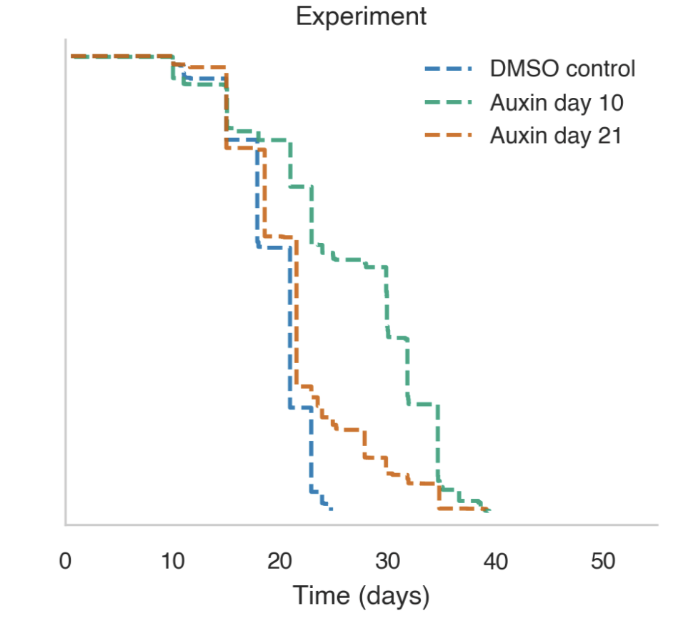
Worms have a gene that, when switched off, doubles lifespan. Even in animals already close to death. That shouldn't be possible. If aging is just damage piling up, by the time you're old, you've missed your window. But old worms, visibly falling apart, respond just as powerfully as young ones. All that damage is still there. They live longer anyway. The explanation — from the Fedichev-Gruber dynamical framework — is that what kills you isn't accumulated damage. It's your proximity to a failure threshold on an unstable trajectory. The organism's physiological state drifts along an unstable mode — slowly at first, then exponentially, then in runaway collapse. Death is a first-passage event: the moment the trajectory crosses the edge. 75% of the worms had already died by day 21. They weren't older in chronological time — they were further along the instability trajectory. The survivors, by chance, were still early in the exponential regime. Biologically younger, despite identical ages. Reduce the instability rate for those lucky few, and they respond as powerfully as young animals — because dynamically, they still are. No damage reversal. No clock reset. Just a change in the slope of the landscape for animals who happened to still be far enough from the edge. The precision of the prediction is striking. Irreversible structural damage — pharyngeal degeneration, gonadal atrophy, uterine tumors — persists after treatment, exactly as the model predicts. But proteostasis recovers and stress resilience returns — because these are coupled to the dynamical mode the intervention modulates. Worms age in the unstable regime from birth. Humans don't — damage slowly erodes our stability over decades. The interventions that work here will be transient in us. Our targets are different: the rate of damage accumulation and the biological noise separating average lifespan from maximum lifespan. Aging and death are not one thing. Death is the result of a transition between two dynamical regimes. Nematodes are great examples of aging in an unstable regime, and experiments confirm the theory works exactly as predicted. Please find a moment to like, follow, and repost. The full piece is linked below. Discussion welcome.
15
20
135
10,927
In the world fascinated by AI, it's hard to see how much fast and impressive is the progress in medicine. In @DavidBerry26's words: "GLP-1 drugs will generate more revenue than OpenAI, Anthropic, and Mistral combined. They're also reducing heart attacks, slowing Alzheimer's, and may rewire addiction. But yet, pharma is the most hated industry in America. Meanwhile, AI — widely believed to be destroying jobs at scale — is celebrated, funded, and plastered on magazine covers. We've decided that software that predicts the next word and replaces your coworker deserves infinite goodwill and drugs that save and extend our lives. I understand the frustration with drug pricing. But the hatred isn't targeted at pricing. It's targeted at profit. And profit is what funds the next GLP-1. We need a more sophisticated conversation about pharmaceutical value rather than killing the golden goose, especially given that we all want the benefits." Please like, follow and repost and if you want to see more like this. Subscribe for my sub stack updates: bit.ly/42F3opK
Most people don’t realize how big consumer biotech already is. Ozempic Mounjaro (2025): $71B OpenAI Anthropic (2025): $29B GLP-1 was just the beginning. The next category is drugs that slow aging.
1
1
10
1,207
Learn more: bit.ly/42F3opK
1
8
1,228