Joined March 2010
23 Photos and videos
LLMs are boooooring… There, I said it. Nothing fundamental about their architecture has changed since the 2017 transformer, check Attention is all you need, you’ll see the same pieces that power any frontier LLM today (okay, MoE fans don’t beat me up too much, it’s just a smart router anyway) The genuinely hard, unsolved architecture problems in AI aren't in language anymore. They're in 3D structure prediction, where diffusion, physics-based guidance, and inference-time scaling are colliding in ways that exist nowhere else in the field. @enfeinberg and I went deep on it with @latentspacepod, including the first public look at Sapphire, our agentic drug discovery system. Watch here: youtube.com/watch?v=YQWXxnkK… Read more here: latent.space/p/the-coolest-d… Listen here: open.spotify.com/episode/3jG…
Agents 🤝 GEMS. For the first time, we’re sharing details on Sapphire 💎 our agentic drug design system built on top of our SOTA molecular foundation models. Sapphire works 24/7, autonomously iterating on drug candidates – reasoning about 2D chemical structures and 3D molecular poses, and forming and testing hypotheses with real intelligence along the way. It represents a view we've held from the start: agents become meaningful for drug design only once the underlying molecular foundation models are capable enough to perform on real drug programs. We built those models first. Our CEO @enfeinberg and CTO @edunov cover both topics on @latentspacepod, including what separates models that hold up in reality from those that only look good on benchmarks.
2
1
13
77,182
Reasons to join @genesismolai: * We're building AI to save human lives, not to generate ads, engagement, or spam. * We're building our own foundational AI models that are fundamentally more complex and more interesting than traditional LLMs. * We're agile, with none of the bureaucracy of a big tech company. * We have a great multidisciplinary team -- top AI scientists, engineers, chemists, physicists, and biologists -- to learn from.
As our pharma partnerships expand and foundation models scale, we’re growing our team to match. Some key roles we’re looking for: → ML & Molecular Simulation Scientist: advance our GEMS drug discovery platform using 3D diffusion models, physics-inspired neural networks, and large-scale molecular simulations → ML Research Scientist, Foundation Models: drive foundational research at the intersection of deep learning, physics, and computational chemistry to build generative AI models powering drug discovery → We also have openings across ML research, applied ML science, product, software engineering, and more.
12
1,461
Sergey Edunov reposted
Protein–ligand cofolding models are getting incredibly powerful… but do they have to be so slow? 🧬🐢💊 Our new preprint introduces a new flow-map framework called DeCAF for fast few-step cofolding — up to 5× faster while preserving sample quality on the SOTA Pearl model and 20x faster than Boltz 1x. ⚡🧵 📜 Blog: genesis.ml/news/genesis-mode… 🔗arXiv: arxiv.org/abs/2606.08375 Code (coming soon): github.com/genesistherapeuti…
5
25
156
21,471
Diffusion models are an amazing tool for cofolding, they allow us to predict a protein and the molecule bound to it at once. But they are not exactly fast and require a lot of denoising steps to get accurate predictions. So we distilled ours. Meet DeCAF-Pearl: the first flow map model for all-atom cofolding. Instead of inching along the denoising trajectory, a flow map learns to jump across it. DeCAF-Pearl runs structure generation ~5x faster than Pearl, our SOTA model, while still maintaining the performance of the teacher model. That speed up allows us to run larger experiments and generate more synthetic data to improve our models. Getting there meant reparameterizing into noise-level space to stabilize gradients, committing to clean-structure prediction to keep the rigid-alignment loss biomolecules needed, and building DeCAF-Search, one steering algorithm for every compute budget. For more technical details, read out blog post: genesis.ml/news/genesis-mode… And the paper: arxiv.org/abs/2606.08375
1
17
169
37,017
Great piece by @AlexWestchester at @GENbio. Multi-parameter optimization is exactly the type of hard engineering problem our team was made to solve, and the results from our initial @Incyte programs show what that capability looks like in practice. Looking forward to what we tackle together in the expanded collaboration.
Is cutting-edge AI for drug discovery most valuable for 0 ➞ 1 opportunities or 1 ➞ 10 opportunities? Yes! GEMS AI played a key role in one hit ID target that had no known chemical matter to start, and another lead optimization target that had promising chemistry but major roadblocks on the way to a development candidate. Incyte President and Global Head of R&D Pablo Cagnoni and our CEO @enfeinberg spoke with @AlexWestchester about how our AI-enabled scientific progress drove our expanded collaboration, and what the continued partnership means for both companies. On the path towards INDs, we are turning drug discovery from a game of whack-a-mole to a matter of engineering. Read more about our plans to further accelerate drug development across new challenging targets in @GENbio: genengnews.com/topics/artifi…
1
1
3
811
Making a language model bigger and training for longer is not going to make it understand the molecular world. An LLM's understanding is bounded by the feature set it was trained on, and that feature set is human language. This is why progress in AI for science requires more than “let’s just fine-tune an LLM”, we need to learn entirely new representations, the ones grounded in physics and structure rather than text. The good news is that AI can actually learn the true language of nature: the underlying grammar of how molecules, proteins, and chemical systems behave. When a model learns those representations directly from physical reality, it can reason about systems we have no vocabulary for. It's a fundamentally different kind of understanding of nature, and is one of the most technically exciting problems to solve.
1
230
Language can only describe reality up to a point, and we rarely notice the ceiling because we spend our whole lives below it. Words were optimized for the problems our ancestors actually faced: predators, weather, food, status, trade, each other. They were never optimized for the problems that quietly run the universe underneath all of that. Good luck using words to explain things like protein-ligand conformation. "This side chain rotates about thirty degrees, which nudges the backbone, which opens a pocket, which changes how a small molecule settles into it, which shifts the binding affinity, which…" The real language of nature is a continuous, high-dimensional choreography of thousands of atoms, and language can only gesture at it with clumsy approximations.
1
4
280
I’m old enough to remember the days when feature engineering was an actual job. An entire generation of ML researchers spent their careers hand-crafting the inputs that made models work. Today we just send our favorite LLM to gobble whatever information is available in whatever form. We moved on to the most advanced features ever engineered by humanity: language -- the most distilled form of human knowledge accumulated over generations. Now the challenge is that language is inherently limited as it only evolved for the domains humans interact with on a daily basis.
2
1
16
17,550
Genesis just got a lot stronger: welcome Han! 🚀 Training and scaling foundation models like Pearl is as much an infrastructure problem as a science one. Han has spent his career building systems that hold up under serious pressure: high-energy physics at Lawrence Livermore, cyber ops as a Captain in the U.S. Army Reserve, and engineering leadership at YC-backed Upfort and Numeral. That's exactly the kind of engineering this moment demands as we scale Pearl and our foundation models. Excited for what we'll build together.
Welcome to the team, Han Wang! Han joins as VP of Engineering, bringing expertise in computational mathematics, national security, and cybersecurity, with hands-on experience leading large-scale engineering infrastructure from Lawrence Livermore National Laboratory to the U.S. Army Reserve Cyber Corps. Han also co-founded YC-backed Upfort and most recently served as Head of Engineering, Infrastructure at Numeral. His expertise comes at a pivotal moment: as we build the infrastructure to train and scale our foundation models like Pearl, having the right engineering leadership in place is critical. Learn more and explore our open roles: genesis.ml/careers
3
2
8
1,054
Re-tracing the AI roadmap established in the LLM world, we built in inference time scaling techniques into the Pearl system. Those are essential to achieve state of the art performance. The naive way to get more out of a cofolding model is to sample a lot of poses and hope one is good. That helps, but it's a lottery, and it's incredibly expensive. What we built instead generates a diverse set of poses, steers them toward physically and geometrically valid structures with physics-based guidance during generation, and then ranks the result with a combined physics AI scoring function.
3
324
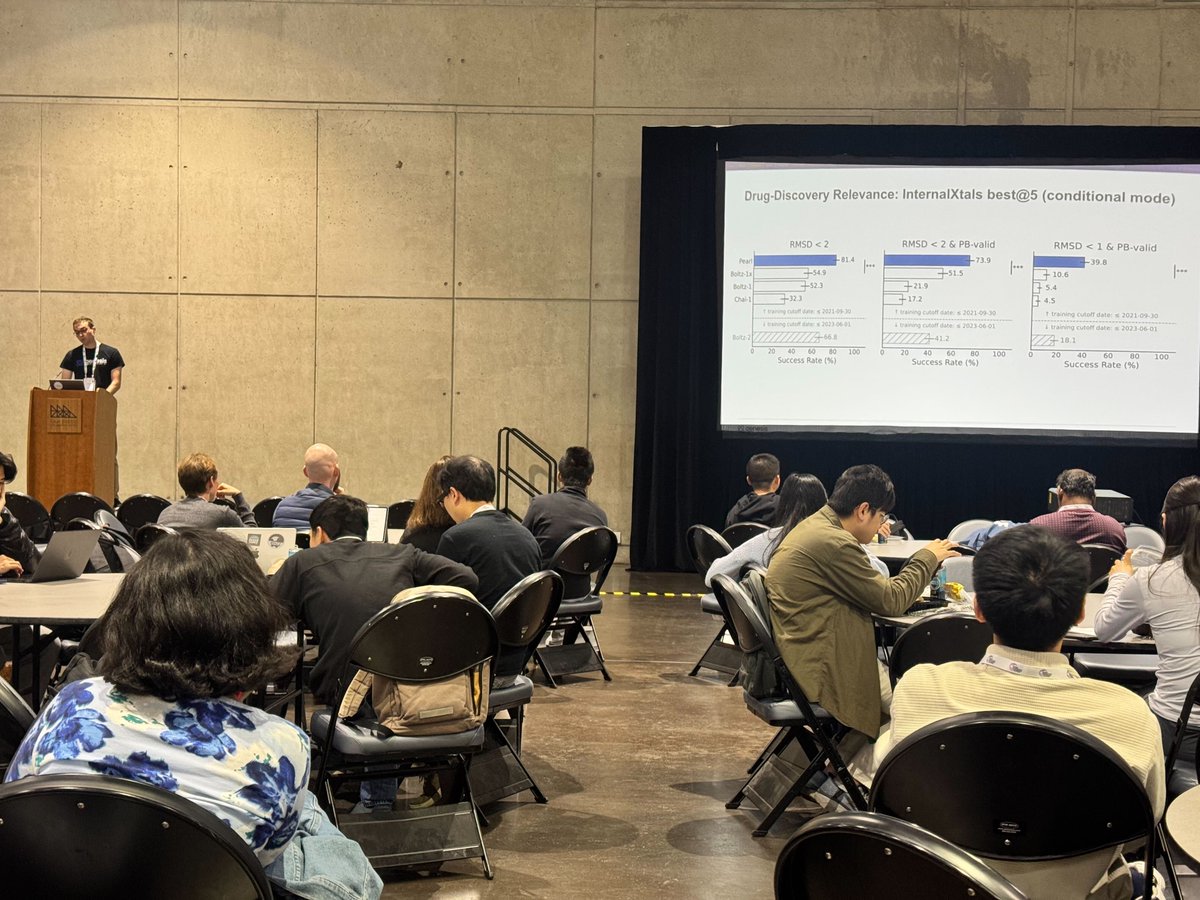
It is common in our field to report cofolding success at 2 Å RMSD. If you've sat with medicinal chemists, you know 2 Å is forgiving. At that resolution you can't reliably reason about a displaced water, a subtle scaffold hop, or which way a substituent should point. 2 Å isn’t precise enough for real drug discovery programs. So the threshold we actually care about is sub-1 Å. There, zero-shot Pearl is at 60%. The next best model is 27%, and most are in single digits. At Genesis we put a lot of effort into making sure our predictions are not just directionally correct, but are practically useful.
1
4
547
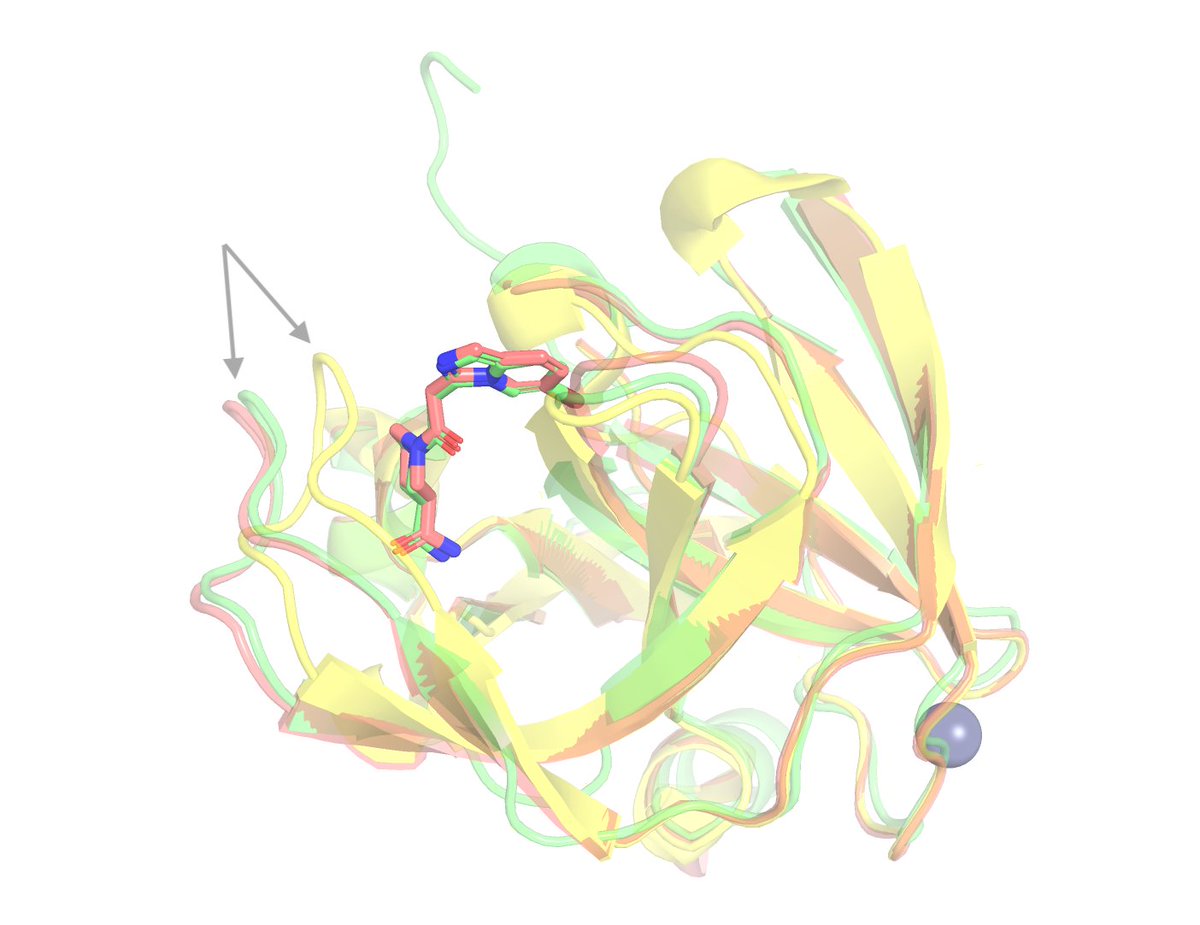
Most docking and cofolding methods assume the protein pocket is roughly fixed: place the ligand into a shape that's already there. That assumption breaks on a lot of real targets, and EV-A71 2A protease is a clear example. When a ligand binds, a loop next to the site moves about 4 Å. Every one of the 802 structures in OpenBind's benchmark needs that rearrangement, which is why classical docking into the unbound structure has only 5% success rate. Turns out, the real problem isn't "where does the ligand needs to go" it's "what shape does the protein become when this specific ligand shows up." Ligand and protein are coupled, and you have to solve them together. Pearl predicts that motion from sequence and the ligand alone. On one compound that no other zero-shot method in the benchmark solves, it placed the ligand within 0.28 Å of the crystal structure and got the loop rearrangement right. Modeling induced fit instead of assuming a rigid pocket is a big part of why this holds up on actual programs.
5
7
41
39,116
A month ago, OpenBind released their first public structure-affinity benchmark. Our team ran the Pearl system on it, zero-shot, with no tuning for the target, and it came out ahead of every cofolding model evaluated, especially at the sub-angstrom accuracy that actually matters for drug discovery. Genuinely proud of our team here. genesis.ml/news/zero-shot-pe…
6
10
42
81,559
The meme is real: we are, in fact, building AI to discover new medicines. At @genesismolai, our foundational models are designed for drug discovery. This week's collaboration with @Incyte gives those models vast amounts of real experimental data to train on. If you want your work on things that truly matter, come build with us. We have open roles in AI research, ML Infrastructure and product. Link to apply: genesis.ml/careers/
3
597
Super excited to share that @genesismolAI’s partnership with @Incyte is expanding into one of the largest pharma-AI collaborations. For an AI researcher, the truly exciting part of this expansion is the unique data opportunity. Most pharma-AI deals are limited to small, target-specific datasets. Our expanded collaboration with Incyte takes this to the next level, greatly scaling the extent to which we are leveraging Incyte’s significant volume of internal data to train AI models for drug discovery. Proud to be part of this collaboration and excited to work together with our partners at @Incyte to train the next generation molecular foundation models and unlock the next era of innovation for drug discovery 🚀🚀🚀
Our AI partnership with @Incyte has taken a major step forward and is now one of the most ambitious AI-pharma collaborations. Here's how the partnership is growing: ➡️ $120M upfront consideration ($80M cash $40M equity investment in Genesis), plus recurring research funding, potentially up to several billion dollars in contingent milestone payments, and royalties ➡️ Incyte's proprietary experimental data will help train the next generation of foundation models in GEMS (Genesis Exploration of Molecular Space) ➡️ At least five new collaboration targets, with options for more AI for drug discovery just hit a new milestone. By pairing our AI platform with Incyte’s best-in-class drug development engine and proprietary data, we’re building a flywheel to accelerate the discovery of novel medicines, helping us get new drugs to patients who need them. Full announcement: businesswire.com/news/home/2…
2
2
8
1,427
Great to join @Biocom #ConvergeSummit last week for a panel on AI’s role in drug discovery alongside @ECratsenburg, @nouradaadaa, and moderator @brogoz. Drug discovery is where I see AI’s biggest near-term impact, and it’s exactly what we’re building at @genesismolai, translating computational predictions into validated drug candidates.
4
786
Attending @iclr_conf in Rio de Janeiro? Please come to meet @genesismolai team, sign up for a coffee chat with our team, join workshop or find us at a poster session
We’re looking forward to @iclr_conf in Rio de Janeiro. ➡️ Our Staff ML Research Scientist Pranav Murugan and former Genesis intern @zhang_ouyang, now a postdoc at MIT, will present findings from our Pairmixer biomolecular structure prediction model as a poster on Sat, Apr 25. More details: iclr.cc/virtual/2026/poster/…. We’ve also released the accompanying open-source model weights - check it out: github.com/genesistherapeuti…. ➡️ Our ML Research Scientist @RBoiarsky is co-organizing the Learning Meaningful Representations of Life (LMRL) Workshop on Mon, Apr 27: lmrl.org/ ➡️ Sign up for a coffee chat with a member of our team to learn more about our open roles in ML research: jobs.ashbyhq.com/genesis-mol… Hope to see you there!
5
528
Looking forward to discussing AI in drug discovery and the parallels and differences between scaling LLMs and molecular AI foundation models.
This Thursday, our CTO @edunov will speak at the @Biocom #ConvergeSummit on how AI is reshaping drug discovery and biotech. If you’re attending, be sure to join the panel discussion at 9:05am PT. Learn more about the program here: biocom.org/conferences/conve…
5
414
Proud to be part of this team that’s pushing the frontiers of AI drug discovery with our Pearl model. Excited to scale this model to uncover new discoveries, powered by our friends at @NVIDIAHealth
⚡Sparked by innovation, powered by collaboration At #JPM2026, Jensen honored leaders who are redefining the boundaries of science with cutting‑edge AI. Congratulations @alexrives, @biogerontology, @BrianHie, @RecursionChris, @enfeinberg , @GabriCorso, @glen_gowers, @joshim5, @maxjaderberg, Najat Khan, @saakohl, @tfmiller3, and @zwcarpenter.
1
3
912
Woot 🥳 that was fun!
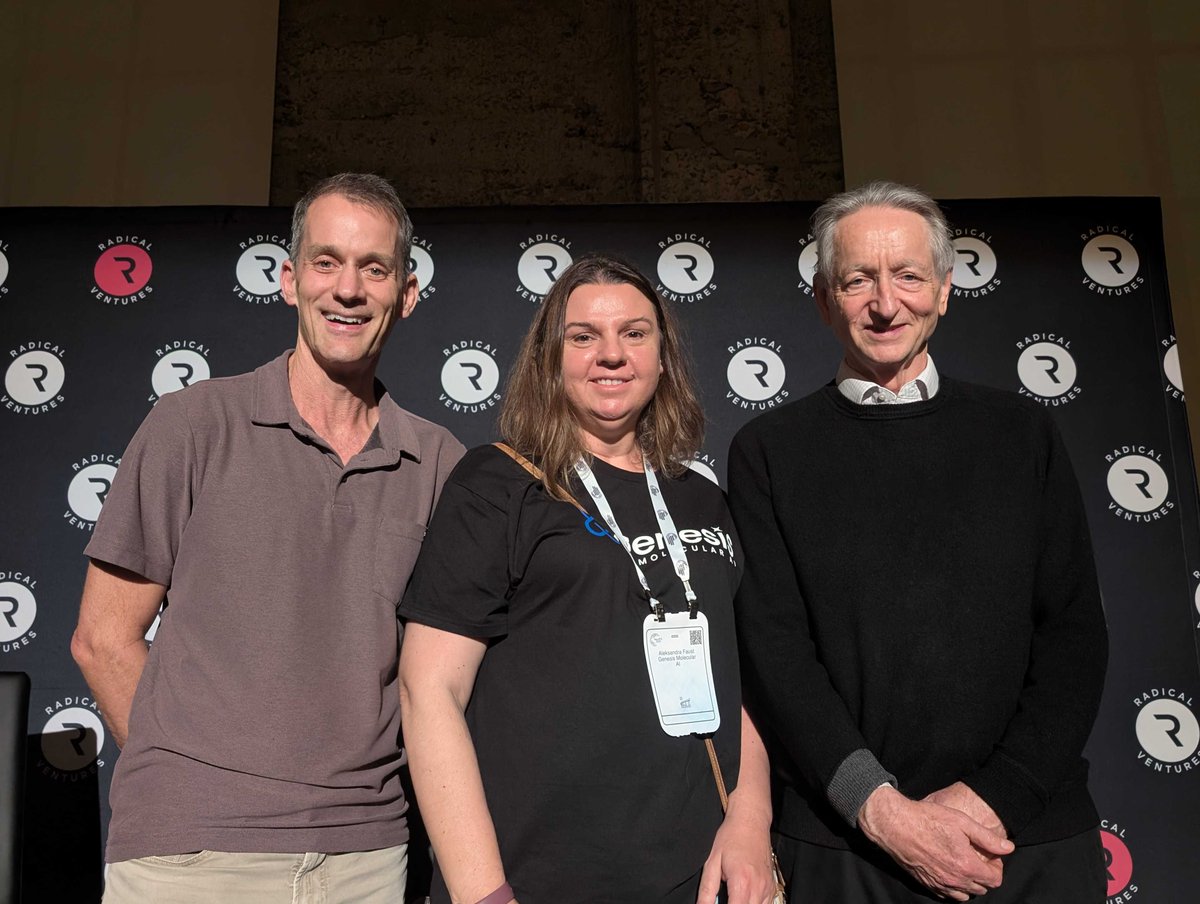
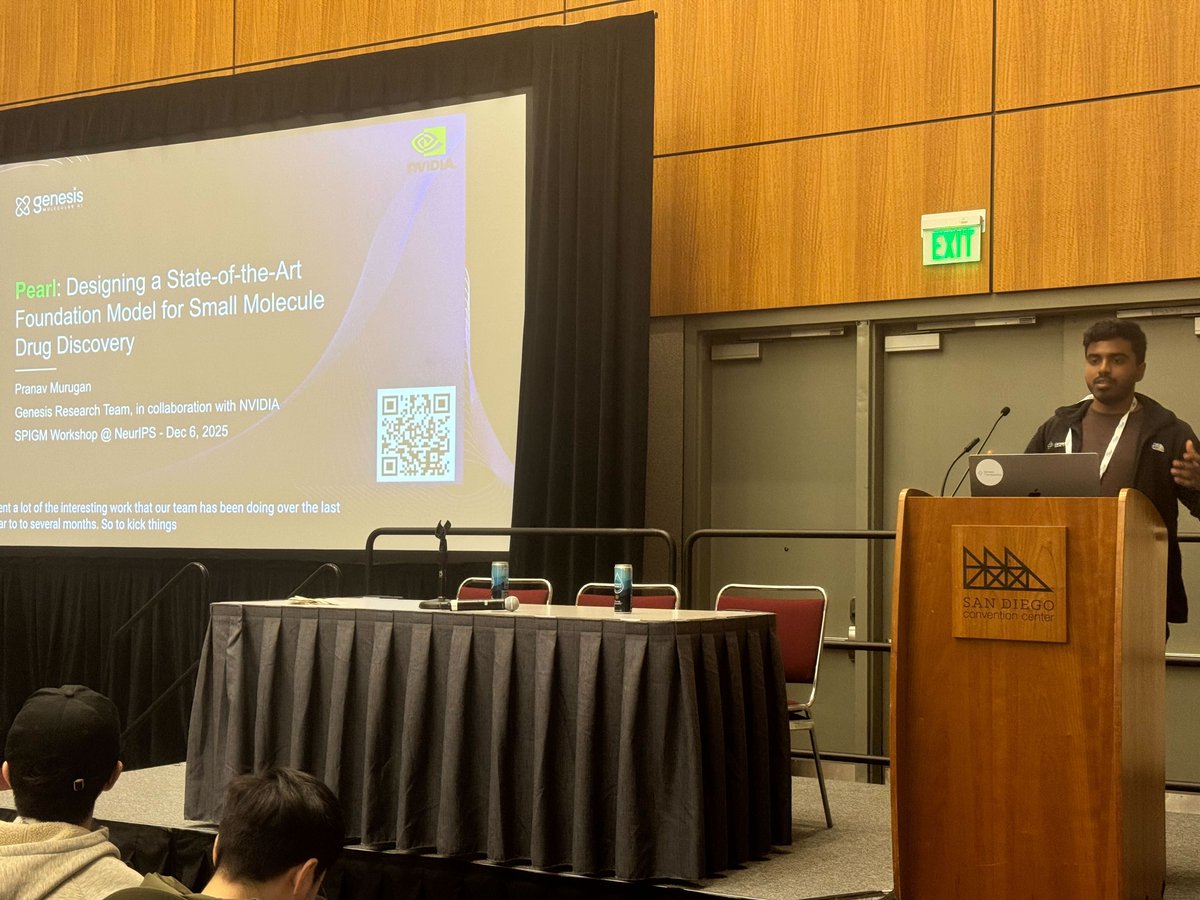
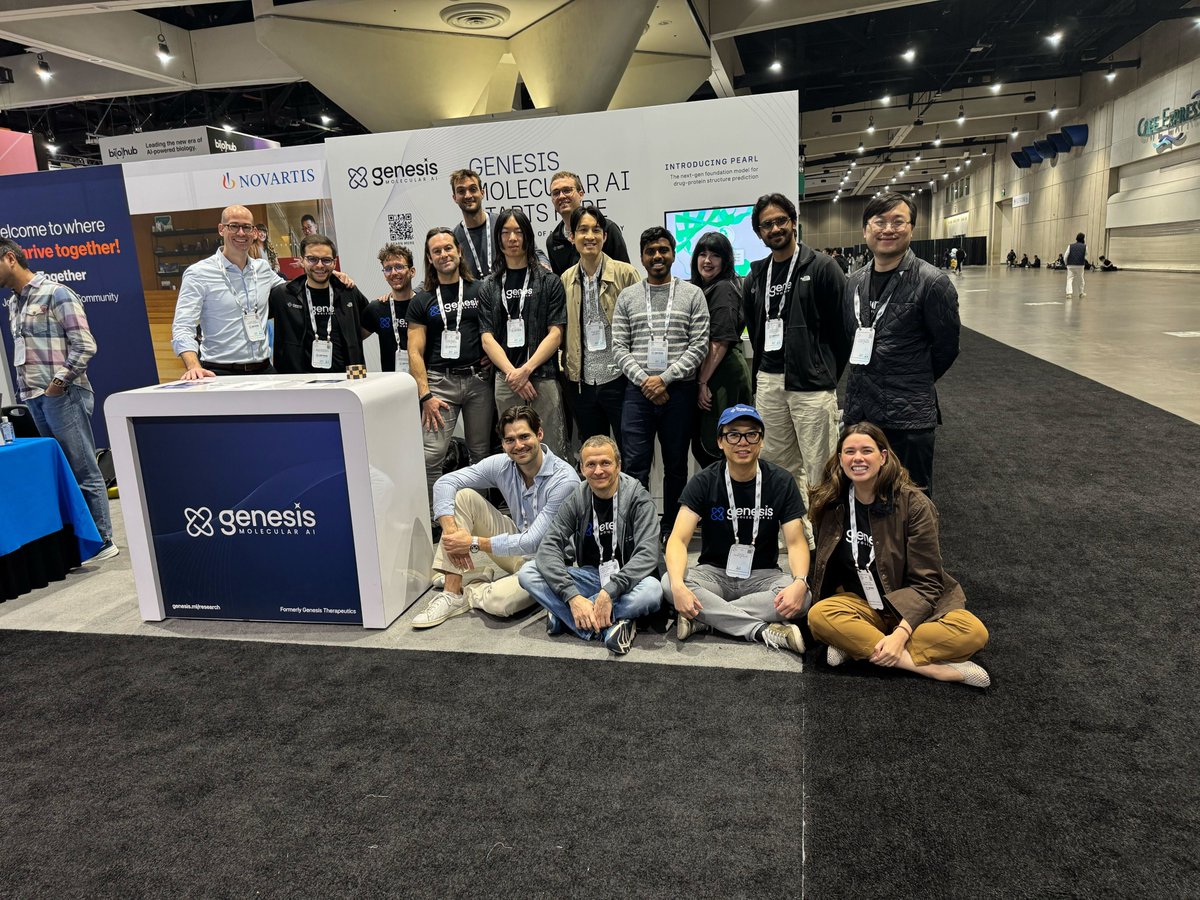
Great time at #NeurIPS2025 connecting with the broader ML community and sharing our latest work on foundation models in molecular AI. We were excited to have 20 members of our team onsite, contributing across talks, workshops, and demos – including @KenLeidal’s presentation on Pearl, our state-of-the-art co-folding model, and a poster from @zhang_ouyang and Pranav Murugan highlighting Pairmixer, our latest open source contribution. Thank you to everyone who stopped by to connect and attended our sessions. If you missed us at NeurIPS, visit our website to learn more about what we’re building at Genesis: genesis.ml/research/
1
3
1,048