Independent Technologist | Global B2B Thought Leader & Influencer | Advancing Human-Centered AI & Digital Transformation

Joined December 2015
22,439 Photos and videos
Pinned Post
Many people think of AI as the train. In reality, AI is the railway. The real shift is the infrastructure being built today: compute, energy, talent, and digital stack. Countries that invest in this infrastructure will shape the future of AI. My conversation with @BCG at MWC.
22
86
133
31,441
Digital transformation can create efficiency, but it can also hide costs that do not appear in financial reports. Faster systems may reduce control, flexibility, and understanding if trade-offs are not measured. Microblog by @antgrasso about #DigitalStrategy #Leadership The issue appears when organizations optimize for speed without checking what they lose along the way. Automation can reduce direct oversight. Standard processes can make local adaptation harder. Scaling digital systems can increase coordination effort if processes are not simplified. Platform dependency can limit autonomy when critical operations rely too much on external systems. These risks can be mitigated by measuring non-financial effects, keeping human review where decisions carry consequences, and designing systems that remain flexible as the organization grows.
1
12
343
Antonio Grasso reposted
Your data may be wrong, outdated, manipulated, or incomplete. Trusting it without continuous verification can turn business intelligence into business risk. Modern organizations cannot assume that data is reliable just because it is stored in a system. Microblog by @antgrasso Data integrity needs continuous checks, real-time anomaly monitoring, and clear visibility across processes. Access to critical systems must be controlled because weak identity rules can expose sensitive information or allow unauthorized changes. Sources and data flows also need validation. When teams do not know where data comes from, how it moves, or who can modify it, trust becomes fragile. Cybersecurity and information integrity are no longer only IT responsibilities. They are operational requirements for every team that uses data to make decisions.
3
35
59
1,697
Antonio Grasso reposted
AI-first ventures demand new baselines for speed and output. Teams must align data, roles, and learning loops, or scaling stalls under pressure. Source @McKinsey Link mck.co/48r3mVS via @antgrasso
7
36
73
1,983
AI simulations do not tell leaders what the future will be. They help leaders explore what could happen and compare strategic options, so decisions are prepared before uncertainty turns into pressure. Microblog by @antgrasso
4
44
87
1,782
Antonio Grasso reposted
Human progress has always learned from nature. In the age of AI, we should not abandon that habit, because biological systems can still teach organizations how to adapt through local autonomy, shared rules, and continuous feedback. Microblog by @antgrasso #AdaptiveOrganizations The same logic can appear in different business situations. A local warehouse can adjust delivery priorities when demand changes, while still following shared company rules. A customer support team can solve recurring issues faster when feedback from users is visible across the organization. A manufacturing unit can adapt production when sensors show a problem, without waiting for every decision to move through headquarters. Digital systems can support this model by making rules, signals, and responsibilities clearer across distributed teams. The goal is not less control. It is better coordination, where teams act closer to reality while the organization stays aligned.
6
29
67
2,040
Digital Complexity appears when companies keep adding tools without simplifying how work flows across them. The cost is not always visible in the budget, but it appears in slower decisions, duplicated work, and lower efficiency. Microblog by @antgrasso #DigitalTransformation You can see it in daily operations. A team enters the same data in two different platforms. A manager cannot see the full process because information is spread across systems. Employees use manual workarounds because tools are only partially connected. Meetings increase because nobody has a shared view of what is happening. Over time, this creates more friction, more errors, and more effort to coordinate basic activities. The solution starts by simplifying processes, connecting critical systems, and measuring whether each tool supports real business outcomes.
6
39
74
1,727
Antonio Grasso reposted
After learning how RAG gives AI better context, the next question is how AI connects to the world around it. MCP, or Model Context Protocol, helps applications reach tools and data in a structured way, while governance defines what they can actually do. Microblog by @antgrasso RAG, or Retrieval-Augmented Generation, helped many people understand that AI needs more than a model. It needs relevant knowledge from approved sources, so the answer is grounded in the right context instead of relying only on what the model already knows. MCP moves the conversation one step further. If RAG helps AI bring knowledge into the answer, Model Context Protocol helps AI applications connect with external capabilities in a more consistent way. That connection matters because useful AI work rarely stops at generating text. An application may need to search records, check information, update a ticket, or support an operational task. MCP gives this kind of interaction a clearer structure. Governance is what keeps these connections safe. Governance is what keeps these connections safe. Permissions and usage limits define what an AI application can read or activate, so connection does not turn into uncontrolled access. In the end, RAG gives AI better context, while MCP gives AI a more structured way to act. The value comes when both are designed with clear boundaries from the start.
4
37
73
2,206
Capital is concentrating on AI while total venture declines, leaving less room for average ideas. Teams now need fast proof of value or funding disappears quickly. Source @VisualCap via @antgrasso #AI
12
45
73
2,548
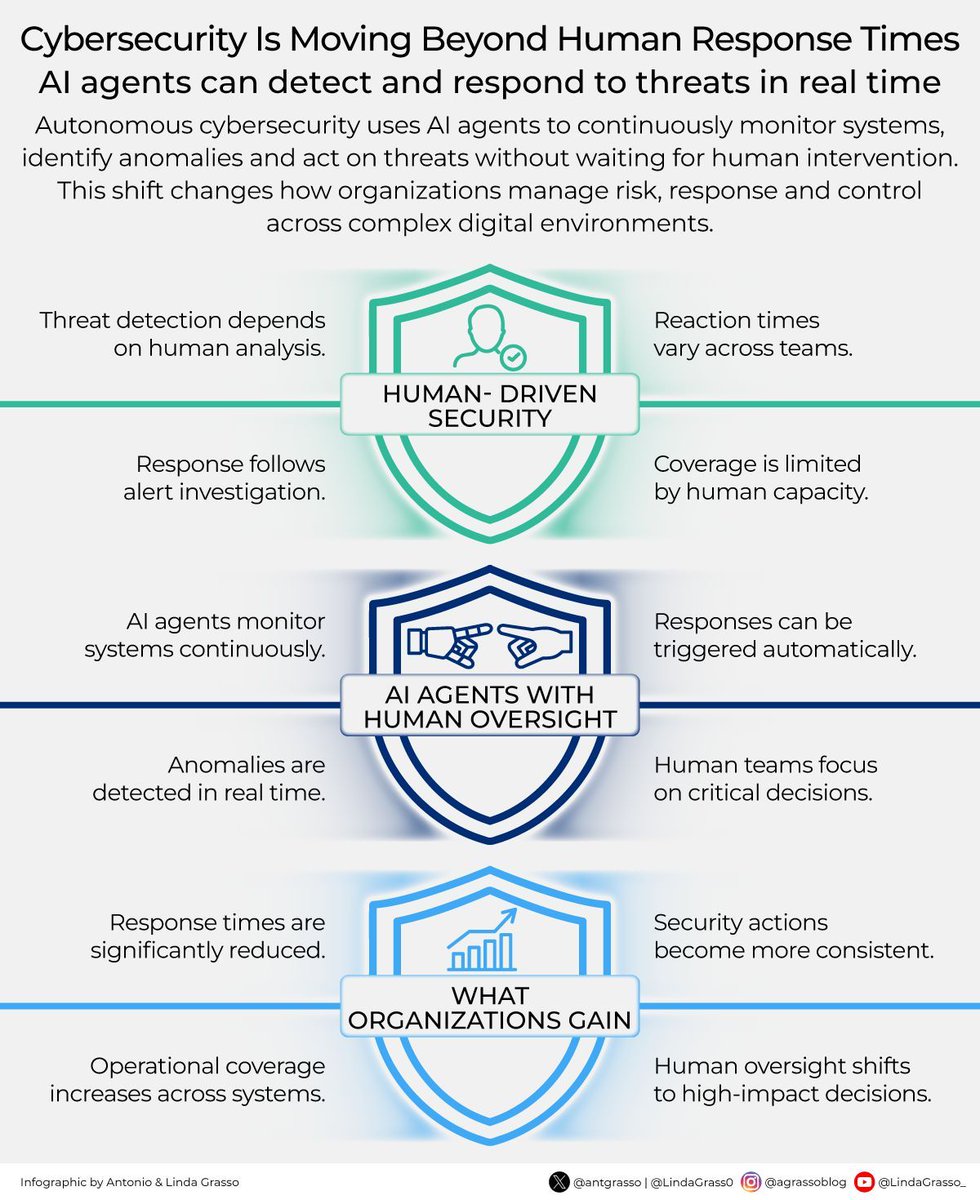
You may think your security team can respond in time, but attackers are already using automation and AI to move faster. Defensive AI agents can help close that speed gap while human oversight keeps every automated action under clear control. Microblog by @antgrasso #AiAgents The point is not to remove people from cybersecurity. It is to protect their attention and give them more time for the decisions that require judgment. AI agents can monitor systems continuously, detect anomalies earlier, and trigger controlled first responses before damage expands. Human teams should focus on the choices that carry real consequences: containment, escalation, legal exposure, business continuity, and trust. In cybersecurity, machines can handle speed, but people must keep responsibility and final control.
14
27
63
1,757
Antonio Grasso reposted
Market cap concentration is dominated by US tech giants, with Nvidia leading on AI demand and compute. Capital allocation will follow this path, forcing firms to rethink supply chains and digital investment priorities. Source @StatistaCharts via @antgrasso
3
42
80
2,518
Antonio Grasso reposted
AI agents are powerful because they can act across your business, and dangerous when nobody has designed where they must stop. This is the real difference between a chatbot and an AI agent. A chatbot mainly responds. An agent triggers actions. Microblog by @antgrasso #AIAgents That power is useful, but it also changes the risk profile of automation. Governance has to begin with boundaries. Teams need to define what an agent can do, what it must never do, and when human review is required before action. Without these limits, autonomy can quietly move from assistance to uncontrolled execution. Permissions are just as important. An agent should only access the data and tools required for its task. Broad access may look convenient at the beginning, but it can turn a useful system into a wider source of exposure. Accountability must also be named. Every agentic workflow needs human owners who can explain decisions and take responsibility when something fails. If nobody owns the outcome, the organization has not delegated work; it has hidden responsibility inside automation. Monitoring keeps agent behavior visible. Requests, tool use, exceptions, and approvals should be tracked so people can understand what happened when a result looks wrong or unexpected. The human role is most important when confidence is low or context is unclear. A well-designed agent should pause before sensitive action, because the point of governance is not to slow innovation. It is to make autonomy safe enough to use.
14
28
75
2,149
Antonio Grasso reposted
AI does not make strategy smarter by itself. It can only accelerate the quality, or the weakness, of the decisions leaders are already prepared to govern. Microblog by @antgrasso #Leadership #DecisionIntelligence
4
49
77
2,308
Antonio Grasso reposted
More digital tools do not always create more value. They can increase messages, meetings, notifications, and task tracking, while attention becomes fragmented and real outcomes remain unclear. Microblog by @antgrasso #DigitalWorkplace #Productivity
6
47
81
2,613
Antonio Grasso reposted
AI delivers the most value when it becomes part of how teams work together, not just how individuals work faster. Shared ownership, collaboration, and governance will define the next generation of AI agents. #HyperagentPartner
Mutliplayer agents are the new default. Singleplayer is fine for personal productivity, but you'll only get org-level impact if your team owns the agents together. We just added Team-owned Agents to @hyperagentapp to solve this
6
58
67
1,636
Antonio Grasso reposted
Innovation deserves recognition when teams turn technology into outcomes people can actually use. @TMobileBusiness Partner.
Some of the most important work in business happens behind the scenes. For the 5th year, the Innovate Awards are recognizing the people and projects delivering real-world impact on Oct. 19 at Gartner IT® Symposium/Xpo™. Nominate your team: t-mo.co/45PBQRn
4
34
57
2,094
Antonio Grasso reposted
Enterprise platforms converge on data, models and orchestration layers. Choices on architecture now steer how fast AI agents act across processes, so delays shift from code to coordination. Source @Gartner_inc Link gtnr.it/4tKg5vC via @antgrasso
6
50
72
2,605