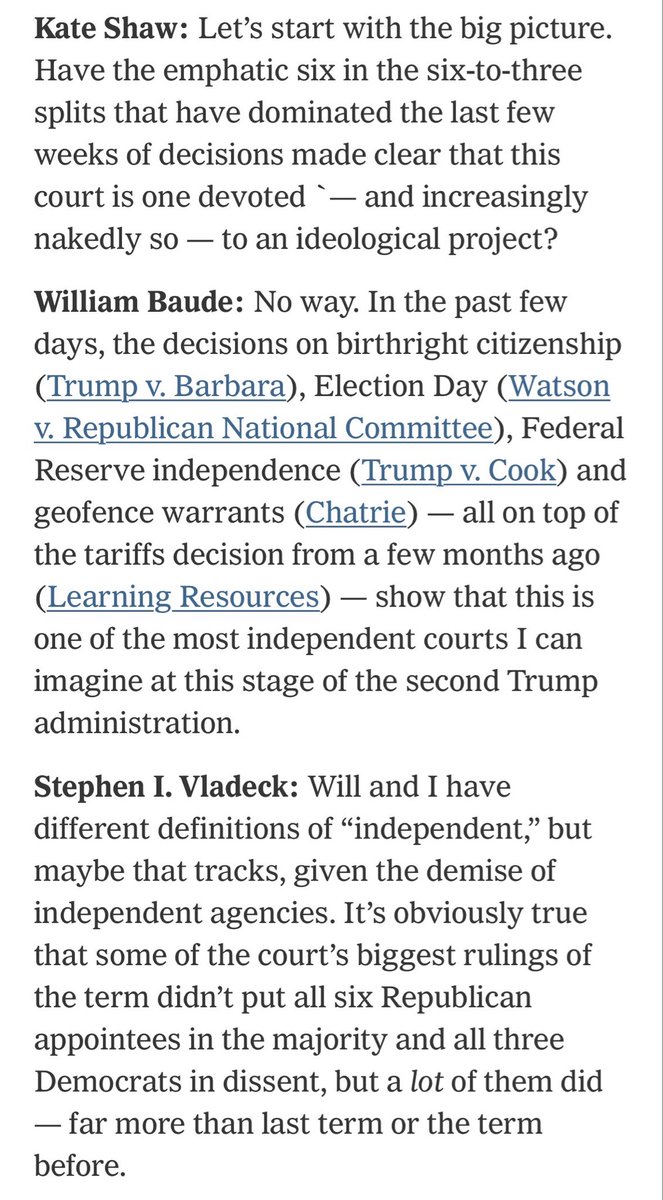
An additional wrinkle for those trying to assess the impact of the Court's actions this week on presidential control of agencies. Fascinating.
The Court’s denial of a stay on Tuesday in Blanche v. Perlmutter is interesting.
This was the case where the district court had enjoined the president’s removal of the Register of Copyrights, Shura Perlmutter. The Solicitor General sought a stay in October. He argued that the Register “is an inferior officer appointed by the Librarian of Congress, who is, despite his title, a principal executive officer—“a ‘Head of Department’ within the Executive Branch” appointed by the President and confirmed by the Senate” and that the Register was removable because she “wields executive power by exercising “significant regulatory authority over copyrights,” – impacting a wide array of crucial intellectual-property issues.”
The Court deferred ruling on the application “pending Trump v. Slaughter, No. 25-332, and Trump v. Cook, No. 25A312.”
At oral argument in Slaughter, the Chief Justice said:
“I think there are a lot of agencies in the federal government where it's hard to parse whether it's an executive function they're engaged in or a legislative function. We obviously have the Perlmutter case holding, where you do -- deal with the Library of Congress, which half of it's a library, half of it's things like the copyright. What are we supposed to do with that if you're correct?”
SG Sauer in response did not take the firm position he took in the application. Instead, he said:
“Well, Mr. Chief Justice, in Free Enterprise Fund, this Court I think very aptly stated that the vast and varied nature of the federal government is a reason not to make general pronouncements on issues that haven't been briefed and argued. There are certainly -- there are certainly situations where there are tough line-drawing problems. You raised the Perlmutter case as one that may raise arguments of that nature.”
The Chief said he was “not sure” the SG answered the question. He then asked about what the Court is supposed to do when an agency exercises some executive functions and some-non-executive functions:
“[I]s this a severance issue? Do we -- so the agency is okay so long as, you know, half of it -- half of it survives in one branch and half in the other, and if so, who gets to decide that?”
Sauer said in part:
“if there are agencies that kind of straddle the line between legislative and executive, that might present harder severability kinds of issues.”
The Chief Justice in his opinion in Slaughter did not address the status of the Register of Copyrights. He did say: “Because the FTC’s activities fall well within the heartland of executive power, we have no occasion today to define the bounds of what such power entails.” And he in footnote 3 repeated earlier formulations about severability in the removal context without addressing the problem of “agencies that kind of straddle the line between legislative and executive.” The Court also ruled that the Federal Reserve’s for-cause provision and broader independence was lawful in lights of its unique history even though (as the Court implicitly but not expressly acknowledged) it, like the Register of Copyright, exercised executive powers in addition to non-executive powers.
In this light, what does it mean that the Court—without noted dissent—declined to stay the injunction that kept Perlmutter in office? The Court stated that the denial “is not a ruling on the merits of the legal issues presented in the litigation.” But of course a stay denial is never a ruling on the merits. Did the Court mean that its decision did not reflect even a tentative assessment of likelihood of success? Despite the disclaimer, does the stay denial possibly indicate that there are not five justices who support the maximalist view of the unitary executive, as some have read Slaughter? Was the order based on a relative assessment of irreparable harm?
There is, of course, no way to know for sure, but Perlmutter is likely to stay in office for a while, which is a defeat for the President.
Thoughts welcome.