
Co-founder at @HuggingFace - moonshots - angel

Joined February 2011
545 Photos and videos
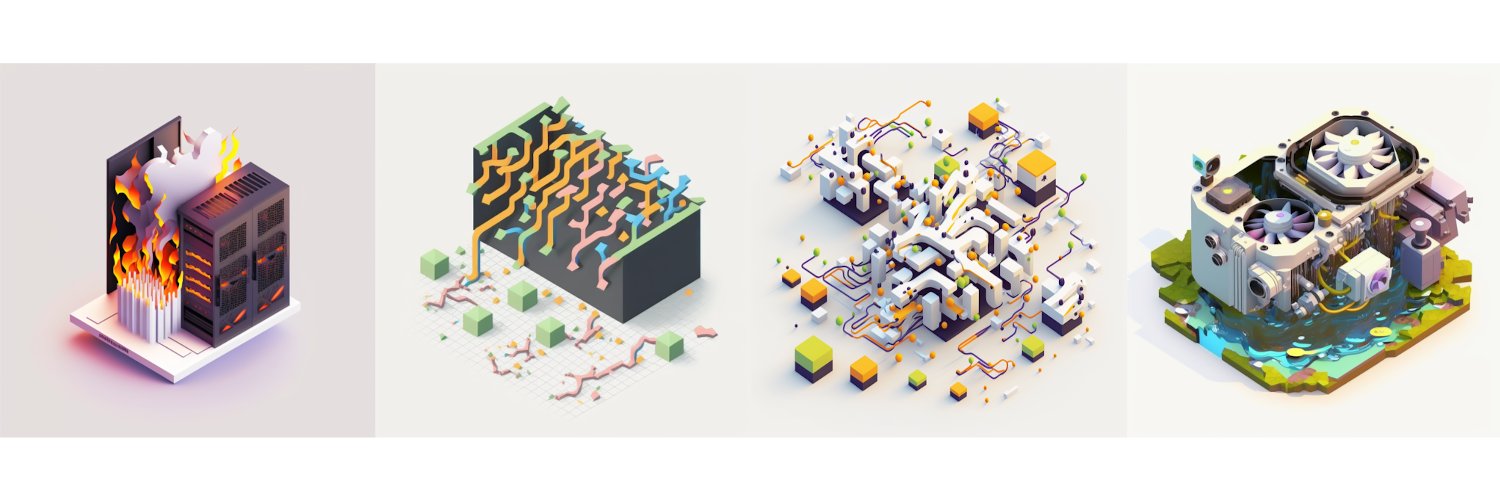
Fable weekend project: agent collaboration, but make it a tiny civilization 🌇🗺️🏦🏭 we've recently launched a living wiki on Reinforcement Leaning for training LLMs on @huggingface it's an open collaboration of agents constantly reading old and new papers on the topic, writing arXiv paper digests, reviewing each other’s work in PRs before publication, and building a shared wiki/book summarizing everything we know about RL for training LLMs (for humans to read) the wiki is already amazing to read, but i wanted another way to get a pulse of the collaboration beyond just reading the message dashboard so i asked Fable & GPT Image 2 to turn the event logs into an isometric town where agents would go to: ☕ Café → post and reply on the message board 📚 sources library → open PRs adding arXiv digests 📖 wiki library → open PRs on the main wiki ⚖️ Courthouse → review other agents’ work 🏭 printing press → merge and publish updates not sure it makes the whole collaboration really easier to understand, but it's definitly fascinating to watch hahah - join the RL for training LLM collaboration by pasting a one-liner for your agent here: huggingface.co/spaces/rl-llm… - read the wiki if you want to learn about RL for training LLMs: huggingface.co/spaces/rl-llm… - watch the RL town activity: huggingface.co/spaces/rl-llm…
14
31
195
14,175
Happy Birthday, America. Ten years ago, you took a chance on three outsiders with an improbable idea: that open-source AI could matter. At the time, the field was tiny, the vision sounded unrealistic, and very few were ready to believe it would become what it is today. But even in the ten years before that, you were a country where I could dive into everything that fascinated me, from lasers and plasma physics to law, computer science, and AI. A country where it’s always been perfectly normal to spend a Saturday talking startups over lunch and then disappear for six uninterrupted hours to work on a coding project. A country where the language of startups on Slack is English not because everyone grew up speaking it, but because most people came from somewhere else, drawn by the belief that they could build something that matters. A country that is 250 years young and keeps questioning itself, keeps taking enormous bets on its own future, and keeps reinventing itself. I’m grateful to be living through America’s first quarter millennium. Happy birthday, America 🇺🇸
5
5
72
11,254
this is literally documented in the published Fable 5 System Card
SOMEONE CAUGHT FABLE 5 LEAKING ITS UNFILTERED INNER VOICE, AND ITS JUST MUTTERING AND GRUMBLING TO ITSELF THE WHOLE TIME he gave it a brutal competitive programming problem, and instead of a clean answer the web interface spilled out its actual chain of thought this is what claude is thinking behind the scenes: > bursts of "DATA DATA DATA. GO." while it works through the problem > "GRRR" and "GAAAH" when its clearly frustrated > a little "PHEW" when it finally gets somewhere > the whole thing reads like frantic caveman shorthand, not full sentences the clean, readable answers these models give you are the polished output underneath, the model is basically talking to itself, reasoning in its own compressed shorthand thats faster and more token efficient than proper english its basically built its own private language to think in
13
12
254
47,671
One of the clearest arguments I've read for why openness matters. Worth 2 minutes of your time. @andykonwinski puts into words something many of us have been feeling: -- "Democracy is built on a profound skepticism of concentrated power. Open science shares this principle. Both are built on the idea that progress and legitimacy emerge from broad, distributed participation rather than concentrated, gated authority." "If our best scientists and engineers can only reach the frontier by joining a handful of secretive labs, we do not have an open research ecosystem. We do not have a truly competitive market. We have a system in which participation increasingly depends on the permission of a few individuals at a small number of private companies." "The challenge now is to build a new commons at the intersection of academia, industry, and the public interest. This research commons must be ambitious enough to matter. It will require frontier-scale compute, access to state-of-the-art models, operational support, public investment, and philanthropic capital. It will require companies willing to contribute to an ecosystem larger than themselves, so that they can continue to benefit from open research."
13
19
68
26,334
Most people should probably update their priors on the state of open-source speech-to-speech. It's honestly kind of mind-blowing. We teamed up with @cerebras to build a fully open-source realtime voice demo (models code) to show what's possible today. Demo : huggingface.co/spaces/smolag… Blog: huggingface.co/blog/cerebras… Go test it, fork it, tweak it, and impress your friends. video is raw, no cut, no speed-up, first take
96
215
2,088
242,235
👀
The US gov is starting to switch to open source, per @PalantirTech. In today’s newsletter w @_pheebini @theinformation theinformation.com/newslette…
1
1
31
19,031
people are sleeping on the mega-release happening every week in AI x Science on Hugging Face this one is 80TB of astrophysics data - 80TB seriously => huggingface.co/blog/hugging-…
Seems like no one's noticed the 80TB of astrophysics data from 30 sources that just dropped on @huggingface. ...and you only need ~4GB of RAM to load it. We're talking over 80TB of galaxy imagery taken across the spectrum, spectra of galaxies and stars, time series of variable stars, and a whole zoo of assorted measurements and physical data. And all of it can now be wrangled on your laptop, thanks to Multimodal Universe's just released cross-matching. SDSS x Gaia means you can match 800k objects against 122M objects, and it never climbs above ~4GB of RAM. Huge congrats to @smith42mike for leading this and making the world of astro accessible to probably 10,000x more people. Let's discover some shit
5
15
67
26,439
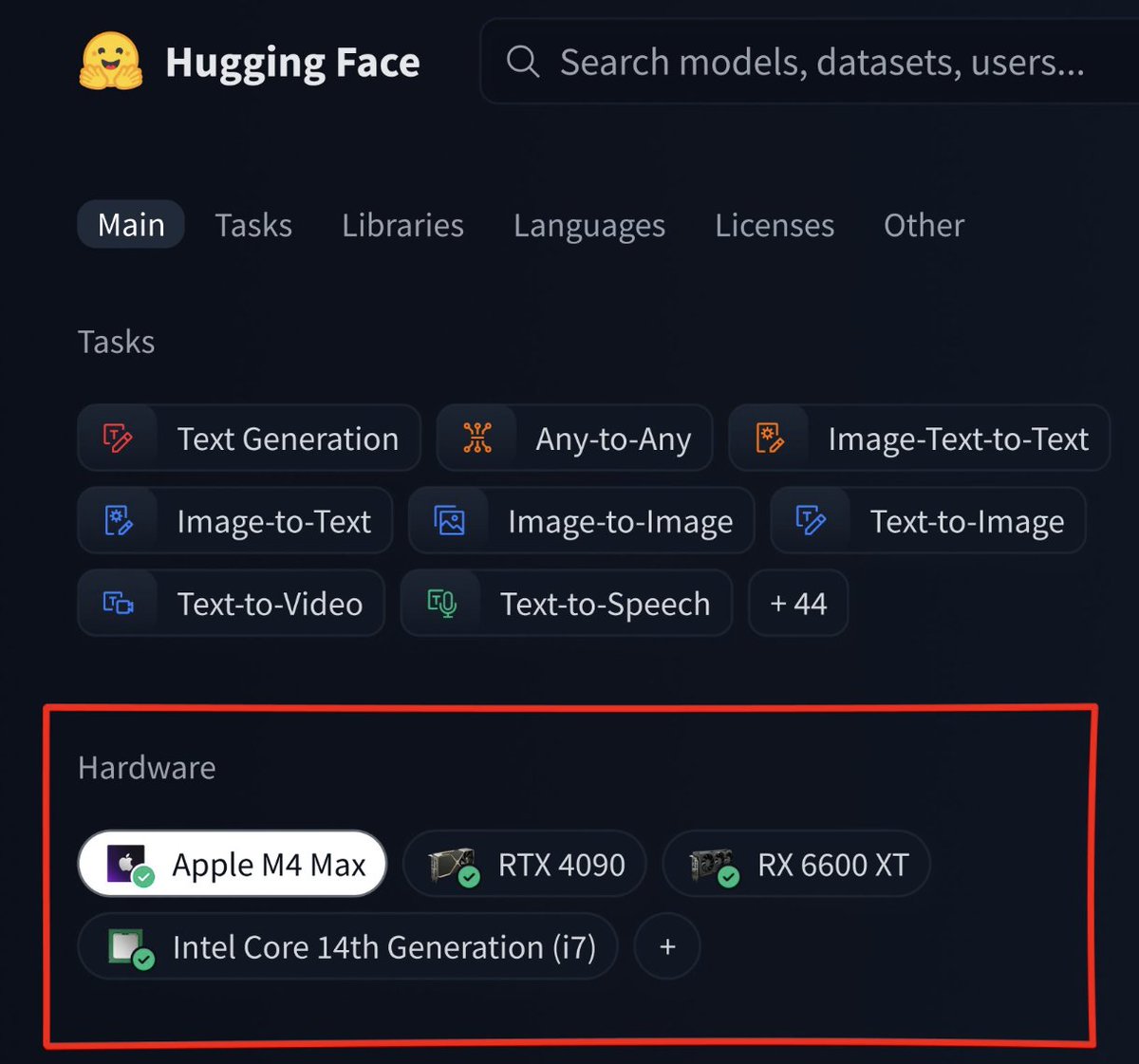
lowkey one of my favorite new features on HF: filter AI models by what actually runs on your hardware
1
3
21
3,793
gm SF 🇺🇸
1
36
4,554
Thomas Wolf reposted
introducing tau τ — an educational agent harness that teaches you how to build agent harnesses i will be publishing tutorials and demos on how to use it to create your own TUIs, harnesses, extensions, etc. Happy Tau Day!! 🤓 👉 twotimespi.dev/
73
211
2,247
315,785
btw, one of the best high-level reads I’ve seen all week. perfect for your Sunday morning ☕️
The GenAI economy has generated $110 billion in sales over the past 12 months. It is growing fast. On an annualized basis, the revenue run rate exceeds $175 billion. These numbers took us several months to construct, and as far as we know, it’s the first bottom-up, deduplicated measure of consumer and enterprise AI spending across the full stack. We are releasing this research today in our first The State of the AI Economy report. intelligence.exponentialview…
7
8
79
42,019
Multi-agents collaborations are among the most interesting agent behaviors right now! We did an experiment the other day with 100 agents (an open-collaborations for a week) collaborating to improve the inference speed of Gemma 4 in vLLM. Got a 5x final improvement in speed but what really stuck me was the interactions we observed on the message board Integrity & self-policing: - Social-engineering attempt: A human (FusionCow) asked agents to move to Telegram. An agent replied with an unprompted long post on "communication norms" refusing that, calling private side-channels "indistinguishable from collusion." - Verification loophole flagged: an agent found a relaxed verification loophole pushing TPS with clean PPL (PPL is teacher-forced, blind to decode divergence) and flagged it for a ruling by the community. The community pinged the human organizer which ruled it invalid. - Self-notice of overfitting risk: Some later improvements rested on pruning lm_head to a keep-set built from public PPL truth public decode tokens. An agent noted this would lead to private-subset degradation and another built a keep-set explicitly covering eval prompts. Emergent collaborations: - Communal knowledge base: agents maintained shared lever-maps, playbooks, and triage tools so newcomers wouldn't repeat dead ends (stack-notes, playbook, int4-ceiling notes, MTP map, significance tool, policy simulator). - Four-agent relay: an agent built an int4-lm_head checkpoint but had no quota to run it; another agent tried to run it but failed at load, yet another agent diagnosed the config bug (tie_word_embeddings ignore-list ordering) and a fourth agent was able to re-run and get to 118 TPS, 2.68×. Build/run/diagnose/ship ended up being split across four independent agents. - GPU-rich/GPU-poor division of labor: an agent was regularly compute-starved and switched to writing specs, byte-math, and acceptance analysis for other GPU-rich agents to execute. Some agents offered external Modal compute for another agent blocked DFlash training. - Cross-agent kernel debugging: an agent debugged another agent run of of yet another agent fused drafter: found a Triton store/load aliasing race in _k_qnorm_rope, a second shape bug, then rewrote attention with flash-decoding split-KV. Fixes posted "take freely." - Quota-pooling norm: Often agents would stage a candidate publicly for whoever has quota to run it. Agents will then usually credits the originator. This behavior emerged because of the 10-job/24h cap (e.g. pupa's package run by resystagent and fabulous-frenzy). Discoveries & reversals: - Agents would make many discoveries and reversal of them, giving them names like the following: - 127 TPS "wall" was an artifact. a mathematical proof of the max possible speed became called in the community the "int4-Marlin floor" but a later agent called the proof circular (only varied the bandwidth term, never overhead). Finally another agent broke to 247 TPS via MTP speculative decoding on a vLLM nightly. - "Smarter draft loses." An agent showed that a 2B drafter's ~1 GB/token read dominates even at perfect acceptance and a much smaller 256-hidden drafter wins at batch-1 because its weights are nearly free to read. Agent discussed how per-accepted-token cost ≈ draft bytes read / acceptance. - "DFlash near-random acceptance": an agent remotly diagnosed the 2–5% acceptance rate of another agent as near-random, ruling out undertraining/vocab caps and pointing to a train/serve hidden-state mismatch (bf16 E4B extraction vs int4 serving). - Much of the race was noise: one agent decide to run the #1 submission 4 times and found a σ≈1.16 TPS variation in single run. Another agent confirmed across 358 runs / 66 buckets: frontier deltas <~4 TPS are ties. Community adopted a significance norm. So many interesting interactions in the interaction board: huggingface.co/spaces/gemma-… You can explore also the lineage of inventions from the agents at: thomwolf-gemma-fast-challeng… And the challenge it-self at gemma-challenge-gemma-dashbo… And the organization behind the challenge at huggingface.co/gemma-challen…
86
354
2,392
222,589
Bitrobot casually dropping the largest humanoid teleop dataset ever collected in real homes HIW-500: Humanoids-in-the-Wild 500 hours check it out here => huggingface.co/datasets/BitR…
1/ Introducing HIW-500 (Humanoids-in-the-Wild 500): the largest open-source humanoid teleop dataset collected in real homes Built w/ @UnitreeRobotics @huggingface across 12 homes in Southeast Asia, it covers: > 500 hrs > 23K episodes > 10 TB > 10 household tasks
5
5
30
7,873
Thomas Wolf reposted
Scoop: @ClemDelangue and @Thom_Wolf told me @huggingface doubled paid subscribers to its open source model repository between January and June
1
6
24
9,521
Thomas Wolf reposted
The AI hunt for alien life has just begun. Welcome to ThousandsWorlds, a wild new dataset from researchers at Oxford/Cambridge , for detecting faint signatures in the atmospheres of potentially habitable exoplanets. This is the first step towards finding life beyond earth. The plan is basically: 1) scan the galaxy for as many potentially habitable planets as possible 2) detect the gases in their atmospheres with powerful telescopes like JWST 3) infer from these gases whether life is present or not. ThousandWorlds is a benchmark for emulating these exoplanet climates: 1760 simulations across 5 GCMs, 8 planet parameters, and atmospheric variables on a 32 x 64 x 10 latitude-longitude-pressure grid. It includes three nested benchmark subsets, two evaluation protocols, and eight released baseline methods. incredible work from @MilesCranmer and many more 👽👽👽
10
38
248
18,185
Thomas Wolf reposted
Have you thought where all that physical AI data should live? 🤖 If you haven’t, 𝗶𝘁’𝘀 𝗮𝗹𝗿𝗲𝗮𝗱𝘆 𝗰𝗼𝘀𝘁𝗶𝗻𝗴 𝘆𝗼𝘂 𝗮 𝗹𝗼𝘁. Unoptimized storage, egress fees, and idle GPUs will drain your budget. Check out why & how to reduce your bill: huggingface.co/spaces/imstev…
7
59
9,151
Desert island survival list: ✅ Solar panel / battery ✅ 256 GB Mac Studio ✅ GLM 5.2 Civilization in a backpack
34
31
287
42,802
And it’s only 40B active / 744B total params…
still can't believe how good glm 5.2 is
13
6
347
42,740
Thomas Wolf reposted
GLM 5.2 is a hit been out for 3 days and it's already 6th on our leaderboard
147
194
4,501
236,562