
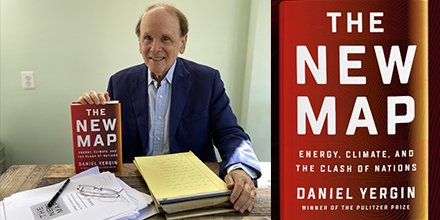
From its beginnings writing longhand on dozens of legal pads, to innumerable manuscripts and now the finished product, I am so pleased to share my latest book, #TheNewMap (bit.ly/3fawpiD) out today from @penguinpress.
Oil markets continue to assess what the shape of a new normal in the Strait of Hormuz will look like, including the re-entry of unsanctioned Iranian crude into the market. My talk w/ @SquawkCNBC@BeckyQuick👇
Gasoline prices bring world affairs to the wallet like little else. When Americans fill up at the pump this summer, they are looking at the Strait of Hormuz, their country’s role in the world and the changes in global politics. My latest essay for @TIME: time.com/article/2026/06/20/…
As U.S.-Iran talks show little sign of progress, commercial traffic through the Strait of Hormuz remains sharply reduced, raising concerns about global energy markets and supply chains.
@GeoffRBennett speaks to Daniel Yergin, vice chairman of S&P Global, about what a prolonged disruption might mean.
Appreciated unpacking my new WSJ column w/ @SullyCNBC. The global energy system is far more diversified than the 1970s. That (plus US & China inventories) have so far mitigated a potentially catastrophic energy shock. But peak summer season shaping up to be a critical juncture.👇
My new @WSJ column: The closure of the Strait of Hormuz has revealed how much has been learned about energy security since the 1970s oil crises. The global energy system is far more diversified now, mitigating (so far, at least) what could have been a catastrophic energy shock.👇
My recent dialogue w/ Bridgewater Associates on how the Iran war and the race for AI are reshaping the global energy map (and the global economy) in a world where capital intensity, strategic competition and security concerns are rebalancing priorities. Listen 👇
The Strait of Hormuz closure has taken a combined 1.2 billion barrels out of the oil market so far. Inventories that have (somewhat) cushioned the blow are now getting low. My talk w/ @andrewrsorkin@SquawkCNBC on what lies ahead. cnbc.com/video/2026/05/18/we…
With the closure of the Strait of Hormuz now into its 3rd month, I sat down for a wide-ranging discussion with @ProfGMarkets on the reverberations from the largest disruption in history of oil markets, and where we go from here. @edels0n@profgalloway
Watch/Listen 👇
The nightmare scenario for oil markets (closing the Strait of Hormuz) is now seeing daylight. So far, most acute impacts vary across different regions and markets. But they are spreading. My in-depth talk w/ @WalterIsaacson & @AmanpourCoPBSyoutube.com/watch?v=hbp2iO7m…
World events have thrust energy security & diversification of supply to top of the global agenda. My talk about the issues that will be in sharp focus when global energy leaders gather for our @CERAWeek conference next week. @CNBC@PowerLunchcnbc.com/video/2026/03/16/ir…
The global oil and gas system is more resilient and diversified than it has been for decades.
On other hand, nothing compares to the scale of current disruption in the Middle East.
Much depends on the duration of the conflict.
My talk w/ @businessbloomberg.com/news/videos/20…
The war in Iran has caused the biggest disruption in oil production in history. Whether it becomes the long-feared “nightmare scenario” for energy markets (and the global economy) now depends on the duration of the conflict. My @FT column: ft.com/content/5a74c0f8-1cf2…
Expectations of a possible US strike on Iran—currently oscillating between wait-and-see and watchful anticipation—have introduced a risk premium into an otherwise well-supplied oil market. My talk w/ @KellyCNBC@CNBCTheExchangecnbc.com/video/2026/02/19/oi…
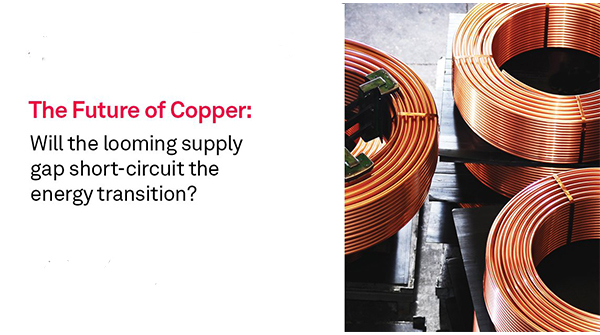
The world will need 50% more copper by 2040. Big question whether supply can keep up w/ accelerating demand from electrification, AI, defense and more. My talk w/ @CNBC@KellyCNBC about our major new @SPGlobal study. cnbc.com/video/2026/01/08/wo…