When I started @cortexa_labs with @shreyasmav, I had an ideal future in mind:
Automate the scut work. Allowing people to pursue their curiosity. Focusing on new problems that accelerates our civilization.
A “curiosity-driven economy.”
Such an exciting future. Like Minecraft!
At some point, we all need to pause and reflect on what initially sparked our journey.
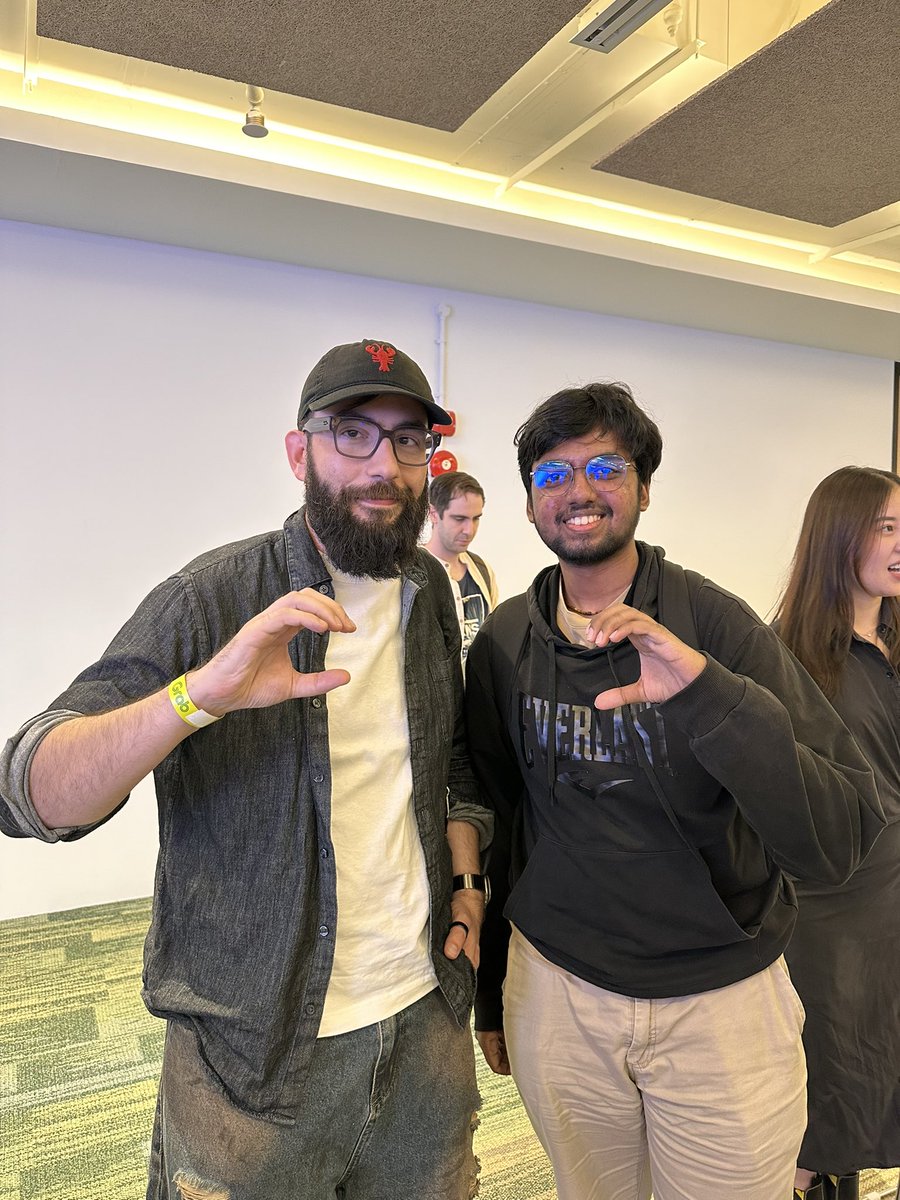
@sabeer was definitely one of the big reasons why I started @cortexa_labs along with @CharanCodex . @fdotinc OffSeason 2 has been paying me back in experience dividends so far 😊
Met the man himself @vincent_koc . Learnt a lot from his talk today and I was blown away when he showed how he used OpenClaw. Definitely gonna implement it on my stack. Even throw in some ideas of mine and modify em a lil.
Hope to learn more from him in the future 🫡 🦞🦞
how does the brain build and track an internal state of the world from (possibly incomplete and noisy) visual observations?
i believe visual state tracking will be the grand challenge for vision in the coming years, and i hope this benchmark can be a useful starting line. enjoy!
Can MLLMs actually track what's happening in a video?
Introducing VSTAT 🎯, our new benchmark for visual state tracking.
The tasks are simple: count cups, read typed words, count page flips. Humans solve them easily. MLLMs don't.
vision-x-nyu.github.io/vstat…
🧵 [1/11]
Project Sentry: Underway
Analyses your repo, finds security vulnerabilities (data, inference, prompting, tooling) in your agents and if given the green light it fixes them and does a PR
Word on the street is @cortexa_labs is looking for interns:
1. AIML Engineers
2. GTM/Growth Engineers
3. Content and Social Media
DM @cortexa_labs and apply to their career page cortexa-labs.ai/careers
Recently spoke with the engineers at OpenAI’s engineering side. They are shutting down public fine-tuning access via API soon.
If your startup is deeply dependent on proprietary models, it’s time to shift:
- open-source models
- self-hosting
- hybrid inference stacks
This episode features an interview with Yao Shunyu @ShunyuYao14 , Research Scientist at Google DeepMind. Yao has held research scientist roles at both Anthropic and Google DeepMind, contributing to the development of key models including Claude 3.7, 4.5, and Gemini 3.
Yao Shunyu is not your typical nerd. Every now and then, he’ll catch you off guard with a flash of irreverence.
“None of the old guard are your relatives — so if you think someone’s being dumb, they’re just being dumb. Say it. No big deal.” (laughs)
“Everyone’s a surfer now, but what really matters is the wave — not the person riding it.”
“AI doesn’t actually require that much brainpower — I mean it genuinely doesn’t — most of this is work any undergrad could do. The most important quality in this industry is reliability: being meticulous, and taking responsibility for what you put out.”
“You don’t need to worry too much about ruffling feathers with your opinions. As long as your views are internally consistent — not just taking random shots at people, but grounded in your own genuine understanding — there are objective standards for how you’re doing in this field. People will respect you for it.”
Let us have a little fun with this one! 😄
youtu.be/ttkd0t5qTD4?si=0uFT…
Such an inspiring moment. And the most inspiring person. I envision and dream to see Cortexa Labs making a difference like he is. I had goosebumps when I saw the documentary.
New Anthropic research: Natural Language Autoencoders.
Models like Claude talk in words but think in numbers. The numbers—called activations—encode Claude’s thoughts, but not in a language we can read.
Here, we train Claude to translate its activations into human-readable text.
Neural networks might speak English, but they think in shapes.
Understanding their rich *neural geometry* is key to understanding how they work – and to debugging and controlling them with precision.
Starting today, we’re releasing a series of posts on this research agenda. 🧵