Partner @sequoia. Working w/ founders from idea to IPO & beyond: @airbnb @doordash @citsecurities @kalshi @clay @foundforbiz @Nominal_io @zipline

Joined March 2008
131 Photos and videos
Pinned Post
x.com/i/article/207333322149…
12
9
204
15,303
"Underneath the statute is a belief, the one that strung the wire and funded the labs and put men on the moon: that building hard things at scale is worth doing, and that this is the country that does them. The American method was never the state alone or the market alone. The wire reached the farms because federal credit met local cooperatives that did the stringing. Apollo was a government program executed by four hundred thousand people who mostly worked for contractors. Warp Speed was public money and private molecules. Public purpose set the pace and wrote the check. Private ingenuity built the thing. Deep capital markets funded the improbable. A bankruptcy code cleared failure fast. Immigration imported a century of talent. The answer to a rival that builds by command isn’t to become one. It’s to run the harness again, by choice this time."
2
40
11,196
Alfred Lin reposted
Our intern just built the first zero-person company. Listen's agent ran a loop: - Interview users - Build - Test with real people - Fix issues - Repeat 2,000 interviews and 100 concepts later: an app with 100s of paying customers. Here’s how it works:
100
66
935
551,473
If your company doesn't have a GEO strategy yet, it's time.
Today, @tryprofound is launching Aim, the first background agent purpose-built for marketers. For months, we've been obsessed with one problem: dashboards tell you what's happening, but not how to act on the data. Aim is the agent harness designed specifically for marketing. Aim is trained from scratch on Profound's proprietary data, grounded in our research, and understands how marketers get work done. Aim analyzes your AI Search data, Prompt Volumes, competitive insights, and Knowledge Base to surface the opportunities worth acting on. It finds the anomalies that matter so you can spend your time on what moves the needle. Every Project comes with a data-backed brief and recommended tasks. From there, you can: • Chat with Aim to refine the plan • Deploy the custom Agent in one click • Track progress automatically Aim is your newest teammate keeping you moving in the right direction, working 24/7.
4
7
87
34,855
There is a reason that advice is free. It worked for the person asked, but that advice is unlikely to work for us. Our situation is different. The world has moved forward. New solutions developed, and new challenges are present. What has worked in the past is unlikely to work precisely in the future.
16
5
137
17,524
The business world is humbling, and there are few hard and fast rules. If you are not willing to admit that you're wrong and correct your mistakes daily, you won't get very far.
22
20
403
202,785
Alfred Lin reposted
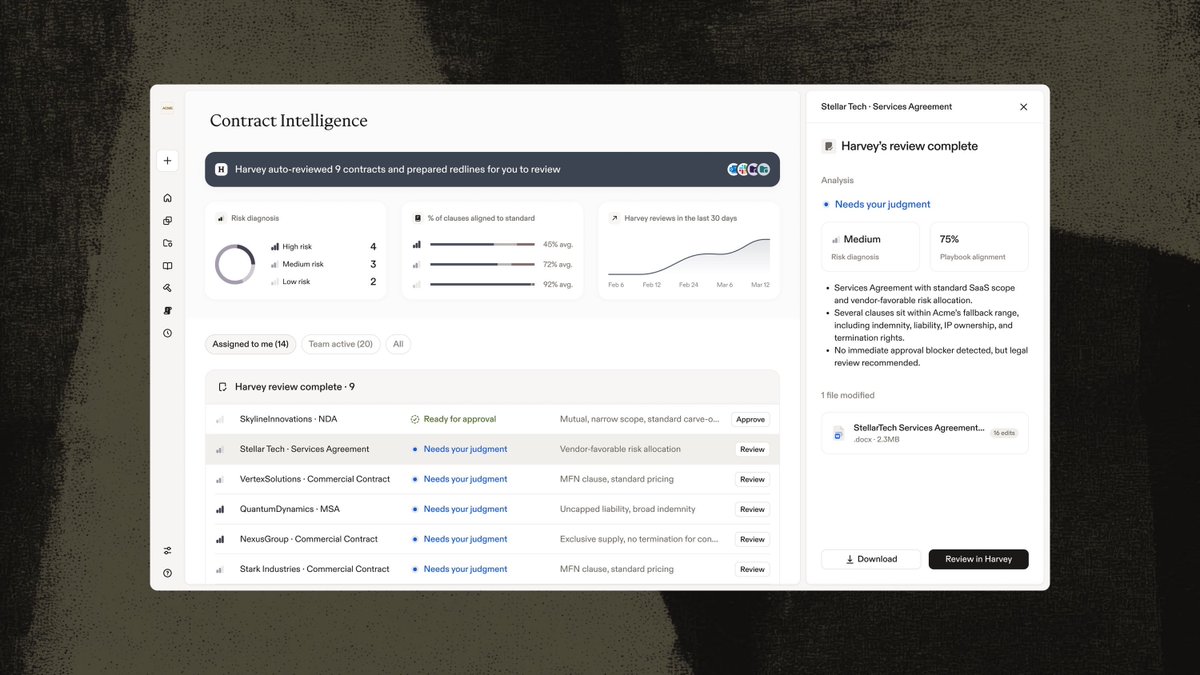
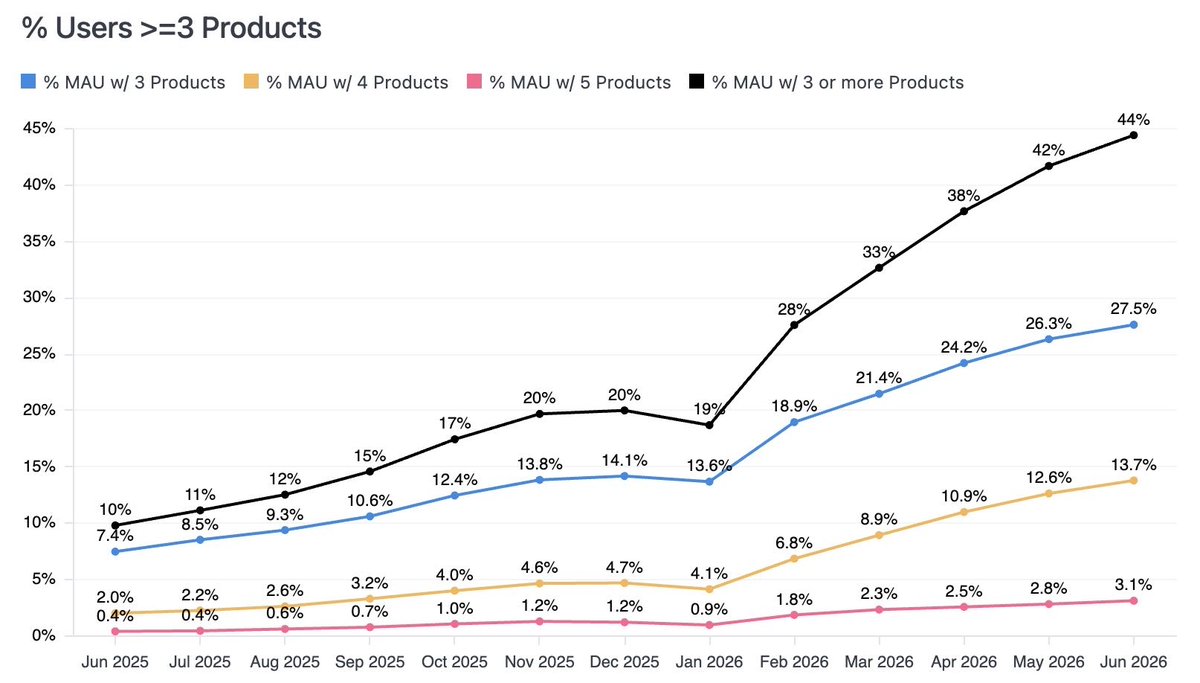
Q2 recap for @harvey - $100M NNARR - 53% DAU/MAU Key hires (including Q1) - Anique (CPO) - prev VP of Product at Rippling - Rachel (CMO) - prev CMO at Notion - Brooks (CISO) - prev CISO at Roblox - Keith (CSO) - prev CPO at Google Product - Agent unification - cloud agents can use all Harvey product surfaces - Command center (EA) - monitor adoption and ROI by use case - Contract intelligence (EA) - agentic contracting platform for enterprises Eng - Migration to cloud agent infrastructure - Integrating open source inference providers - Scaling document processing (54TB / week) AI - Legal Agent Bench - Open source post training - Published multiple research directions with partners We invested heavily in cloud agent infrastructure at the end of last year and in Q1. In Q2 we also unified many of our product surfaces (collapsed as @winstonweinberg says) by making them all tools accessible by our cloud agents. Prior to this, there were a lot of capabilities in Harvey that were often only discovered by power users. As cloud agents get better and our product becomes more connected we are seeing users discover more of the product by learning from their agents (see plot of product surfaces per user).
36
45
409
246,637
What we learned from the DeepSeek R1 moment, that also applies to GLM-5.2, and will apply to others in the future: Limits push you to get creative - Not having enough, whether it's chips, money, or time, forces clever solutions that you'd never find when you have plenty. So treat limits as a reason to invent, not a problem to fix. When you're stuck, try the opposite of what feels natural: cut the budget, shorten the deadline, or raise the bar instead of adding more. The big surprises are usually predictable - When a model is improving fast, that speed is the clue. Strong results aren't a shock; they're just where the trend was already heading. People come around to new ideas slowly, so if you pay attention and form a view early, you can get ahead before everyone else catches on. Don't write off huge leaps as cheating or fake - When a competitor jumps way ahead, the easy reaction is to assume they cut corners or made up the numbers. Maybe some of that is true, but there's almost always real innovation behind it. Better to assume they genuinely beat you at something and figure out what you can learn.
10
8
76
14,355
Alfred Lin reposted
Very excited to see this new effort from Stripe, Visa, Coinbase, Mastercard, Amex, Blackrock, and many others to build a new open stablecoin that shares economics back to users and distributors. OpenUSD will be natively issued on Tempo on day 1!
Introducing Open USD: a stablecoin built for the internet economy, designed by the businesses growing it. joinopenstandard.com/blog/in…
34
26
531
93,146
Alfred Lin reposted
Palmer gets it: If you're going to say something everyone agrees with, you might as well have said nothing at all. You're not going to build a following of people who say, "I just love his right-down-the-middle, very hedged takes that everyone agrees with." If some people love what you're saying and some people hate what you're saying, that's a lot better than having everybody lukewarm agree with you. Don't waste time communicating about what everyone already agrees on. Focus on the things where you need to change their mind.
If you are going to say something, SAY something!
40
73
1,399
247,273
Alfred Lin reposted
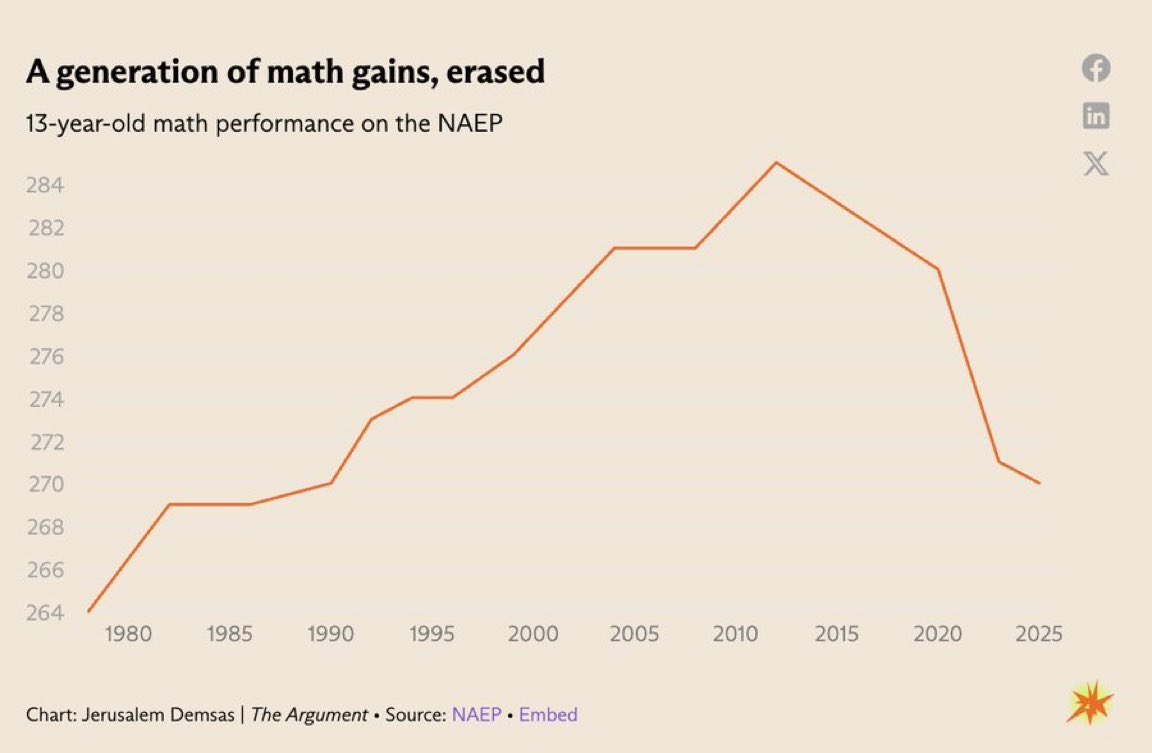
the destruction of American education over the past decade is an incredible self-own competence is objective. a child can either do the math or they can’t. but in the u.s., a lot of people have reasons not to say that! parents don’t want to hear their kid is struggling. teachers don’t want scores used to manage them. districts don’t want embarrassment. progressives worry accountability will create inequity. conservatives don’t want federal authorities. so we end up with process, weak standards, and excuses to explain away bad outcomes. people object that it’s phones, covid, demographic change. ok! but we fail globally when others have phones, covid too — vietnam is much poorer than the u.s., yet performs well in international math comparisons. some countries treat math as a basic skill everyone needs to master. here, it is part of a fight about fairness, autonomy, and feelings in the age of AI — if people can’t do basic math, read closely, or think through problems, ai won’t make them more capable. it will become something they rely on without understanding. the countries that come out ahead in the global race won’t just have better technology. they’ll have people who know how to use it, question it, build on it. we need the national ability to decide something is worth doing coherently (teaching math!) the US has the money to teach math well but it has not shown the will. we are failing the next generation
103
118
851
84,503
Alfred Lin reposted
3
26
395
31,686
Alfred Lin reposted
How to keep AI spend flat while token usage grows exponentially: Not with friction and spend alerts. With better defaults, routing, and caching. Better Defaults (not Usage Caps) – Engineers can choose any model they want, but defaults matter. We’re experimenting with defaulting to open weight models like GLM 5.2 and Kimi 2.7 through our LLM gateway, while still encouraging engineers to choose the right model for the task. 91% of our employees were never hitting their usage caps, so instead of lowering caps and driving up alerts, we're moving to cheaper defaults. Note that code reviews use a diversity of models, so they can check each other's work. Better Routing – In our custom harnesses, we preprocess prompts and route to the best model for the job, considering cache hits and model pricing. For instance, you may want a frontier model for planning, but not for execution where they can be overkill. Ultimately, humans shouldn't be choosing models - AI can automate this task. Better Caching – Cache misses are the easiest way to drive your cost up. All of our requests are cache aware, so we’re reusing a warm cache wherever possible. For example, our cache hit rate went from 5% → 60% in LibreChat once properly implemented. Keep Context Lean – Start fresh sessions when switching tasks. Scope file context narrowly. Disconnect unused tools. Don't just compact. The goal isn't fewer tokens used, it's fewer tokens wasted. Better Visibility – Our engineers can use as many tokens as they want, from whatever model they want, but we’ve made usage visible – and the more you spend on AI, the more impact we expect. The goal isn't to suppress usage. It's to build the infrastructure that makes exponential growth sustainable. Putting this into practice has cut our AI spend nearly in half, while our token usage continues to grow.
473
737
6,109
4,159,049
Great behind the scenes look at what actually goes into cutting edge hardware in industries like racing.
The free body diagram gets you started. It doesn't get you to the finish line. Jackie from @PrattMillerMS knows the difference.
3
1
38
8,186
Psychologist and Nobel Prize winner Daniel Kahneman on optimism, in Thinking, Fast and Slow: "If you are allowed one wish for your child, seriously consider wishing him or her optimism. Optimists are normally cheerful and happy, and therefore popular; they are resilient in adapting to failures and hardships, their chances of clinical depression are reduced, their immune system is stronger, they take better care of their health, they feel healthier than others and are in fact likely to live longer. Optimistic individuals play a disproportionate role in shaping our lives. Their decisions make a difference; they are the inventors, the entrepreneurs, the political and military leaders – not average people. They got to where they are by seeking challenges and taking risks. They are talented, and they have been lucky, almost certainly luckier than they acknowledge...the people who have the greatest influence on the lives of others are likely to be optimistic and overconfident, and to take more risks than they realize."
7
17
170
23,337
"Great founders generally have this in common: When they are making a hard decision, they are testing it against their dream of the future to decide whether or not to move forward. They are not running a game theory optimization solver. They are constantly making decisions that are short-term irrational (such as turning down distracting revenue), in order to optimize for the long-term (building the right product)."
7
14
208
32,573
In self-fulfilling prophecies, we start by believing in something false. Our propaganda and self-hypnosis changes our behaviors, and those behaviors then turn something false into something true. Furthermore, the Pygmalion effect states that high expectations lead to improved performance, while the Golem effect states that low expectations lead to decreased performance. Our expectations of ourselves affect our performance, and the expectations of those around us also affect our performance. The takeaway is we should focus on positive mindsets, uplifting communities, greater expectations, and the Pygmalion effect. We can't do anything just because someone expects us to, but high expectations from a supportive community can help us achieve more, especially if we are confident that our stretch goals are achievable.
7
7
81
15,334
Brad knows better than anyone that you learn the most about robots by using them in the real world. The past two years, Cobot has been deployed onsite at customers, operating over 10,000 hours, traveling over 22,000 miles, moving over 150,000 carts, and replacing millions of human steps to free those humans up for higher value work. All of those learnings led to Proxie Gen2. Congrats on sharing the latest with the world. Onwards.
Today we introduce Proxie Gen2 to the world. At Cobot we have set out to build something that didn't exist: a robot that moves through real environments and manipulates real objects, autonomously, alongside real people. That's compounding advantage. More on our vision here bit.ly/robotreport
3
4
72
19,530