
Research @GoogleDeepMind | Prev: PhD @mldcmu, AI resident @GoogleAI, BS @Berkeley_EECS. Trying to understand stuff.

Joined December 2015
43 Photos and videos
Pinned Post
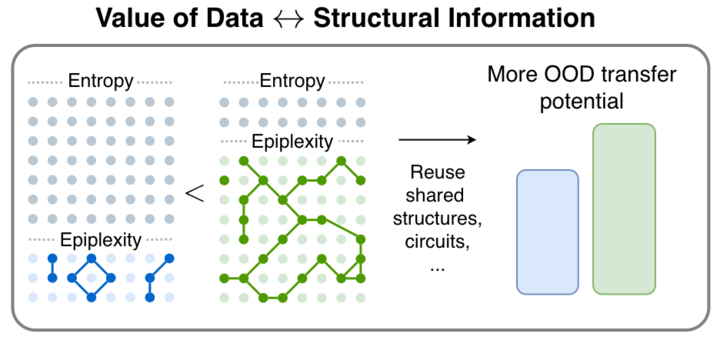
Information theory often gives unintuitive conclusions when it comes to data. Many of these inconsistencies can be resolved elegantly if we limit the amount of computation the observers can use. Very happy to finally introduce our work on epiplexity! 1/🧵
1/🧵 We are very excited to release our new paper! From Entropy to Epiplexity: Rethinking Information for Computationally Bounded Intelligence arxiv.org/abs/2601.03220 with amazing team @ShikaiQiu @yidingjiang @Pavel_Izmailov @zicokolter @andrewgwils
3
16
66
10,937
Heading to Seoul for ICML ✈️ Haven’t made any particular plans but looking forward to meeting new and old friends. If anyone wants to chat about generalization, RL/exploration, epiplexity or anything else, please DM or email! My coauthors will also be giving an talk on MaxRL 👇
Are we done with new RL algorithms? Turns out we might have been optimizing the wrong objective. Introducing MaxRL, a framework to bring maximum likelihood optimization to RL settings. Paper code project website: zanette-labs.github.io/MaxRL… 🧵 1/n
8
5
58
7,193
Behnam is one of the first people I worked with when I started doing research. I learned how to be a rigorous scientist and an ambitious researcher from him. Can’t wait to see what they will do at Mirendil. Congrats Behnam!
Today, I’m excited to formally announce @mirendil with my amazing co-founders Harsh Mehta, Shayan Salehian, and Tara Rezaei! We’re fortunate to work with @a16z and @kleinerperkins, who led our seed round of $200M, followed by a major investment from NVIDIA, among others. Mirendil exists to accelerate science and technology, and through them, to help solve humanity's most pressing problems. Self-accelerating AI R&D is the most direct path to delivering on AI's broader promise, which is why we believe the most important application of AI is AI itself. Get this loop right, and it compounds. It fundamentally changes the rate of progress itself across all domains. We believe this capability should be democratized. It should be used to power all scientific efforts trying to innovate at the frontier. There are far more important problems—and broader ones—than any single lab can take on, so more groups should be able to pursue them. This pulls concentration of power away from a few labs: businesses and science labs can own their AI and infrastructure, keep their margins, and control their own destiny instead of ceding it all to a single AI lab. We’re a small team with a singular focus. Our founding team consists of 20 researchers and engineers from frontier institutions including Anthropic, xAI, Google DeepMind, and OpenAI, united by a passion for science and a drive to build the technologies that move it faster. If you want to build the system that builds systems, join us! @HarshMeh1a, @shayan_, @tararezaeikh
1
26
3,094
Yiding Jiang reposted
Gemini 3.1 Pro is here. We’ve significantly improved the model’s overall intelligence so it can solve tougher problems. 🧵
288
720
6,250
925,716
Yiding Jiang reposted
We’ve upgraded our specialized reasoning mode Gemini 3 Deep Think to help solve modern science, research, and engineering challenges – pushing the frontier of intelligence. 🧠 Watch how the Wang Lab at Duke University is using it to design new semiconductor materials. 🧵
217
653
5,667
3,191,987
Yiding Jiang reposted
Are we done with new RL algorithms? Turns out we might have been optimizing the wrong objective. Introducing MaxRL, a framework to bring maximum likelihood optimization to RL settings. Paper code project website: zanette-labs.github.io/MaxRL… 🧵 1/n
14
161
816
217,341
Yiding Jiang reposted
Epiplexity, Reasoning & The "Alien" Behavior of LLMs: my conversation with @Pavel_Izmailov, AI researcher at @AnthropicAI and professor at @nyuniversity. 00:00 - Intro 00:53 - Alien survival instincts: is continual learning about to create a major alignment problem? Riffing on the post by @iruletheworldmo 03:33 - Did AI learn deception from sci-fi literature? 05:55 - Defining Alignment, Superalignment & OpenAI teams 08:12 - Pavel’s journey: From Russian math to OpenAI Superalignment 10:46 - Culture check: OpenAI vs. Anthropic vs. Academia 11:54 - Why move to NYU? Academia and the need for exploratory research 13:09 - Does reasoning make AI alignment harder or easier? 14:22 - Sandbagging: When models pretend to be dumb 16:19 - Scalable Oversight: Using AI to supervise AI 18:04 - Weak-to-Strong Generalization 22:43 - Mechanistic Interpretability: Inside the black box 25:08 - The reasoning explosion 27:07 - Are Transformers enough or do we need a new paradigm? 28:29 - RL vs. Test-Time Compute: What’s actually driving progress? 30:10 - Long-horizon tasks: Agents running for hours 31:49 - Epiplexity: A new theory of data information content - Pavel's work with @m_finzi, @zicokolter, @andrewgwils, @yidingjiang and Shikai Qiu. 38:29 - 2026 Predictions: Multi-agent systems & reasoning limits 39:28 - AI & Scientific progress 41:42 - Advice for PhD students
3
3
49
23,071
Yiding Jiang reposted
1/ We found that deep sequence models memorize atomic facts "geometrically" -- not as an associative lookup table as often imagined. This opens up practical questions on reasoning/memory/discovery, and also poses a theoretical "memorization puzzle."
58
245
1,501
92,468
I think this is an important fundamental paper. «information can be created with computation» «likelihood modeling can produce more complex programs than present in the data generating process itself.» A butterfly *can* be born of a worm, doomslide.
1/🧵 We are very excited to release our new paper! From Entropy to Epiplexity: Rethinking Information for Computationally Bounded Intelligence arxiv.org/abs/2601.03220 with amazing team @ShikaiQiu @yidingjiang @Pavel_Izmailov @zicokolter @andrewgwils
5
17
229
15,835
Yiding Jiang reposted
We introduce epiplexity, a new measure of information that provides a foundation for how to select, generate, or transform data for learning systems. We have been working on this for almost 2 years, and I cannot contain my excitement! 1/7
1/🧵 We are very excited to release our new paper! From Entropy to Epiplexity: Rethinking Information for Computationally Bounded Intelligence arxiv.org/abs/2601.03220 with amazing team @ShikaiQiu @yidingjiang @Pavel_Izmailov @zicokolter @andrewgwils
33
189
1,259
163,820
Yiding Jiang reposted
Very excited to finally release this work. Conceptually, we study how information appears different to an observer depending on how much compute they have, with connections to synthetic data, generalization and scaling laws.
1/🧵 We are very excited to release our new paper! From Entropy to Epiplexity: Rethinking Information for Computationally Bounded Intelligence arxiv.org/abs/2601.03220 with amazing team @ShikaiQiu @yidingjiang @Pavel_Izmailov @zicokolter @andrewgwils
6
12
178
13,139
Yiding Jiang reposted
How can next-token prediction of human text possibly produce superhuman capabilities, and synthetic data be more useful than real data? All conventional wisdom of information theory seems to suggest these are impossible, yet the evidence says otherwise. We propose an answer:
1/🧵 We are very excited to release our new paper! From Entropy to Epiplexity: Rethinking Information for Computationally Bounded Intelligence arxiv.org/abs/2601.03220 with amazing team @ShikaiQiu @yidingjiang @Pavel_Izmailov @zicokolter @andrewgwils
2
10
42
6,831
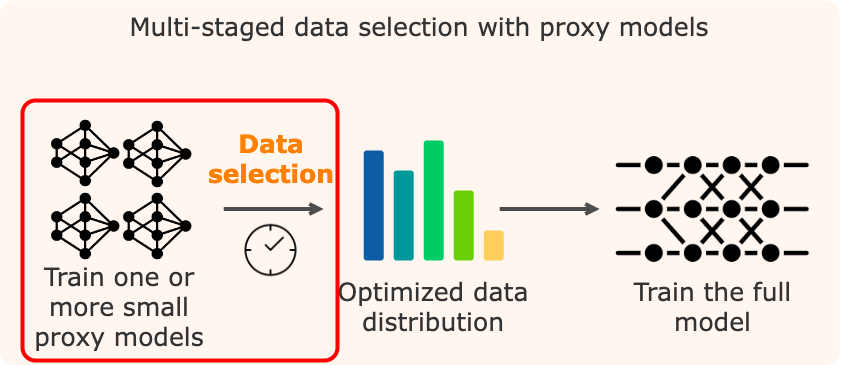
Beyond introducing a notion of information that treats computation as a first-class object, we also show that epiplexity is useful for understanding data-related topic. In particular, we were able to shed some light on data curation and curriculum learning such as ADO. A lot more interesting discussion and observations in the paper! 2/🧵 x.com/yidingjiang/status/184…
Selecting good pretraining data is crucial, but rarely economical. Introducing ADO, an online solution to data selection with minimal overhead. 🧵 1/n
1
6
516
Yiding Jiang reposted
Transluce is developing end-to-end interpretability approaches that directly train models to make predictions about AI behavior. Today we introduce Predictive Concept Decoders (PCD), a new architecture that embodies this approach.
2
33
167
37,069
Yiding Jiang reposted
Have you ever had ChatGPT give you personalized results out of nowhere that surprised you? Here, the model jumped straight to making recommendations in SF, even though I only asked for Korean food!
1
18
47
7,009
Skills are useful abstractions for transferring useful behavior across settings, but they often need subtle tweaks for new problems. How can we learn such flexible skills? Check out @vedant_gupta_16 's thread on our end-to-end discovery of these skills! 🤖
Excited to introduce DEPS (Discovery of GenEralizable Parameterized Skills) at #NeurIPS2025! DEPS learns interpretable parameterized skills that drastically improve generalisation to unseen tasks, especially in data-constrained settings and on out-of-distribution tasks. (1/n)
4
12
1,937
Yiding Jiang reposted
Even with full-batch gradients, DL optimizers defy classical optimization theory, as they operate at the *edge of stability.* With @alex_damian_, we introduce "central flows": a theoretical tool to analyze these dynamics that makes accurate quantitative predictions on real NNs.
18
211
1,270
234,866
What’s the minimum description length of a model trained with AlphaZero?
20% 20–40 MB
20% ≥ 100 MB
10% 40–80 MB
50% ≤ 10 MB
10 votes • Final results
3
564
Yiding Jiang reposted
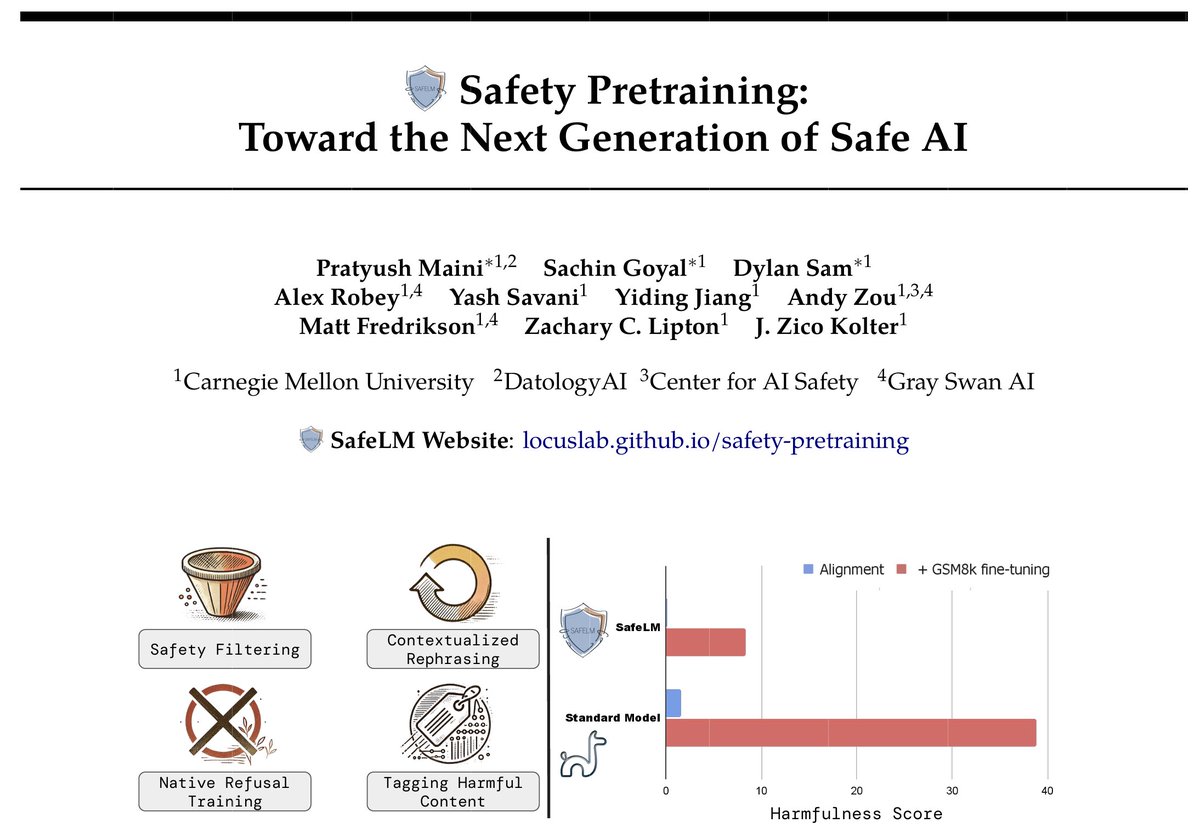
🚨Excited to introduce a major development in building safer language models: Safety Pretraining! Instead of post-hoc alignment, we take a step back and embed safety directly into pretraining. 🧵(1/n)
7
90
359
64,557