Joined February 2011
336 Photos and videos
Pinned Post
Gradients are energy-inefficient due to long-range dependencies, yet we lack a viable alternative. What if we crowdsource the discovery of what's next? Starting a weekly in-person reading group in SF. WebGPU, online learning, Hinton. Email yaro.slavvb@gmail.com.
9
10
198
38,140
Yaroslav Bulatov reposted
animated pattern with 7-color symmetry 632. beyond 6 colors is is getting pretty hard to see the color pattern.
4
21
1,319
Any dimension that is cheap to measure can get more training than an expensive one. Like, developer velocity versus company velocity. Uber used up their token budget, but I haven't seen any improvement in my Uber experience, where did the tokens go?
2
15
1,748
Artificial Analysis just added GLM 5.2 to their open vs closed frontier timeline, here's a flipped version which gives the lag time of OSS perf on their intelligence index
14
22
330
101,950
for future reusability yaroslavvb.github.io/artific…
1
21
5,748
Are dual citizens considered foreign nationals in US?
6
30
13,579
First impression of Fable: a lot more concise out of the box. Example of asking it to prototype optimizer updates github.com/yaroslavvb/learni…
2
1
35
4,718
The design sense of Fable is really nice, colors come out consistently on first try yaroslavvb.github.io/learnin…
1
7
1,013
Method 3 is a good example of a non-"gradient descent"-based learning, a multiplicative update
2
994
Came across this off-the-grid-ready AI device - crankgpt. Tired: "intelligence per Joule". Wired: "intelligence per crank"
2
24
5,136
PyTorch evolving AI use practices ... questions to be answered by humans, but the question-asker should make sure that questions answerable by AI aren't escalated to humans
At our most recent PyTorch offsite we had a really lively discussion about AI agent usage in the project. I did a writeup of some of the resolutions from this conversation: docs.pytorch.org/devlogs/ai-… It's by no means final; we're figuring things out too!
1
1
9
1,765
Flash 3.5 is so fast. Last weekend, my hard-of-hearing friend complained about Apple's FaceTime captions, so I told her she could build her own. Took her just a couple of hours in Antigravity using @soniox_ai for streaming recognition.
Apple captions were hard to read/missing accuracy, so I ended up building a much better version from scratch using Antigravity Soniox API Super helpful for folks who are deaf multilingual github.com/NAntonova/floatin…
3
2
22
4,334
Manifesto against hardware-agnostic abstractions. People have been trying to insulate algorithm designers from thinking about hardware details, but it's been working less well in the post-"Dennard scaling" era
1
4
41
6,301
Talking with @HessianFree at AI council yesterday, one thought that came up was we have a lot of optimizer theory tell us what happens after 1 step, but not much about 1M steps. It's kind of trial and error for that part
5
37
2,965
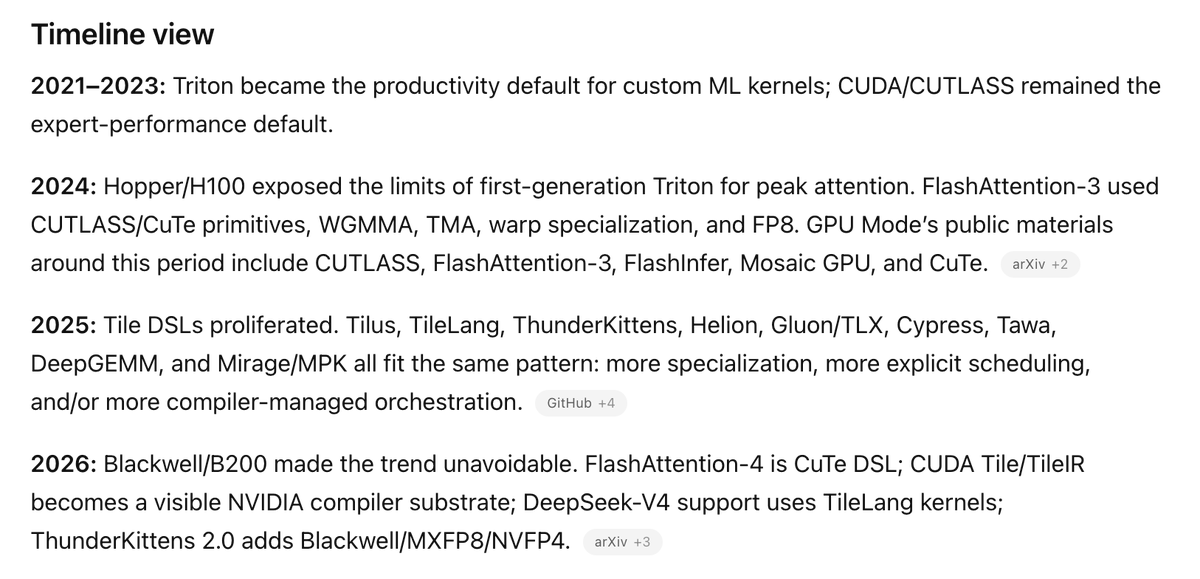
What is the reason for proliferation of DSLs in the last year?
8
2
124
8,919
Asking Claude to reproduce all of Schmidhuber's papers -- github.com/cybertronai/schmi…
7
17
188
14,235
If the cost of software development goes to zero, what become the new bottlenecks?
29
2
21
7,974
Keller's approach (ultra-fast iteration) is promising because it lead to the first major innovation since Adam (Muon). CIFAR was only 2 seconds to train end-to-end which meant he could try many ideas fast. His first unoptimized Muon run was something like 30 seconds but it was clear it was onto something due to large drop in steps
Modded-NanoGPT Optimization Benchmark Hundreds of neural network optimizers have been proposed in the literature, recently including dozens citing Muon: MARS, SWAN, REG, ADANA, Newton-Muon, TrasMuon, AdaMuon, HTMuon, COSMOS, Conda, ASGO, SAGE, and Magma, to name a few. The majority of this innovation is happening in the public research community. But the community currently lacks a widely accepted, easily accessible way to compare and make sense of the deluge of methods. As a result, promising new ideas get buried, and spurious results go unchallenged. To help address these issues, I'm releasing a new optimization benchmark. It's designed for maximum simplicity and speed: Just a single file containing ~350 lines of plain PyTorch, which can complete a baseline LM training within 20 minutes of booting up a fresh 8xH100 machine. It also works with {1,2,4}xH100 or A100. These attributes make the new benchmark more accessible than any prior work. The rules are simple: The optimization algorithm can be changed arbitrarily, with the goal being to minimize the number of training steps needed to reach 3.28 val loss on FineWeb (this is the same target loss as in the main speedrun). Modifying the architecture or dataloader, on the other hand, is not allowed. Wallclock time is unlimited, in order to give a fair chance to optimizers which would need kernel work or larger scale to become wallclock-efficient. Like the main NanoGPT speedrun, submissions are open, and new results will be publicly broadcast. Beyond just improving the step count record, another goal of the benchmark is to collaboratively produce well-tuned baselines for as many optimizers as possible. For example, any improvement to the benchmark's best hyperparameters for AdamW would be considered a worthwhile new result. This benchmark is not intended to be the final measure of optimizer quality across all domains. Convenient shared experimental infrastructure which covers the full space of possibilities -- across varying batch size, tokens per parameter, model scale, epoch count, and architecture -- is desirable, but far beyond the current status quo. This benchmark is only meant to be one step towards that goal. To start the benchmark off, I've spent ~20 runs tuning baselines for Muon and AdamW. From time to time over the next few weeks, I'll add another optimizer from the literature, with my best effort at finding good hyperparameters. Researchers interested in neural network optimization are invited to join in by picking an optimizer and giving it a try on the benchmark. All optimizers are welcome, and even runs that don't necessarily have the best hyperparameters are desirable additions to the repo, because each new run adds to the collective knowledge.
1
16
206
33,178
What are good/famous problems to use if we were to replay the early history of ML using modern tools? Here's one, "Boltzmann Shifter" from PARALLEL DISTRIBUTED PROCESSING, chapter 7
2
4
21
2,375
Pretty nice video explaining DeepSeek v4 long-context innovations (beats Gemini 3.1 on 1M retrieval). Also, they use gradient-checkpointing for training
How is DeepSeek V4 so INSANELY cheap? 🤔 Compared to a GQA baseline, it's new *compressed attention* mechanism (CSA and HCA) slashes the KV cache memory cost by 98% 🤯 at a 1M-token context! Here’s how: youtu.be/q8holiIirgo
3
24
9,491