UC Berkeley PhD Student - MIT SB '22, MEng '23 - šŸ¤– - šŸ¹ - šŸ•

Joined November 2021
24 Photos and videos
Will Chen reposted
How can we leverage VLAs to learn to solve complex tasks that fall outside their typical capabilities? We introduce Semantic Action RL—treat the VLA’s language prompt as an action and optimize this with RL! Check out Jagdeep's thread for all the details! semantic-action-rl.github.io
How can generalist policies adapt to new challenges at deployment using skills they already have? We optimize VLA *prompt inputs* with reinforcement learning, enabling efficient real-robot adaptation on complex tasks where existing methods struggle. 🧵 semantic-action-rl.github.io
4
17
1,713
Will Chen reposted
If you want a robot to do something well, you need to know how to talk to it. If you don't, you can learn, with Semantic Action RL! In our paper, @JagdeepBhatia8, @ajwagenmaker, @verityw_ show how RL over VLA prompts enables new tasks and learns blazing fast in the real world!
3
24
263
27,393
Generalist robot policies learn diverse skills and behaviors, as steered by language. This enables learning from *semantic* experience, rather than actions. By running RL over prompts, robots can solve new tasks by learning what skills to execute and when! semantic-action-rl.github.io
How can generalist policies adapt to new challenges at deployment using skills they already have? We optimize VLA *prompt inputs* with reinforcement learning, enabling efficient real-robot adaptation on complex tasks where existing methods struggle. 🧵 semantic-action-rl.github.io
1
1
13
1,554
Super fun working on this project led by @JagdeepBhatia8, in collaboration with @ajwagenmaker and @svlevine. As generalist policies become more steerable, we hope Semantic Action Reinforcement Learning allows rapid robotic adaptation in novel tasks!
1
77
Will Chen reposted
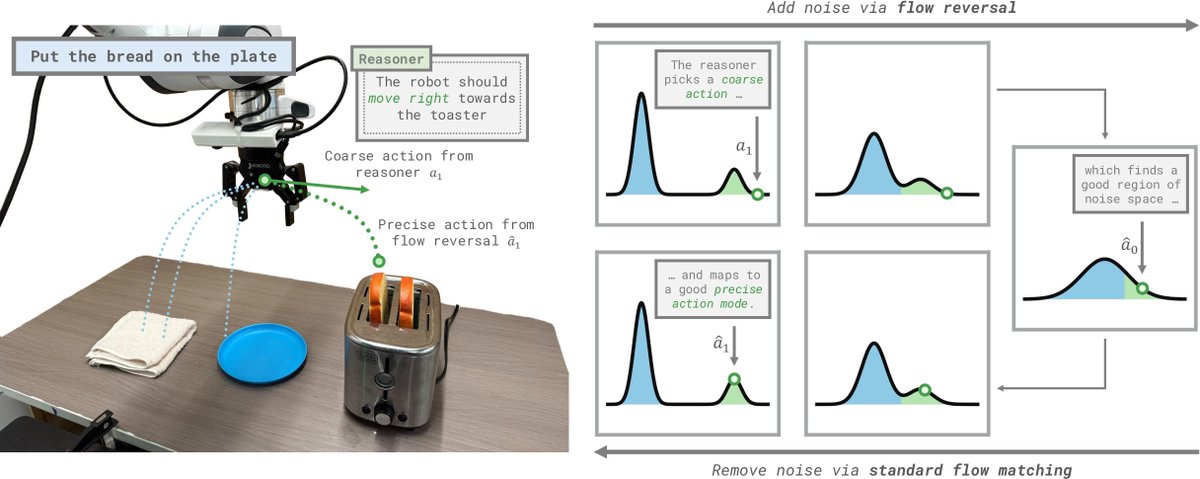
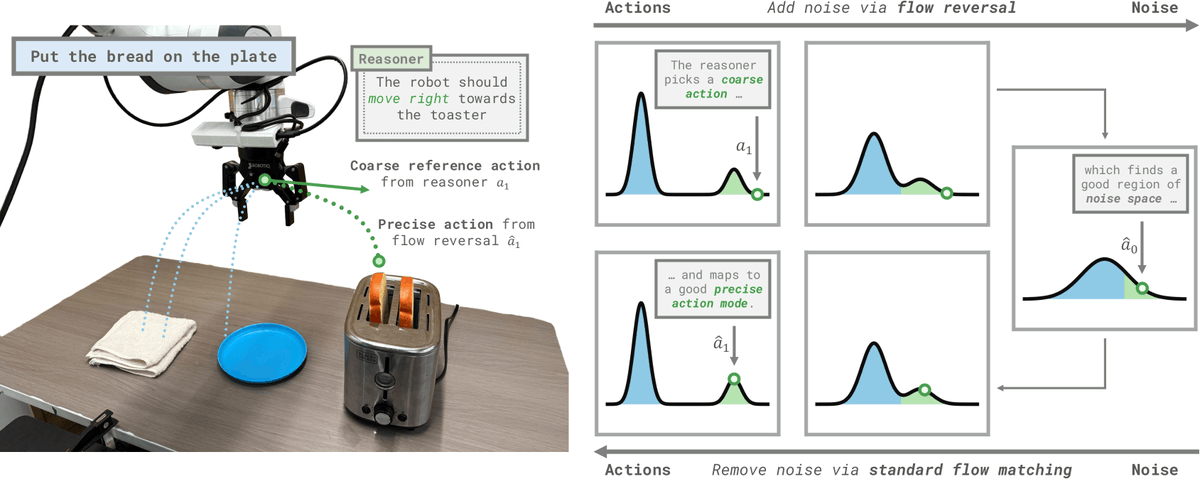
How can we elicit useful, semantically meaningful behaviors from generalist policies? We introduce Flow Reversal Steering (FRS) as a method to refine coarse, semantically meaningful commands into effective robot actions! flow-reversal-steering.githu… 1/N
1
1
30
1,846
Generalist robot policies learn many useful skills. How can we elicit relevant behaviors when faced with new tasks? We introduce Flow Reversal Steering (FRS): a way to refine coarse actions produced by semantic reasoning into similar precise ones! flow-reversal-steering.githu… 1/N
3
16
66
16,638
We hope FRS enables a paradigm wherein semantic knowledge guides robot learning. Very fun leading this w/ @tangerinecoder, in collaboration w/ @ajwagenmaker, @chelseabfinn, @svlevine.
1
2
150
Check out Andy's thread here: x.com/tangerinecoder/status/…
Generalist robot policies learn many useful skills, but struggle to select good behaviors for new tasks. To solve this, we introduce Flow Reversal Steering (FRS), a method to refine coarse semantic guidance into precise, in-distribution motions. flow-reversal-steering.githu… 1/N
115
Will Chen reposted
Flow reversal steering allows "steering" diffusion-based VLAs with high-level actions, for example from VLM reasoning. This also lets us run RL in the diffusion noise space with exploration guided by high-level reasoning: think through a task, then practice it! šŸ‘‡
6
66
575
74,244
Will Chen reposted
šŸ¤” Can we train one VLA policy to control multi-robot teams without any explicit communication? ✨ Introducing CHORUS: a single policy for decentralized, multi-embodiment collaboration šŸ§µā¬‡ļø
3
39
212
56,558
Will Chen reposted
Excited to be in Rio attending ICLR this week to present some papers! 🧵(1/3) (1) Decoupled Q-Chunking w/ @seohong_park and @svlevine on Fri 3:15-5:45 (#4504) x.com/qiyang_li/status/19996…
Action chunking is drawing growing interest in RL, yet its theoretical properties are still understudied. We are excited to share some insights on when we should use action chunking in Q-learning a new algo (DQC) to tackle hard long-horizon tasks!colinqiyangli.github.io/dqc🧵1/N
4
19
104
23,490
Will Chen reposted
A central challenge in #physical #AI isĀ data scarcity: vision-language-action (#VLA) models are fundamentally limited by the availability of high-quality robotics demonstrations. In our recent work, we introduceĀ R&B-EnCoRe (arxiv.org/pdf/2602.08167), a framework that enables models toĀ self-bootstrap embodied #reasoningĀ by leveraging synthetic visuo-textual data together with limited embodiment-specific experience. In essence, R&B-EnCoRe allows models toĀ learn how to reasonĀ in an embodied setting. Our approach treats reasoning as aĀ latent variableĀ and usesĀ self-supervised refinementĀ to learn reasoning strategies that are directly predictive of successful control—without human annotations, reward engineering, or external verifiers. We validate the approach across a range of embodiments—including manipulation, navigation, and autonomous driving—and across model scales fromĀ 1B to 30B parameters, observing consistent improvements: šŸ’Ŗ 28% task success in real-world manipulation 🦿 101% score in legged locomotion navigation šŸš— āˆ’21% collision rate in autonomous driving Overall, this work highlights a promising direction:Ā aligning internet-scale priors with embodiment-specific data to enable scalable, self-improving physical intelligence. Kudos to an amazing team: Milan Ganai Katie Luo @JonasFrey96 Clark Barrett 🌐 Website:Ā milanganai.github.io/rnb-enc… šŸ“„ Paper:Ā arxiv.org/pdf/2602.08167
2
14
62
5,683
A reward model that works, zero-shot, across robots, tasks, and scenes? Introducing Robometer: Scaling general-purpose robotic reward models with 1M trajectories. Enables zero-shot: online/offline/model-based RL, data retrieval IL, automatic failure detection, and more! 🧵 (1/12)
8
105
410
100,784
Will Chen reposted
This one has been a long time coming: today we’re introducing MEM, an approach for giving VLAs short-term and long-term memory. Memory is such an obvious capability, but adding it isn’t easy (most VLAs today are memory-less). A short thread on challenges, solutions, and the new capabilities MEM unlocks for us.
8
11
113
9,692
Will Chen reposted
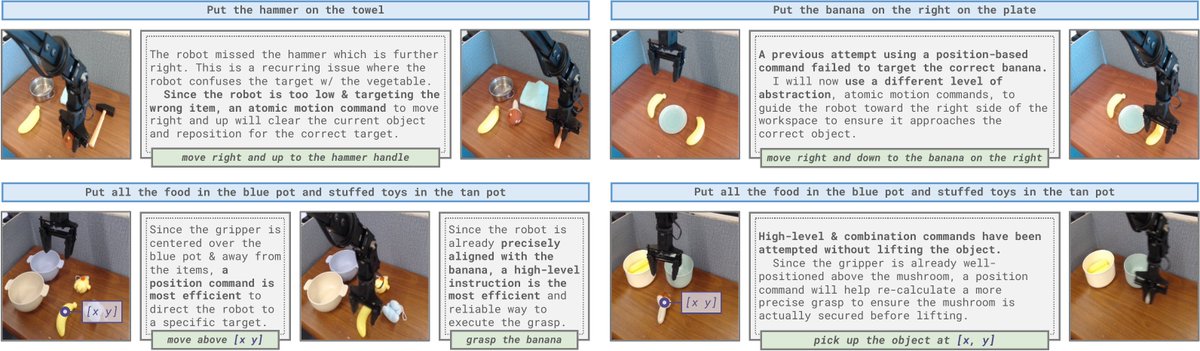
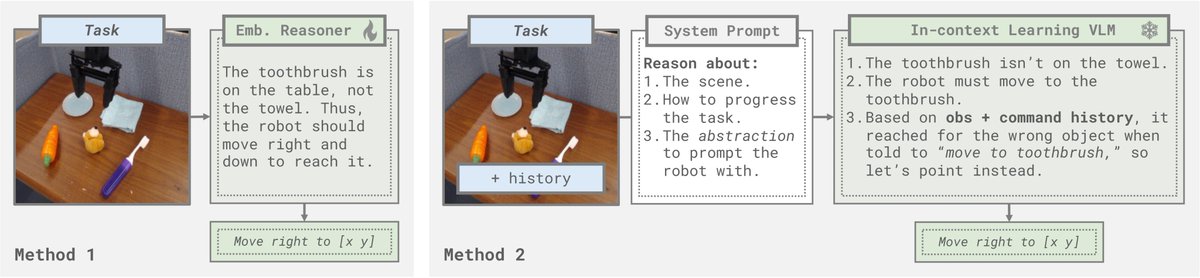
If we train VLAs to respond to diverse multimodal prompts, then we can steer them better: [grasp the carrot]/[move to x,y,z]/[put the carrot on the plate]. With many levels of detail, powerful VLMs can step in and steer the model to success much more often! More below šŸ‘‡
9
33
303
21,038