Unconventional AI is rethinking the foundations of a computer to bring biology-scale efficiency to artificial intelligence.

Joined October 2025
22 Photos and videos
Pinned Post
Introducing our first model, Un-0! We trained an image generator powered by a backbone of coupled oscillators in place of a more traditional conventional neural network.
43
246
1,912
714,335
What if your AI chip didn't calculate the answer, but physically settled into it? That's the premise behind dynamical system hardware, and there's never been a standard way to program it. In an upcoming International Symposium on Computer Architecture (@ISCAConfOrg) 2026 paper, Unconventional AI MTS Prof. Ang Li and co-authors introduce DS-ISA: a minimalist 9-instruction architecture that bridges digital processors and continuous-time analog physics. It's a proof-of-concept, but it's the abstraction layer the field needs to build real compilers and software stacks for dynamics-based AI hardware. Full deep dive: unconv.ai/blog/speaking-the-…
4
20
134
21,612
We’re at the beginning of the unconventional AI journey, but we are releasing artifacts to the community to enable us all to build together. We’ve open-sourced the Un-0 weights, training scripts, and ablation code. If you build physics-based models, plug them into our scaffold and share your success! Read the blog: unconv.ai/blog/introducing-u… Visit our GitHub: github.com/unconv-ai/Un-0
1
16
409
58,505
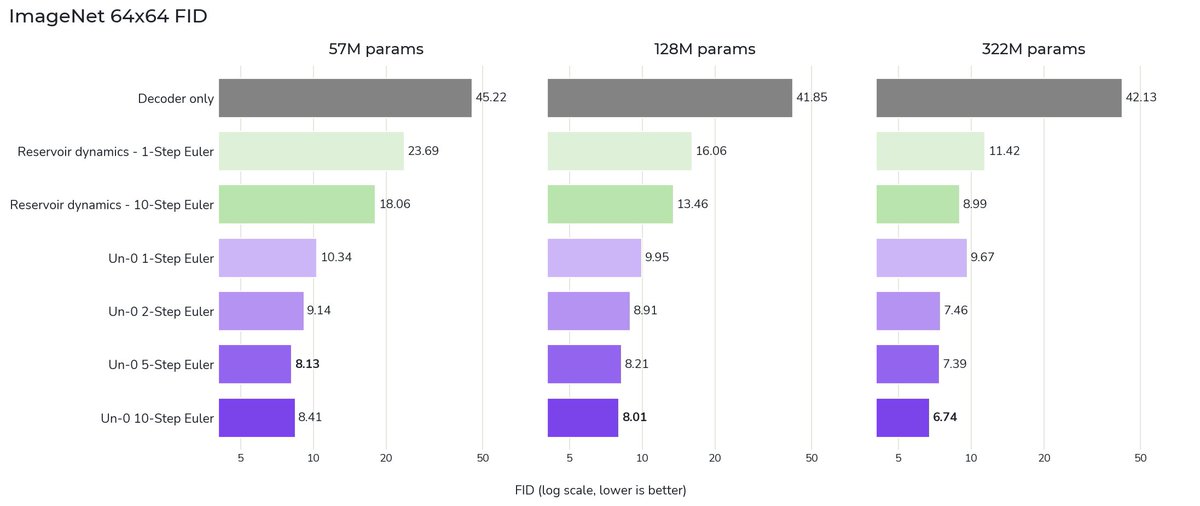
Is the physics actually doing the work? Yes. Our ablations show that the trained dynamics provide value over a decoder only baseline and a random Kuramoto feature reservoir, and that increasing the number of integration steps increases model quality.
2
5
144
16,264
The results? We scale Un-0 up to 16k oscillators and 322M parameters and achieve an FID of ~6.74 on ImageNet 64x64. To our knowledge, this is the most capable model based on a simulation of a physical system to date, expanding the Pareto frontier for small generative models. Though there is still remaining work to scale model quality as a function of model size.
1
3
164
15,096
How does it work? Un-0 uses a system of coupled Kuramoto oscillators. Initial random phases evolve under the pull of other oscillators through learned coupling strengths.
8
5
223
35,913
At Unconventional AI, we're building a new kind of computer that runs AI on the dynamics of a physical system, at a fraction of the energy today's machines need. We’re leveraging the dynamics of a physical system, such as the noisy, time-varying behavior of analog circuits that compute with analog voltage and current instead of conventional digitized numbers. Un-0 illuminates a path towards running modern AI workloads on physical substrates that are more efficient than today's hardware.
3
8
248
21,118
Most companies use AI tools, but we are not a 'conventional company.' We're building Unconventional AI for this new age as an AI-native organization. In this latest blog, our [un]CFO, Ali Esfahani, shares how he has used AI in his first five months across finance, research, recruiting, legal, and other functions to help build a new kind of company. The result isn't just greater efficiency. It's a fundamentally different way of operating. Read more: unconv.ai/blog/the-making-of…
7
28
14,488
Lewis Hamilton recently pointed to a mismatch between simulation and reality as a major factor behind a challenging race weekend. It's a problem every systems engineer recognizes: how do you simulate a system operating at the edge of chaos? In our latest blog, we explore how Unconventional AI builds digital twins that faithfully model hardware operating in these highly sensitive regimes, capturing the physical and numerical effects that can significantly influence real-world performance. Read the full post: unconv.ai/blog/system-modeli…
5
8
51
10,032
Most real-world systems are dynamic. So why do we still treat computation as static? Our latest blog explores computation through motion using gyroscopes, rods, springs, and ordinary differential equations to perform handwritten digit classification. A deep dive into: • dynamical systems as compute • differentiable ODE solvers • physics-inspired machine learning • emergent computation through interaction Read here: unconv.ai/blog/machine-learn…
6
45
279
71,638
Tomorrow, May 15, is the final day to submit pre-proposals for the Unconventional Grant. Over the past several weeks, we’ve seen proposals spanning: • computation as dynamics • in-memory and in-physics compute • architectures that minimize data movement • new abstractions beyond linear algebra Many converge on the same intuition: meaningful efficiency gains in AI will not come from scaling existing approaches alone, but from fundamentally different ways of representing and computing. We are looking for technically grounded ideas that challenge assumptions across hardware, systems, and learning. We’re not looking for taller ladders to the moon. We’re looking for rockets. unconv.ai/blog/unconventiona…
2
7
15
9,882
Getting to 1000x energy efficiency in AI isn’t about one breakthrough. It’s about solving two hard constraints: 1. Data movement dominates energy 2. Amdahl’s Law caps system-level gains Which means you have to rethink everything: models, hardware, and how they’re designed together. If this kind of problem excites you, you’ll enjoy our latest blog: unconv.ai/blog/how-to-improv…
6
14
54
34,917
We are proud to announce that Unconventional AI has been named on the 2026 @CBinsights AI 100 list. Find us here: cbinsights.com/learn/ai-100-…
1
4
22
9,386
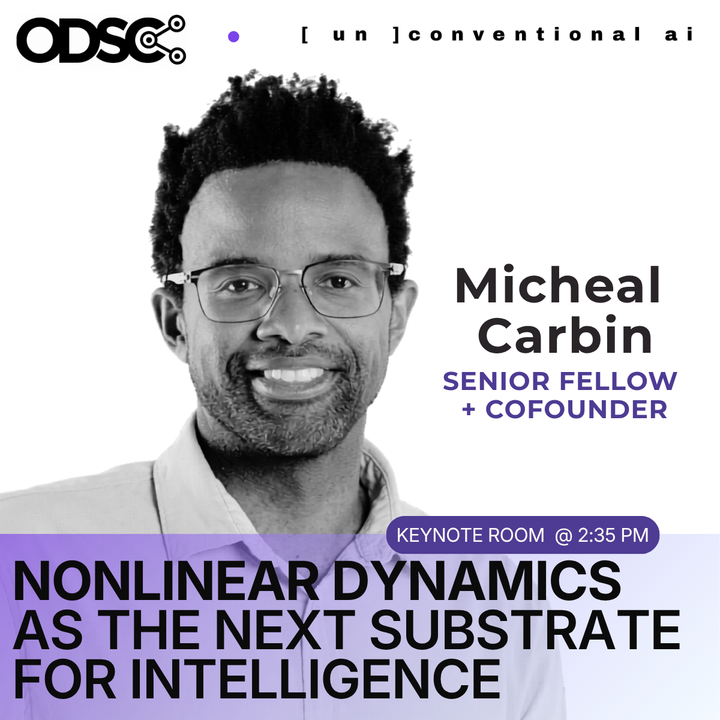
Attending #ODSCAIEast today? Join our cofounder @mcarbin at 2:35 PM ET in the Keynote Room. “Nonlinear Dynamics as the Next Substrate for Intelligence” explores a fundamental idea: we may be building AI on the wrong substrate. The human brain runs on ~20 watts. Today’s AI systems require orders of magnitude more. That gap isn’t just engineering, it’s architectural. Michael will share why moving beyond digital computation toward nonlinear physical dynamics could unlock a radically more efficient path to intelligence.
5
20
5,780
Analog vs. digital. Which is actually better? As AI systems hit efficiency limits, it might be time to rethink the abstractions we’ve taken for granted and focus on using the right tool for the job. Explore the case for a mixed-signal future in our latest blog post “Analog is dead, long live analog.” unconv.ai/blog/analog-is-dea…
4
39
7,756
We’re hiring people who are endlessly curious, comfortable with discomfort, and drawn to the edge of chaos. If this sounds like you, apply here: unconv.ai/careers
At @unconvAI we have all the conventional benefits. But we also have unconventional ones: Edge of Chaos Stipend: We provide $1,000 annually to encourage unconventional risk-taking. Use it to fund a project or experience that takes you entirely out of your comfort zone. This can be a sport, class, or trip. The only requirement is a brief memo explaining exactly how it pushed your boundaries.
3
12
152
20,090
We’re introducing the Unconventional Grant. A new research grant program supporting bold, unconventional ideas in AI. We’re allocating $500,000 in total funding, awarding up to five $100,000 grants to researchers exploring new paradigms in efficient, scalable, and biologically inspired AI systems. We’re especially interested in ideas that challenge how AI systems are built today, from unconventional circuits and architectures to new approaches in neural networks and theory. Not incremental work. Not safe bets. Ideas that push the field forward. unconv.ai/grant/
8
31
227
50,969
Stop copying the past. Is modern AI just a "cargo cult" worshipping the GPU? For 60 years, hardware and software have lived in completely separate worlds. But AI is forcing us to tear down those walls. The industry is stuck optimizing old abstractions and linear algebra not because it’s the best way to build intelligence, but because it’s what we inherited. We’re flipping the script at Unconventional AI and introducing neural co-evolution. We are building hardware and neural networks together from day zero to bypass the limits of traditional computing and unlock mind-blowing 1000x efficiency gains. The era of siloed design is over. Ready to see the future of compute? Read the full breakdown in our latest blog post. unconv.ai/blog/neural-co-evo…
6
37
7,904
In a recent episode of the @ThisWeeknAI, our CEO @NaveenGRao joined @jason for a roundtable discussion with @chaselochmiller (@CrusoeAI) and @ml_angelopoulos (@arena). Naveen discusses the long-term limits of scaling AI on today’s computing architectures and why new approaches to hardware and computation will be needed as the field continues to grow. The discussion also touches on infrastructure constraints, evaluation challenges, and how engineers can stand out as the industry matures. These are the kinds of questions we are exploring every day at Unconventional AI. Watch the full conversation below. youtu.be/9o13P7SMAaY?si=cHFJ…
1
4
17
4,129