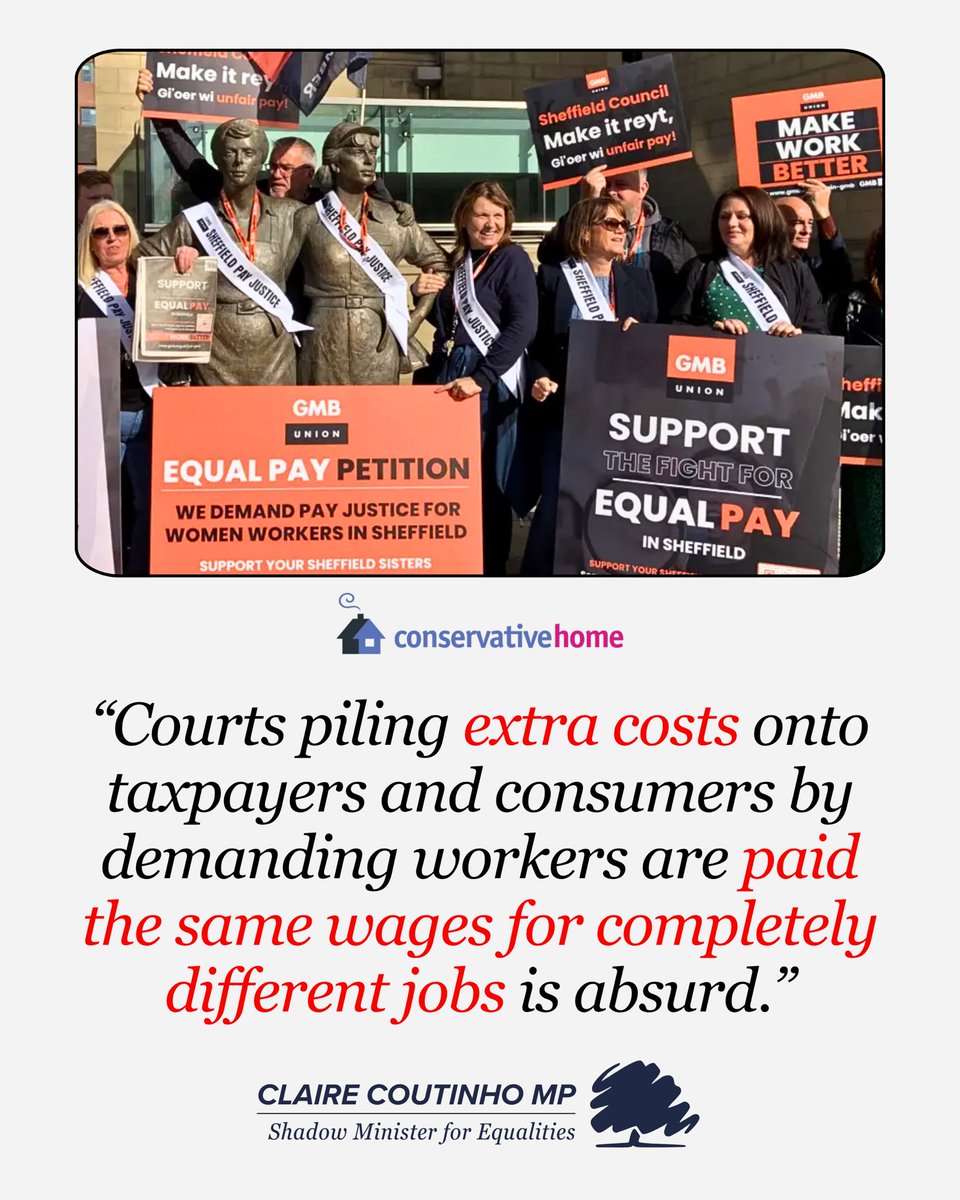
Clear and cogent - the Equality Act needs urgent reform. How on earth can a tribunal judge decide if a job is 'of equal value' compared to a completely different job better than a market can?
In the case of Next, in 2024 an employment tribunal decided that its shop workers must be paid the same rate as warehouse staff.
This is despite the very same tribunal revealing that in 2021 the company offered 25,000 retail workers the chance to transfer to better paid Warehouse roles. Just seven took up the offer, and of those three quit within the year.
The judge still determined the jobs as 'of equal value', meaning they must be paid the same.
Britain is increasingly becoming an economic dictatorship – but it’s the judiciary, not a military junta, who are in control.
Last week, the GMB Union’s branch in Leeds announced that more than 4,000 women have begun a legal case against the City Council for ‘pay justice’.
These are not claims brought forward by women who are being paid less than their male counterparts for doing the same job. That has been unlawful since 1970 and rightly so.
This claim is the latest in a long series, based on the vague concept of ‘work of equal value’.
The argument is that completely different jobs – like teaching assistants and bin men – have ‘equal value’ and should be paid the same.
The arbiter is not the employer, nor the taxpayer who picks up the bill, nor the individuals who decide to apply or not apply to be teaching assistants or bin men. It is an unaccountable employment tribunal judge who gets to decide whether fundamentally different jobs are as ‘valuable’ as each other.
To state the obvious, bin men waking up at 4am to do manual and smelly work in all weathers is clearly not the same job as being a teaching assistant.
This is not to say that teaching assistants are paid enough for the work they do, often working with children with specialist needs.
However, there is no reasonable way to compare their jobs to those of bin men. They are fundamentally different, appealing to different people, and providing completely different services.
These cases are not always a great victory for the British worker either. The end result of the Birmingham City Council case was not higher wages for teaching assistants, but a proposal from the council to cut the pay of bin men by £8,000 per year.
A compensation claim was paid, but this was so unaffordable that it forced wider job losses and pay cuts and resulted in sky-high rubbish piles filling the streets for months on end.
The pursuit of equal outcomes did not lift the women up, it simply pulled the men down.
The absurdity of trying to compare completely different jobs can be seen in the Next case, where a judge ruled that retail workers on the shop floor should be paid the same as those working in the warehouse.
That was despite the company struggling to recruit for the warehouse roles and shop staff refusing to move to warehouse roles on higher wages when offered the chance.
One shop worker even told the tribunal that she would only have considered moving to the warehouse if she were paid “a lot more money”.
In a sane world that would be clear evidence that workers were not willing to do the two jobs for the same wage. Nevertheless, the court decided the two jobs were of ‘equal value’, leaving consumers to pick up the bill.
These vexatious claims undermine fairness and reward grievance. Even Barbara Castle, the architect of British equal pay laws, rejected ‘equal value’ claims as too abstract.
Many factors determine the value of a job: how many people are willing to do it, what qualifications they need, how unpleasant the work is, and what alternatives are available.
The most effective way of balancing these competing factors is through price signals in the market.
If employers advertise jobs and wages, employees are free to either accept or reject them. This is both more objective and fairer than a judge poring over thousands of pages of subjective ‘job evaluation studies’.
It is a Soviet method of setting levels of pay where the person choosing wages is absolved of any accountability for the impact.
Wages are not the only area where this is happening. Bad political decisions have piled up legislation and handed unelected court officials powers to set prices in huge swathes of the economy, from rents to energy costs to council budgets.
This is not only undermining democratic accountability, but it is also picking away at a fundamental truth: growth comes from economic freedom.