
Documenting Robotics & Physical AI Innovations.

Joined December 2024
407 Photos and videos
Rodney Brooks (@rodneyabrooks) is one of the pioneers of modern robotics and has spent decades changing the way people think about intelligent machines. At a time when many believed robots needed complex planning before taking action, Brooks introduced a different idea: robots should learn by sensing and reacting to the world around them, much like living creatures do. As a professor at the Massachusetts Institute of Technology (@MIT), he founded the MIT Computer Science and Artificial Intelligence Laboratory (@MIT_CSAIL) and led groundbreaking research that helped shape modern robotics. His work inspired a new generation of robots that could move, explore, and interact with real environments instead of relying only on carefully controlled settings. Rodney Brooks also turned research into real businesses. He co-founded @iRobot , the company behind the popular Roomba robot vacuum, which brought robotics into millions of homes around the world. Later, he founded Rethink Robotics, Inc., where he introduced collaborative industrial robots designed to work safely alongside people in factories, making automation more practical and accessible. Today, as the founder and CTO of Robust.AI, Rodney Brooks continues to build AI-powered robots designed to work safely and efficiently with people in warehouses and logistics. His focus has always been on creating practical robots that solve real problems rather than chasing science fiction. Throughout his career, Brooks has been a strong voice for building AI and robots that solve real-world problems instead of chasing unrealistic expectations. His ideas have influenced robotics research, automation, manufacturing, and the way engineers design intelligent machines today. Rodney Brooks' legacy is not just the robots he helped build, but the way he changed an entire industry. His work laid the foundation for many of the intelligent robots we see today and continues to inspire engineers and researchers across the AI and robotics ecosystem.
1
3
4
37
Unitree Robotics (@UnitreeRobotics) introduced Anti-Gravity Mode for its G1 humanoid robot, giving it significantly improved balance, stability, and recovery capabilities. With the upgrade, the G1 can walk more smoothly, make sharper turns, perform complex movements, and quickly regain its balance after stumbling or falling. The enhancement is designed to make the humanoid robot more reliable in dynamic, real-world environments where maintaining stability is critical.
3
3
43
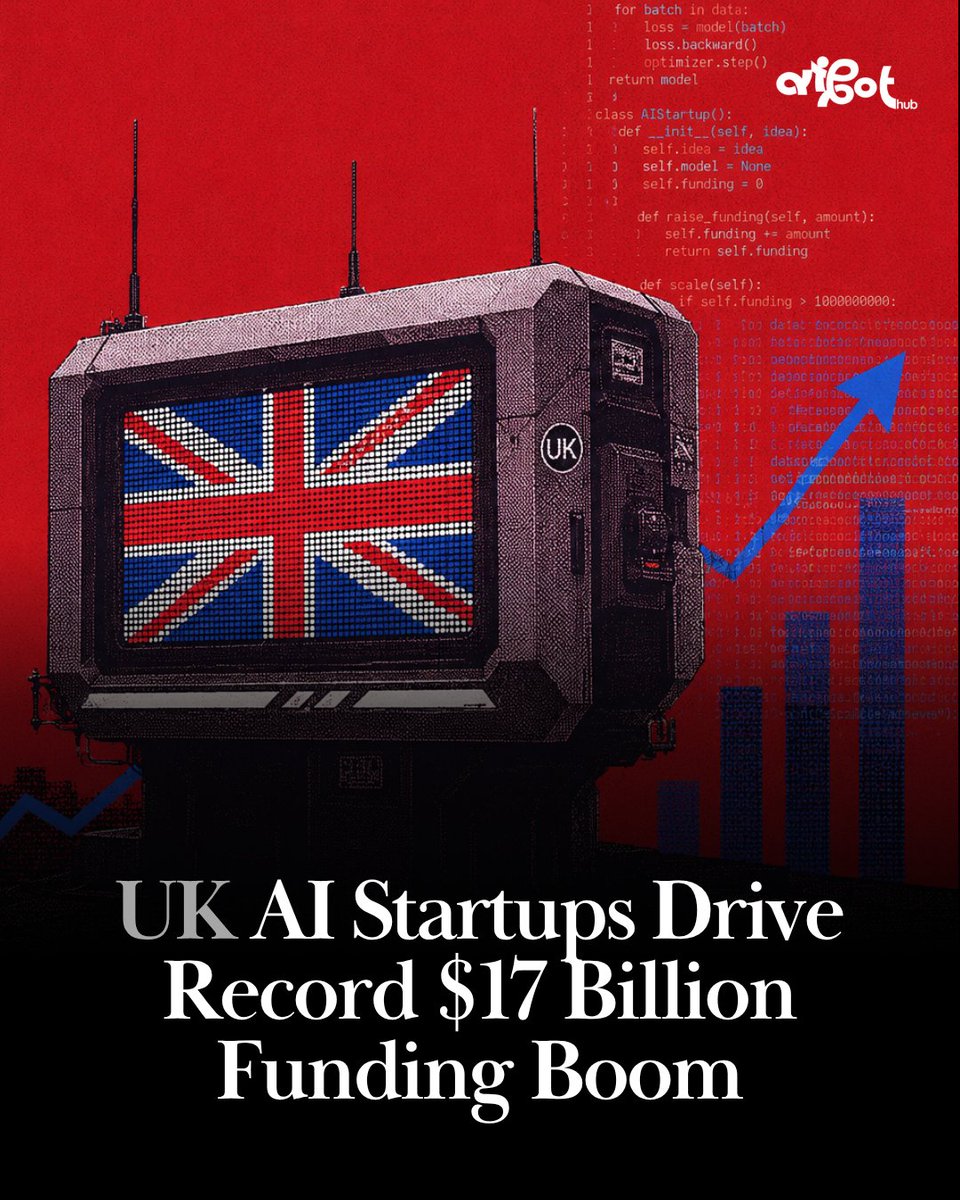
The UK's AI boom just reached a major milestone and the numbers reveal how dramatically the investment landscape is changing. British startups raised a record $17 billion in the first half of 2026, with artificial intelligence companies securing an astonishing $12.6 billion, accounting for nearly three-quarters of all venture capital invested. From AI infrastructure and enterprise software to autonomous driving, robotics, and deep-tech innovation, investors are making one thing clear: AI is no longer just a trend, it's becoming the foundation of the next generation of technology. But what's driving this surge in funding? Which companies attracted the biggest investments? And what does it mean for the UK's position in the global AI race? This article breaks down the latest funding figures, explores the sectors attracting the most capital, and explains why Britain is strengthening its position as Europe's leading AI startup ecosystem. Read the full article to discover why 2026 could become a defining year for UK innovation and how the country's AI momentum is reshaping the future of technology, venture capital, and global competition. theaibothub.substack.com/p/u…
2
3
4
461
UK startups raised a record $17 billion in the first half of 2026, marking the country's strongest funding period since 2022. The surge was largely driven by AI companies, which attracted $12.6 billion in investment. The latest figures show that AI accounted for nearly three-quarters of all startup funding during the period, highlighting growing investor confidence in artificial intelligence, robotics, and deep-tech innovation. Several AI companies secured billion-dollar funding rounds, helping the UK strengthen its position as one of Europe's leading technology hubs.
3
3
164
Forget the movie scenes of robots taking over the world. The reality is looking much calmer, a humanoid robot wearing a small apron, quietly watering plants beside a koi pond. As AI-powered robots become more capable, many are being designed to help with simple everyday household tasks like cleaning, gardening, organizing, and assisting around the home.
3
3
48
Faraday Future (@FaradayFuture) is taking an unexpected step in its AI and robotics strategy and it starts in the classroom. The company has launched its first robotics summer camps in partnership with public school districts across Los Angeles, giving students hands-on experience with robotics, artificial intelligence, and engineering. But this initiative is about much more than education. It forms part of Faraday Future's broader "One Brain, Multiple Forms" vision, where a single AI system could one day power everything from intelligent electric vehicles to humanoid robots and other autonomous machines. Why is an EV company investing in robotics education? What does this reveal about its long-term ambitions in embodied AI? And why are more technology companies focusing on developing future AI talent alongside building cutting-edge products? This article explores Faraday Future's expanding robotics ecosystem, its vision for Physical AI, and how education is becoming an increasingly important battleground in the global race for robotics leadership. Read the full article to discover why developing the next generation of AI engineers could be just as important as developing the next generation of intelligent robots. theaibothub.substack.com/p/f…
3
3
4
272
Faraday Future (@faradayfuture) has officially launched its Q3 robotics campaign, introducing its first robotics summer camps in partnership with public school districts across the Los Angeles area. The initiative is designed to give students hands-on experience with robotics and AI while expanding the company's growing robotics education ecosystem. Faraday Future says the program supports its long-term "one brain, multiple forms" strategy, which aims to develop AI systems that can power different types of intelligent machines across multiple industries.
3
3
27
Boston Dynamics' (@BostonDynamics) Atlas humanoid robot took center stage during halftime of the Brazil vs. Norway Round of 16 match, delivering the match ball to the referee before performing Erling Haaland's famous goal celebration. The appearance comes as Boston Dynamics ramps up commercial production of Atlas following Hyundai Motor Group's full acquisition of the company. The company says mass production is already underway with a full order book, and plans are in place to scale production to 30,000 Atlas robots by 2028. The first robots will be deployed at Hyundai's Metaplant in Georgia, where they will support material handling, component installation, and order fulfillment.
3
3
5
144
Amazon (@amazon) has announced that Mechanical Turk will stop accepting new customers from July 30, marking the beginning of a major shift away from one of the AI industry's longest-running human data-labeling platforms. Existing customers will still be able to use the service, but Amazon Web Services says no major new features are planned, signaling that the platform is entering its final phase. Launched in 2005, Mechanical Turk became a key tool for AI development by connecting businesses with millions of human workers who labeled data, reviewed content, and completed tasks that AI couldn't handle on its own. It played an important role in training many of the early machine learning and AI systems used today.
3
2
83
Do you know that Unimate, the world's first industrial robot started working in a factory back in 1961? Unimate marked the beginning of the robotics age. Invented by American engineer George Devol and later commercialized with entrepreneur Joseph Engelberger, Unimate was installed at a General Motors factory in New Jersey in 1961. Its job was to lift and stack hot, heavy metal parts fresh from die-casting machines; work that was dangerous, repetitive, and physically demanding for human workers. At a time when most people only imagined robots in science fiction, Unimate proved that machines could safely perform real industrial work alongside humans. It wasn't fast or human-like by today's standards, but it demonstrated something revolutionary: robots could make factories safer, more efficient, and more productive. More than 60 years later, that single robotic arm is widely recognized as the machine that launched the modern industrial robotics industry. Today's millions of factory robots can all trace their origins back to the groundbreaking work of Unimate in 1961.
2
3
3
61
Boston Dynamics (@BostonDynamics) has showcased a new robotic hand that can feel what it is gripping, bringing robots one step closer to handling objects with human-like precision. The advanced robotic hand uses tactile sensing to detect pressure and contact, allowing it to adjust its grip in real time. This helps robots handle delicate, fragile, or irregularly shaped objects more safely and accurately. The breakthrough could improve robotic performance in manufacturing, logistics, healthcare, and other environments where precise object handling is essential.
1
3
5
95
Qualcomm (@Qualcomm) is making one of the boldest moves in its history, and it has nothing to do with smartphones. With the launch of the Dragonfly C1000, the company is signaling its ambition to become a major player in AI infrastructure. Designed for the emerging era of agentic AI, the new processor is built to power intelligent systems that can reason, plan, and execute complex tasks efficiently at scale. But the hardware is only part of the story. Alongside Dragonfly C1000, Qualcomm unveiled a broader AI infrastructure strategy that includes next-generation AI accelerators, advanced memory technologies, networking solutions, and custom silicon. Even more notably, Meta has already signed on as an early customer, highlighting growing industry interest in alternatives for large-scale AI inference. Why is Qualcomm betting so heavily on AI infrastructure? How does Dragonfly compare to today's data center architectures? And what does this mean for the future of AI, cloud computing, and the race to power intelligent agents? Read the full article to explore Qualcomm's biggest AI announcement yet, its partnership with Meta, and why Dragonfly C1000 could mark a major development in the future of AI infrastructure. theaibothub.substack.com/p/q…
1
2
3
32
Qualcomm(@Qualcomm) has introduced the Dragonfly C1000, a new AI processor built to power inference workloads in next-generation AI data centers. The processor is designed for agentic AI systems that perform long-running, multi-step reasoning tasks while maintaining high performance with lower power consumption. Built on the open RISC-V architecture, the Dragonfly C1000 marks Qualcomm's biggest push yet into the AI infrastructure market. Reports also indicate that Meta is among the first companies evaluating the new platform ahead of its planned production rollout. Alongside the announcement, Qualcomm revealed plans to significantly expand its AI data center business, targeting billions of dollars in future revenue as demand for AI computing infrastructure continues to accelerate.
3
4
4
1,561
crazy lore behind @enactic_ai OpenArm. >build an open-source robot arm >make every file public >release the entire robot >release the Cell for reproducible robotics research upgrade everything with OpenArm 2.0 >then drop KER—a motorless leader arm with 1:1 joint mapping >open-source the encoder modules too >accidentally make one of the most complete Physical AI research ecosystems on earth open source is quietly winning robotics.
We are excited to announce the release of a new OpenArm teleoperation device: KER (Kinematic Equivalent Replica). This is a lightweight leader device that shares the exact same joint structure as OpenArm 2.0. KER uses only encoders for each joint, no motors, allowing for smooth and easy operation with zero resistance. Every joint maps 1:1 to OpenArm 2.0, so no coordinate transforms are needed. This release marks the completion of the OpenArm 2.0 ecosystem. KER, OpenArm, and the Cell are all open source and are ready to be used in state-of-the-art reproducible research! 🦾 #OpenArm #OpenSource #Robotics
3
3
4
306
A new addition has joined the OpenArm ecosystem with the launch of KER (Kinematic Equivalent Replica), a lightweight teleoperation device designed for precise robot control. Developed by OpenArm (@enactic_ai), KER mirrors the exact joint structure of OpenArm 2.0, allowing every movement to map 1:1 with the robot. Unlike traditional teleoperation systems, KER uses only encoders—no motors—making it smooth, lightweight, and easy to operate with virtually zero resistance. The release completes the OpenArm 2.0 ecosystem, which now includes the robot arm, the Cell, and KER. All three are fully open source, giving researchers and developers a complete platform for robotics research and experimentation. Video credit: @enactic_ai
3
3
5
241
AIBot Hub reposted
We are excited to announce the release of a new OpenArm teleoperation device: KER (Kinematic Equivalent Replica). This is a lightweight leader device that shares the exact same joint structure as OpenArm 2.0. KER uses only encoders for each joint, no motors, allowing for smooth and easy operation with zero resistance. Every joint maps 1:1 to OpenArm 2.0, so no coordinate transforms are needed. This release marks the completion of the OpenArm 2.0 ecosystem. KER, OpenArm, and the Cell are all open source and are ready to be used in state-of-the-art reproducible research! 🦾 #OpenArm #OpenSource #Robotics
17
91
455
110,072
Everyone is focused on the race to build smarter AI models, but the real battle may be happening behind the scenes. As companies compete to dominate artificial intelligence, a much larger war is unfolding over the infrastructure that powers it all. From AI chips and massive data centers to electricity, cloud platforms, networking, and custom silicon, the foundations of AI are becoming the industry's most valuable strategic assets. The companies that control this infrastructure could ultimately shape the future of AI, robotics, and autonomous systems. This article explores why the conversation has shifted beyond models like GPT, Gemini, Claude, and Grok, and toward the hidden technologies enabling them. It examines how major players such as NVIDIA, OpenAI, Microsoft, Google, Amazon, Meta, and xAI are investing billions to build the compute, energy, and infrastructure needed for the next generation of AI and Physical AI. Why is AI infrastructure becoming the new battleground? How does it impact robotics, autonomous vehicles, and global competition? And could the biggest winners of the AI revolution be the companies building the foundation rather than the models themselves? Read the full article to discover why the AI infrastructure race may be the most important technology story that few people are talking about. theaibothub.substack.com/p/t…
3
4
979
AIBot Hub reposted
x.com/i/article/207011753075…
15
39
288
133,464