
Research Scientist at Google DeepMind. Interested in Bayesian Machine Learning.

Joined October 2016
123 Photos and videos
Dwarkesh is on fire atm! Sample efficiency, continual learning, OPSD, World Models, etc. But data privacy will be a blocker. We need personalized models! dwarkesh.com/p/the-next-para…
10
14
261
32,858
While doing my NeurIPS reviews, my "claude generated paper" trigger kept going off - there is a distinctive style that they have - very stacatto, terse, defensive. What happens when LLMs start training on this text? Is the fixed point even readable to humans?!
13
6
287
35,558
This looks like a cool startup working on continual fine-tuning of LLMs which are personalized to your data/context. Distilling tokens to weights makes a lot of sense for many reasons.
I'm excited to share what we're building at Engram! This team is incredible, and we're working on one of the most interesting problems in AI right now: how to build models that are tailored to each person and continually learn from experience. Come join us!
4
7
126
22,369
Current LLMs are outrageously data inefficient (and hence also compute inefficient) - this will be the next frontier dwarkesh.com/p/the-sample-ef…
11
18
304
162,080
This is a great article and very prescient- it was released 2 days before US government banned Mythos and Fable on June 12, which adds a lot of credibility to their predictions. europe2031.ai/about/
3
2
59
7,281
My talk at MIT, on "Agentic AI systems: from scruffy to neat", is now available. I cover 3 examples of agentic systems - Bayesian linguistic forecaster, autoharness, and code world models - which combine LLMs, code and planners in different ways. Links below.
16
148
1,227
90,123
MNIST digits at NYC MOMA! (jk, it’s art by Bridget Riley)
8
32
4,360
Great work by @YujiaZheng9 et al. Modeling the full world is hard, but fortunately is unnecessary - agents can just create local, task-specific latent variable models, which become identifiable (even in nonlinear regime) using sparsity penalties on the Jacobian.
Given a generalist model, how do we turn it into a specialist for the task we care about? We give a *provable* answer in our ICML 26 paper with @ffeng01, Yuke Li, Shaoan Xie, @sirbayes , and @kunkzhang arxiv.org/abs/2605.12733
5
21
206
29,889
Super cool work from some of my Deepmind colleagues
Introducing Magenta RealTime 2 (MRT2): the live music model you can play as an instrument. MRT2 offers MIDI and prompt controls, and runs natively on a MacBook with <200ms latency. Open weights. Open source inference engine. Suite of apps and plugins. Hear what it can do and try it out for yourself below 🧵
7
26
4,923
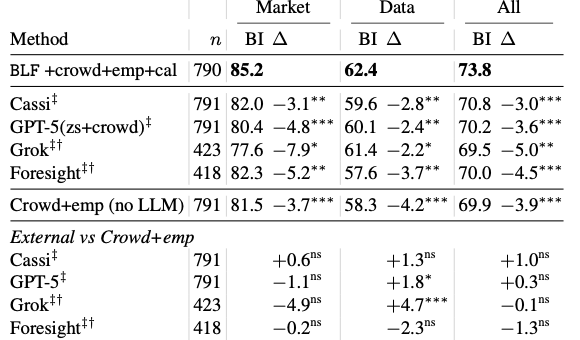
New paper: "Agentic Forecasting using Sequential Bayesian Updating of Linguistic Beliefs". Our system (BLF) matches human superforecasters on ForecastBench, and beats all the top methods (GPT-5, Cassi, Grok 4.20, and Foresight-32B). 🧵
13
33
227
30,210
Updated version: x.com/sirbayes/status/205149…
Major update to my "Bayesian Linguistic Forecasting" paper! I have now tried it on 5 different LLMs: Gemini 3.1 Pro, Gemini 3 Flash, Sonnet 4.6, GPT 5.4 and Kimi K2.5. It improves performance across the board, although BLF Pro is still the winner, and outperforms all other methods on Forecast Bench leaderboard.
1
9
2,846
Here is a video of the BLF system in action applied to this question (inspired by Albert Podusenko).
1
1
8
1,484
Finally, it is interesting to note that although my agent is Bayesian, my analysis is frequentist (bootstrap sampling distribution, p-values, etc). The reason is simple: the agent sees a single data stream, so should be Bayesian, but the analysis is about the performance of this agent across a distribution of questions, so should be frequentist. Lots more details in the paper! arxiv.org/abs/2604.18576
2
11
1,527
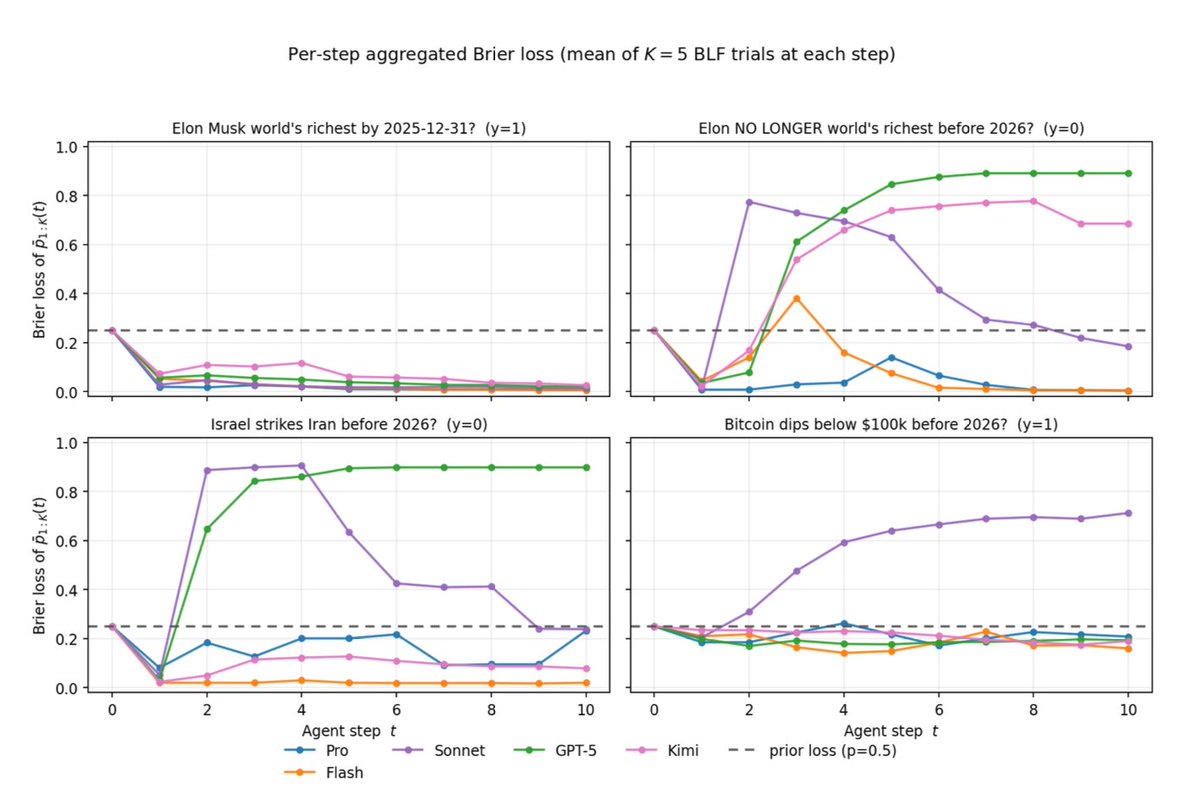
The models behave quite differently in terms of how they update their beliefs over time. Pro and Flash (and to a less degree Kimi) all behave in a "sensible" way, and reduce their prediction errors as more evidence is collected. Surprisingly, GPT and Sonnet often increase their error over time, although I am not sure why. Interestingly, these are also the two models that benefit the least from BLF.
2
1
4
1,862
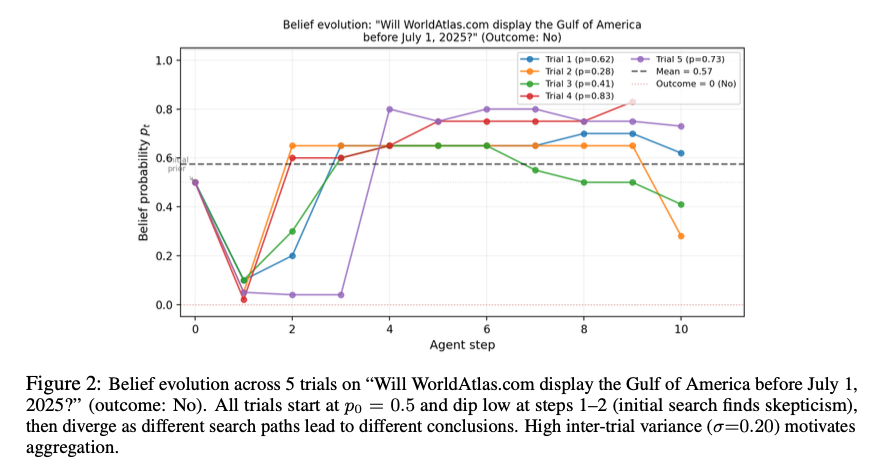
It is also instructive to look at the belief dynamics over time across trials for a single model (eg Pro) for a single question (eg. will WorldAtlas rename its map from "Gulf of Mexico" to "Gulf of America", as Trump requested - answer was No). We see that agent #2 (orange) has an "aha" moment at step 9, and sharply reduces its probability from 0.65 to 0.28, due to piecing together key evidence from various search results. (As inter-trial variance rises, the amount of shrinkage towards 0.5 increases, regularizing the prediction.)
1
1
4
1,128
I did an analysis of the effect size of each component (using a paired bootstrap test), and found that all 3 components (linguistic belief state, hierarchical calibration, and hierarchical shrinkage aggregation) help, although the magnitude depends on the model and on whether we have a crowd baseline or not. Kimi benefits the most from BLF, and comes in tied second place (after BLF Pro) - which is good news, since it is much cheaper than the other models, and is open weights.
2
1
6
2,137
Major update to my "Bayesian Linguistic Forecasting" paper! I have now tried it on 5 different LLMs: Gemini 3.1 Pro, Gemini 3 Flash, Sonnet 4.6, GPT 5.4 and Kimi K2.5. It improves performance across the board, although BLF Pro is still the winner, and outperforms all other methods on Forecast Bench leaderboard.
4
10
79
9,852
On Monday at #ICLR2026 World Models workshop, I will give a talk on "Code Synthesis for Improving Agentic Decision Making", including our AutoHarness and Code World Models work. Lots of other cool talks - check it out!
2
6
93
7,955
Cool Bayesian analysis of satoshi nakamoto identification claims by @eringger open.substack.com/pub/eringg…
1
6
73
7,603