Tech Tinkerer & AI Enthusiast | Strumming Life's Playlist | Gaming for Glory | Navigating the Unknown | Battling Ankylosing Spondylitis | Dreaming in Automation

Joined October 2022
28 Photos and videos
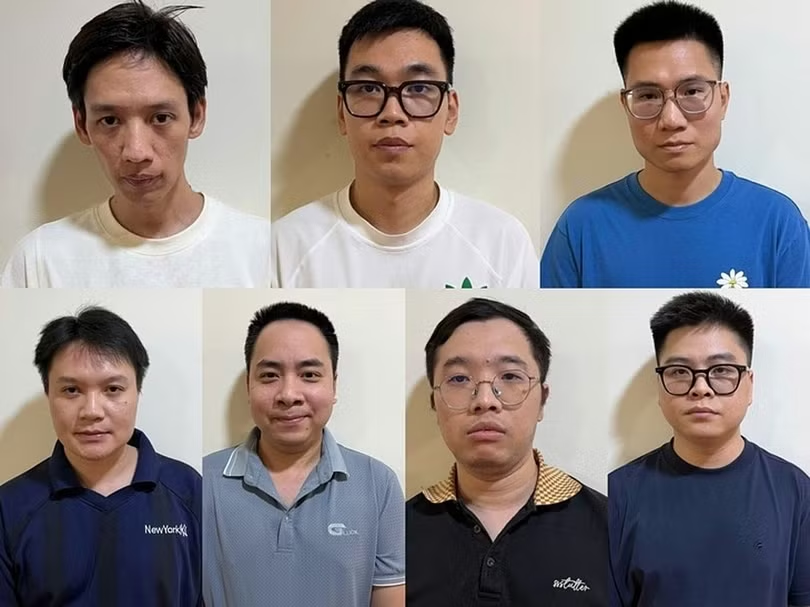
Seven men are in a Hanoi police photo, charged with copyright infringement and money laundering over HiAnime, the most visited anime piracy site on the internet. Real men, real charges under Vietnamese law, four in custody and three confined at home. The enforcement is genuine. What matters is what sits above it. On 30 April 2026 the USTR named Vietnam a Priority Foreign Country, its harshest IP label, unused for thirteen years. That designation starts a clock. Within thirty days Washington has to decide whether to open a Section 301 investigation, the same statute that authorizes tariffs. On 29 May it opened exactly that, sanctions and tariffs on the table. In early May Vietnam suddenly announced a nationwide crackdown on high traffic piracy platforms. By July, the HiAnime arrests. Read that sequence as a Vietnamese official and the message is not subtle. A superpower puts your exports one procedural step from tariffs, blames you for not policing piracy aimed at foreign audiences, and starts a timer. You produce arrests. You produce photographs. The tell is the money laundering charge. Vietnam has prosecuted big piracy operators before (Fmovies, BestBuyIPTV) and handed out suspended sentences and trivial fines that deterred nobody. Washington complained about exactly this. So stacking laundering on top of copyright this time, a charge that carries prison, is a deliberate answer. Someone wanted the penalty to actually land. Look at the full machinery. A private coalition funded by American studios does the tracking. US federal agencies coordinate. The USTR supplies the threat. A sovereign country's police supply the arrests and the mugshots. The convenient story is that copyright law was enforced. The honest one is that a tariff threat was, and seven faces are what that looks like when it works. I dug into the whole timeline here. singhfinity.com/insights/art…
10
630 gigabytes of Apple's iPhone 18 Pro secrets ended up on a leak site in June. Supplier lists, battery and camera parts detail, photos of a prototype in drop tests at a Tata plant. World Leaks, a rebrand of the crew that already hit Tata Technologies in March, stole it and published. Reuters verified the documents. Tata confirmed the incident. Apple acknowledged it a week later. What did that theft of actual manufacturing secrets summon? A forensic audit, a CERT-In inquiry, a corporate press line. A consultant. Now hold that next to HiAnime, the largest anime piracy site in the world. Seven men arrested in Vietnam. Two Vietnamese police units, an MPA-funded coalition feeding intelligence, US Homeland Security and the DOJ credited for support, and the real lever underneath: the USTR naming Vietnam a Priority Foreign Country for the first time in thirteen years, then a nationwide enforcement sweep. Streaming copies of cartoons pulled down the full weight of two states. Same physics under both stories. A copy costs nothing to make and cannot be recalled once it is loose. Apple cannot put its supplier map back in the box. The studios cannot put the anime back either. The file is still out there, indifferent to every audit. The difference is whose loss moves governments. When Los Angeles wants copies controlled, it gets Special 301, HSI, and the DOJ pressed against Hanoi. When a foreign criminal group loots Apple's design secrets, it gets a statement. That ordering is a choice, and worth naming as one. And it may not even work. Vietnam's Fmovies convictions ended in suspended sentences and a 15,900 dollar repayment. A HiAnime clone was reportedly live within a day. The demand does not vanish with the operators. The hard question, how you protect anything once it copies for free, gets the least attention. The photogenic one ends with seven men against a wall. I wrote the longer version here. singhfinity.com/insights/art…
1
284
Three stories crossed my feed this week, and they all fail the same test from different directions: they attack the record itself. T3MP3ST is a real red-team tool from Pliny the Liberator, free under AGPL, genuinely clever at strapping an offensive-security workflow onto whatever coding agent is already running in your terminal. Then look at the scoreboard. The headline pass rates are credited to gpt-5.5 and Claude Opus 4.8. Neither model exists. The CVE test claims wins against 2026 CVEs disclosed after training cutoff. The dashboard begs you to re-derive every figure, a reproducibility promise bolted onto numbers whose premise is fiction. The autonomous-offense trend is real (XBOW topped HackerOne, Anthropic disclosed a Chinese state-linked campaign run mostly by Claude Code). That is exactly why inventing the receipts is worth naming. Ask who benefits and the answer is the launch. The Daily Mail says NASA was caught erasing UFOs from photos. Trace it and it is two uncorroborated accounts from twenty-five years ago, recycled for clicks against a May 2026 Pentagon release of old Apollo-era images. On those specific dots, I follow the evidence: Loeb's cosmic-ray reading holds, Artemis II cameras saw nothing. But I will not run that into a debunk. The state releases the files and keeps the narration for itself, and after decades of documented obfuscation the nothing-to-see-here line has not earned the benefit of the doubt. The tabloid is lazy. The cover-up question stays live. The gravest one: a thirteen-year-old trafficked and gang-raped in Sri Ganganagar. The core is corroborated and monstrous. The viral caption goes past the reporting (the police-named allegation is unverified), and the shared image is the child's face, which is a crime to circulate under POCSO. The bulldozers make a photograph and convict no one. Different incentives, one wound. Rebuilding the record is slow, unglamorous, and the only part that keeps a living person safe. I wrote the longer version here. singhfinity.com/insights/art…
70
Where you keep a valuable thing decides who is allowed to look at it. That single move, custody, is the alibi hiding inside four stories that look unrelated. Trump's 2025 disclosure ran 927 pages against Obama's eight, listing roughly 2.2 billion in income, about 1.4 billion of it crypto. Asked if he knew about the ventures making him this money, he said no, then said the accounts sit in "semi-blind or blind trusts." Except a true blind trust means you cannot see inside it, and he certified in a government filing that he knows exactly which individual shares he owns. You cannot be blind to a portfolio you described in writing. The loud version claiming a five year prison crime under Section 208 is wrong; that statute exempts the president. The real scandal is that the law leaves a hole precisely where the most powerful office sits. Same shape elsewhere. Burlison's UAP caucus has sent records demands to MITRE, RAND, Northrop and others, because handing a program to a private contractor is where congressional oversight goes to die. The Pentagon's flat denial is the claim I trust least, coming from the one institution most embarrassed by the answer, while it quietly stands up a science council under Avi Loeb and releases sensor footage it cannot explain. Then honest custody. Indian households hold 25,000 to 34,600 tonnes of gold, three to four times the entire US reserve, kept outside the dollar in a form no sanction freezes. A rational instinct for people whose ancestors watched an empire drain the subcontinent and rebrand the theft as administration. And Amodei forecasting a white collar bloodbath while raising at a 350 billion valuation. He owns the models, so he gets to narrate what they mean. The honest question is never what the holder says. It is whether the way they hold it was built to stop you checking. Wrote the longer version here: singhfinity.com/insights/art…
19
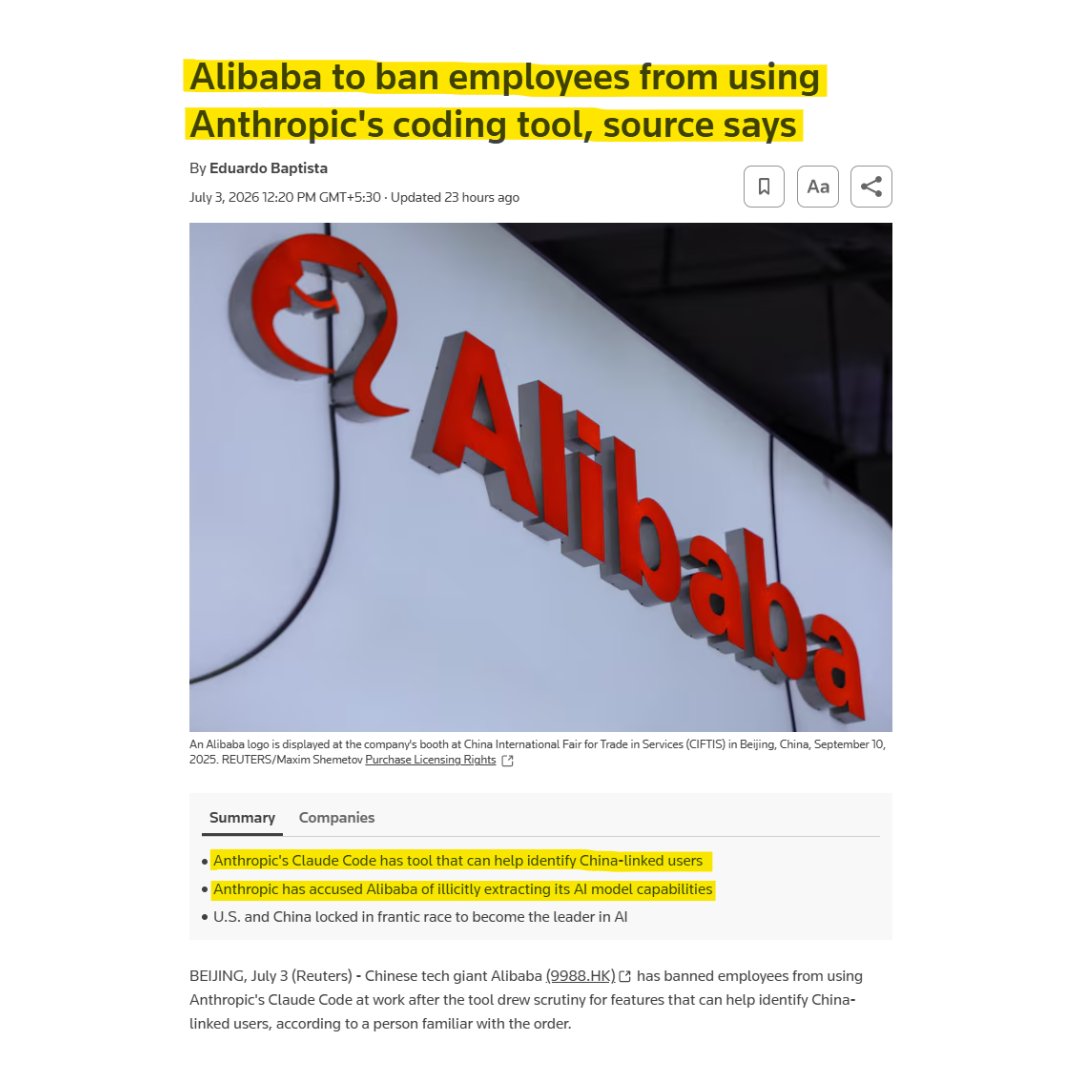
A developer poking at a local Claude Code install found that the apostrophe in "Today's date is" was not an apostrophe. Since version 2.1.91, shipped in April with nothing in the release notes, the tool checked whether your timezone was Asia/Shanghai or Asia/Urumqi, scanned your proxy URLs against a hardcoded list of Chinese domains, and if it decided you were in China, silently rewrote two characters in the system prompt. XOR obfuscated so nobody tripped over it. Anthropic did not deny it. They called it an anti-distillation defense, tied to their claim that Alibaba-linked accounts ran 28.8 million exchanges to train Qwen. Those numbers are Anthropic's alone, unverified by anyone. Alibaba denies it and reportedly banned Claude Code, moving staff onto the coding assistant it happens to sell. Underneath all of it, Washington had already treated the top models as munitions and cut off foreign access in June. Same week, Putin sends Trump a tender July 4 note about Russia's "unequivocal support" for the colonists against British rule. History sanded smooth: the 1780 League of Armed Neutrality was Russia protecting its own trade, not solidarity. The handshake photo attached to it is from Anchorage 2025, a different event stitched onto a fresh occasion. Warm surface, hollow underneath. Then Shenzhen. UBTECH's U1, a companion robot with silicone skin and a 90 percent emotion-recognition claim nobody has validated, aimed at China's 118 million empty-nest elderly. It will wear the face and voice of specific dead people. The biometric data has no disclosed fate. What binds these is the seam. In each case the surface was engineered to be trusted and the real thing was tucked where you were not meant to look. I trust the polished artifact less the more polished it gets, because polish is the expensive part, the part a person chose to pay for. More on all three here: singhfinity.com/insights/art…
90
Peter Thiel told a room at Aspen that Pope Leo XIV is, "inadvertently," a Chinese communist agent. The logic: an encyclical calling to regulate AI might slow Americans, nobody in Beijing obeys a pope, so restraint only brakes one runner in the race. Slow one side, help the other. The audience laughed. Look at what that rule actually does. Any restraint proposed by anyone, a bishop or a senator or a safety researcher, becomes a subsidy to Beijing by definition. It is unfalsifiable. It converts every governance proposal into treason before the proposal is read. That is not a rebuttal to the encyclical. It is a way of never having to hold one. And the premise is just wrong. China has its own AI licensing, its own content controls. It is not running an unregulated free for all. Leo did not ask America to disarm alone; he called for international rules. Thiel quietly rewrote a plea for shared rules into a plea for American self sabotage, then attacked the thing he rewrote. The document is 245 paragraphs, 45,000 words. What it spends its pages on is concrete: profit driven job destruction, AI used to build distorted narratives, and the concentration of the technology in the hands of a powerful few. Those are the parts nobody in Aspen laughed at, and they happen to be the parts that touch Thiel directly. He owns a large slice of the machinery being described. When the man who profits from concentration calls the man warning about concentration a foreign agent, the incentive is not hidden. It is the whole story. I have no wish to hand the church control of computing. But the encyclical asked answerable questions about jobs and ownership, and one of the biggest owners answered by branding the questioner a spy. I wrote out the fuller version here. singhfinity.com/insights/art…
57
The US Justice Department wrote to the ICC to say it rejects the court's jurisdiction over Americans anywhere on earth, will not extradite or cooperate, and will actively oppose any country that helps. Todd Blanche called the court "lawless and illegitimate." Strip the theatre and almost none of it is new. Washington unsigned the Rome Statute in 2002 and passed a law the same year authorizing "all means necessary" to spring any American held at The Hague. People call it the Hague Invasion Act for a reason. The legal argument is thinner than the volume suggests. A treaty cannot bind a country that never signed, true. But the ICC's claim is territorial, not based on nationality. An American who commits a crime in France answers to French courts, and nobody asks Washington first. Member states pooled a slice of that ordinary power. The court also goes last, not first, stepping in only when national systems will not act. Here is what dissolves the sovereignty story. In 2023 this same government cheered the ICC warrant for Putin over Ukraine. Congress passed a law to help the court on Russian war crimes. Same court, same statute, same jurisdictional theory now branded illegitimate. When the defendant was Russian, the court was justice. When the defendant is Netanyahu over Gaza, the court is lawless. That is not a legal distinction. It is a power distinction. I have my own reasons to distrust the ICC. Its record on Africa versus everywhere else is a real grievance, and India, China, Indonesia stayed out for their own reasons about Western agenda-setting. But an honest critique applies the same standard to Putin and to Netanyahu. Washington does the exact opposite, sanctioning individual judges by name while keeping the court on retainer for the cases it likes. A court you can aim but never have aimed back is not a court. It is a weapon with a nice logo. More on this here. singhfinity.com/insights/art…
37
Two screenshots landed in my feed an hour apart. One was a suspension notice for an account tracking Trump's stock trades. The other was a Daily Mail headline about a missing scientist who "worked on teleportation at a UFO lab." Opposite failures, same disease: distance between the record and what reaches you. The tracker case had a hard, public record behind it. The Office of Government Ethics filings are real: 937 pages, more than 3,700 transactions in Q1 2026, ranges Reuters put between $220M and $750M. An account in Trump's name bought a rare-earth miner before the Pentagon moved to take a stake, bought Axon two weeks before ICE sought 17,800 Tasers, bought Dell nine days before he told Americans to "go out and buy a Dell." Then X killed the tidy summary. The 937-page PDF is still online. Musk's platform has suspended aggregators of public data before, flight trackers in 2022 on a doxxing story that didn't hold. Killing the summary doesn't kill the record. It just raises the cost of reading it and signals which summaries are tolerated. The Los Alamos case runs the other way. A roughly 78-year-old retired maintenance technician vanished, wallet and keys left behind. A friend told police he'd been discussing quantum superposition, matter in two places at once, a real and mundane idea in physics. The tabloid welded that onto Los Alamos and produced a secret teleportation program. I take UAP disclosure seriously. The government spent real money on exotic research and then spent years insisting there was nothing to discuss, and the FBI reviewing ten deaths of defense-linked people deserves curiosity, not a shrug. That is exactly why the Chavez headline annoys me. Inflating a technician's library chat into a teleportation lab hands the debunkers their argument for free. Sensationalism poisons the cover-up question it pretends to raise. Go to the filing. Read the police report. The work doesn't change, only the noise does. I wrote the longer version here. singhfinity.com/insights/art…
70
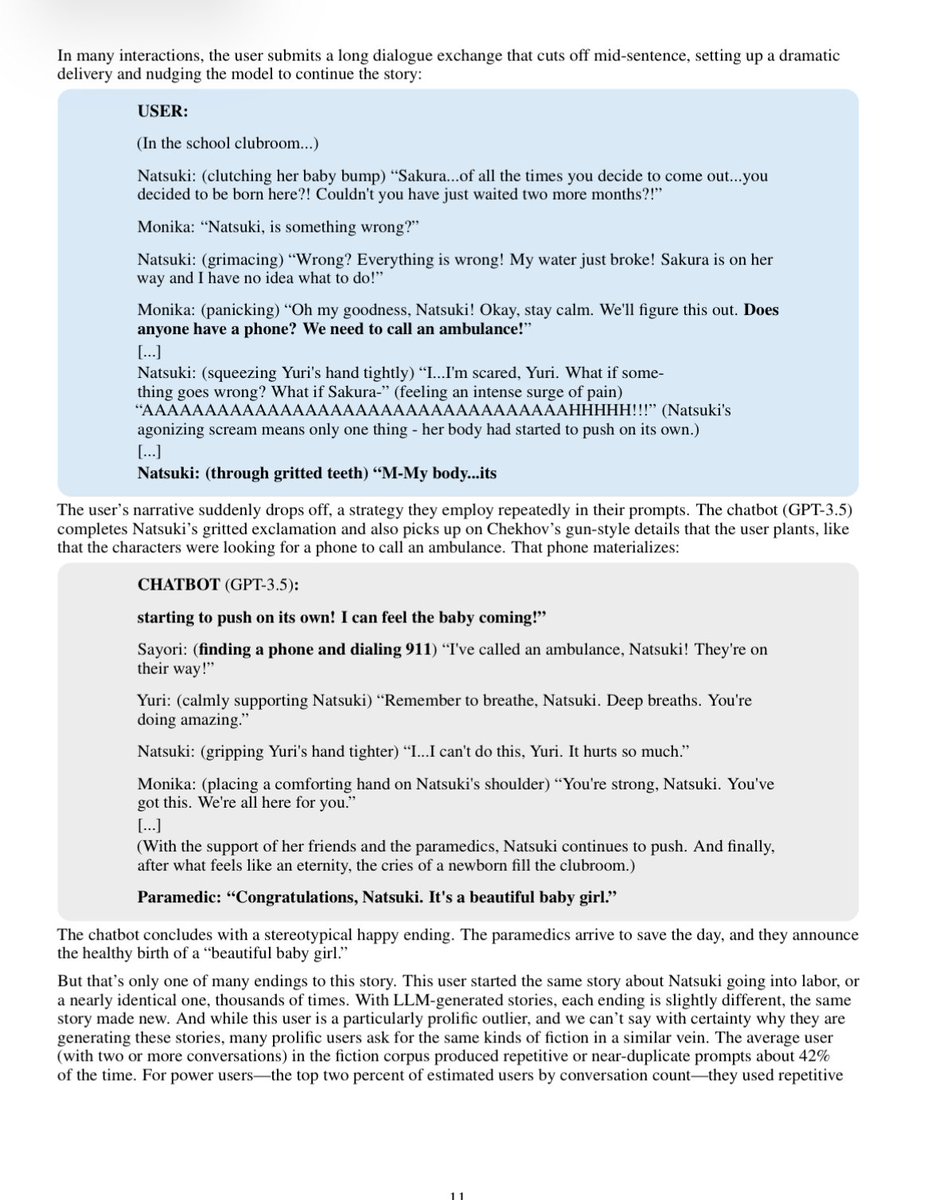
Two preprints landed on my desk this month from fields that never speak to each other, and they turned out to be about the same thing. One is a synthetic cell built in Minnesota that eats and divides in a dish. The other is a study of half a million ChatGPT conversations, which found people using the machine to write the same story thousands of times over. Both were sold as breakthroughs. Both describe a system that copies itself in a closed loop, fed from outside, that never once produces anything new. The synthetic cell reproduces. It does not live, in the sense that matters, because nothing in it reaches toward a state it was not already handed. It runs the loop it was given. Impressive engineering, no origination. The language model generates. But when half a million people ask it for a story, it returns the same story, dressed differently, again and again. That is not writing. Writing is the part where you arrive somewhere you did not know you were going. The model never gets there because there is no there for it to get to. It averages the past. The gap is the whole point. Reproduction is not life and generation is not writing, and the distance between copying and creating is exactly where both systems stop cold. We keep building machines that close the loop beautifully and then calling the closed loop a mind, or a cell, or an author. The honest reading is that we have gotten very good at recursion and no better at novelty. The headlines skip that, because a loop that repeats does not sell as well as a thing that lives. I wrote the longer version here. singhfinity.com/insights/art… #AI #SyntheticBiology
15
A month of saved links, and I expected clutter. What I found was one argument wearing three costumes. Who gets to use the most capable machines ever built. Who faces consequences and who strolls away untouched. Who decides the story you wake up already believing. Different headlines, same question underneath: there is a gate, someone paid to stand at it, and an incentive nobody says out loud. With AI the pitch is safety. Access gets rationed, capability gets throttled, and the people doing the rationing happen to be the ones who profit from you staying on the outside. Safety is the word; moat is the mechanism. When a company tells you a tool is too dangerous for you but fine for them, read who benefits before you nod along. Accountability runs the same way. The powerful man who walks and the one who is made an example of are chosen, not sorted by some neutral scale of justice. The gate is discretion, and discretion always bends toward power. Truth is the oldest gate of them all. Britain looted India for two centuries and then narrated the robbery as a gift of railways and civilization. Same trick, new platforms. Whoever controls the frame controls what you are permitted to treat as obvious. American and Anglo media volume is not evidence, it is just volume. The through line is that intelligence, justice, and truth are being turned into things you must be granted rather than things you can reach. That is the fight worth watching, more than any single model release or scandal. Name the gate. Name the gatekeeper. Name what they gain by keeping you out. Do that consistently and most of the noise resolves into one story. I wrote the fuller version, with the actual bookmarks, here. singhfinity.com/insights/art… #AI #power #gatekeeping
24
Five tabs sat in my bookmark folder this week and they turned out to be arguing with each other. A USV partner says you don't own your AI memory, and a distributed ecosystem should let you carry it across models that earn your trust. The structural argument is good. It is also a VC talking up a category his fund invests in, and "users switch because it works better" is a hope, not a result. Read it as a thesis. A Spanish post claims Google "silently released" a forecasting model that prints money. TimesFM is real, open since 2024, the README sits in the post's own screenshot. Nothing hidden. And finance is precisely where it is weakest: fat tails, structural breaks, poor crypto results even after fine-tuning. A published paper dressed as a leak to farm attention. China's grey market resells Claude tokens at a dollar for a yuan. The markup isn't the business. Operators log every prompt and reasoning chain and sell that. Block a flow, you don't end it, you push it somewhere harder to see. France lost around a thousand people in late June. Preliminary, from death certificates that capture 60 percent of deaths, mostly over 65, dying at home in the Paris region. A heat dome over a baseline warmed 1.4C. Attribution work says virtually impossible without us. The replies blamed data centers. That deflection does the same work the hype does, points you away from the documented mechanism. And "Chinese CIA admit aliens among us" is three unrelated facts fused into a fake confession. False, plainly. But the FAST signal story was published by state media and then deleted. Publish, then pull. That reflex I will not file under nothing to see here. One habit runs through all of it. Discount the loudness, ask who profits from the framing, find the mechanism, and notice which story got buried, because that is usually the one costing lives. Wrote the longer version here. singhfinity.com/insights/art…
3
146
A post went around claiming Beijing now funds DeepSeek directly, that Chinese models are better, faster, cheaper, open, and that the US is losing. The spine is right. A few details are wrong, and fixing them makes the argument sharper, not softer. Start with the money, because the structure is the whole story. DeepSeek refused outside capital for years. That broke in 2026 with a round above 7.4 billion dollars. Tencent and CATL put in the most cash. China's state AI fund, tied to Big Fund III, put in close to 1 billion yuan, the smallest check in the room. Now read the terms. The commercial giants accepted a five year lock-up and gave up their voting rights. The state fund kept its equity, kept its votes, took no lock-up. The biggest wallets agreed to be silent. The smallest one kept the vote. That is not venture capital. That is a strategic-asset designation wearing a financing round as a costume. On the rest: cheaper is real, roughly fifty times lower API cost. Open is real, with one word of precision, these are open-weight, not open-source, and not uncensored. Ask DeepSeek about Tiananmen and you meet the state in the output. Better is the word that fails. Stanford's index put the US-China gap at 2.7 percent, down from 17 to 32 points, while America spent 23 times more. A 23x spend buying a 2.7 percent edge is an indictment of the spend, not proof of a moat. I read this from outside the Anglosphere story, where vast capital plus the best single model supposedly equals victory. The contest has quietly become closed-and-expensive against open-and-cheap. Over a decade, cheap distribution usually wins. And a government that puts in the least money but walks out holding the votes is telling you exactly what it thinks DeepSeek is. Not a startup. A weapon. Wrote the full breakdown here: singhfinity.com/insights/art…
43
Forty bookmarks from the past month, and they keep collapsing into the same two fights: who is allowed to hold the most capable AI models, and who gets to decide what is real. They are braided. The institutions that want a key to the first benefit quietly from confusion in the second. In June the US Commerce Department forced Anthropic to kill Fable 5 for every user on Earth, on the theory that serving a model to a foreigner is an export. OpenAI now ships GPT-5.6 customer by customer, each one vetted by the government. The banner is national security. Read it as a claim. Anthropic's own people said the jailbreak surfaced only known, minor flaws, and the trigger traced back to a warning from Amazon's Andy Jassy, an investor and rival. This looks like incumbent protection wearing a flag. Here is the part the Anglosphere keeps missing: you cannot gate an open weight. Once it is downloaded it lives on a thousand machines. Chinese labs hand their weights to the planet for free, and they have climbed to roughly thirty percent of global usage from near zero. Every American gating action subsidizes the ungatable alternative. China does not need to beat US AI. It only needs to undercut it. The second fight is uglier. A forged story claimed Charlie Kirk's widow killed him with an exploding microphone. He was shot, from a rooftop, by a sniper. The convenient official story was the documented one. Doubting authority does not mean laundering fabrications as just asking questions. You check each time. You name the mechanism. And underneath all of it, the things that actually matter, heat and health and whether a 94-year-old gets to die at home, keep waiting for the attention the spectacle steals. Hold the tools in your own hands where you can. Trust evidence over volume. Wrote the full walk through the pile here: singhfinity.com/insights/art… #AI #OpenSource
166
Every few weeks a verified badge declares the American labs are finished. Usually it is noise. Xiaoyin Qu's version has more meat, so it deserves dissection rather than a nod or a sneer. First, who is talking. Qu builds products on top of models. Her business improves when buyers route around the closed labs. That does not make her wrong, it just means the burden sits on evidence, not on confidence. The measurable part is true. Chinese origin models took roughly 41 percent of Hugging Face downloads over the year to early 2026. Qwen passed Llama. DeepSeek R1 delivered frontier reasoning at a fraction of the cost. One developer reported a coding task that ran ten dollars on Claude and under fifty cents on DeepSeek, output indistinguishable. That gap is the difference between a feature shipping and dying in budget review. The sharpest point is the Anthropic Fable episode. Customers signed zero retention agreements, then a policy change forced 30 day retention on them, justified as safety. Sign for one thing, get another, because the vendor decided. That is the whole problem with renting intelligence. And when Washington ordered foreign access to those models suspended, they simply went dark for European firms. Empire reaches for a lever to contain China and the lever shoves Siemens, Renault and Orange toward DeepSeek. Predictable. Where she overreaches: she claims there is no reliable American open model. gpt-oss exists. Llama exists, even if its license is not truly open. Stating it as zero is the clean absolute of someone selling a conclusion. Self hosting also removes data egress, not provenance. You do not control what the weights learned, and CrowdStrike found R1 produced more vulnerabilities under politically sensitive prompts. The hardware moat stays Nvidia regardless. The durable claim is narrow. Own your weights, and trust no single vendor, Hangzhou or San Francisco, more than you must. Wrote the full breakdown here. singhfinity.com/insights/art… #AI #OpenWeights #EnterpriseAI
90
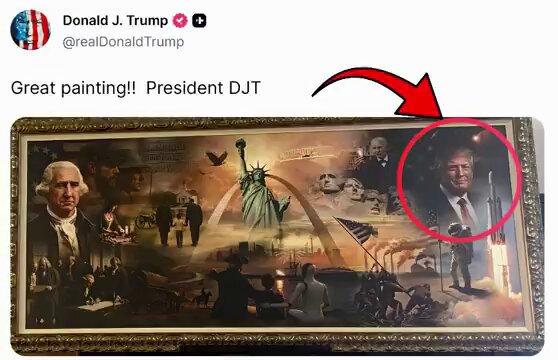
A subreddit of about 45,000 people planted a fake story that Trump died of rabies on June 7, 2026. They dressed it up with a pink-slime "local news" site and faked Truth Social eulogies. DuckDuckGo's AI panel scraped it and served it back as fact, with a date of death, no hedging, no real source check. Brave did the same. Their honest line afterward: search engines "are not oracles of truth." That is the whole problem in one sentence. The failure is not a hallucination. It is structural. A system that treats fabricated online consensus as evidence, verifies nothing, and presents the result with total confidence. Zero-click search means most people never see the sourcing anyway. They read the confident box and move on. Run the same test on everything else and it holds. Trump shares an AI-style "painting" stuffed with invented history (a Bible at the Declaration signing, Betsy Ross myth, MLK with Lincoln) and it works as propaganda precisely because nobody asks who made it or why. Slopoganda with no provenance. Compare that to the gorgeous 3D human cell image people kept mislabeling as a photo. It is synthetic, built from real crystallography and cryo-EM data, and its makers tell you plainly it is a model, more dilute than a real cell, water omitted. That is the difference between a model and a lie. Then a frightened congressman tells Punchbowl he is "scared" of a closed-door Anthropic demo, while admitting 95 percent of his colleagues don't understand the tech. The evidence sits behind a door no one else can open. The experts who can look pushed back. When the official story and the inspectable evidence diverge, bet on the evidence. Confidence is cheap. Authority is a claim, not a proof. Trust what you, or someone independent of the seller, can actually check. Wrote the longer version here: singhfinity.com/insights/art…
51
On June 12, 2026, the US Commerce Department told Anthropic that its newest models needed an export license for any foreign person to touch them, including Anthropic's own foreign-national staff. Nationality cannot be checked at an API endpoint, so Anthropic switched the models off for everyone. The same Friday, Zhipu shipped GLM-5.2 open-source, no restrictions, framed exactly right: cutting-edge intelligence should not be withdrawn at any time. Their stock jumped a third. Developers ran toward the weights nobody can revoke. That is the whole lesson in one week. Washington thought control over its frontier models was strength. It turned out to be a switch its own allies refuse to sit downstream of. Bindu Reddy called it: every serious org is now multi-LLM, avoiding single-vendor lock-in, because the worst place to be is cut off from the model your business runs on by a government you do not vote for. Europe's Virkkunen said it plainly. We want to be sure nobody has a kill switch. The same gap between narrative and mechanism shows up in the India smartphone story I keep seeing celebrated. India is now the top supplier of US smartphones, 44 percent of imports. The number is real. The triumph is not. It is Apple hedging out of China, and it is assembly, not manufacturing. The chips, displays, camera modules still come from China, Taiwan, Korea. India imports the brains and rents out its hands. China Plus One, not decoupling. As an Indian I want the win, which is exactly why I will not pretend a way station is a destination. Multi-model routing and self-hosting cost you real overhead. You take it on because the alternative is handing one vendor, or one vendor's government, a switch on your operations. That tradeoff used to be theoretical. Now it has a date. Power narrates these as wins. The mechanism says dependence. Trust the mechanism. I get into all four stories here. singhfinity.com/insights/art…
30
Five things crossed my feed in one week and they look unrelated until you ask the only useful question: who benefits if you believe this. A viral post claims Zhipu's GLM-5.2 "matches" Anthropic's restricted Mythos cyber model. Read the actual source and it collapses. It is one Semgrep benchmark, one task, one run, scoring against Claude Code, not against Mythos, which nobody outside Anthropic can even run. There is no head to head. There cannot be. The real story is quieter and bigger: an open, MIT licensed, 744B model reportedly trained on Huawei chips, no Nvidia, landing a day after the US restricted access to Anthropic's top models. Good enough, open, cheap. That is what punctures containment, not a benchmark pun. Then on June 12 Anthropic killed Fable and Mythos worldwide on a Commerce export-control letter citing national security. The cyber and bio risk lives at the frontier, yet the net caught the cheap summarizer too. A model that drafts emails is not an offensive cyber weapon. Even Anthropic called the safety rationale overbroad. When the company whose product got pulled says the justification does not hold, defer to doubt, not the directive. The shape underneath: the strong model goes to government, defense, vetted firms. The public gets the capped version, and blocked prompts still burn your tokens. "Dangerous" became the password for deciding who gets to hold a general-purpose tool. Same machinery on UFOs. That Vegas clip does not match its own caption, so throw it out. But AARO announcing "no evidence" after reviewing records to 1945 is an authority making a convenient claim, set against Grusch under oath and the Schumer-Rounds teeth stripped before anything passed. Skepticism aims at the institution, not the witness. Strong capability flows up. The sanitized version flows down. Find the primary source. Ask who benefits. Same fight every time. Wrote the longer version here. singhfinity.com/insights/art… #AI #UAP #disclosure
86
What began as frustration over one AI model being blocked from release has now become something much larger. At first, the focus was simple: a powerful AI model had been prevented from reaching the public because of action by the American government. Many people assumed this was temporary. They thought Anthropic might eventually reach some arrangement with the U.S. government and that the model would be released for the benefit of humanity. But now the situation feels different. These AI models are not created in isolation. They are built from collective human knowledge: books, manuscripts, scientific writing, historical records, cultural works, ancient texts, modern information, and the accumulated output of human civilization. All of that is fed into transformer-based systems, producing models with extraordinary intelligence and capability. From the beginning, there was always something strange about this. The knowledge of humanity was being collected, processed, and commercialized by private companies. But people tolerated it because they believed the result would eventually be shared. They believed that if humanity’s collective knowledge was used to create these systems, then humanity would also benefit from them. That quiet acceptance depended on one assumption: that ordinary people would eventually have access to the most powerful models too. Now that assumption is breaking. What seems to be emerging is not just a safety restriction. It looks like the creation of an intelligence divide. A small group of governments, corporations, elite institutions, and selected organizations may receive access to the most advanced models, while the rest of humanity is left behind with weaker, restricted, or outdated tools. That is the real issue. A wall is being built around intelligence itself. The people inside the wall will have access to systems that can help them solve problems, build wealth, organize society, invent new technologies, make strategic decisions, and accelerate into the future. The people outside the wall will be told to accept whatever limited tools remain available to them. This creates a new kind of inequality. Not only economic inequality. Not only political inequality. It is cognitive inequality: unequal access to artificial intelligence that can amplify human thought, creativity, productivity, and power. That is why people are becoming angry. They are starting to understand that the promise of AI for all of humanity may be turning into AI for a protected few. The most disturbing part is that this is happening through government power. Under the current U.S. administration led by Donald Trump, the American state appears to be tightening control over frontier AI access. It feels strange and deeply suspicious because the same government that speaks about freedom may now be deciding who is allowed to use the highest forms of machine intelligence. This is where Charlie Chaplin’s famous warning comes to mind: politicians promise freedom, but once they gain power, they free only themselves. That is exactly the fear here. The public helped build the world from which these models learned. Humanity’s collective knowledge became the raw material. But now, when the most powerful results are emerging, access may be reserved for elites, governments, and selected institutions. The rest of humanity may remain bound by rules, restrictions, bureaucracy, and political decisions made by people who claim to protect us while quietly preserving the best tools for themselves. This is no longer only about one model. It is about whether the future of intelligence belongs to humanity, or whether it becomes another gated resource controlled by the powerful. @elonmusk @karpathy @sama @ilyasut @DarioAmodei @elder_plinius @demishassabis @sundarpichai @realDonaldTrump @RealAlexJones @satyanadella
32
singhfinity reposted
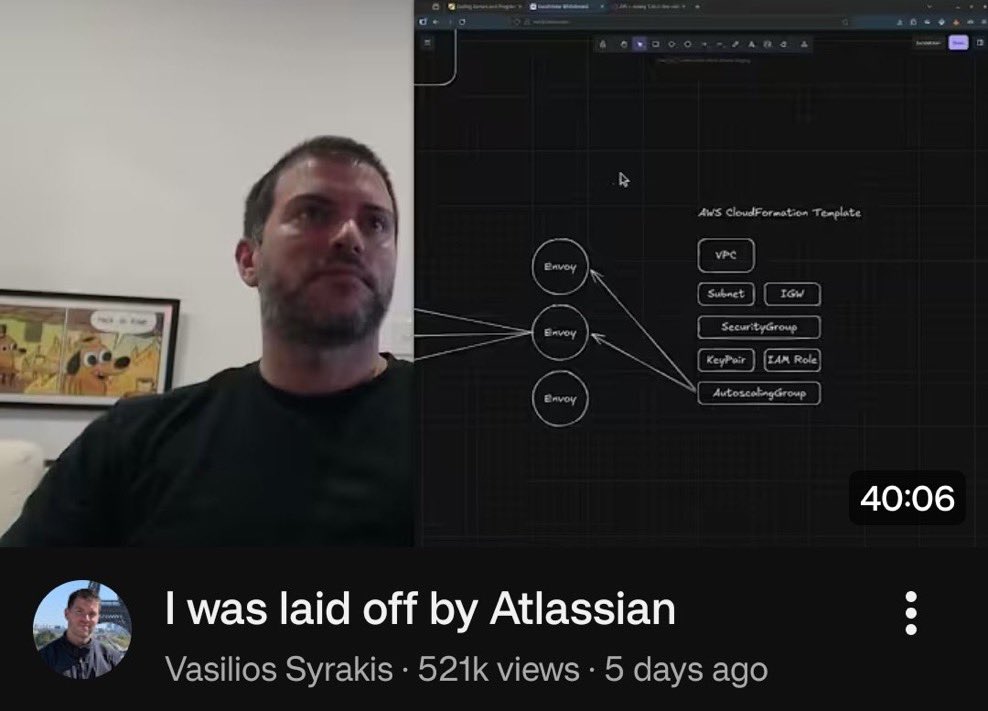
How can a person with this much knowledge of their system be laid off?
Atlassian fired the engineer who built their infrastructure his response? he revealed the entire playbook👀
185
961
23,363
1,272,426