Joined May 2025
11 Photos and videos
Pinned Post
🎉 SGLang v0.5.14 is out! First, we welcome 55 new contributors to this release 🙌 And the supported new models: GLM-5.2, Kimi-K2.7-Code, LiquidAI LFM2.5, Poolside Laguna-M.1, DiffusionGemma, Zyphra ZAYA1, and MiMo-V2-ASR. Here are the highlights for this release: - New LPLB load balancer that evens out MoE expert traffic across GPUs (DeepEP) - Kimi-Linear (KDA) runs faster on NVIDIA Blackwell with a new CuteDSL prefill kernel - Lower memory use for linear-attention (GDN/KDA) models - Faster multi-GPU communication with MSCCL and MNNVL allreduce fusion - Nemotron now supports DP attention and MTP - Breakable CUDA Graphs now run on AMD ROCm/HIP - Multiple DeepSeek-V4 performance updates: NVFP4 MoE, FlashMLA head64 decode, and faster FP8 quantization Thanks to our amazing partners and model makers: @NVIDIAAI @AMD @intel @Kimi_Moonshot @Zai_org @liquidai @poolsideai @GoogleDeepMind @ZyphraAI @XiaomiMiMo Now. MAX LOAD! MAX OUTPUT!
7
17
99
9,521
Hy3 final looks like a solid step up from the preview. For a ~300B MoE model, it’s showing pretty strong performance. Congrats to @TencentHunyuan team!
🎉 Meet Hy3 from @TencentHunyuan, a 295B MoE with 21B active params and 256K context. Day-0 support is now live in SGLang! 1️⃣ Agent-first: rivals flagship open-source models with 2–5x the parameters across reasoning & agentic tasks 2️⃣ Anti-hallucination training: hallucination rate cut from 12.5% to 5.4% in real-world evals 3️⃣ Multi-turn intent tracking: MRCR jumps from 42.9% to 75.1% 4️⃣ MTP EAGLE speculative decoding out of the box, with an FP8 checkpoint (Hy3-FP8) for cost-effective serving Cookbook: docs.sglang.io/cookbook/auto… Run it now with SGLang!
1
23
1,508
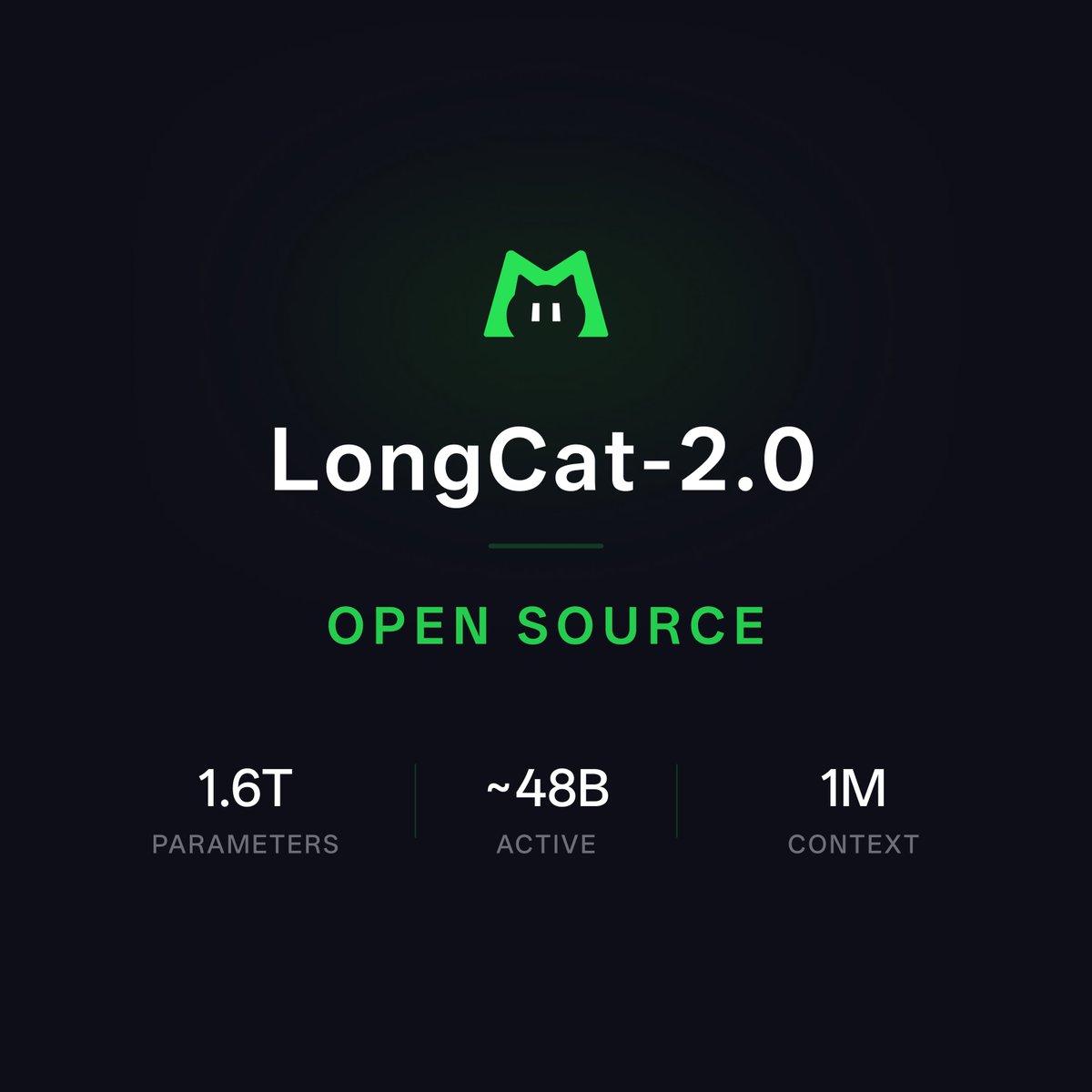
Owl Alpha, the model that hit Top 3 Call Volume on OpenRouter right after launch, is now open source. It's LongCat 2.0 by @Meituan_LongCat, exclusively supported by SGLang. Download the weights and deploy it yourself. Everything you need is in the model card 🐱
🐱 LongCat-2.0 is now fully open-source — MIT licensed, no restrictions. Since our launch a few days ago, the response from the community has been incredible. Thank you for all the feedback, discussions, and interest. Today, we’re releasing the model weights and inference code to everyone. ◆ 1.6T MoE · ~48B active · 1M token context ◆ Agent-native: Integrates directly with Claude Code, OpenClaw, and Hermes Agent ◆ Deployment: Support both GPU and NPU platforms— verified on large-scale domestic clusters 📑 Tech Blog: longcat.ai/blog/longcat-2.0/ 🤗 HuggingFace: huggingface.co/meituan-longc… 💻 GitHub: github.com/meituan-longcat/L… 🪄 ModelScope: modelscope.ai/collections/me… 👇 Inference Code GPU: github.com/sgl-project/sglan… NPU: github.com/meituan-longcat/S…
4
26
3,372
We've spent months encoding our team's hard-won engineering know-how (benchmarking, profiling, CUDA kernel tuning, production triage) into executable agent skills. Now agents handle the repetitive grind, and developers focus on the hard calls. And it's working! 3 KDA-Pilot kernel PRs already merged upstream, up to 2.75x kernel speedups on B200, 71.4% serving throughput on Qwen3-Next. Huge effort from the team, and we're just getting started. Dive in 👇
🚀 New blog: Agent-Assisted SGLang Development, the story of how we turn benchmarking, profiling, and kernel optimization know-how into executable agent skills. Agent-assisted workflows are saving our team massive engineering hours while delivering major gains across the stack: ⚡️ 71.4% throughput & TTFT 456→168ms for Qwen3-Next via allreduce fusion ⚡️ 29–49% TTFT reduction on long-context prompts via router tokenization deduplication ⚡️ Up to 2.32x diffusion denoising speedup via Spectral Progressive Diffusion ⚡️ 10 B200 kernel tasks at 1.13x–2.75x speedups via KDA-Pilot; 3 PRs merged upstream ⚡️ 1.41x faster LTX-2 VAE decode, saving 9.7 GiB peak memory And rigor is built into every step: benchmarks are fixed before any patching, baseline and candidate share the same ABI, and every change must be backed by profile evidence, eliminating benchmark reward hacking. Each iteration passes a Humanize/RLCR review loop before proceeding. Read the full blog to see how we're rethinking development workflow 👇
1
18
145
10,286
SGLang reposted
SGLang Office Hour 7/2 x.com/i/broadcasts/1OGwbbqPM…
1
10
1,278
SGLang reposted
🎉 Day-0 support for Laguna XS 2.1 from @poolsideai is now live in SGLang! This is a 33B total params MoE built for agentic coding and long-horizon work on your local machine. 1️⃣ Native interleaved thinking between tool calls, toggle per-request 2️⃣ Mixed SWA global attention (3:1 across 40 layers) with sigmoid gating 3️⃣ FP8 KV cache 262K context — runs on a Mac with 36GB RAM 4️⃣ 70.9% SWE-bench Verified, 5.4% jump on SWE-bench Multilingual vs XS.2 Cookbook: docs.sglang.io/cookbook/auto… Run it now with SGLang!
Today we’re releasing Laguna XS 2.1. It’s a small upgrade to the Laguna XS.2 model, the same 33B total / 3B active MoE and stronger results on multilingual coding and terminal-style tasks. Available now on @huggingface, @OpenRouter, and via Poolside API.
3
4
29
3,401
🎨 SGLang Office Hour on Training & Serving Krea 2 SGLang Office Hour is back! This week, we're joined by Gabriel Jorge Menezes, Infra Engineer at @krea_ai , to share the BTS of training and serving Krea 2 in production. Krea 2 is Krea's first foundation image model built from scratch. It ships as two open checkpoints: RAW for finetuning and LoRA training, and Turbo, an 8-step distilled model for fast inference. Bring your questions for Gabriel! Register here: luma.com/sglang-4sxx
1
5
8
1,682
SGLang reposted
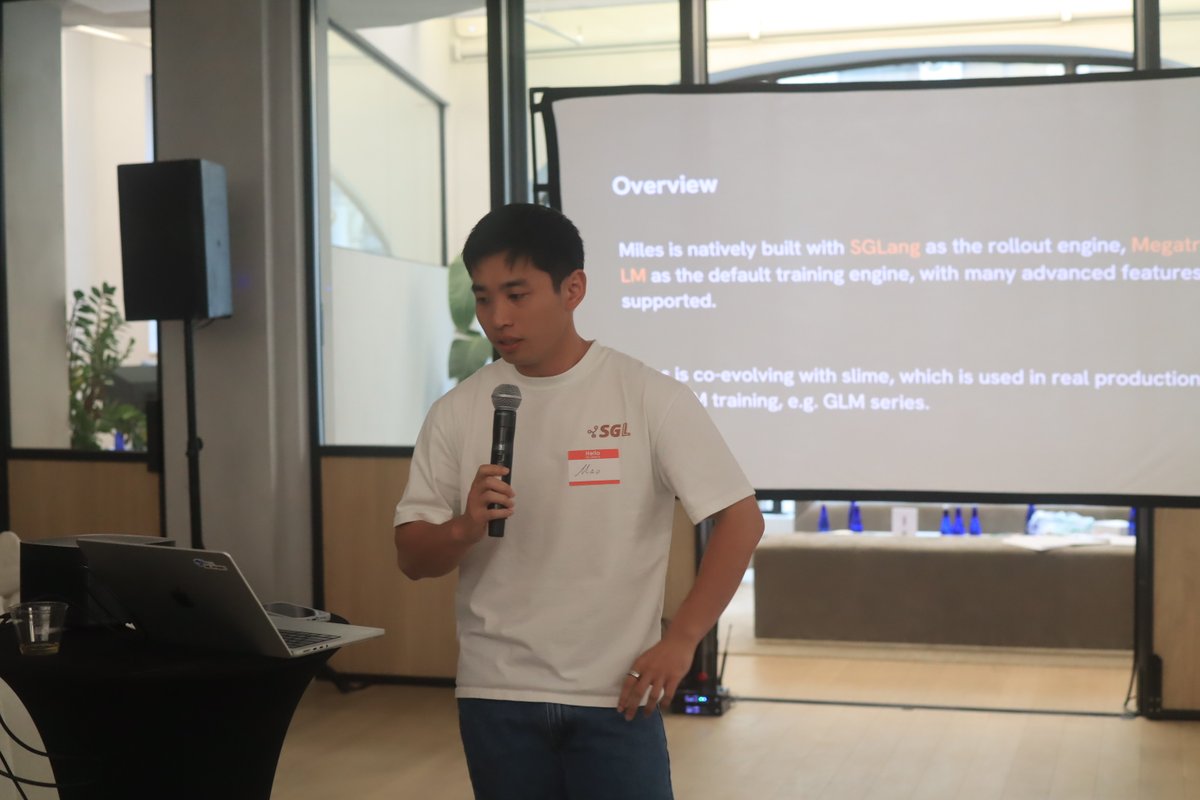
Miles is now featured on the PyTorch Foundation blog. As models grow, shift from dense to MoE, and span more specialized hardware, RL post-training is no longer just about the algorithm. It is a distributed systems problem. Miles is our open-source RL training framework, built for exactly that. It comprises four systems behind a small, pluggable trainer: SGLang (@sgl_project) for rollout, Megatron-LM (@NVIDIAAI) for training, Ray (@raydistributed) for orchestration, and PyTorch (@PyTorch) as the common layer for models and numerics. Out of the box, you also get MoE-aware rollout/training alignment, a unified BF16/FP8/MXFP8/NVFP4/INT4-QAT pipeline, fast NCCL/RDMA weight sync, fault tolerance, and ready-to-run recipes for frontier models like DeepSeek V4, GLM 5.2, Qwen3.6, Kimi K2.6, and Nemotron 3 Ultra. Our goal is simple: make frontier-scale LLM RL easier to reproduce, extend, and operate. Thank you, PyTorch Foundation, and everyone who got Miles here, especially the legendary @slime_framework team!
Built on PyTorch, Ray, SGLang, and NVIDIA Megatron-LM, Miles is an open source framework from RadixArk for large-scale LLM reinforcement learning post-training. Miles uses PyTorch for models, numerics, profiling, and extensibility; Ray for orchestration; SGLang for rollout generation; and Megatron-LM for distributed training. The framework supports asynchronous rollout and training, NCCL/RDMA weight synchronization, MoE-aware rollout/training alignment, low-precision recipes, LoRA, fault tolerance, observability, and extension points for custom algorithms and model architectures. 🔗 Read more in our latest blog from the Miles Team: pytorch.org/blog/miles-a-pyt…
1
8
27
4,918
SGLang reposted
Glad to be featured in @nvidia's latest on inference software economics. The open source flywheel keeps spinning: more devs optimizing CUDA-native inference paths, lowering cost per token for everyone. SGLang is part of that flywheel! We deliver day-0 Blackwell recipes for frontier models like DeepSeek V4, driving up to 5× performance gains in ~a month. Check out the full blog: blogs.nvidia.com/blog/infere… And how we worked with the @NVIDIAAI team to improve DeepSeek V4 performance on Blackwell up to 5x: pytorch.org/blog/serving-dee…
NVIDIA inference software keeps driving down token costs, long after AI infrastructure is deployed. ⚡ In just one month on NVIDIA Blackwell, software optimizations improved DeepSeek V4 performance by up to 5×, reducing token costs to roughly one-fifth of previous levels. NVIDIA's integrated inference software stack compounds improvements across runtimes, kernels, networking, and hardware, delivering up to 20× higher throughput on the same GPU. Co-designed with NVIDIA GPUs, CPUs, networking, and systems, and powered by CUDA-native open source frameworks, NVIDIA's inference software stack ensures new model breakthroughs and optimizations run on NVIDIA from day zero, and keep improving throughput and lowering cost after deployment. See how @Baseten, @Cognition, @DeepInfra, @togethercompute, and @Cursor_ai are turning continuous software innovation into lower cost per token: nvda.ws/4eRT43m
3
20
3,395
SGLang reposted
Got to work on this one with the @nvidia team — a genuinely fun systems problem 🙏 EPLB balances MoE experts offline, but the router never emits perfectly balanced traffic, so every live batch still skews load and the EP group waits on its busiest rank. Waterfill LPLB close that gap at dispatch time, no change to model semantics. ➡️ Waterfill pours the dense shared expert onto lighter ranks instead of every rank paying it locally — near-zero overhead via shared-expert fusion into the DeepEP layout. ➡️ LPLB solves a per-layer LP on-GPU each batch to split redundant-replica traffic optimally and shrink the busiest rank. Throughput up to 7.34%, 4.92% on DeepSeek V4, accuracy fully preserved. Thanks @gazhitt , Fei Liang & Aichen Feng!
🚀 New blog: Improving DeepEP MoE Load Balance in SGLang with Waterfill and LPLB We're introducing two dispatch-time load balancers for DeepEP MoE. Even with EPLB, a single batch still hits ranks unevenly. Waterfill and LPLB fix that residual imbalance at runtime, no change to model semantics. 1️⃣ Waterfill for the dense shared expert Pours shared-expert work onto lighter ranks (“filling the valleys”) instead of every rank paying it locally. Near-zero overhead via shared-expert fusion into the DeepEP layout. ⚡️ 1.48% to 4.66% on DeepSeek V3/R1 across MMLU, GPQA, GSM8K ⚡️ V4 Flash: 49,253 → 51,677 tok/s ( 4.92%) 2️⃣ LPLB for redundant routed-expert replicas EPLB splits hot experts evenly, but live traffic drifts from calibration. LPLB solves a per-layer min-max LP on-GPU each batch to split replica traffic optimally and shrink the busiest rank. ⚡️ 0.84% to 7.34%, strongest when redundant replicas exist (red16/red32) Both preserve accuracy: same logical top-k, identical replica weights, only the physical rank changes. Huge thanks to the @nvidia team for the collaboration!
1
5
53
5,910
SGLang reposted
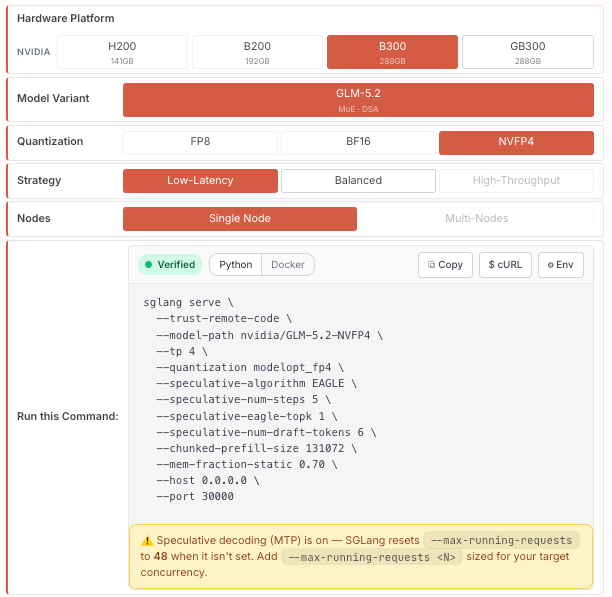
🎉 NVIDIA just released an NVFP4 checkpoint of GLM-5.2 from @Zai_org, a 744B MoE (40B active) for reasoning & coding. Day-0 support is live in SGLang! 🤝 @nvidia > NVFP4 quantization via NVIDIA Model Optimizer: frontier-class reasoning at a fraction of the memory > Sparse attention with IndexShare indexer for efficient long-context > Ready to serve on Blackwell / Grace Blackwell, run it now with SGLang!
6
10
112
10,640
SGLang reposted
🚀 New blog: Improving DeepEP MoE Load Balance in SGLang with Waterfill and LPLB We're introducing two dispatch-time load balancers for DeepEP MoE. Even with EPLB, a single batch still hits ranks unevenly. Waterfill and LPLB fix that residual imbalance at runtime, no change to model semantics. 1️⃣ Waterfill for the dense shared expert Pours shared-expert work onto lighter ranks (“filling the valleys”) instead of every rank paying it locally. Near-zero overhead via shared-expert fusion into the DeepEP layout. ⚡️ 1.48% to 4.66% on DeepSeek V3/R1 across MMLU, GPQA, GSM8K ⚡️ V4 Flash: 49,253 → 51,677 tok/s ( 4.92%) 2️⃣ LPLB for redundant routed-expert replicas EPLB splits hot experts evenly, but live traffic drifts from calibration. LPLB solves a per-layer min-max LP on-GPU each batch to split replica traffic optimally and shrink the busiest rank. ⚡️ 0.84% to 7.34%, strongest when redundant replicas exist (red16/red32) Both preserve accuracy: same logical top-k, identical replica weights, only the physical rank changes. Huge thanks to the @nvidia team for the collaboration!
4
13
75
11,631
Come see @adarshxs talks about SGLang on July 25th in Bengaluru!
[HF ML Club India] We are proud to announce the second IRL event from the HF ML Club India in Bengaluru. This time we have parterned with the @RedHat_AI India team (particularly their PyTorch Engg team). It is happening on the 25th of July. Talks: > @adithya_s_k speaks on OpenEnv > @adarshxs talks about SGLang > I cover torch profiling > Mansi (RedHat) takes on torch distributed > Arkadip (RedHat) provides in-depth knowledge about gpu2gpu comms in distributed setups This is also golden opportunity for folks who were not accepted for the first event, to come and enjoy the talks and network with peers.
2
12
1,956
SGLang reposted
Seems like @lmsysorg / @sgl_project are crushing it as of late! Thanks for this, please don't stop whatever it is y'all are doing <3
🎉 Meet LFM2.5-230M from @liquidai, their smallest model yet at 230M params, but it punches way above its weight. Day 0 Support is live on SGLang! Built on the LFM2 architecture for on-device deployment: > Blazing-fast inference, runs everywhere, from cloud GPUs to low-cost CPUs > Capable of tool use and structured data extraction > Outperforms models twice its size Try it now on SGLang!
1
1
13
1,263
SGLang reposted
@lmsysorg SGLang @krea_ai Krea-2-Turbo = High quality images, local, unlimited, free, in 15 seconds! - Hands, fingers, limbs? check - Legible, correctly spelled, valid text in the image? check - Shade from the sunlight in the correct places? check
1
6
248
SGLang × Oracle Cloud Infrastructure (OCI): AI Infrastructure Meetup @ ICML 2026 After a busy day at the conference, unwind with fellow engineers, researchers & AI practitioners in Seoul. Lightning talks, demos, food & drinks, and plenty of time to connect. 🎤 Featuring Shi Dong (@ShiDong14, MTS at @radixark), plus speakers from OCI Strategic Customer Engineering. 📍 Near COEX, Seoul 🕠 5:30 - 9 PM Space is limited, register to reserve your spot 👇
2
2
24
4,214
SGLang reposted
A few years ago, the future of artificial intelligence looked dark - proprietary models, proprietary inference services. I joined Modal to fix that. Today, we take a major step forward. Optimized inference, open source, with a click.
It is not too late to _actually_ own your inference. Introducing: Modal Auto Endpoints.
6
12
152
10,384
Huge congrats to @modal on Modal Auto Endpoints! 🎉 Owning your inference means owning the code that runs it, and we love seeing that philosophy in action🫡Honored that SGLang powers part of the stack, alongside the work on DFlash speculative decoding 🧡
It is not too late to _actually_ own your inference. Introducing: Modal Auto Endpoints.
9
10
67
7,195
🔥DFlash on NVIDIA Blackwell: up to 15x throughput at the same interactivity! Block-diffusion drafting proposes a whole token block in one pass for the target model to verify in parallel, and this is now in SGLang! Migrating from EAGLE is one swap: set spec decode to DFlash the matching checkpoint. Read the full guide: developer.nvidia.com/blog/bo…
Increase inference performance by up to 15x without sacrificing responsiveness. DFlash, an open source lightweight block diffusion model designed for speculative decoding, delivers up to 15x higher throughput on NVIDIA Blackwell while maintaining the same user interactivity target. Instead of drafting tokens one at a time, it proposes a whole block in a single pass for the main model to verify in parallel. Adoption is drop-in with support in @lmsysorg SGLang, TensorRT-LLM, and @vllm_project.
19
12
100
8,799