China’s DEEP Robotics Is Emerging from Unitree’s Shadow
China’s DR02 could be the world’s toughest humanoid robot.
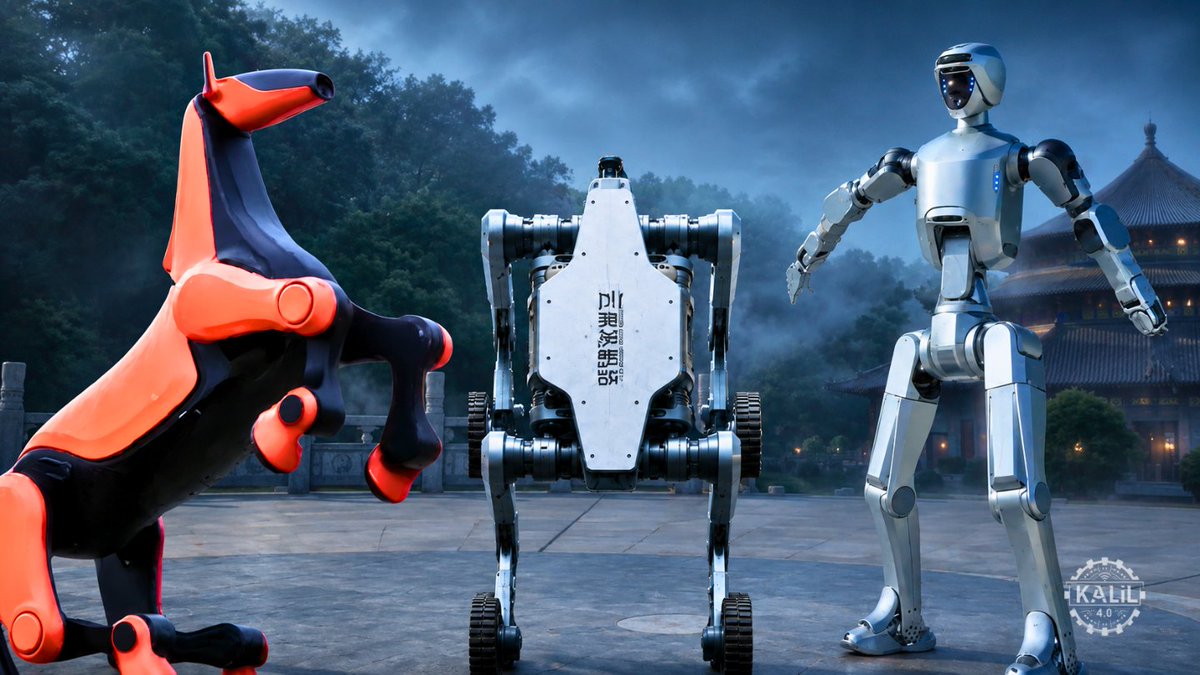
Hangzhou-based DEEP Robotics, known for its industrial robodogs, is developing the walking tank for environments that humans can’t endure.
The startup is racing toward an IPO alongside the nearby robotics leader Unitree. Though its competitor is the much larger and more visible robot manufacturer, DEEP Robotics arguably has a stronger footing in the industrial sector.
Out of the shadows of its flashier rival, it’s preparing an AI-powered machine built for the impossible. The industrial battlefield is about to get a lot more interesting.
DEEP Robotics launched in November 2017 in Hangzhou as a spinout of Zhejiang University. Its co-founders, Zhu Quiguo and Li Chao, both hold doctorates from the elite institution that’s similar in stature to the University of Michigan.
The company’s Chinese name is Hangzhou Yunshenchu Technology, which roughly translates to Deep in the Clouds. It belongs to a collective nicknamed Hangzhou’s Six Little Dragons alongside the AI disruptor DeepSeek, Game Science (the developer of the popular video game Black Myth Wukong), the brain-computer interface maker BrainCo, the Autodesk rival Manycore Tech, and Unitree Robotics.
A few months after its founding, DEEP Robotics launched its first-generation Jueying quadruped, named after Cao Cao’s legendary horse from the Three Kingdoms period nearly 1,800 years ago.
DEEP Robotics used many of its breakthroughs in quadrupeds as the foundation for its move into humanoid robotics.
It introduced its first humanoid, the DR01, at the 2024 World Robot Conference (WRC) in Beijing. Its development began in 2023 as the Chinese government set a national goal to mass manufacture humanoids by 2025 and to lead the market by 2027.
DEEP Robotics earned Little Giant status from Beijing in 2024, which gave it access to state-backed financing and tax incentives. To date, the startup has raised at least $140 million from a mix of Chinese financial institutions and state-affiliated funds.
It’s one of a growing number of Chinese robotics firms heading toward an initial public offering alongside Unitree, Shanghai’s Agibot, Beijing’s Galbot, and the Shenzhen companies EngineAI, Pudu Robotics, and Leju Robot, among others.
It’s expected to join Unitree on the tech-heavy Shanghai STAR Market after its application was approved in May 2026. It plans to raise $347 million for a valuation around $2 billion. It’s reported strong growth, with revenue rising from around $7 million in 2023 to $47 million in 2025.