CEO & Founder at SignalRank. Previously founding investor at TechCrunch. Publisher of That Was The Week

Joined May 2007
1,032 Photos and videos
Pinned Post
"Please Regulate Me" Oh Wait!, open.substack.com/pub/thatwa… Anthropic can't Decide What it Wants
1
84
Keith Teare reposted
Universal Basic Capitalism, by @ajkeen open.substack.com/pub/keenon… “The pinnacle of capitalism is still flawed. Any idea that it’s perfect — this idea of the perfect union — is deeply flawed as a concept and always has been.” — @kTeare With July 4 finally done, we can look forward to the next American revolution. Just as AI is revolutionizing the economy, so too are radical ideas about harnessing this disruption for the benefit of all Americans. One idea that is acquiring more and more currency in and out of Silicon Valley is what we might call universal basic capitalism. Six months ago, nobody knew what “universal basic capital” even meant. Now everyoneis talking about it. What if the answer to inequality, AI disruption, and the slow hollowing out of the American economy isn’t a return to socialism — but a new, more distributive kind of capitalism? As That Was The Week’s Keith Teare argues in our weekly tech roundup, universal basic capitalism offers the best way to simultaneously empower all Americans without turning them into the welfare “queens” so disparaged by neo-liberals. Economists agree that AI is going to eliminate vast numbers of jobs, probably within the decade, certainly in time for America’s 300th anniversary. One fix is the democratic socialist strategy of tax and spend through the state. Universal basic capitalism, in contrast, takes the wealth generated by AI companies, puts it into a sovereign wealth fund, and distributes the dividends directly to citizens. Rather than an ever-more-bloated bureaucracy redistributing wealth, the state miraculously shrinks. It’s a neat idea. Instead of welfare queens, we get shareholding kings. But is this really the next American revolution? Or just the trickle-down economics of the DOGE crowd for an AI age of mass unemployment?
1
1
74
AI governance should follow the work: where agents act, money moves, code ships, and humans decide what outcomes are acceptable. thatwastheweek.com/p/payback…
1
40
The wrong question is whether innovation destroys work. The better question is how people benefit from the wealth it creates. thatwastheweek.com/p/payback…
1
38
If government controls AI model release, what is the standard? Without a standard, permission becomes industrial policy by ambiguity. thatwastheweek.com/p/payback…
1
57
The fight is not safety vs. no safety. The fight is who controls AI product release: the companies and scientists, or government without a clear framework? thatwastheweek.com/p/payback…
1
64
Payback is getting what you asked for. Frontier AI leaders invited government into the room. Now government is deciding who gets the models. thatwastheweek.com/p/payback…
1
74
The show opened by proving its own point: Andrew had to react to a fake Andrew from the previous episode. AI governance is no longer abstract. thatwastheweek.com/p/payback…
1
101
Let the agent have the charted ground. You go and work the edge: the part nobody has written down yet, where the map does not exist. thatwastheweek.com/p/your-jo…
1
58
Keith Teare reposted
This is a new paradigm for interacting with Claude that is significantly more "inline" with all the other human activity org-wide. Once you do all of the under the hood engineering work to make this "just work" (e.g. across tools, integrations, compute environments, memory, security, etc.), Claude basically joins the team in a seamless way - you can talk to it as you would talk to a person and it can help with a very large variety of workloads. Imo this is the 3rd major redesign of LLM UIUX. The first paradigm was that the LLM is a website you go to, the second was that it is an app you download to your computer. This third one is that it is a self-contained, persistent, asynchronous entity with org-wide tools and context, working alongside teams of humans. It really takes a while to wrap your head around it, but it works and it is awesome.
Introducing Claude Tag, a new way for teams to work with Claude. In Slack, Claude joins as a team member with access to the channels and tools you choose. Tag Claude in and delegate tasks to it while you focus on other work.
1,301
1,891
22,962
7,821,641
Yes. Efficiency can me measured in several ways. @SignalRank investor score has it at the heart. The other key is measured time. We measure the past three years, stage specific scores, and that elevates continuous success over time with a daily computed leaderboard
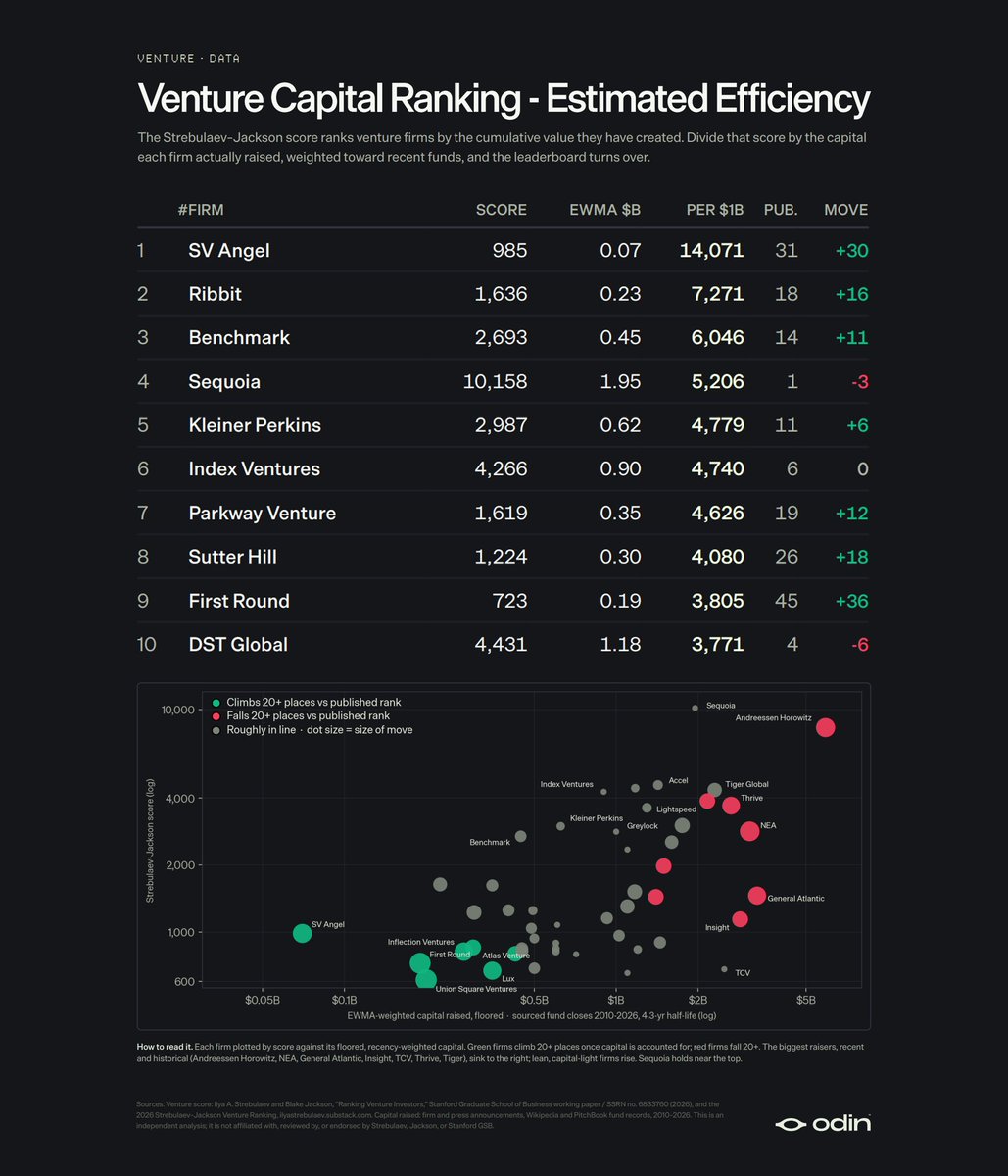
Why do the largest venture firms consistently top industry rankings? Indeed, how is it possible that Tiger Global scores higher than Founders Fund in the recent VC ranking from Ilya Strebulaev and Blake Jackson? The simple explanation is that any ranking based on a cumulative score, rather than a normalised rate or efficiency metric, will reward scale over quality and favour larger firms with more activity. If the objective of the ranking is to reflect impact or relevance that's fine, but it should not be perceived as a ranking of performance. A simple way to address this (with Strebulaev's data and methodology) would be to divide the sum of net profits by the total capital the firm deployed. Quality Score = (Sum of all individual Net Profits) ÷ (Total capital the firm deployed across all investments) The output would be a capital efficiency ratio, similar to TVPI but accounting for overvaluation, monitoring, dilution and human-capital decay, etc. A more useful lens on quality. There's a second problem, as some of these firms have changed their strategy dramatically over the last 15 years, particularly those which have scaled significantly. So any attempt to correct for AUM will not fully recognise recent scaling. A better result might come from calculating a "horizon capital efficiency", putting looking at returns within the window of a typical fund term. (Sum of Decayed Net Profit from investments in last 10 years) ÷ (Total capital deployed in last 10 years) Some exits take longer than a decade, and this will trim those from the data. However, delayed liquidity is bad for the ecosystem and firms should be rewarded for successful exits delivered within the fund term. Without the underlying data, we can still approximate the outcome by comparing the Strebulaev-Jackson score to an exponentially weighted moving average of fund size (to account for scale while favouring more recent data). This will produce a rougher result that the fully updated methodology, but a useful indication of direction. The resulting ranking (full list of 50 in the PDF linked below) is more intuitive if the objective is to understand firm quality. The top 5 gains from this update: 1) @usv ( 37 places) 2) @firstround ( 36 places) 3) @svangel ( 30 places) 4) Inflection Ventures ( 28 places) 5) @Lux_Capital ( 27 places) The new top 5: 1) @svangel 2) @RibbitCapital 3) @benchmark 4) @sequoia 5) @kleinerperkins Full analysis, methodology and ranked list of 50 linked in the post below. Finally, there's also a good argument that the approach to overvaluation (based on Gornal and Strebulaev's prior work) should factor what drives overvaluation: volume of venture dollars consumed, which may further shape the outcomes in favour of smaller firms. e.g. A private company that has raised ~$200M from VCs is structurally more inclined to overvaluation than a company that has raised ~$20M. N.B. This is not a criticism of Strebulaev and Jackson's work, which is excellent. They deserve full credit for the quality of their analysis and the transparency of their methodology. My intent is just to provide a different perspective.
2
115
A slightly worse model you can run yourself can beat a better model that might vanish on a Tuesday. Availability is now part of capability. thatwastheweek.com/p/your-jo…
1
33
The moat is not the model. Models change. Prices change. Capabilities change. What stays yours is the loop around the model: workflows, evals, permissions, traces, and skills. thatwastheweek.com/p/your-jo…
1
50
Everyone's instinct is that agents leave less for humans to do. Keith's argument is the reverse: there is more to do, it is harder, and the skill goes up. thatwastheweek.com/p/your-jo…
1
49
The first AI wave was tools. Agents are different. They enter workflows, use tools, make calls, and return with results. That is agency, not just automation. thatwastheweek.com/p/your-jo…
1
41
Your job title is a liability because it names a task. And the task is the charted bit the machine comes for. The new work is judgment, not title. thatwastheweek.com/p/your-jo…
35