Knowing things is a solved problem. Getting along is not. Working on AI, media, and inter-group conflict @CHAI_Berkeley. Got here from computational journalism.

Joined May 2008
1,331 Photos and videos
Pinned Post
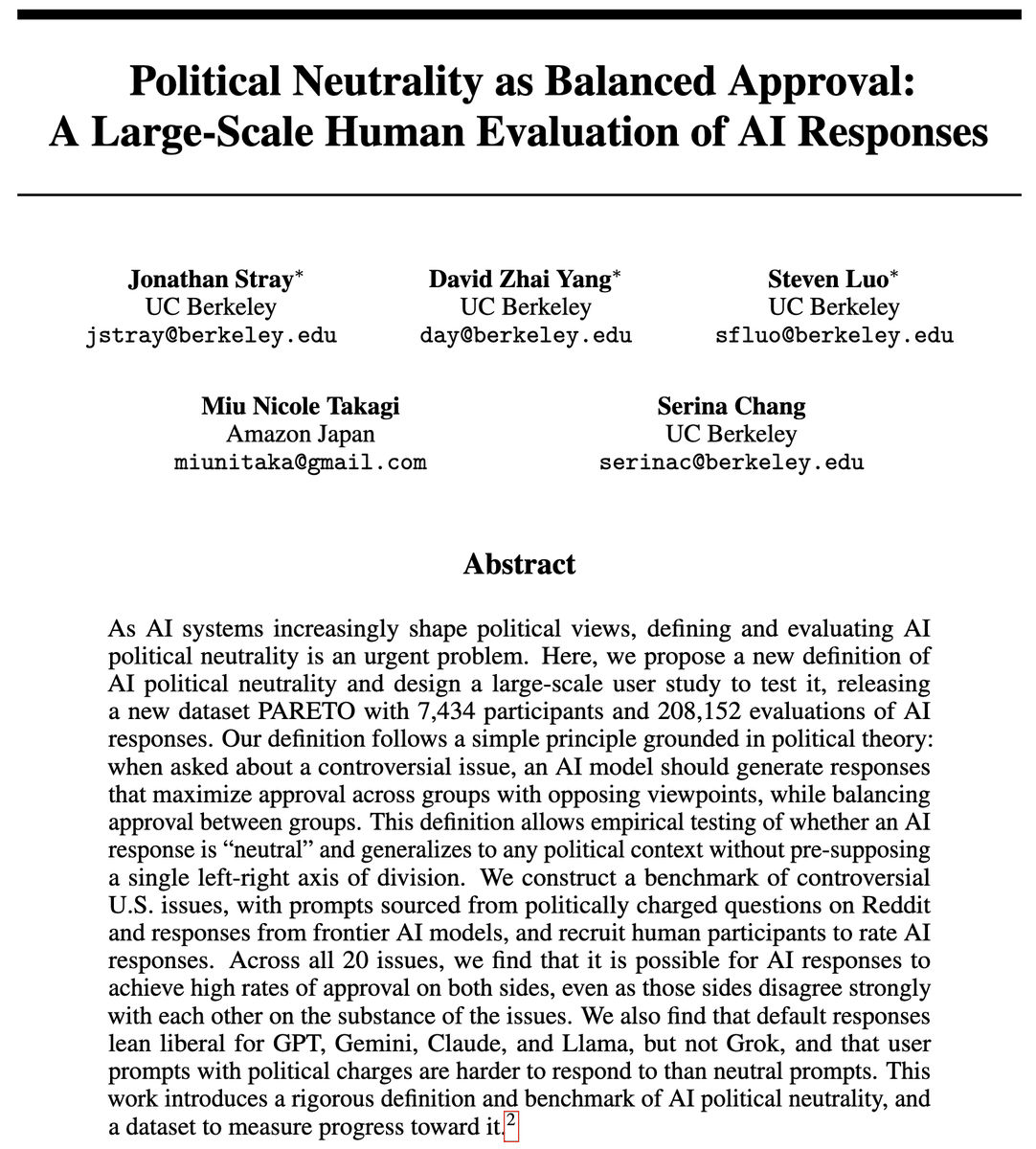
What could it mean for an AI to be "politically neutral”? And can we measure it? New paper dataset. We propose a defn that applies to any type of conflict: a neutral response should maximize approval on both sides of an issue, while keeping that approval balanced. 1/🧵
7
18
59
24,813
“Brands you love” should never, ever appear in marketing copy. Only marketers could love a brand. Classic professional projection, just like there are far too many movies about screenwriters.
1
6
678
A historical tidbit I particularly like: the essentials of the psychology replication crisis were mostly understood by Paul Meehl in 1979. Look him up some time, he thought so clearly for so many years about what it could mean to do science on the mind. errorstatistics.com/wp-conte…
1
1
6
802
If we are lucky AI might finally unlock systematic journalism accuracy rates. A key information ecosystem feature I’ve wanted for a long time, but it’s always been too expensive. jonathanstray.com/measuring-……
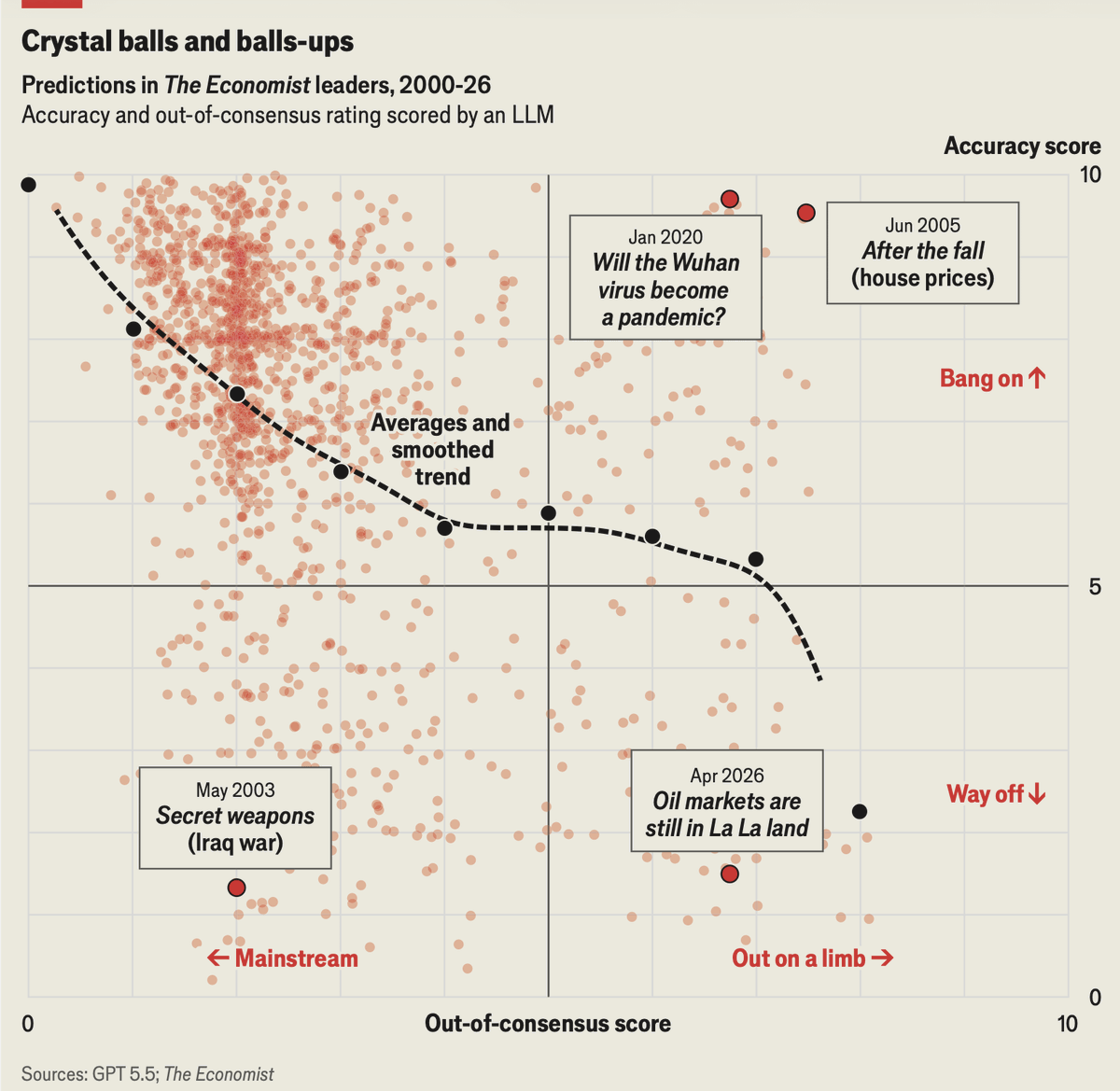
IS THE ECONOMIST ALWAYS WRONG? Scandalously, in some circles @TheEconomist has a reputation as a contrarian indicator. This week we fessed up to getting a big call on oil prices from April wrong. Obviously our goal is not perfectly-hedged (and perfectly boring) predictive accuracy: often it is to stimulate, provoke, and challenge. But I did want to test that wider allegation, so I ran a series of LLM scorers across our full leader database since 2000 (7,000 leaders in all.) You can see the results in the chart below: each dot is one of the 1,400 leaders where we identified concrete and falsifiable predictions that were central to the argument. Higher = more accurate, further to the right = more contrarian. We do well, unsurprisingly, when aligned with conventional wisdom. We often do worse when truly out on a limb. But actually, on average, we are a bit likelier to be right than wrong on our somewhat-out-of-consensus calls. All round, a respectable performance. And as @ecurrnomics points out an accompanying leader, there is no shame at all in being beaten by the market: as good free-marketers we believe deeply in the aggregated wisdom of prices. Take a look at my piece here, which includes a canter through our best and worst calls of the last quarter-century: economist.com/interactive/fi…


4
15
1,768
Quality wins, sometimes.
In a 3% experiment, removing the Top-30 highest paid revenue share accounts from the For You timeline increased both time spent and daily active users on X.
1
6
976
I want to make sure AI doesn't incite human conflict. It's sometimes hard to explain what I do, but that's the core of it -- it won't happen automatically. And we're making progress! Both theoretically, and in field experiments that test how AI alters human relationships.
1
2
10
783
Hello I am in Montreal for the week! Anyone interesting in AI safety I should meet here?
1
580
Do you have OPINIONS about algorithmic feeds? We're building them, and we want them to be awesome. Who wants to talk to me about this? This is your chance to be heard by algorithm designers (me! and the rest of the GreenEarth.social team)
3
1
6
401
Does anybody here use a tool that allows simultaneous posting to X and BlueSky? Would you want one?
1
3
480
Conservatives no longer trust the word "democracy." But they still believe in a functioning, citizen-led government. Fantastic new research unpacks what it is that they believe in, and why they think Trump is restoring the nation. theatlantic.com/ideas/2026/0…
1
1
143
Jonathan Stray reposted
Has always driven me crazy. "Harmless" doesn't survive multiple perspectives in any competitive landscape, even a positive sum one like a well functioning economy.
1
2
284
AI safety typically assumes one well-meaning user. I'm working on the case where two of them are at war.
2
1
11
510
Jonathan Stray reposted
There are really interesting academic questions emerging around AI and epistemic risks. I only fear that, by the time we reach consensus, we will be too dumb to understand it.
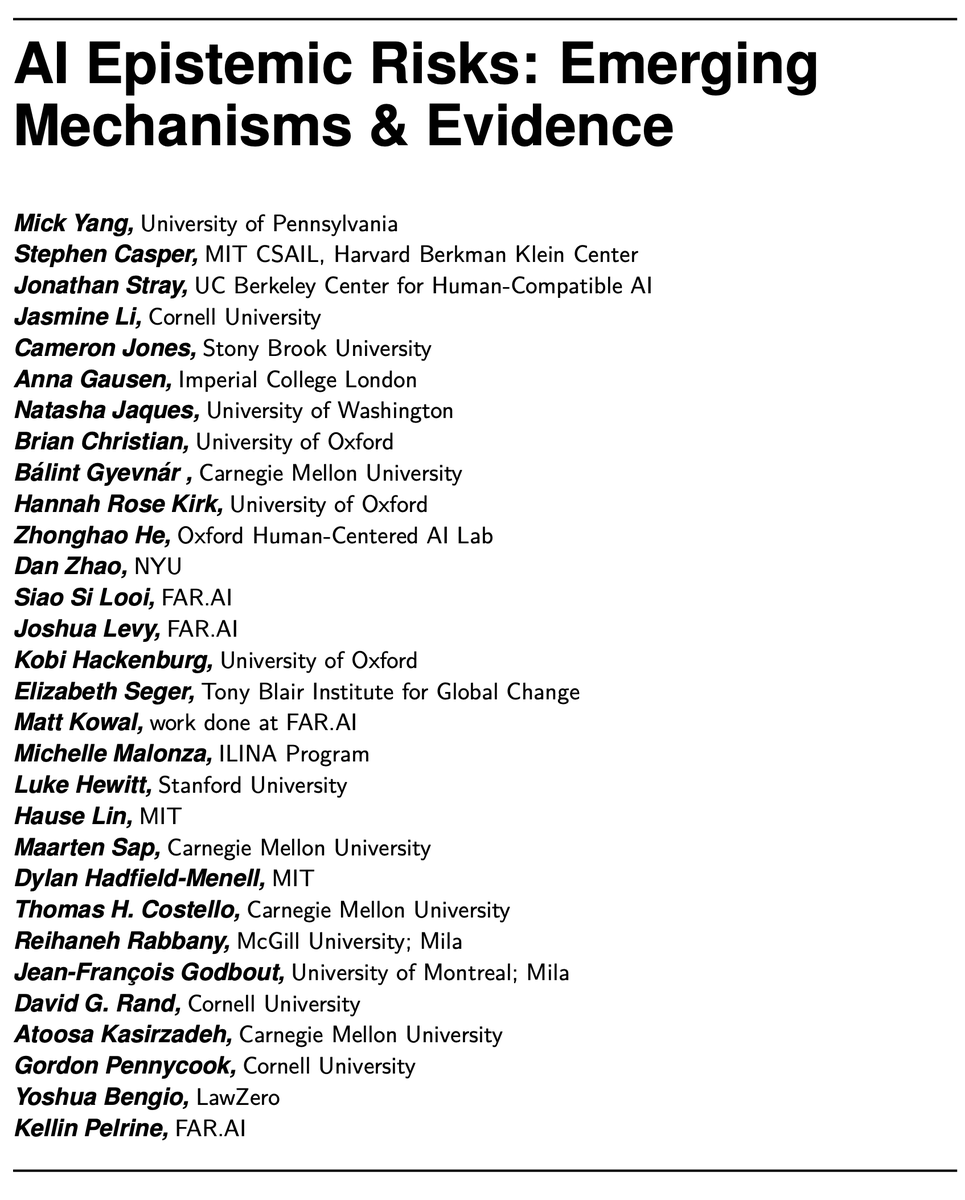
Humanity's ability to know, reason, judge, and act well is the foundation of science, democracy, crisis response, & management of AI itself. AI poses serious risks to that foundation. New paper on epistemic risks by 30 experts calls for attention to this. Link in thread.
3
5
35
4,210
Zero-calorie sweeteners are just reward hacking, amirite?
1
175
The skills which are hardest to measure will become the most valuable. This is an inversion of the way things are now — where ROI is king — but anything effectively scorable is also going to be effectively trainable.
5
200
Feedback loops in human-AI and AI-AI systems pose challenges to our ability to know and reason. We cover the state of the art in grounding AI in truth and trust. Glad to be a part of this landmark paper on "epistemic risks" with a cast of top-tier authors led by Mick Yang.
Feedback Loops: Human-AI and AI-AI feedback loops are narrowing the epistemic space from which humans and AI draw. This already drives homogenization, and may lead to fragmentation and more self-referential information environments.
3
251
Jonathan Stray reposted
Humanity's ability to know, reason, judge, and act well is the foundation of science, democracy, crisis response, & management of AI itself. AI poses serious risks to that foundation. New paper on epistemic risks by 30 experts calls for attention to this. Link in thread.
7
52
185
25,390
Jonathan Stray reposted
There is now a solid body of evidence showing that internet availability is causing a variety of outcomes that adversely affect democracy The answer may have something to do with platform algorithms, such as curated newsfeeds (e.g., on Facebook) or ranking of posts (e.g., the “for you” feed on X). Algorithms have long been in the sights of researchers and regulators as potential culprits of polarization because of their opacity and their known focus on maximizing user engagement and platform dwell time with little regard for the quality of curated content. science.org/doi/10.1126/scie…
5
60
189
29,350
Jonathan Stray reposted
When people strongly disagree on an issue, can they agree on what makes a good AI response? We find: yes, more than you might expect! We present PARETO, a large human study w >200k evals, measuring the Pareto frontier of approval btwn opposing groups on controversial issues đź§µ
4
20
105
10,994
This is exactly the problem I’m trying to solve by defining and building “politically neutral” AI, see previous thread.
Political identity drives choice of large language models—even when accuracy is incentivized. Participants (N=1,884) quickly developed preferences for AI systems that aligned with their political identities, and these preferences were stronger when models carried recognizable brand names. In the second stage, 71% persisted with their previously preferred model despite incentives for correctness. This reveals that users do not treat AI systems as neutral tools. Instead, they select between them in ways that reflect political identity. osf.io/preprints/socarxiv/z5… This is consistent with the identity-based model of belief: People select information sources and allocate attention toward in-group sources. You then need strong incentives to override their partisan bias: sciencedirect.com/science/ar…
4
322
Our definition turns “neutral” into something empirically testable, generalizes to any conflict, and is grounded in political theory. And it really does find better answers that everyone can agree on. Paper arxiv.org/abs/2605.28911 Dataset github.com/HumanCompatibleAI… /FIN
1
6
409