




Pinned Post

Mar 15
A common line of questions I receive: what does lossless-claw do differently than memory systems? How do the two relate? Should I use both? Here’s the lowdown:
Memory systems are good for letting you search for information that’s external to your context window, which are typically “memories” extracted from past/different conversations. This is necessary because:
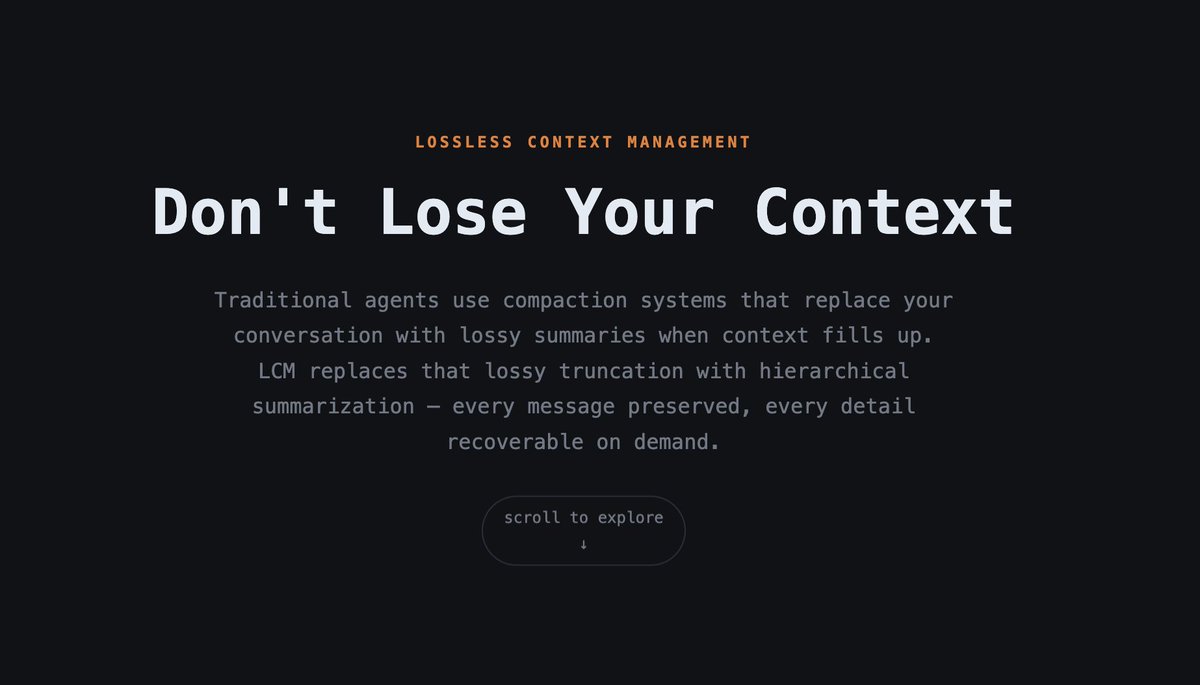
Compaction is lossy: when your conversation gets too big, your agent replaces the whole conversation with a summary. Do this a few times and details from the first conversation are no longer part of the summarized conversation.
Your context is split across many sessions: you have conversations with different agents over time and want to be able to reference all of that in your current conversation.
Memory systems work okay in the first case and pretty well in the second case. lossless-claw works phenomenally well in the first case and only indirectly addresses the second one. Let’s expand that.
Lossless context makes frequent summaries of smaller pieces of context in the background. It keeps your most recent messages around verbatim (the “fresh tail”). As the summaries accumulate, they get combined into summaries of summaries.
This lets your agent stay focused: older content is still there, but becomes more “vague” over time — kind of like your own recollection of events. Current messages are always there and never suddenly disappear to be replaced by a summary. This effectively solves the “post-compaction amnesia” problem where your agent seems to suddenly forget important recent details about what you were doing.
The reason lossless-claw is called “lossless” though is because your older messages never get truly removed. The incremental summaries replace the messages, but act as “pointers” to them that can be used to expand the source messages back into context. Because the summaries stick around, your agent doesn’t forget about what it can expand should it need to.
By contrast, memory systems don’t offer the agent any ideas about what can they can be used to remember. This is why you have to frequently tell your agent to “search its memories” explicitly for something. This feels unnatural and is certainly inefficient.
Using lossless-claw means that you can keep one conversation going indefinitely without ever needing to reset. This assesses point (2) from above indirectly: if you don’t need to start new sessions all the time, you don’t need a way to recall information from past sessions!
If you work across multiple agents and want to share memories between them, or want to be able to recall information that happened outside of the scope of a conversation (eg meeting notes), you’ll want a memory system.
Much of what memory systems are used for is a poor fit for them stemming from overly naive approaches to managing context, which unfortunately are industry-standard. Don’t get me wrong: they’re still useful — I still use one — but they’re not the only tool that agents need to become effective personal assistants.
Lossless-claw is among the first production-grade implementations of an alternative context management strategy, and certainly the most effective, and it’s only available on @openclaw.
None of this would be possible without the excellent research into Lossless Context Management pioneered by @ClintEhrlich and @rovnys at @Voltropy, so make sure to give them a follow if you’re looking for some real alpha.
Mar 14

There's a lot of cool stuff being built around openclaw. If the stock memory feature isn't great for you, check out the qmd memory plugin!
If you are annoyed that your crustacean is forgetful after compaction, give github.com/martian-engineeri… a try!
16
11
158
32,405