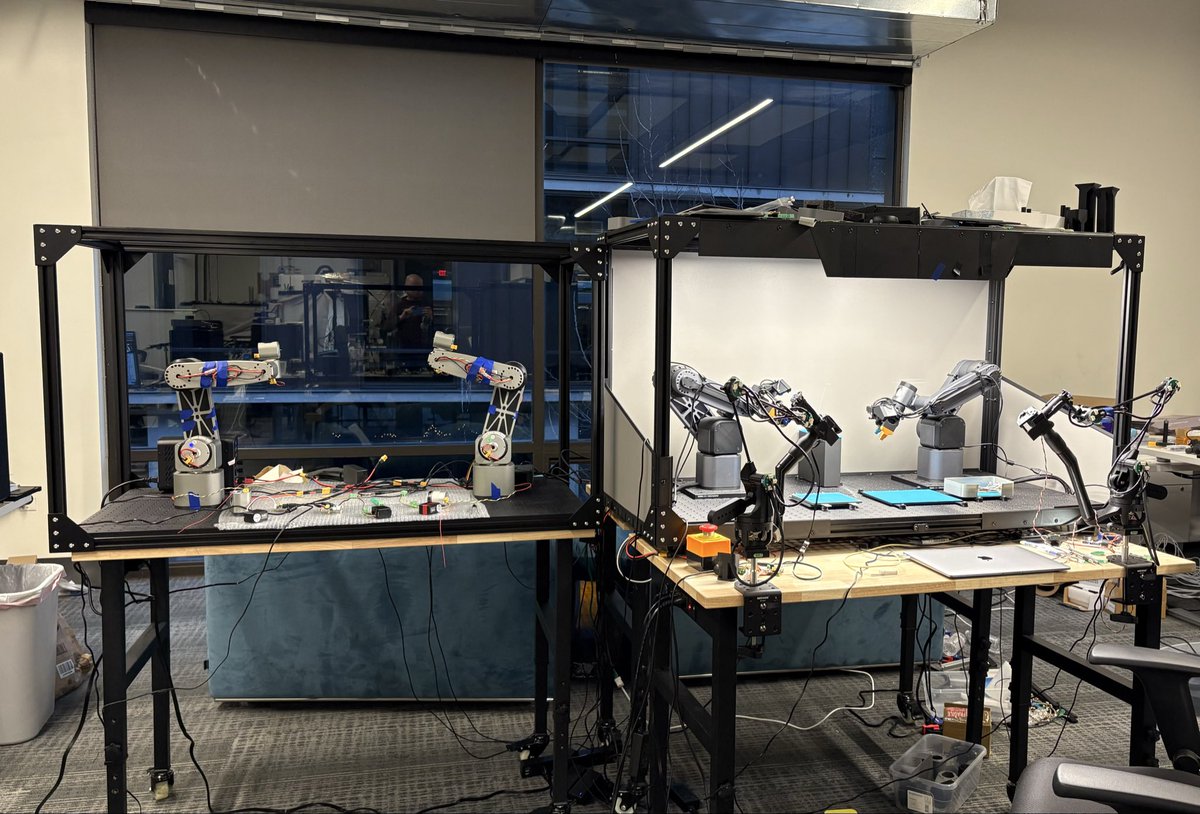
Building MicroFactory - personal factories accessible to everyone.

Joined November 2007
155 Photos and videos
Local language models aren’t smart enough to create real economic value just by working 24/7. But a personal robo-factory powered by local AI can.
11
6
138
7,654
Model precision test. Trained with 2 minutes examples.
32
55
1,023
321,963
Preparing a photo for the website
1
1
100
4,658
A few complex bin-picking grasps.
3
4
103
12,809
Benefits of using a reliable VLA model on example of our customer’s task. Instead of building special tooling, we use the model to separate the top magnet from the stack directly in the grippers. In the demo, the model moves the stack up, one magnet at a time, visually finding the right height. It also corrects the slight randomness in the magnets’ positions so the top magnet ends up in the same place, where it’s easy to pick it off. When the stack is almost empty, the model sees it as the right gripper covers the stack, and later it will go get a new batch, but for now, in this test, it just throws it away. No coding, except saving points 1x speed, autonomous
6
10
95
7,815
I didn't expect our grippers to evolve into cute little hands. But it’s the most functional design for now.
5
1
76
4,199
Strong magnets can make the environment self-resetting.
12
24
439
95,899
Customer self-onboarding into our system. They are deploying the robot themselves, consulting with us in chat. They will collect data (the least time-consuming part) and train the Loop Model using our tutorial.
1
17
1,045
We have news! We created a new robotics model called Loop Model 1. On the zip-tie insertion task, it achieves 20x more throughput per unit of data than "Pi06 RLT" from Physical Intelligence, a top model for such tasks. It’s the missing piece that makes MicroFactory work, because now deployment becomes so simple and fast that our users can do it themselves.
22
42
437
76,253
You can try it on your own task using our guest robot in San Francisco. DM me if interested.
6
1
19
2,661
A Salesforce Tower full of MicroFactories could replace Shenzhen for the US. A single Microfactory occupies about 3×2×2 feet (12 cubic feet). The Salesforce Tower in San Francisco is about 22 million cubic feet, so it could fit around 1.83 million MicroFactories. Meanwhile, Shenzhen has 1.8 million people employed in manufacturing. Sure, factories need extra space for elevators, material storage, etc., but Shenzhen also ships only 20% of its output to the US, and not everyone is doing physical work, many hold managerial positions.
5 million humanoid robots working 24/7 can build Manhattan in ~6 months. now just imagine what the world looks like when we have 10 billion of them by 2045. now imagine the year 2100.
2
1
38
4,166
Preparing the second MicroFactory unit so they can work in a line. Real-world Factorio is coming.
21
32
732
20,333
Let’s use MicroFactory as a ScienceFactory. Standardized replicable cells, industrial grade precise arms, interchangeable grippers for tool use
Intelligence is becoming too cheap to meter. We're on track for AI reasoning to be 100x cheaper by 2027. When hypothesis generation is free and experimental design is automated, the bottleneck isn't ideas—it's the physical world. Science is about to go exponential. Get ready for all frontier labs to start building "Science Factories" to mine new data out of nature.
4
22
146
11,460
Robotic insight 3 There’s a widely held view among leading robotics thinkers: the current priority is to automate some commercially profitable work to get real-world data. If you set the goal as “the first profitable deployment that also generates data” you get a few insights: - People with industry experience may be better positioned to nail this than academic researchers. - You can try to find non obvious initial domain, that’s easier to deploy in practice, while still provide useful data.
Robotic insight 2: One undocumented feature of VLA models is that they can generalize pretty well from very little data, if you run them on good hardware. Here, with 35 demonstrations (5 mins in total), robot can pick up small pcb from any position and at any rotation angle.
12
12
182
19,919
Robotic insight 2: One undocumented feature of VLA models is that they can generalize pretty well from very little data, if you run them on good hardware. Here, with 35 demonstrations (5 mins in total), robot can pick up small pcb from any position and at any rotation angle.
The advantage of arms with industrial internals is that they don’t wobble, so the AI model can control it faster by just multiplying frames per second. Here’s we multiplied the FPS by 3× compared to teleoperation (180 instead of 60).
20
25
336
47,420
The advantage of arms with industrial internals is that they don’t wobble, so the AI model can control it faster by just multiplying frames per second. Here’s we multiplied the FPS by 3× compared to teleoperation (180 instead of 60).
19
21
370
70,045
It’s quite underestimated that with just 8–10 hours of training, you can have a robot that performs commercially useful tasks already today. Spend a little time once, and you get a mechanical worker that reliably does the job 24/7 for years.
Building upon SimpleVLA-RL, we have implemented real-world RL on long-horizon dexterous tasks and witnessed a non-trivial (~relatively 300%) performance improvement over the SFT model, along with surprising capabilities on auto-recovery. Blog coming soon. The entire process uses very little data and training compute—basically costing no more than a single robotic arm—hinting that real-world generality for machines is actually within sight.
10
23
253
24,768
Industrial UR5e arm inside our box for size comparison. Industrial arms are good because they are rigid and have low backlash, so they do not shake during operation. However, they are quite bulky. One of the reasons to build own arms is to combine the best of both worlds: compact size and stability.
6
5
145
8,622