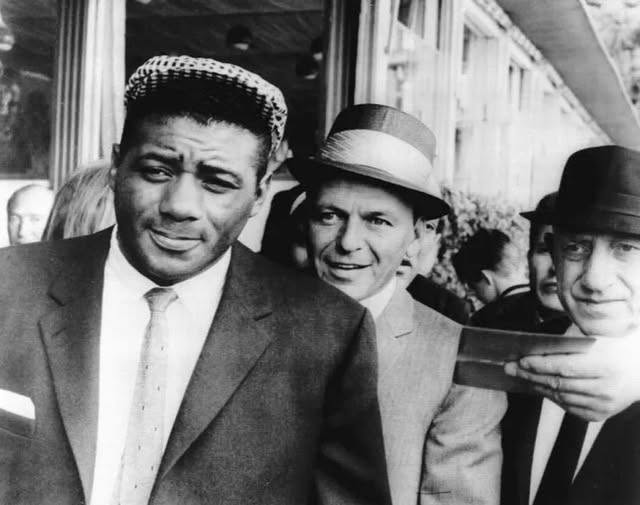
Former Heavyweight Champion Floyd Patterson on July 6, 1964, a day after his 12-round decision over Eddie Machen, enjoys the company of "Old Blue Eyes" Frank Sinatra in Sweden.
--------------------------------------------------------
Anthony Martin Sinatra was also a prizefighter.
His ring name was Marty O’Brien because Italian boxers would often use Irish names in the hope that it would endear them to a New York audience.
Born in Sicily, he fought out of Hoboken in New Jersey having emigrated several years earlier.
According to BoxRec, ‘O’Brien’ debuted in 1910 and wound up winning four and losing six while other records have him at 1-7. There were no listed fights between 1914 and 1920 but O’Brien came back and fought twice more, losing both and bowing out.
It is likely that he met his wife, Dolly Garaventa, through another fighter as she was the sister of boxer Dominick Garaventa.
‘O’Brien’ and Dolly were married in 1913 and two years later they would have a son, naming him Francis Albert Sinatra. He would be known as Frank Sinatra.
Frank Sinatra forged close relationships with many Hall of Fame boxers but always wanted to get closer to the action.
He bought a stake in New York light-heavyweight and heavyweight contender Tami Mauriello, who fought Bruce Woodcock and challenged Gus Lesnevich (twice) and Joe Louis for their world titles.
He also had a piece of another heavyweight, Chuck Crowell, who’d fought Buddy Baer and Lou Nova and he managed solid Chicago welterweight Ray Brown, who once went 10 rounds with the great Ike Williams.
Sinatra even tried his hand at promoting fights, staging the 1947 clash between Jersey Joe Walcott and Joey Maxim. Walcott won with a dull split decision over 10 rounds at Gilmore Field in Los Angeles.
Joe Louis boxed a four-round exhibition in a show which was headlined, 'Will the three Joe’s ever meet?'
There were pictures of Maxim, Louis and Walcott on the fight poster and it said, “Frank Sinatra presents… for Hollywood Square Garden Inc… The Fight of the Year."
Sinatra had a genuine interest in boxers and a fondness for them. There was one story that he was staying in a hotel where one of the employees shining shoes was a former champion (supposedly it was Kid Gavilan) who’d fallen on hard times. As soon as Sinatra was told who it was, he gave him $1,000.
Sinatra also managed Los Angeles lightweight Cisco Andrade through the 1960s.
Andrade was trained by Al Silvani, who would become close with the singer. They had met in a New York bar years earlier and Sinatra wanted to learn some of the intricacies of the sport.
“I took him to Stillman’s and taught him how to throw a punch and how to move,” Silvani would later say after Sinatra's death, “He caught on quickly.”
The two were close friends and they’d travel together. Some saw Silvani as an assistant or his security detail but in the 1970s Silvani, who had bit parts in several Sinatra films, said: “I don’t like the word bodyguard. But if somebody starts to cause trouble, I can take charge.”
Silvani’s decorated training career also saw him work with Carmen Basilio, Henry Armstrong, Jake LaMotta and Eddie Machen, among many others.
Sinatra had a press seat and photographed the main event (Ali-Frazier) on March 8,1971, at Madison Square Garden, for LIFE magazine. One of his images even made the cover.
Like many of his generation at the time, however, Sinatra was not an Ali fan.
He had been turned off by Ali’s self-confidence and draft refusal. He’d been ringside at the first fight between Ali [then Cassius Clay] and Sonny Liston, sitting next to Elizabeth Taylor and Jackie Gleason, but he would only come around to Ali years later.
“Sinatra was a big Joe Louis fan,” Gene Kilroy would later say, “He helped Joe many, many times and when Ali fought Larry Holmes in Caesars Palace, Sinatra was appearing there and he was sitting ringside about three rows back and I had a security guard move two chairs over and put them [Louis and Sinatra] right by the ring. Then, Sinatra said that night [after Holmes had beaten the ghost of Ali], ‘There’s a man in a room upstairs, he has nothing to be ashamed of. He’s truly a great man, he has a great heart and he’s a champion in and out of the ring’. That was the tribute Sinatra gave to Ali.”
Sinatra, who as an adolescent had the likes of Jack Dempsey and Gene Tunney to look up to, had seen many of the great heavyweights up close and personal.
He was ringside for Rocky Marciano’s 1953 rematch win over Roland LaStarza, saw Ali, Frazier, Floyd Patterson, Liston and others but there was only one who was truly close to his heart and that was Joe Louis.
As he wheeled an ailing Louis into a room for a 1980 benefit evening for the fallen great at Caesars Palace, Sinatra said:
“We’ve been friends for about 35 years. [From] the first time I ever saw him… I’ve been cheering him ever since. I think this is long overdue. God bless him. He’s going to have a good time tonight.”
After Louis suffered a stroke, Sinatra had the heavyweight legend flown in his private jet to Texas for the best treatment and rehabilitation money could buy. He told Joe’s wife, Martha, not to give the cost a second thought.
Then, when Louis died, Sinatra spoke at the funeral.
“Joe’s biggest fight ended a few days ago,” lamented Sinatra. “And I don’t know how the refs voted yet, but I lay you 100 to 1 he gets a unanimous decision.”