Brief glimpses into fights, and fighters, of the 20th century; the great, the near great, the very good, the journeymen, the opponents and much more.

Joined April 2025
8,829 Photos and videos
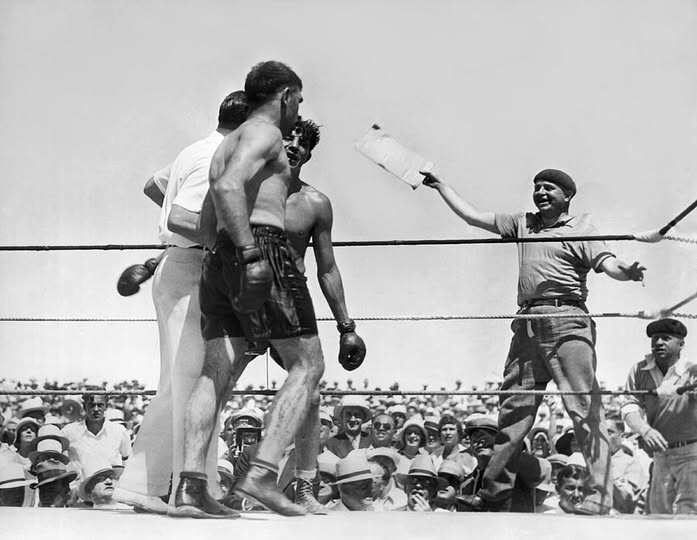
Earlier this week we had discussed former Heavyweight Champion Jack Dempsey's ill-fated, and thankfully abandoned, comeback efforts. Here is the 45-year-old former titlist (left), on July 6, 1940, sparring with highly regarded heavyweight Arturo Godoy. Godoy is just under three weeks removed from an 8th round TKO loss to then Heavyweight Champion Joe Louis. He'll be meeting Gus Dorazio at the Philadelphia Arena in early October and will win a 10-round UD.
1
20
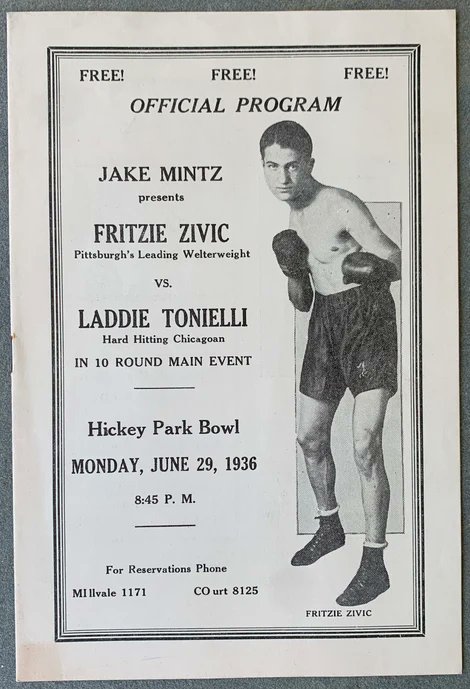
Future Welterweight Champion Fritzie Zivic TKO's Laddie Tonielli in the 4th round (cuts) on july 6, 1936 at Hickey Park in Millvale, Pennsylvania. Tonielli had been TKO'd by Barney Ross in his previous bout and he'd be stopped again by Zivic on July 30th at Forbes Field on the undercard of a card that featured light heavyweight Champion John Henry Lewis, future titlist Billy Conn and future Lightweight Champion Sammy Angott.
1
15
For your Sunday reading pleasure. From the July 6, 1935 edition of The Staurday Evening Post: Inside Those Ropes Ten Fights To The Top By Jim Jeffries with Eddie Orcutt. (Please go to my FB group to read the story) James J. Jeffries: Inside Those Ropes | The Saturday Evening Post, July-August 1935 (4-Part Series)
1
22
July 6, 1935 adveritisng poster for the film showing of Joe Louis' 6th round TKO of former Heavyweight Champion Primo Carnera on June 26th at Yankee Stadium. ---------------------------------------------------------- A few nuggets from The New York Times after louis disposed of another former titlist, Max Baer, in September: ...As he fought his way unquestionably to a title chance, therefore, Louis not only increased his own fortunes but brought to boxing the first million-dollar fight the sport has attracted in eight years, the sixth million-dollar bout of record and the greatest crowd ever to witness a sport event in this city. The net receipts, less the Federal tax of 10 per cent and the State tax of 5 per cent, were $804.955. The Free Milk Fund for Babies, Inc., of which Mrs. William Randolph Hearst is chairman, shared in the profits to the extent of $80,495, boosting to about $150,000 the sum the fund has realized on three boxing matches this year. The Jimmy McLarnin-Barney Ross fight and the Louis-Carnera battle, all held by the Twentieth Century Club, brought the fund a combined total of about $70,000..... .....Louis's fists have opened the chance to make himself the first Negro fighter to hold the world's heavyweight title since Jack Johnson, with the tremendous fortune the crown brings. He has the world at his feet and he intends to see most of it on a combination honeymoon and business trip. Looking over available opponents, Louis realizes that the field for future conquests is alarmingly limited. The amazing speed with which he has rushed to the front, the fourteen months of professional boxing he has had through twenty-five unbroken victories, twenty-one of them by knockouts, find him with but one more possible foe worthy the distinction before a title match...... .....In fourteen months he has catapulted to the top. In three major fights Levinsky. Carnera and Baer Louis has well-nigh exhausted his supply of ring rivals. He has amazed more than $300,000, his biggest purse being the sum he received for one of the shortest and easiest battles of his brilliant career - the destruction of Baer...... .....Louis revealed yesterday through one of his manager Julian Black, that he plans a foreign tour following the Christmas holidays. He will tour South America and Europe, accompanied by Promoter Jacobs, to whom the new ring sensation is bound by contract until January, 1937, with an option of renewal. In the capitals of Europe and South America Louis will engage in a succession of fights if they are available. He has no serious thought of exhibitions. He wants actual combat..... ....In fourteen months he has catapulted to the top. In three major fights Levinsky. Carnera and Baer Louis has well-nigh exhausted his supply of ring rivals. He has amazed more than $300,000, his biggest purse being the sum he received for one of the shortest and easiest battles of his brilliant career - the destruction of Baer.... .....Louis revealed yesterday through one of his manager Julian Black, that he plans a foreign tour following the Christmas holidays. He will tour South America and Europe, accompanied by Promoter Jacobs, to whom the new ring sensation is bound by contract until January, 1937, with an option of renewal. In the capitals of Europe and South America Louis will engage in a succession of fights if they are available. He has no serious thought of exhibitions. He wants actual combat..... ....."We'll leave probably in late December or after the holidays," said Jacobs. "We may go to South America first for actual battles there, and visit Europe afterward, fighting in London, Paris, Berlin and other capitals. Any matches Louis engages in on the foreign tour will be real matches. There will be no exhibitions..... ....."While we are in Germany I'll try to sign Schmeling for a bout with Louis next Spring or Summer. The match will be held here unless a better locality presents itself. I have offers from Detroit and Chicago right now. After the Schmeling match, Louis will be ready for Braddock, providing he wins."..... Critical opinion on the fight was unanimous that Louis is one of the greatest fighters in ring history; certainly the greatest piece of fighting machinery that has come along since Dempsey. One veteran follower of the sport expressed the belief that only Jim Jeffries could have beaten Louis, adding the conviction that the Brown Bomber would have knocked out Dempsey had they been contemporaneous ring figures.
3
44
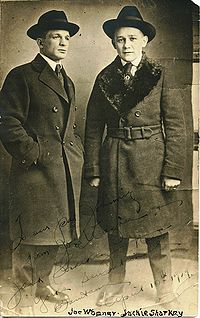
Johnny Dundee (right, I'm not 100% on that, sorry) defends the World Junior Lightweight Championship against Jackie 'Little Jack' Sharkey on July 6, 1922 at Ebbetts field in Brooklyn, New York, retaining his title with a 15-round unanimous decision. Such was the nature of the sport that you'll find the Junior titles of that era being defended in 10, 12 or 15-round bouts, and that title often disappeared for years at a time; in addition, a generation of Italian immigrants adopted more 'Americanized' names (typically Irish) for their ring careers. Sharkey was born Giovanni Cervati in Bologna, Italy. His manager, Joe Wagner (also a boxer, he's on the left in the photo attached, with Sharkey) was born Giuseppe Valinotti. Johnny Dundee, of course, was known as 'The Scottish Wop' and he was born Giuseppe Curreri in Sicily. From Rolando Vitale, the author of “The Real Rockys: A History of the Golden Age of Italian Americans in Boxing 1900-1955”, for The Irish Times: To the untrained eye, it seemed that prior to the 1920s there were few noteworthy American boxers of Italian origin and only a limited presence in the decades that followed. But behind many Irish boxing names there frequently stood an olive-skinned, dark-haired battler with a hidden identity. More than one thousand Italian professional boxers went by Irish pseudonyms. Italian immigrants entered boxing at a time when the booming American economy took advantage of Italian muscle to fuel the nation’s growth. However, the ruling elites – the very ones who benefited from cheap labor – disparaged Italians, describing them as “biologically incapable” and a “burden on America.” In addition to enduring these attacks, Italian immigrants came into conflict with the established Irish working class in almost every sphere of society. They fought over municipal and construction jobs. They argued over church matters within the predominantly Irish-controlled Catholic Church. In many instances, Italians were forced to worship in the back, and sometimes even in the basement of these buildings. Neighborhood enmity spilled onto the streets with frequent skirmishes, particularly in New York. Italians feared the Irish controlled police force leading some to change their names. This included one Peter Robert Gagliardi, who changed his name to Bobby Gleason in an attempt to keep the Irish cops from beating him up. Gleason later became a boxer before opening the famous Gleason’s Gym in the Bronx, a place where the likes of Muhammad Ali and Mike Tyson trained. During the pre-World War I era, most Italian men were laborers, many of them working in railroad construction camps and on large-scale city-wide projects. Their Irish counterparts complained that they worked for lower pay and longer hours. Brawls ensued, and in some cases the problem got so bad that separate crews were delineated along ethnic lines. The strife contributed to an overall anti-Italian sentiment. Some of that sentiment painted Italians as anarchists and or communists. It also led to the enactment of immigration quotas, singling the group out as undesirable and inferior. With such prolonged stigmatization, many Italians opted for a name change. The world of boxing was not immune from anti-Italianism. Angelo Dundee, the legendary boxing trainer from Philadelphia who trained champions like Ali and Sugar Ray Leonard, said: “In the early 1900s it wasn’t advantageous to have an Italian name. Italians were not held in high esteem by the host population. We lived in Italian ghettos, held menial jobs, spoke funnily and ate spaghetti and ice cream and were considered by the average American to be “gangsters” and members of crime societies.” The Palermo-born Gaspare Leone was the first notable Italian prizefighter, competing between 1891-1904. Leone changed his name to Casper Leon, yet he still bore the brunt of racist epithets and jeers from the predominantly Irish club patrons. By the time he retired the derision had not diminished. In 1903 the National Police Gazette captured this, reporting that: “It is amusing to note the way in which the crowd at ringside receives the different nationalities of fighters. There is always a hearty cheer and earnest backing for the Irishman; grins and good-humored tolerance for the German and virulent hostility to the Italian and the Negro. Put a boy of any race in with an Italian and everybody in the house who is not himself of Italian origin at once begins to root frantically against the son of ancient Rome. It is to the credit of the Italians that they have pushed so far forward against such adverse influences.” Immigrants had arrived in the United States, and those who pursued boxing quickly discovered that an Irish cohort dominated the sport. Boxers like John L. Sullivan and Jim Corbett were part of the steady stream of Irishmen who held the heavyweight title, creating the misconception that nobody could be successful in the ring unless they had an Irish name. This led many Italian fighters to adopt a pseudonym so that their ability to make a living in the ring wasn’t defeated before they even set foot in it. The Irish stronghold over what was America’s second most popular sport at the time gave them a virtual monopoly over it and allowed them to dictate the rules of engagement to ethnic newcomers. According to Carmelo Bazzano, Professor Emeritus of Physical Education at the University of Massachusetts, commercial considerations also pressured Italians into adopting non-Italian names. Irish or English promoters sought to manipulate the cosmetics of boxing. They forced Italian boxers to adopt Irish names, thereby producing an army of “ready-made Irish” boxers who were palatable to the predominantly Irish patrons. Those who refused to change their names frequently complained at the lack of regular fights. Minnesota native Tony Caponi who fought between 1902-1917, blamed his lack of booking on his surname, believing that to promoters his real name sounded “more like a music master than a prizefighter.” For a time he changed it to TC O’Brien. For the next several decades, a host of other Italian boxers from all across the country followed the trend. New Jersey-native and pre-World War I heavyweight contender Andrew Chiariglione claimed his Irish moniker on a Utah boxing card. Irritated by the announcers’ inability to pronounce his surname correctly and anxious to get the fight underway, Chiariglione bellowed, “Oh, hell, just call me Jim Flynn.” From then one he became known as Fireman Jim Flynn, the only fighter to ever knock out Jack Dempsey. The Calabria-born Francesco Conte settled with his family in Kenosha, WI where he grew up attending Catholic School. When he flattened the school bully one day, his Irish friends started calling him Frankie Conley. He later adopted the alias and in 1910, Conley laid claim to the world bantamweight title when he knocked out Monte Atell. Vincent Esposito, who hailed from South Philadelphia, fought as a flyweight boxer during the early 1930s and changed his name to Jimmy Dugan just to get fights. Later on, he reflected on the South Philly Italian enclave that “all of the fighters down there were (Italians), but almost none of them used their real names.” John De John (Di Gianni), a member of the famous fighting clan from Syracuse, NY and the eldest son of sharecroppers from Avellino, Campania. He grew up during the 1920s, managing and training Italian boxers through the 1940s and 1950s, and remembered the strain on his fellow countrymen to conform. “The Italians were forced to change their names because the Irish and the Germans were running everything. They had to change their names otherwise they would have got the worst of it. They got better jobs.” While no area remained untouched, having an Irish moniker was a necessary evil just to get a foothold in the boxing arena. It offered more prominent billing on boxing cards and ensured a wider appeal to audiences expecting to see men with crowd-pleasing qualities that were synonymous with Irish-American prizefighters. But with greater participation and frequent championship success, Italian boxers started to become more visible. As the economic position of Italians improved, vigorous support from the fighters' local community followed. Italian crowds clamored to see their hero enter the ring under his real name. The boxing landscape started to shift, and shrewd promoters began to exploit neighborhood inter-ethnic tensions by bringing them into the ring. Ticket sales rose and boxers with Italian names grew to be so common that they started to gain acceptance. From the 1920s to the 1950s Italian boxers with Irish names steadily became a thing of the past. Instead, names like Tony Canzoneri, Jake la Motta (the “Bronx Bull”), Joey Giardello, Carmen Basilio, and Rocky Marciano filled the boxing ring. By the mid-century, Italian boxers didn’t have to face a backlash simply because of their name. They could finally step into the ring under their real names, ones that proudly represented those who came before them.
3
98
Al Braverman dies on July 5, 1997 at the age of 78. From the July 7, 1997 edition of The New York Times: Al Braverman, 78, a Fixture On Boxing Scene Since the 30's Al Braverman, a former boxer, fight manager and trainer who spent the last two decades as an aide to the promoter Don King, died on Saturday. He was 78. The cause was complications from diabetes. Mr. Braverman, unbeaten as a heavyweight from 1938-41, was a throwback, a Runyonesque character of the kind who thrived in New York during the 1940's and 1950's. Mr. Braverman went to work for King in 1975 as director of boxing, negotiating contracts for King-promoted fights. "He brought the mashed face and the mashed pronunciation into the 90's,'' said Bert Sugar, a boxing expert. Mr. Braverman is survived by his wife, Renee, with whom he was a partner in an antique store; a son, Gary; a daughter, Cory; two grandchildren and one great-grandchild. Among the 30 boxers Mr. Braverman managed, 5 fought for world titles -- Billy Bossio, Carlos Ortiz, Jimmy Dupree, Frankie DePaula and Chuck Wepner. Wepner, known as the Bayonne Bleeder, fought Muhammad Ali for the world heavyweight championship in 1975. Before the fight, won by Ali in the 15th round, Mr. Braverman told reporters that he had a salve that he put on the fighter's face to keep him from bleeding. No chemist had ever been able to completely break down the compound, Mr. Braverman said with a straight face. ''But Al,'' someone asked, ''won't they complain about using a foreign substance?'' ''It ain't a foreign substance,'' Mr. Braverman replied. ''It's made right here in the United States.'' Earlier, Wepner went nine rounds with Sonny Liston, incurring cuts that needed 75 stitches. Liston was asked after the fight if Wepner was the bravest opponent he had ever faced. "No,'' Liston said, ''but his manager is.''
2
8
183
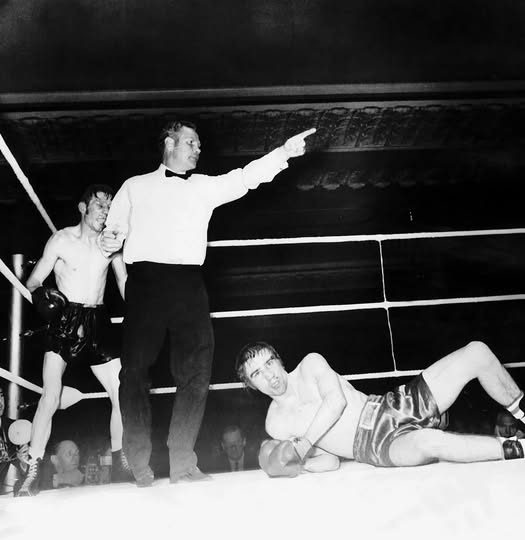
Evan Armstrong (left) has Jimmy Revie on the canvas, on July 5, 1971, scoring a 12th round KO of southpaw Jimmy Revie, at Grosvenor House in Mayfair, London, UK, to win the British Featherweight Championship. Evan Armstrong would go after the Commonwealth Featherweight Championship in his next bout, losing a 15-round points decision to Toro George, and in his next bout lose in a bid to take the European Featherweight Title from Jose Legra. In the penultimate bout of his career, in July of 1974, Armstrong will finally add the Commonwealth Featherweight Championship to his resume with an 11th round TKO of Alan Richardson. He'd lose that Commonwealth Title in his final fight, via 10th round TKO in Accra, Ghana, to David Kotey (who would win the World Featherweight Championship nine months later). Armstrong would finish his career at 39-14-1 (30 KO's).
6
132
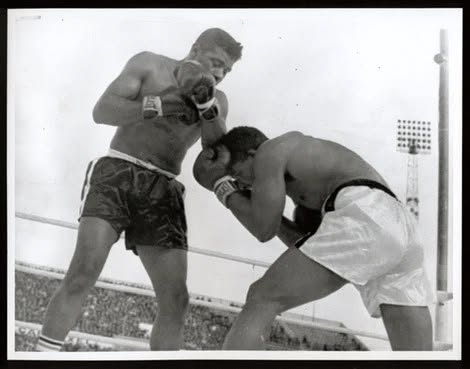
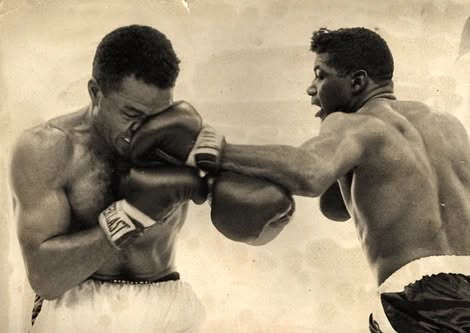
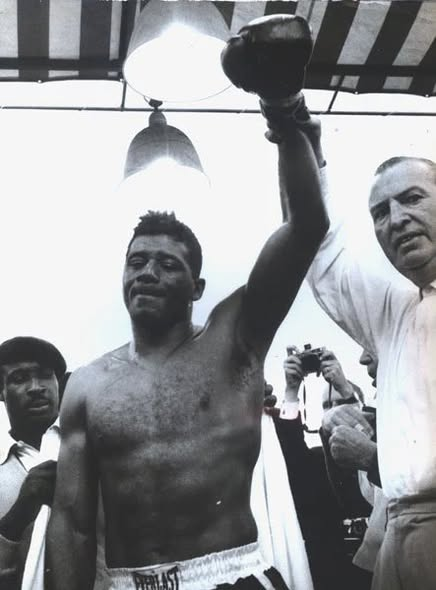
In a critical heavyweight matchup on July 5, 1964, former titlist Floyd Patterson scores a 12-round points decision over Eddie Machen, in Rasunda, Solna, Sweden. The Associated Press would report: "Floyd Patterson decisively outpointed Eddie Machen in their 12 round bout here last night before 40,000 at the Rasunda outdoor stadium. Except for the 7th round, which Machen won with a stinging right to the jaw, Patterson dominated the fight with his familiar peekaboo guard and lightning fast series of kangaroo rushes. Machen was down in the 10th and 11th from slips for no counts. Blood stains showed on his white trunks and he nursed a closed left eye at the end. Machen confused Patterson at times by keeping his head low at close quarters, but only his defensive skill - and maybe Floyd's lack of a takeout punch - kept him on his feet for the distance. Teddy Waltham, the British referee and sole arbiter, raised Patterson's hand as soon as the final gong sounded. He gave Patterson nine rounds, Machen one round and called two even, the same as the AP scorecard. In points, Waltham scored it, 59-49." A preview of this bout in the July 6th issue of Sports Illustrated, written by Tex Maule, was pretty interesting and it follows: The winner of the fight between Eddie Machen and Floyd Patterson in Stockholm this Sunday may be the first man to challenge Cassius Clay for the heavyweight championship. The loser, quite possibly, will never fight again, and the loser, most probably, will be Floyd Patterson. Patterson, after two brief and disastrous appearances against Sonny Liston, won a notably unimpressive victory over Sante Amonti in Stockholm on January 6. He needs a win against Machen to prove that he is a competent enough challenger for Clay. Machen, at 31, is making a belated comeback after having been sidelined for a year by a nervous breakdown brought on in almost equal measure by financial trouble and the frustrations of a boxing career that often brought him to the brink of a championship fight without ever putting him in the ring with a champion. As the two men prepared for the bout last week, it was Machen who seemed the more confident and in the better frame of mind. "I been waiting seven years for Patterson," he said cheerfully. "It has been a very long time and, quite naturally, I became impatient. But I fully believe that I am ready. I have viewed several motion pictures of Patterson and of course I have seen him fight, and I am sure I can defeat him." He was in the living room of a small suite in the comfortable Apollonia Hotel in Stockholm, where he has lived since the first of June. "Floyd used to say I was an IBC fighter and for that reason he declined to meet me in the ring. That was when he was with Cus D'Amato, and there were quite a few IBC fighters around. At least what he called IBC, which was the same thing as good." Machen looked at his hands, inspecting carefully manicured nails. "Quite naturally, I am not underestimating Floyd," he said. "He is a very good man." He was in the living room of a small suite in the comfortable Apollonia Hotel in Stockholm, where he has lived since the first of June. "Floyd used to say I was an IBC fighter and for that reason he declined to meet me in the ring. That was when he was with Cus D'Amato, and there were quite a few IBC fighters around. At least what he called IBC, which was the same thing as good." Machen looked at his hands, inspecting carefully manicured nails. "Quite naturally, I am not underestimating Floyd," he said. "He is a very good man." Patterson is training in Ronneby, a resort town on the southern coast of Sweden, about 300 miles from Stockholm. Not far from Ronneby, in Denmark, is Elsinore, where Hamlet played out his tragedy. Elsinore would have been a good camp for Patterson. Withdrawn and introspective, he works out in a warehouse that was converted into a gym by Dan Florio, his trainer. His workouts are attended by standing-room-only crowds of Swedes who cheer every time he lays a glove on one of his sparring partners, but Patterson's face never changes expression. One day last week he boxed three rounds—one each with Greatest Crawford, Shotgun Shelton and his brother Ray—to the intense delight of the spectators. After he had finished sparring, he punched the light bag briefly, stopping once to beckon to one of his trainers, who trotted over quickly. "Air," said Patterson. The trainer trotted back to his equipment bag and returned with a bicycle pump with which he inflated the punching bag a bit more. Patterson finished his workout and the crowd cheered lustily. He ducked his head in acknowledgment and left the arena, having said one word during the 30-odd minutes he had worked out. "He is in a much better mood than he was before the Liston fights," insisted Dan Florio, who has been Patterson's trainer for 12 years. "I can tell by the way he works and by the way he runs. He ain't training any different, because why should he? But he is happier." Patterson has broken his routine several times to appear in small towns around Ronneby to make luncheon talks, at one of which he told the audience that he would like to live in Sweden six months of the year after he retires. He spends some of his time looking at movies of Machen's fight with Hurricane Jackson. He has sent movies of his last fight with Ingemar Johannson and his fight with Roy Harris to the Machen camp. "If Patterson is looking to see the same Machen as fought Jackson, he's going to be surprised." said Al Silvani, who has been training Machen since August of last year. "I been working with Eddie for a year, but I used to watch him a long time before that. I see him fight guys like Zora Folley. He stands back all the time. He jabs. He don't go in underneath. I say to myself, what is this? If this boy can go inside, if he can be aggressive, who is going to beat him? No one, that's who." Silvani was in the small room he occupies in the Apollonia and he got up from his chair. "He was fighting straight up with a stiff left leg," he said. "Like this." He stood up straight with a stiff left leg. "He couldn't move in and bob and weave and rip and tear underneath. You got to get down a little to do that, and you got to bend your left leg to get down. So when Walter Minskoff got Eddie's contract and asked me to train him, I was very happy to." He sat down. "I didn't come on strong with Eddie," he said. "I had him for three months, when he was first coming back from his trouble, before he ever went into the ring with anyone. I didn't let on like I was the big man knew everything. Everybody in his own mind, he is a superior person, so you don't start off by telling him, look I know everything and you don't know nothing. So I moved very gentle with Eddie and finally I says to him, 'Eddie, why don't you move in underneath and fight on the inside?' And he says to me with his own mouth, 'Al, I don't know the moves.' So I taught him the moves. I didn't change his style because he has got a good style and a great left hook, but I give him some moves so he can go underneath and become aggressive." Silvani made Machen spar with only one glove while he was learning to hook to the body with the left and to hook off a jab. Then he took off the left glove and put one on the right hand and went over the right-hand moves. "It wasn't hard," Silvani explained. "Eddie's got the feet. He moves his feet good and that's where it starts. The hands follow the feet. You got to be able to move on your feet and stay on balance, and Eddie could do that. He is a good athlete." Machen has had five fights since Minskoff and Silvani came into the picture and he has won all five by knockouts. "I feel better now," he said in Sweden last week. "I think better. I don't remember the bad time very well. They tell me about it, but I don't remember." Vince Correnti, who owns a car-wash business in San Francisco and 10% of Machen, is one of the people who can tell Eddie about it. "I've known Eddie 10 years," he said in Machen's dressing room in a gymnasium at Solna, a suburb of Stockholm. "He used to come into my place, and we got to be real good friends. And then this one afternoon he comes in, he looks worried. Eddie was one of Sid Flaherty's fighters, never saw any money, got fights on too short notice, and now it is just before Christmas and I know he hasn't got any money, but I don't know how worried he is. So we talk in my office a little while. Then I get a call and I've got to go out back for a while, and when I get back to the office Eddie is gone. He went off in my car, but I always let him use it, so I don't think anything about it. Then, about an hour later, I get a call and this cop says. 'Do you know Eddie Machen?' and I say, 'Yes.' " Machen had taken Correnti's white Chevrolet convertible and started for Redding, Calif., where he was raised. In the glove compartment of the car was a pistol: Correnti is a deputy sheriff with a permit to carry the gun. When the car ran out of gas, Eddie found the pistol and fired three shots out of it into an embankment beside the road, although now he doesn't remember doing that. A passing motorist heard the shots and called the police. When they arrived, Machen was sitting quietly in the car, the pistol on the seat beside him, and he told the police, "I'm thinking of killing myself." "They took me to Napa for observation," Machen said in Sweden. "I don't remember any of this. Vince came to see me, and someone said I talked to Joe Louis and Archie Moore, but I don't remember any of it. I know I needed $3,000 and it was Christmas time and I couldn't get it and I couldn't sleep. I couldn't sleep after they started taking care of me, either. I couldn't relax. I felt like I had to go and go. And then they gave me the electric treatment." Machen recovered quickly from the breakdown. Walter Minskoff and his brother, who are building contractors and real estate dealers in Los Angeles and New York, bought up his contract in partnership with Correnti, and Machen's financial problems were over, since the Minskoffs pay him $1,000 per month against his earnings. Under Silvani he gained confidence as a fighter as well. "When I was younger, I got in bad," Machen said. "I got in with some bad people. There was a ring of us, and we took turns robbing places. We had a big silver barrel gun and people remembered it and we got caught, seven times altogether. And then Soledad, and I spent three years there." Machen was 23 when he was released from prison at Soledad, and he began fighting then. He talks frankly about prison and about his nervous breakdown. "Now I feel better and stronger and surer of myself. I am not confused." In the heart of Stockholm, surrounded by friends and newfound well-wishers, Eddie Machen goes about his business cheerfully and calmly. "This is one I don't got to worry about," said Al Silvani. "I had Tami Mauriello, you know. A great fighter. I used to say to him, 'Tami, it ain't the punches in the ring makes a fighter punchy. It's the taps on the back from his friends, all those people hitting him on the back saying you're the greatest, buddy. When he loses, they all go away.' Tami comes to workouts with six, eight people. I say, 'Tami, what's this? You got to work.' He says, 'Al, they're my friends.' In a little while the friends pat him on the back so much he can't get his breath. But Eddie, he's been there, that ain't going to happen to him." But fights, of course, are won in the ring. In Ronneby against mediocre sparring partners, Patterson was the same Patterson. He has an unfortunate habit of planting himself flat-footed against ah attack or when he is going to launch an offense. This habit cost him two knockouts at the hands of Liston and knockdowns at the hands of far less talented fighters like Roy Harris and Pete Rademacher. He has little ability to move on his feet. ("He is fast from the waist up, but not from waist down," said Machen.) He cannot move laterally, so that he will not be able to slide away from Machen's left hook or from his strong right hand. Patterson has quick hands and a quick head in avoiding punches, but he tends to depend too much on his hands and his head and not enough on his feet. Finally, he has the most grievous of faults in a heavyweight—he gets knocked down. "I got a stronger head," said Machen, who has been knocked off his feet only once (by Johansson in the first round when Machen came into the ring cold). "I got a better head. Quite naturally, you got to be a better man in the ring with a strong head." After three more wins - over Charlie Powell, George Chuvalo and Tod Herring - Patterson would get another chance to win back the Heavyweight Championship. Eddie Machen, of course, would get a shot at the WBA Title held by Ernie Terrell in his next bout, losing a 15-round UD, and he'd go 0-4-1 in five fights at this point. He'd have enough to score an upset win over Jerry Quarry in 1966 but Machen's best was clearly past him as he'd lose his final three bouts before retiring in 1967. By 1972, at age 40, Eddie Machen would be dead. Floyd Patterson, ironically, would fight his final fight in September of 1972, against Muhammad Ali, just six weeks after Eddie Machen's death.
1
2
12
754
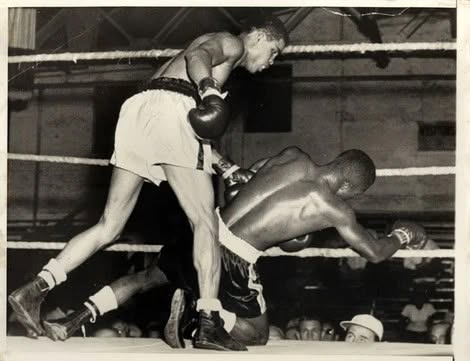
Featherweight prospect , the "Springfield Rifle", Davey Moore avenges a prior defeat, on July 5, 1957, scoring a 10-round unanimous decision over Isidro Martinez, at the Capital Arena in Washington, D.C. Martinez had decisioned Moore over ten rounds in May of 1955. From the AP: “Moore, an 8-5 underdog made the odds appear ludicrous as he battered the Panamanian featherweight champion from start to finish. Davey slashed across a sizzling right in the seventh that sent Martinez to the canvas. Isidro was up at the count of 2 but even after waiting out the compulsory toll of 8 was a wobbly warrior. Moore lost to Martinez in Colon, Panama two years ago." This is the third of thirteen consecutive wins that will lead Moore to his first opportunity to fight for a world title. In March of 1959, he'll stop Hogan "Kid" Bassey in 13-rounds, at the Olympic Auditorium in LA, to win the World Featherweight Championship. David Schultz "Davey" Moore will make five sucessful defenses of the Featherweight Title before his tragic death from injuries sustained in losing his title to Sugar Ramos in March of 1963. 59-7-1, with 30 KO wins, Davey Moore had won the 1952 National AAU Bantamweight Championship and also represented the United States in the 1952 Olympic Games in Helsinki, Finland. He lost a 2-1 decision in the quarterfinals to Joon-Ho Kang of Korea. Out of Springield, Ohio, Davey Moore would soon be immortalized muscially by Bob Dylan who would write a song about his death, titled "Who Killed Davey Moore?" In his typically ironic fashion, when Dylan introduced "Who Killed Davey Moore" during his October 31, 1964 show, he addressed the crowd: "This a song about a boxer... It's got nothing to do with boxing, it's just a song about a boxer really. And, uh, it's not even having to do with a boxer, really. It's got nothing to do with nothing. But I fit all these words together... that's all... It's taken directly from the newspapers, Nothing's been changed... Except for the words." Lyrics to "Who Killed Davey Moore?": Who killed Davey Moore? Why an' what's the reason for? "Not I", said the referee "Don't point your finger at me I could've stopped it in the eighth An' maybe kept him from his fate But the crowd would've booed, I'm sure At not gettin' their money's worth It's too bad that he had to go But there was a pressure on me too, you know It wasn't me that made him fall No, you can't blame me at all" Who killed Davey Moore? Why an' what's the reason for? "Not us", said the angry crowd Whose screams filled the arena loud "It's too bad he died that night But we just like to see a fight We didn't mean for him to meet his death We just meant to see some sweat There ain't nothing wrong in that It wasn't us that made him fall No, you can't blame us at all" Who killed Davey Moore? Why an' what's the reason for? "Not me", said his manager Puffing on a big cigar "It's hard to say, it's hard to tell I always thought that he was well It's too bad for his wife an' kids he's dead But if he was sick he should've said It wasn't me that made him fall No, you can't blame me at all" Who killed Davey Moore Why an' what's the reason for? "Not me", says the gambling man With his ticket stub still in his hand "My wasn't me that knocked him down My hands never touched him none I didn't commit no ugly sin Anyway, I put money on him to win It wasn't me that made him fall No, you can't blame me at all" Who killed Davey Moore Why an' what's the reason for? "Not me", says the boxing writer Pounding print on his old typewriter Sayin', "Boxing ain't to blame There's just as much danger in a football game" Sayin', "Fist fighting is here to stay It's just the old American way It wasn't me that made him fall No, you can't blame me at all" Who killed Davey Moore? Why an' what's the reason for? "Not me", says the man whose fists Laid him low in a cloud of mist Who came here from Cuba's door Where boxing ain't allowed no more "I hit him, I hit him, yes, it's true But that's what I am paid to do Don't say 'murder, ' don't say 'kill' It was destiny, it was God's will" Who killed Davey Moore Why an' what's the reason for? On September 21, 2013, the 50th anniversary of Moore's final fight, his hometown of Springfield, Ohio, dedicated an 8-feet-tall bronze statue in his honor. Located in a public green space just south of downtown near his old neighborhood, the dedication attendees included Moore's widow, Geraldine, and Ultiminio "Sugar" Ramos, visiting from Mexico City.
2
271
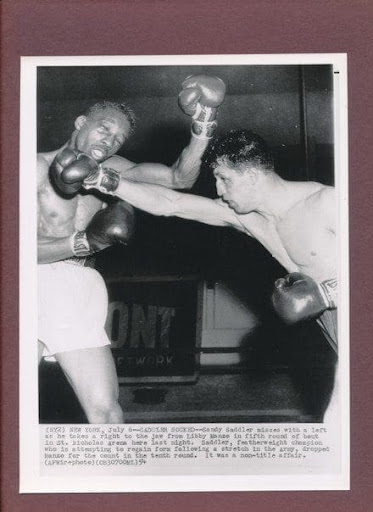
In a non-title bout, Featherweight Champion Sandy Saddler takes a right from Libby Manzo (17-2-3 coming in) but scores a 10th round TKO at St. Micholas Arena in NYC on July 5, 1954. Liberato Mazolillo would lose five of his final six fights, including this one, finishing his career at 18-7-3 (5 KO's).
1
52
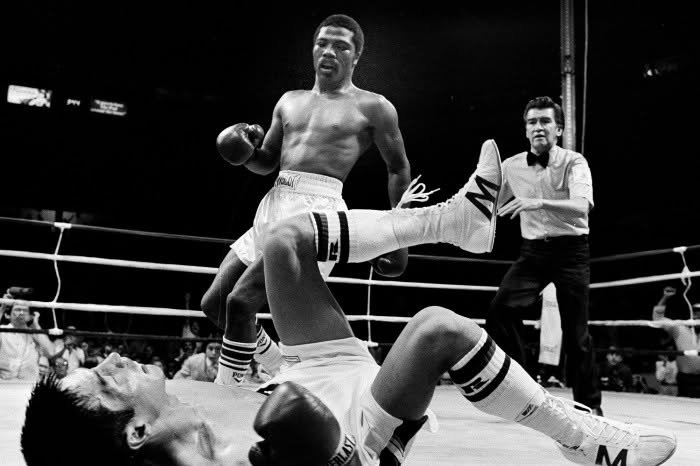
WBA Junior Welterweight champion Aaron Pryor TKO's challenger Akio Kameda in the 6th round, on July 4, 1982, at Riverfront Coliseum in Cincinnati. It was Pryor's 5th defense of the title he'd won from the legendary Antonio Cervantes. Pryor was knocked down in the 1st round but rallied to knock kameda down twice in the second and once in the third, before stopping him in the sixth.
2
3
13
197
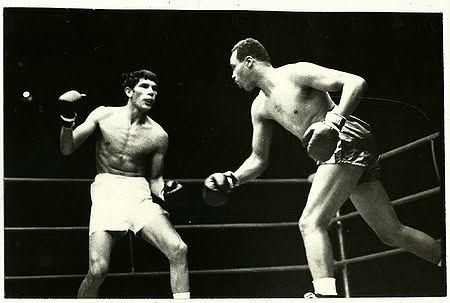
South American Middleweight Champion Carlos Monzon (left) KO's Harold Richardson (25-8-1 coming in) in the 3rd round, on July 4, 1969, at Estadio Luna Park in Buenos Aires, Distrito Federal, Argentina. Monzon, at this point, has not lost since October of 1964 and he's 16 months away from challenging Nino Benvenuti for the middleweight Championship. Richardson had won the 1958 New York Daily news Golden Gloves (Sub-Novice) Championship at Lightweight (135 lbs). Following the Monzon fight he would become a steppingstone for more promising, and younger, middleweights (and future light heavyweights) like Sandro Mazzinghi, Curtis Cokes, Mike Rossman, Bennie Briscoe, Len Hutchins, and Chris Finnegan. The light-hitting Richardson would finish up at 29-23-1 with only 2 KO wins.
1
97
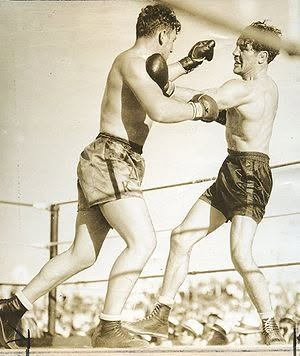
Max Baer (right) wins a 20-round points decision over King Levinsky, on July 4, 1932, at Dempsey's Bowl, in Reno, Nevada. Just to clarify this: The Racetrack Arena, where Baer had lost to Paolino Uzcudun a year earlier, would become referred to as "The Dempsey Bowl" or "Dempsey's Bowl" following that fight. It is the same venue. The Associated Press, which scored it 14-4-2 in rounds for Baer, would write: "Max Baer of California established himself as a leading contender for heavyweight honors in pounding out a 20 round decision over King Levinsky of Chicago, in a furiously fought battle featuring Reno's annual Independence Day celebration today. A vicious and almost ceaseless attack to the body brought Baer a popular decision. Levinsky stood up under a beating that would have dropped many another opponent. The Kingfish started out with a rush to take the play away from his opponent for two rounds. A right to Baer's jaw led Levinsky supporters to shout for an early victory. But Baer found the range in the 3rd frame and from then on had things his own way save for Levinsky rallies in the middle rounds." This was the 6th of 14 consecutive wins that culminated in Baer stopping Primo Carnera for the title in 1934.
1
1
65
Former Heavyweight Champion Jack Dempsey awards the 20-round points decision to Paolino Uzcudun (in the foreground), on July 4, 1931, over Max Baer (to Dempsey's left) in what The New York Times described as the "first heavyweight bout of any importance in Reno since [Jack] Johnson defeated [James] Jeffries July 4, 1910." Max Baer would then commence on a 14-fight winning streak that ended with him destroying Primo Carnera for the Heavyweight Championship in 1934. Uzcudun, coming off of this big win for him, would lose four of his next five bouts - decisons to King Levinsky, Tommy Loughran, Mickey Walker and Ernie Schaaf - and fall out of title contention.
2
95
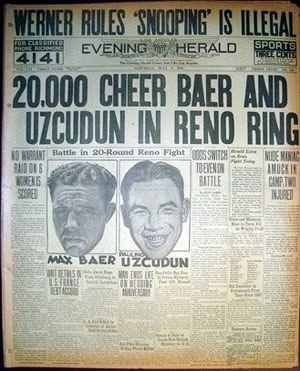
Newspaper write-up for the Max Baer-Paolino Uzcudun heavyweight fight held on July 4, 1931, in which Uzcudun won a 20-round points decision in Reno, Nevada. It was the first major heavyweight bout held in Reno since champion Jack Johnson had battered James J. Jeffries in 1910.
1
88
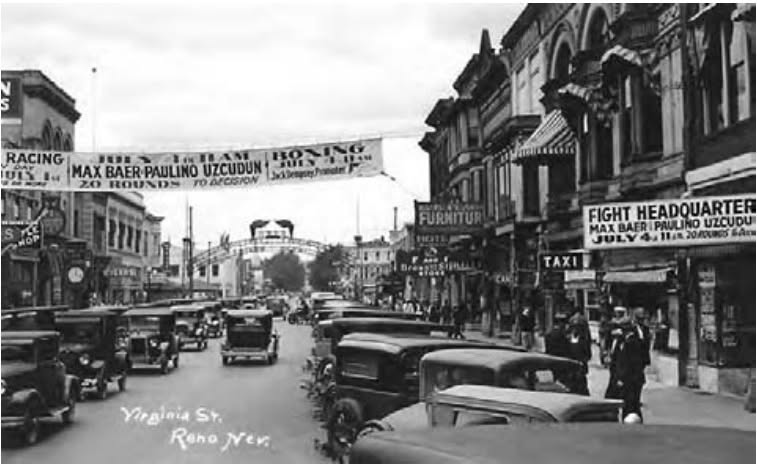
Reno, Nevada welcomes Paolino Uzcudun and Max Baer for their July 4, 1931 heavyweight bout at the Race Track Arena. Uzcudun will win a 20-round points decision.
41
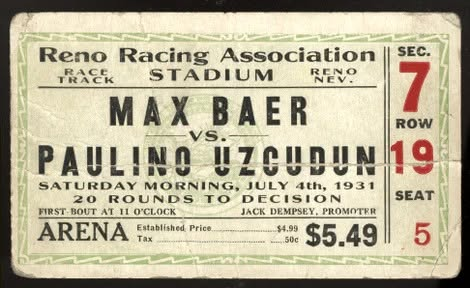
Ticket for Paolino Uzcudun's 20-round July 4th (1931) points decision over future Heavyweight Champion Max Baer.
31
Heavyweight Champion Jack Dempsey (left) and challenger Tommy Gibbons pose, on July 4, 1923, before their title fight in Shelby, Montana. From The Ring: “The Manassa Mauler” often left a trail of destruction inside the boxing ring but after his decision victory over Gibbons, the damage was far more widespread. While Dempsey’s opponent managed to keep his feet for the entire distance, the town in which the match was staged was crippled beyond repair. Shelby was a town in northern Montana that had dreams of becoming an economic hub through tourism and a recent oil boom. Part of the overall plan was to stage a heavyweight title fight involving Dempsey, who proved he was a walking financial bonanza when his fight with Georges Carpentier generated boxing’s first million-dollar gate. Knowing this, Dempsey’s manager Jack Kearns drove an extremely hard bargain: The town was to pay $300,000 in three separate installments – $100,000 when the contract was signed, $100,000 more 60 days before the fight and $100,000 a week before the fight. If the town missed a payment, the contract would be null and void and Team Dempsey would get to keep whatever they had been paid to that point. Eager to stage the fight, Shelby’s officials immediately accepted the terms. The town paid the first installment without incident but collecting the other $200,000 was an excruciating process. A local banker donated the final $98,200 of the second installment but by the time the third payment was due the well had run dry. The fight was called off on July 3 but was back on when Kearns agreed to take whatever he could of the final $100,000 from gate receipts. In retrospect, the deal was doomed from the start. Gibbons, the brother of onetime middleweight king Mike, was a credible but not compelling challenger and ticket sales were extremely slow. A small percentage of the crowd on fight day were paying customers because a multitude of locals rebelled against the high prices, overran the gatekeepers and saw the fight for free. Gibbons, a surprisingly narrow 11-to-5 underdog, was the crowd favorite but, as had been the case throughout this incident, Shelby’s residents walked away disappointed and angry. Dempsey lacked his usual sharpness and power while Gibbons, who managed to cut Dempsey’s eye in round two, slapped on repeated clinches and generally tried to neutralize the champion. After 15 nondescript rounds, referee Jim Dougherty – who was handpicked by Kearns – raised Dempsey’s hand with no argument from Gibbons. Because Kearns had dibs on the first $300,000 of income – and because only $72,000 of the third installment was paid to Team Dempsey – Gibbons ended up fighting for free. Fearing a mob scene, Kearns paid the local railroad $550 (including a $50 tip to the engineer) to get out of a town that was more battered and broken than the fighters. Local historians refer to this promotion as "The Rape of Shelby."
2
235
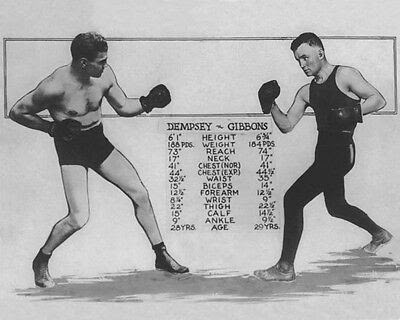
The "Tale of the Tape" for the Jack Dempsey-Tommy Gibbons Heavyweight Championship fight in Shelby, Montana on July 4, 1923.
36