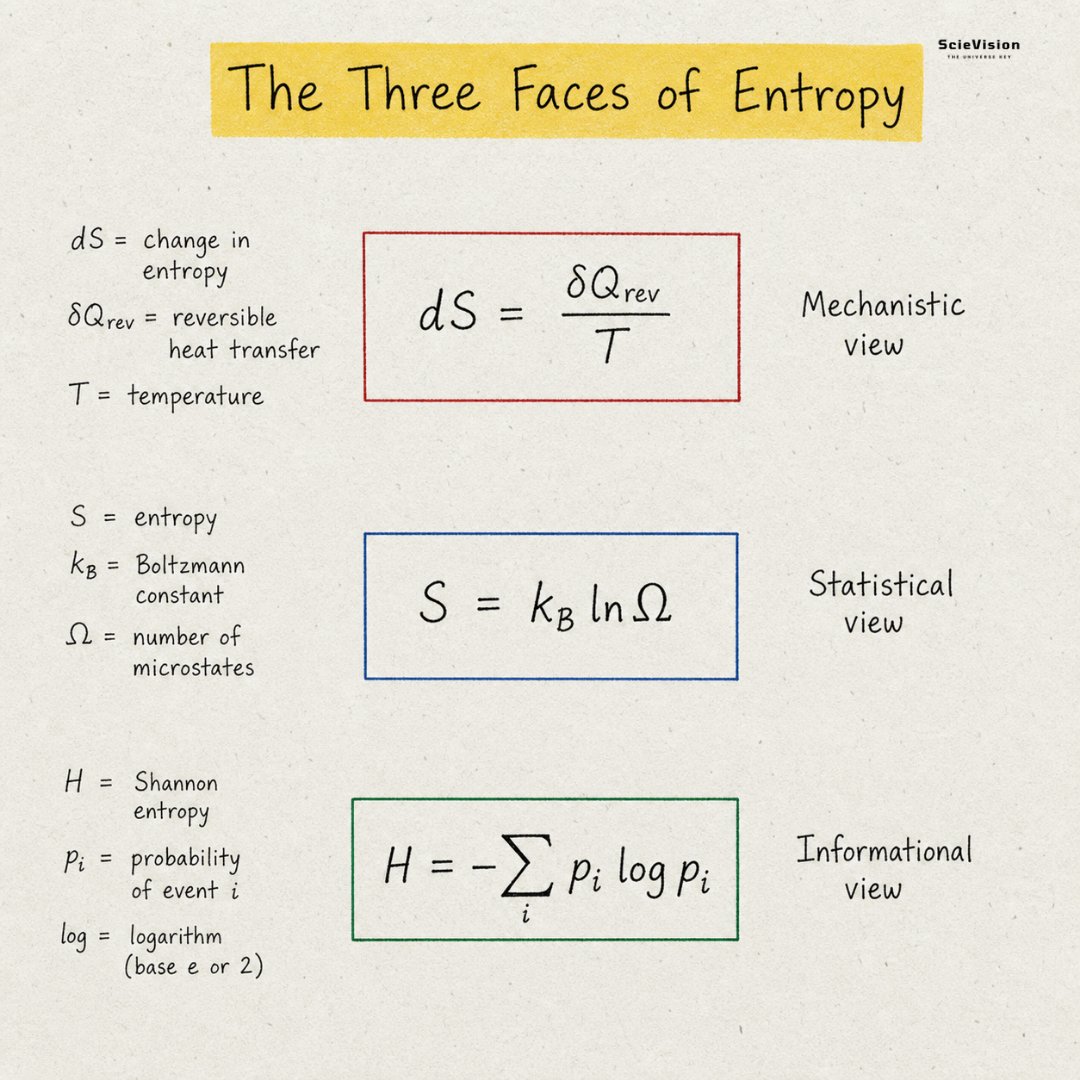
The Three Faces of Entropy ✍️
Entropy is a scientific concept that explains the connection between energy, disorder, probability, and information. The physicist Rudolf Clausius introduced it in 1865 to describe how heat moves in physical systems. Over time, scientists found that entropy appears in many fields, including physics, chemistry, information theory, and cosmology.
One way to understand entropy is through heat and energy. When heat enters a system, entropy usually increases. When heat leaves, entropy decreases. The same amount of heat affects something very cold more than it does something hot. This idea led to the second law of thermodynamics, which states that the total entropy of an isolated system naturally increases over time. This explains why hot coffee cools down, why ink spreads in water, and why broken objects do not fix themselves. Entropy gives time a direction because natural processes tend to move from lower to higher entropy.
Another way to understand entropy comes from Ludwig Boltzmann’s statistical perspective. He noted that entropy depends on the number of possible microscopic arrangements in a system. A system with many possible arrangements has high entropy, while one with few arrangements has low entropy. For instance, gas spread throughout a room has much higher entropy than gas trapped in one corner because there are many more ways for its molecules to arrange themselves. Entropy increases since high-entropy states are much more likely to happen.
The third way to understand entropy comes from Claude Shannon’s information theory. In this view, entropy measures uncertainty or missing information. If something is unpredictable, it has high entropy because learning the result gives us new information. A fair coin toss has higher entropy than a coin that always lands on heads because the outcome of the fair coin is uncertain. This concept links to physics, as a high-entropy physical system is one where we know less about the exact microscopic details.
Together, these three views describe the same idea in different ways. The thermodynamic view explains how energy changes, the statistical view explores the number of possible arrangements, and the information view pertains to uncertainty. Entropy is not just about disorder; it reveals a profound concept that shows how energy, probability, time, and knowledge are interconnected in the universe.