
Technology is helping tackle some of the world’s toughest environmental challenges. One example: MethaneSAT, a satellite developed by the Environmental Defense Fund with support from Google, uses AI and satellite data to detect methane leaks from oil and gas infrastructure. By identifying emissions faster and more accurately, the technology helps operators reduce a potent greenhouse gas and improve environmental accountability. #TechForGoodbuff.ly/ZdDfqlg
Monitoring the health of global rivers is difficult but crucial. Using advanced satellite technology, @uofcincy researchers can now track toxic algae blooms from space – protecting local drinking water and aquatic life from pollution. #TechForGoodbuff.ly/NCfMekh
As America approaches its 250th anniversary, it is worth remembering that the promise of liberty was never reserved for adults alone. The #FirstAmendment protects the right of minors to speak, learn, and exchange ideas, including online. In the digital age, online expression is often how young people engage in civic discourse, access information, and participate in public life. A free society does not silence young voices; it prepares them to become informed citizens. #America250buff.ly/oS24qND
Endless administrative tasks can easily drain your workday. To help you focus on what really matters, @awscloud introduced autonomous AI agents in Amazon Quick that handle the busywork behind the scenes – giving teams hours back every single day. #TechForGoodift.tt/tB6InVq
CCIA urged California lawmakers to revise SB 1130, warning that the bill’s broad definitions and ambiguous liability standards could sweep in everyday wearable technologies and expose manufacturers, retailers, and employers to civil and criminal liability for the actions of individual users. Effective #privacy policy should provide clear rules, target unlawful conduct, and avoid creating legal uncertainty that undermines innovation. Read more: buff.ly/opRNj0w
The detailed new report from the U.S. House Judiciary Committee lays out serious concerns about apparent targeting of U.S. companies by Korean authorities. CCIA hopes the Korean government takes these concerns seriously and works constructively to address U.S. concerns in the interest of promoting economic cooperation between key allies.
🚨NEW REPORT exposes South Korea's discriminatory attacks on American-owned businesses.
Foreign governments are increasingly abusing their authorities to target innovative American companies.
We exposed it in Europe, and now it's happening in South Korea.
Read our latest report on South Korea's harassment campaign of American businesses, including Coupang, Inc.: judiciary.house.gov/sites/ev…
USMCA remains fully in force, and that’s an opportunity to get digital trade right. As annual reviews continue, negotiators should focus on removing barriers that undermine reciprocal market access, including Canada’s streaming and link-tax policies and Mexico’s data-localization measures. Read CCIA’s statement: buff.ly/7ZoIhAK#DigitalTrade
New Jersey's A 4013, which would have restricted lawful speech, compelling speech, and empowered the government to police vague “problematic behaviors,” has been amended to become a study bill, allowing legislators to take time to critically examine this important #FirstAmendment issue. Read more: buff.ly/sNno7ka
The Video Privacy Protection Act was written to protect the privacy of video cassette rentals, not to govern every website featuring video content. CCIA and SIIA filed an amicus brief in Salazar v. Paramount Global, urging the Supreme Court to reject efforts to stretch an analog-era law into a sweeping internet litigation tool. #Privacy protections matter, but laws should be applied as Congress intended. Read more: buff.ly/AWadU2f#SCOTUS#TechPolicy
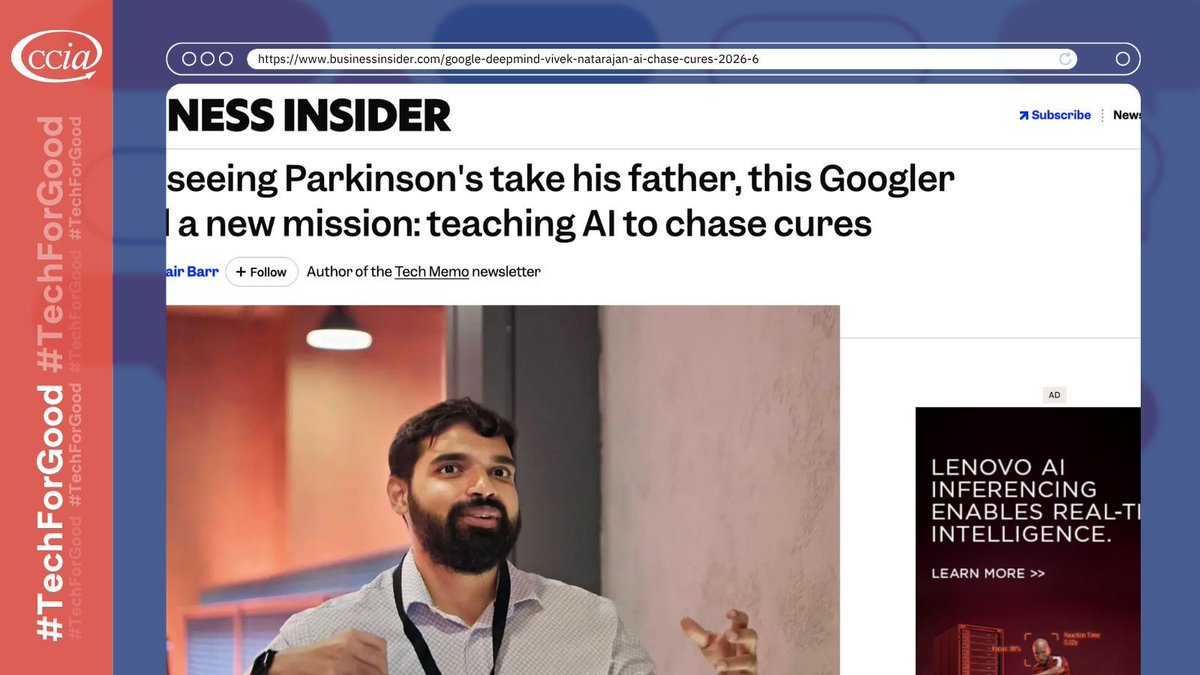
Finding treatments for complex diseases takes years of research. By leveraging advanced AI, researchers are rapidly accelerating drug discovery – helping scientists chase down life-saving cures faster than ever before. #TechForGoodbuff.ly/7EumZeO
In today’s webinar hosted by New America, “The Global Spectrum Fight That Could Define U.S. Satellite Leadership,” CCIA’s Karina Perez emphasized that industry leaders have a critical role to play in educating policymakers about the need for updating space spectrum rules. Her remarks echoed recommendations from CCIA’s report, ”Considerations on Interference Impact in GEO-LEO Spectrum Sharing Systems,” available here: buff.ly/fkloqxl
Amazon just opened up its logistics network. The company's freight, warehousing, fulfillment, and parcel-delivery capabilities are now available to any business, not just sellers on the Amazon store but competitors as well! This move may seem paradoxical as at first glance it appears against Amazon’s interests. Why would Amazon help competitors? However, it actually falls right in line with the company’s virtuous cycle strategy. Learn more: buff.ly/Zy7t2vr
California’s SB 976 regulations should protect kids online without compromising privacy, free expression, or innovation. In its testimony today in Sacramento, CCIA urges lawmakers to adopt clear, evidence-based rules and avoid age-verification mandates that can increase data collection, security risks, and compliance burdens. Read more: buff.ly/7kNiFZe
CCIA’s Space & Spectrum Center Director, Karina Perez, will be a panelist in today’s webinar, “The Global Spectrum Fight That Could Define U.S. Satellite Leadership,” hosted by @newamerica.org. Tune in to this virtual webinar this afternoon, where panelists will discuss the satellite issues and outcomes that should be U.S. priorities at WRC-27: buff.ly/L2sDiTv#SpacePolicy#SpaceEconomy
83
Computer & Communications Industry Association reposted
Amazon just opened its entire logistics network, including freight, warehousing, fulfillment, & delivery, to everyone. Including its own competitors!
Why would a company voluntarily hand its infrastructure to rivals? The economics are more interesting than they look. 🧵
The #FirstAmendment doesn’t begin at age 18. From Barnette to Tinker, the Supreme Court has repeatedly affirmed that young Americans have constitutional rights and do not “shed their rights at the schoolhouse gate.” Protecting children is important, but protecting their freedom to learn, speak, explore ideas, and engage in civic life is equally essential. A free society prepares the next generation for citizenship by teaching them how to exercise liberty, not by restricting it. #FreeSpeech Read more: buff.ly/q9BzlrA
Medical scans can be stressful, and reading them is incredibly complex. @MIT created an augmented reality headset that gives doctors 3D "X-ray vision" during ultrasounds. This means faster, more accurate diagnoses and better peace of mind for patients. #TechForGoodbuff.ly/j1fG7IN
In its latest term, the U.S. Supreme Court considered five cases at the intersection of government power, social media, and the #FirstAmendment. The through-line is clear: government actions that pressure, coerce, or dictate online speech and content moderation can implicate constitutional protections, a foundational principle for free expression in the digital age. By contrast, the independent editorial decisions of private platforms are not government action and do not violate users’ First Amendment rights. Read more from @EFF: buff.ly/HaShP8y
Protecting children online is essential, but government rationing of lawful speech is not the answer. Florida’s HB3 singles out social media platforms, restricts minors’ access to protected speech, and substitutes government mandates for parental choice. As a federal court recognized, these are “extraordinarily blunt” restrictions on #FirstAmendment rights. Online safety should be advanced through parental empowerment, education, and safety-by-design, not by allowing the government to decide which lawful voices young people can hear. #FreeSpeech Read more: buff.ly/LRg5O9Q
Transparency strengthens trust in our innovation system. CCIA supports the ITC’s proposal to require disclosure of third-party litigation funding in patent disputes. Greater transparency helps limit conflicts of interest, protect confidential information, and prevent opaque or foreign-backed entities from weaponizing the #patent system. #IPbuff.ly/rJh1T9n