Joined December 2022
2,835 Photos and videos
Pinned Post
The most important lessons in robotics are the ones you learn the hard way. Around 2018, after having designed mission-critical systems for government agencies in the U.S., U.K. and Netherlands during my time at Motorola, I became deeply interested in robotics—reading voraciously, building 2WD robots, and studying ROS (Robot Operating System). During that time, I was fortunate enough to meet a few inspiring founders of a robotics startup in the Silicon Valley and decided to join this team. It didn’t take long to realize that running a robotics startup is brutally hard. We made plenty of mistakes—some avoidable, some inevitable. This book is an attempt to capture the lessons we learned that I hope will help the next-gen robotics founders, engineers, and investors save a ton of time, health, and capital. Below is a quick overview of these lessons: 1) The Long-Tail Problem in Robotics Is Unforgiving 2) LiDARs Aren’t as Robust as You Think 3) Localization: Easier Said Than Done 4) Scaling Smart: Fewer Clients, More Efficiency—Customization Is a Trap 5) Autonomy Is Just Step One—Integration Is What Matters 6) Running a Robotics Startup Feels Like Running Multiple Companies 7) Global Expansion in Robotics: The Early-Stage Trap 8) The Hardest Part? Building the Right Team 👉 If you need more context, real-world examples and practical frameworks to address each of these risk vectors, the book is now available on Amazon. Link in the comments. I hope these lessons help you navigate the toughest parts of this journey with fewer scars. Until next time - Hello Robot! #Robot
1
3
927
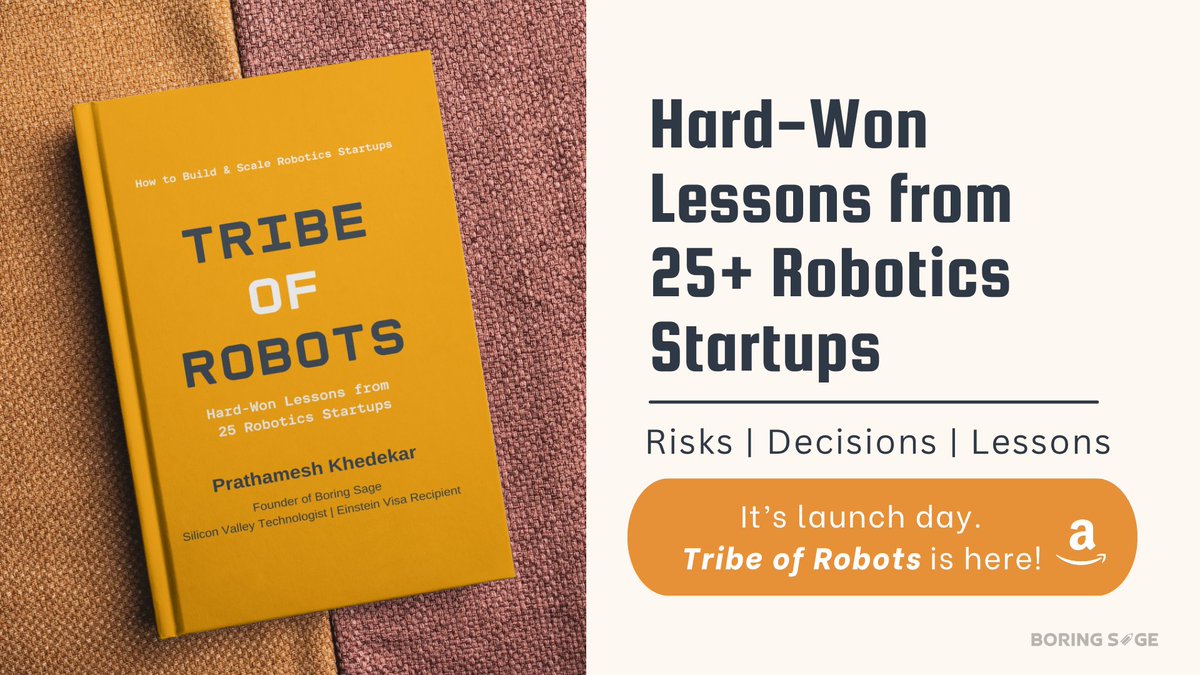
Robotics is one of the most unforgiving arenas for entrepreneurs. Most robotics startups fail within the first few years of launch. Yet, every year, thousands of talented engineers and founders enter the field—often unaware of the technical, operational, and commercial risks that routinely push even well-funded teams into the so-called "valley of death". It doesn’t have to be this way. Founders and engineers don't have to suffer. Having helped build and scale robotic systems across the U.S., the U.K., and Australia—working with startups and Fortune 100 companies, and after studying the trajectories of 25 humanoid, consumer and industrial robotics startups—I’ve seen the same failure patterns emerge again and again. But more importantly, I learned that, for every recurring failure pattern—every core risk vector, there is an APPROACH, i.e., an ANTIDOTE, that you can adopt to address it proactively. It’s this APPROACH that enabled 25 founders around the world surgically address those risks and build enduring robotics startups. That’s why I wrote Tribe of Robots. Now available on Amazon. This book examines the APPROACH adopted by 25 robotics companies and their founders to strategically navigate the risks that decimate most startups in this arena. ✅ For founders and engineers, it breaks down the CORE RISK VECTORS that emerged on the paths of 25 robotics startups and the APPROACH adopted by each of these teams to address them across the startup lifecycle—from fundraising and GTM to operations, talent, execution, and scale. ✅ From warehouse robots powering global logistics networks to delivery robots serving university campuses, and from industrial quadrupeds monitoring nuclear plants to the emerging wave of humanoids automating modern factories, these stories reveal some of the hardest decisions founders must make to survive in this industry. ✅ Those decisions span every layer of the venture. This book examines those decisions through the lens of the founders of robotics companies spanning AutoStore, Univ. Robots, Mayfield, Jibo, Serve, UBTECH, AgiBot, 1X, Figure AI, and more, uncovering the challenges they confronted, the choices they made, and the strategies that ultimately determined the fate of these ventures. Behind every successful robotics company lies a series of difficult decisions that must be made. ✅ This book (Tribe of Robots) distills those decisions and the underlying principles, offering concrete guidance for the next generation of founders, engineers, and researchers—people brave enough to build robots in the real world. If I could hand my past self a manual on Day 01 of my robotics journey, this book would be it—a collection of core risk vectors and corresponding approaches adopted by 25 robotics teams around the world to make some of the hardest decisions that determine the fate of the robotics startups of our time. 👉 Tribe of Robots: lnkd.in/gxrzC6bM #Robot #Robotics
4
1
37
Founder Reflections: boringsage.com/books
9
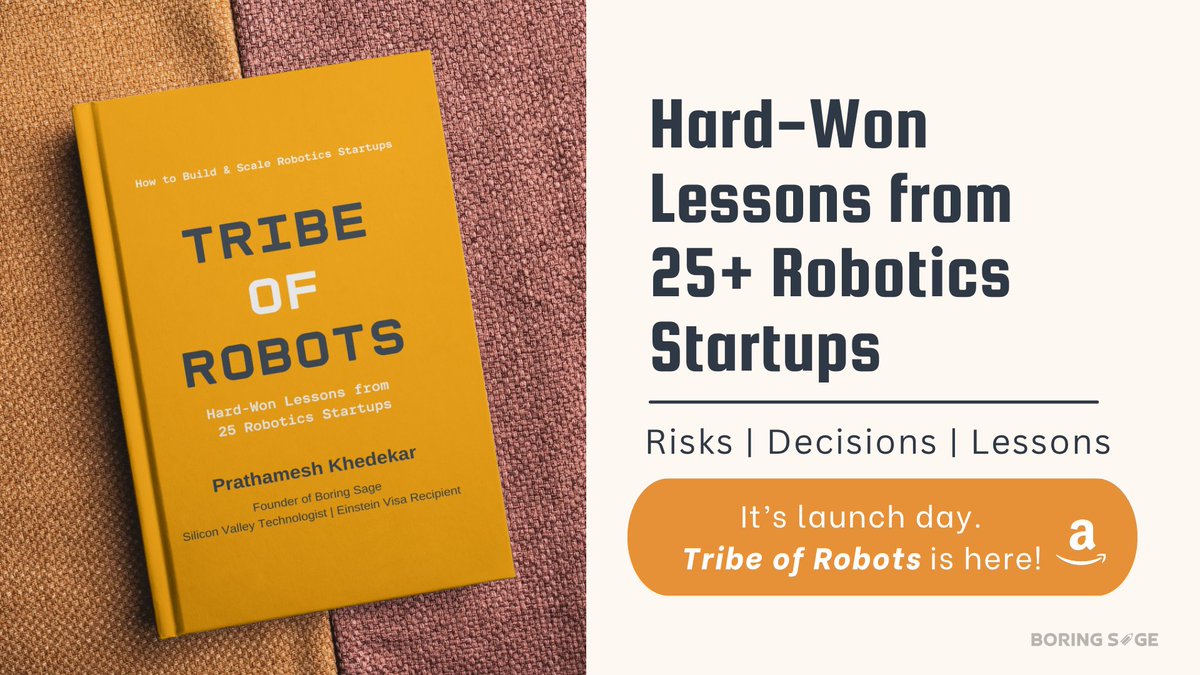
Robotics is one of the most unforgiving arenas for entrepreneurs. Most robotics startups fail within the first few years of launch. Yet, every year, thousands of talented engineers and founders enter the field—often unaware of the technical, operational, and commercial risks that routinely push even well-funded teams into the so-called "valley of death". It doesn’t have to be this way. Founders and engineers don't have to suffer. Having helped build and scale robotic systems across the U.S., the U.K., and Australia—working with startups and Fortune 100 companies, and after studying the trajectories of 25 humanoid, consumer and industrial robotics startups—I’ve seen the same failure patterns emerge again and again. But more importantly, I learned that, for every recurring failure pattern—every core risk vector, there is an APPROACH, i.e., an ANTIDOTE, that you can adopt to address it proactively. It’s this APPROACH that enabled 25 founders around the world surgically address those risks and build enduring robotics startups. That’s why I wrote Tribe of Robots. Now available on Amazon. This book examines the APPROACH adopted by 25 robotics companies and their founders to strategically navigate the risks that decimate most startups in this arena. ✅ For founders and engineers, it breaks down the CORE RISK VECTORS that emerged on the paths of 25 robotics startups and the APPROACH adopted by each of these teams to address them across the startup lifecycle—from fundraising and GTM to operations, talent, execution, and scale. ✅ From warehouse robots powering global logistics networks to delivery robots serving university campuses, and from industrial quadrupeds monitoring nuclear plants to the emerging wave of humanoids automating modern factories, these stories reveal some of the hardest decisions founders must make to survive in this industry. ✅ Those decisions span every layer of the venture. This book examines those decisions through the lens of the founders of robotics companies spanning AutoStore, Univ. Robots, Mayfield, Jibo, Serve, UBTECH, AgiBot, 1X, Figure AI, and more, uncovering the challenges they confronted, the choices they made, and the strategies that ultimately determined the fate of these ventures. Behind every successful robotics company lies a series of difficult decisions that must be made. ✅ This book (Tribe of Robots) distills those decisions and the underlying principles, offering concrete guidance for the next generation of founders, engineers, and researchers—people brave enough to build robots in the real world. If I could hand my past self a manual on Day 01 of my robotics journey, this book would be it—a collection of core risk vectors and corresponding approaches adopted by 25 robotics teams around the world to make some of the hardest decisions that determine the fate of the robotics startups of our time. 👉 Tribe of Robots: lnkd.in/gxrzC6bM #Robot #Robotics
2
49
Founder Reflections: boringsage.com/books
13
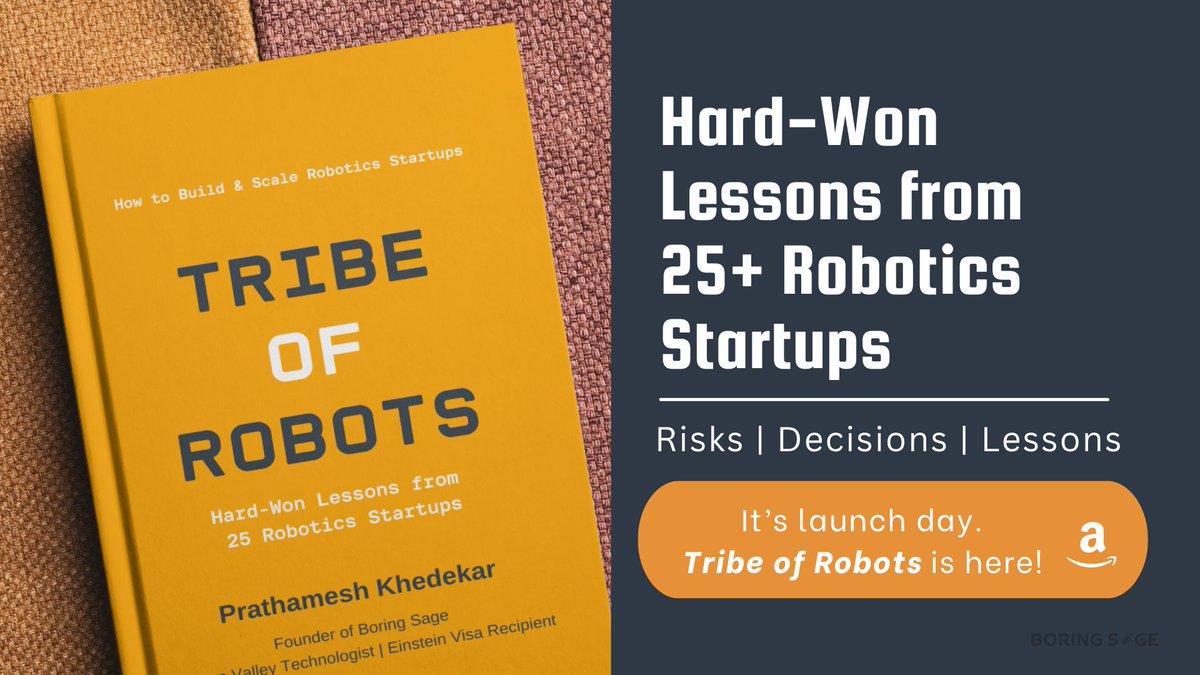
Robotics is one of the most unforgiving arenas for entrepreneurs. Most robotics startups fail within the first few years of launch. Yet, every year, thousands of talented engineers and founders enter the field—often unaware of the technical, operational, and commercial risks that routinely push even well-funded teams into the so-called "valley of death". It doesn’t have to be this way. Founders and engineers don't have to suffer. Having helped build and scale robotic systems across the U.S., the U.K., and Australia—working with startups and Fortune 100 companies, and after studying the trajectories of 25 humanoid, consumer and industrial robotics startups—I’ve seen the same failure patterns emerge again and again. But more importantly, I learned that, for every recurring failure pattern—every core risk vector, there is an APPROACH, i.e., an ANTIDOTE, that you can adopt to address it proactively. It’s this APPROACH that enabled 25 founders around the world surgically address those risks and build enduring robotics startups. That’s why I wrote Tribe of Robots. Now available on Amazon. This book examines the APPROACH adopted by 25 robotics companies and their founders to strategically navigate the risks that decimate most startups in this arena. ✅ For founders and engineers, it breaks down the CORE RISK VECTORS that emerged on the paths of 25 robotics startups and the APPROACH adopted by each of these teams to address them across the startup lifecycle—from fundraising and GTM to operations, talent, execution, and scale. ✅ From warehouse robots powering global logistics networks to delivery robots serving university campuses, and from industrial quadrupeds monitoring nuclear plants to the emerging wave of humanoids automating modern factories, these stories reveal some of the hardest decisions founders must make to survive in this industry. ✅ Those decisions span every layer of the venture. This book examines those decisions through the lens of the founders of robotics companies spanning AutoStore, Univ. Robots, Mayfield, Jibo, Serve, UBTECH, AgiBot, 1X, Figure AI, and more, uncovering the challenges they confronted, the choices they made, and the strategies that ultimately determined the fate of these ventures. Behind every successful robotics company lies a series of difficult decisions that must be made. ✅ This book (Tribe of Robots) distills those decisions and the underlying principles, offering concrete guidance for the next generation of founders, engineers, and researchers—people brave enough to build robots in the real world. If I could hand my past self a manual on Day 01 of my robotics journey, this book would be it—a collection of core risk vectors and corresponding approaches adopted by 25 robotics teams around the world to make some of the hardest decisions that determine the fate of the robotics startups of our time. 👉 Tribe of Robots: lnkd.in/gxrzC6bM #Robot #Robotics
3
1
78
Founder Reflections: boringsage.com/books
7
Robotics is one of the most unforgiving arenas for entrepreneurs. Most robotics startups fail within the first few years of launch. Yet, every year, thousands of talented engineers and founders enter the field—often unaware of the technical, operational, and commercial risks that routinely push even well-funded teams into the so-called "valley of death". It doesn’t have to be this way. Founders and engineers don't have to suffer. Having helped build and scale robotic systems across the U.S., the U.K., and Australia—working with startups and Fortune 100 companies, and after studying the trajectories of 25 humanoid, consumer and industrial robotics startups—I’ve seen the same failure patterns emerge again and again. But more importantly, I learned that, for every recurring failure pattern—every core risk vector, there is an APPROACH, i.e., an ANTIDOTE, that you can adopt to address it proactively. It’s this APPROACH that enabled 25 founders around the world surgically address those risks and build enduring robotics startups. That’s why I wrote Tribe of Robots. Now available on Amazon. This book examines the APPROACH adopted by 25 robotics companies and their founders to strategically navigate the risks that decimate most startups in this arena. ✅ For founders and engineers, it breaks down the CORE RISK VECTORS that emerged on the paths of 25 robotics startups and the APPROACH adopted by each of these teams to address them across the startup lifecycle—from fundraising and GTM to operations, talent, execution, and scale. ✅ From warehouse robots powering global logistics networks to delivery robots serving university campuses, and from industrial quadrupeds monitoring nuclear plants to the emerging wave of humanoids automating modern factories, these stories reveal some of the hardest decisions founders must make to survive in this industry. ✅ Those decisions span every layer of the venture. This book examines those decisions through the lens of the founders of robotics companies spanning AutoStore, Univ. Robots, Mayfield, Jibo, Serve, UBTECH, AgiBot, 1X, Figure AI, and more, uncovering the challenges they confronted, the choices they made, and the strategies that ultimately determined the fate of these ventures. Behind every successful robotics company lies a series of difficult decisions that must be made. ✅ This book (Tribe of Robots) distills those decisions and the underlying principles, offering concrete guidance for the next generation of founders, engineers, and researchers—people brave enough to build robots in the real world. If I could hand my past self a manual on Day 01 of my robotics journey, this book would be it—a collection of core risk vectors and corresponding approaches adopted by 25 robotics teams around the world to make some of the hardest decisions that determine the fate of the robotics startups of our time. 👉 Tribe of Robots: lnkd.in/gxrzC6bM #Robot #Robotics
2
1
58
Robotics is one of the most unforgiving arenas for entrepreneurs. Most robotics startups fail within the first few years of launch. Yet, every year, thousands of talented engineers and founders enter the field—often unaware of the technical, operational, and commercial risks that routinely push even well-funded teams into the so-called "valley of death". It doesn’t have to be this way. Founders and engineers don't have to suffer. Having helped build and scale robotic systems across the U.S., the U.K., and Australia—working with startups and Fortune 100 companies, and after studying the trajectories of 25 humanoid, consumer and industrial robotics startups—I’ve seen the same failure patterns emerge again and again. But more importantly, I learned that, for every recurring failure pattern—every core risk vector, there is an APPROACH, i.e., an ANTIDOTE, that you can adopt to address it proactively. It’s this APPROACH that enabled 25 founders around the world surgically address those risks and build enduring robotics startups. That’s why I wrote Tribe of Robots.  Now available on Amazon. This book examines the APPROACH adopted by 25 robotics companies and their founders to strategically navigate the risks that decimate most startups in this arena. ✅ For founders and engineers, it breaks down the CORE RISK VECTORS that emerged on the paths of 25 robotics startups and the APPROACH adopted by each of these teams to address them across the startup lifecycle—from fundraising and GTM to operations, talent, execution, and scale. ✅ From warehouse robots powering global logistics networks to delivery robots serving university campuses, and from industrial quadrupeds monitoring nuclear plants to the emerging wave of humanoids automating modern factories, these stories reveal some of the hardest decisions founders must make to survive in this industry. ✅ Those decisions span every layer of the venture. This book examines those decisions through the lens of the founders of robotics companies spanning AutoStore, Univ. Robots, Mayfield, Jibo, Serve, UBTECH, AgiBot, 1X, Figure AI, and more, uncovering the challenges they confronted, the choices they made, and the strategies that ultimately determined the fate of these ventures. Behind every successful robotics company lies a series of difficult decisions that must be made. ✅ This book (Tribe of Robots) distills those decisions and the underlying principles, offering concrete guidance for the next generation of founders, engineers, and researchers—people brave enough to build robots in the real world. If I could hand my past self a manual on Day 01 of my robotics journey, this book would be it—a collection of core risk vectors and corresponding approaches adopted by 25 robotics teams around the world to make some of the hardest decisions that determine the fate of the robotics startups of our time. 👉 Tribe of Robots: lnkd.in/gxrzC6bM #Robot #Robotics
2
1
64
How does Amazon deliver 6 Billion orders a year? It all comes down to 9 core robots. Here’s how: 🔹Amazon operates across 25 countries. 🔹Every day, it fulfills 17 million orders. 🔹To make this possible, it runs 175 warehouses. 🔹Employs over 1 million robots (9 core types) 🔹Each warehouse is equipped with a fleet of these robots 🔹From AMRs to spatial manipulators, these fleet has it all 🔹These 1M Robots work in tandem with 1.5M employees This human–robot collaboration enables Amazon to deliver packages on time, at planetary scale. So how does this robotic system actually work? We cover this system in today's guide. Details in our book - Decoding Robots! 👉 Guide: Link in the comments! 👉 Book: lnkd.in/gJWcCrAy 👉 Course: lnkd.in/g2uaziHW #Robot #Robotics
3
37