15 Year Trader, Finally on X. Big numbers guy! (My account is Not Financial Advice)

Joined November 2023
40 Photos and videos
Here is a list of small caps I would buy currently In this down trend $HIMX $IPWR $NRGV $OSS $AIRJ $INFQ $CXDO $ONDS $TE $USAR $LPTH $VLN $UUUU
4
689
$IPWR A micro cap that could change everything for $NVDA 800V & datacenters and make it more efficient.
$IPWR There is a hidden chokepoint inside NVIDIA's Rubin Ultra rack that is being overlooked… remember this name B-TRAN AI racks used to pull 10 to 50kW. Rubin Ultra is pushing toward 600kW and the roadmap points at megawatt racks. At that density, old 400V AC power delivery falls apart. Too much current, too much copper, too much heat. So the entire industry is ripping it out and moving to 800V DC. 800V DC fixes the power problem but creates a new one. DC current does not have a natural zero-crossing the way AC does. When a fault hits, the arc does not want to die. Mechanical breakers are way too slow to catch it. At 800V across a 120kW rack it is a fire. So the rack now needs a new kind of breaker. Solid state. Reacts in microseconds. NVIDIA's own 800V reference architecture lists it as required infrastructure This is where $IPWR shines. Think of a power switch as a gate on a road. Almost every gate only opens one way. If you need traffic flowing both directions, you bolt two gates together. Two gates means double the parts, double the cost, double the heat πŸ”₯ $IPWR built a single gate that flows both ways on its own. They call it B-TRAN. One part instead of two. Traffic barely slows down so it runs cool. In its target jobs it wastes roughly a quarter of the energy a conventional setup does. A safety breaker is the perfect fit. It sits open nearly 100% of the time and only slams shut when something breaks. When a part is on almost constantly, wasted energy is the entire ballgame. Run cooler, win the socket. The demand is up there. $WOLF just guided its data center power business to grow 30 to 50% per quarter. The 800V transition is happening now, not in 2030. The execution is the bet. On May 14 $IPWR signed an LOI to co-develop a B-TRAN solid state breaker prototype for a US hyperscaler building on NVIDIA's Rubin Ultra 800V architecture. Prototype targeted for end of 2026, with a possible production ramp in 2027. Their pipeline grew about 50% since the start of the year. New CEO came from 11 years at $ON, hired specifically to convert lab projects into real orders. The not so rosy part: $IPWR has $0 revenue today. No production orders yet. The whole thesis rests on one thing: turning a prototype eval into a repeating purchase order. Until it lands, this is a lottery ticket on B-TRAN becoming the default safety standard for 800V. But it is a lottery ticket with a floor. No factories, no debt, $16M plus in cash after a recent raise, slow burn. It cannot implode the way $WOLF did a couple years back. The downside is dead money, not zero. This is a binary event with capped downside and uncapped upside. Still size accordingly to a pre revenue company. This is the kind of name where if the design wins this explodes hard. By the time there is coverage, the entry is gone. So I’m betting they win. NFA. I hold a position in $IPWR.
5
891
$IPWR Another INSIDER BUY on June 1 at $7.60!
13
567
@jrouldz @StockSavvyShay take a look at this above!
1
1
229
$TMQ I have added a cooper play, there is a massive shortage, this stock is government owned. $NVDA ceo just reiterated this fact. Avg $4.85
2
4
3,016
Good $IPWR write up here! Read!
AI is shifting to 800V DC racks, but a single microsecond short circuit will vaporize the silicon before legacy breakers can react. I found a stock working to solve this problem. $IPWR (Ideal Power Inc. $128m market cap) Which uniquely controls the patented B TRAN double sided vertically symmetric architecture. Future $NVDA Rubin Ultra architectures require a rewrite of the power delivery stack. Roughly 190 GW of hyperscale capacity has been announced. Rack power densities are shifting from 10 to 50 kW up to 100 to 150 kW per rack. Next generation setups like the NVIDIA Rubin Ultra will push rack requirements beyond 500 kW in 2027 and up to 1 MW by 2030. To manage these power densities and minimize conduction losses, the entire AI industry is standardizing on 800V direct current DC power distribution architectures directly to the server rack. Without advanced solid state protection, the entire supply chain falters. Direct current distribution lacks a natural voltage zero crossing point to extinguish arcs. Clearing a short circuit on an 800V DC bus using legacy mechanical breakers results in severe, destructive arcing. This slow millisecond fault clearing speed cannot prevent transient voltage faults from destroying sensitive silicon. These physical systems have become the primary limiting factor for AI expansion. After looking at TPU BOM to Maia BOM, it looks like future ASICs and GPUs and hyperscaler deployments are heavily reliant on solid state circuit breakers SSCBs. And one vendor could dominate the high voltage DC power protection market covering nearly all of: β€’ Hyperscaler optics and racks (NVIDIA Rubin Ultra 800V DC pods) β€’ EV drivetrain inverters (Stellantis platform) β€’ Solid state EV contactors (battery cut off switches) β€’ Industrial microgrids and solid state transformers SSTs Since this company holds an extensive patent moat of 103 issued and 78 pending patents: β€’ Ideal Power B TRAN single die symmetric setup (reduces component count by 75% and cuts conduction losses by 50% to 90%) That is it. Legacy topologies require pairing unidirectional switches back to back, requiring two discrete IGBTs and two diodes. This introduces significant conduction losses. In testing, a single B TRAN die demonstrated an ultra low voltage drop of just 0.36V at a 50A load current, cutting conduction losses to only 18W. Hyperscalers and AI are moving toward megawatt scale power but the delivery hardware layer is fragile. If mechanical breakers take milliseconds instead of microseconds to clear faults, the entire future AI buildout gets crippled. It is crazy that an approximately $110.78M company could become the center of it all. Financially, backward looking metrics look poor. Their Piotroski F Score is 2 and Altman Z Score is 0.68, placing them in a typical distress zone for pre revenue firms. Q1 2026 net loss was $3.63M with cash burn of $2.03M. This looks weak due to zero revenue during early testing. However, after a $30M offering in May 2026 and a $12.6M offering in February 2026, pro forma cash is $44.50M with zero debt. This provides over four years of operating runway against a full year burn target of $10.0M to $10.5M. The primary risk is commercial execution: converting current evaluations and prototypes into repeat production orders and sustained revenue. Near term catalysts are substantial. A signed LOI ensures a B TRAN circuit breaker prototype is being codeveloped for a major U.S. hyperscaler for delivery in Q4 2026. They are also entering Phase III with Stellantis for EV inverters in mid 2026 after finishing Phase II in early 2024, alongside EV contactor testing with a third global automaker by mid 2026. To secure logistics, they qualified a European wafer fabrication partner, removing supply chain exposure to China. B TRAN architecture will likely be one of the biggest bottlenecks alongside advanced chip packaging as the AI industry shifts to megawatt power distribution. NFA. Do your own DD.
1
4
962
$IPWR Thesis getting stronger by the minute.
$IPWR B-TRAN technlogy is a game-changer for AI DC, ideal for 800V DC NVIDIA Rubin Ultra racks. 1 device replaces up to 4 components, has >60% lower losses vs SiC MOSFET Signed LOI for prototyping intelligent SSCB with a major US hyperscaler I'm personally invested. High-risk!
7
944
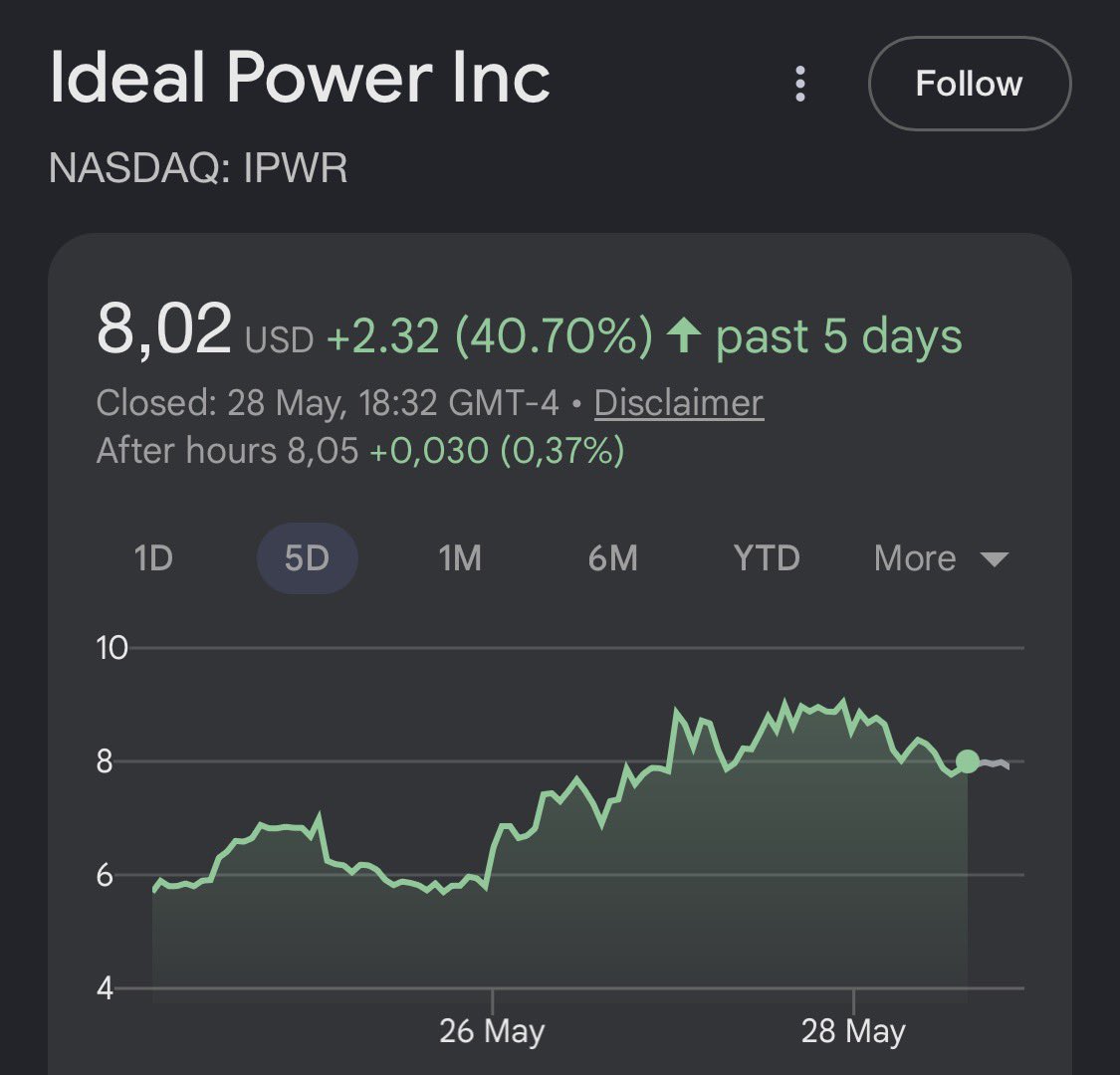
$IPWR My morning thoughts came true, the exposure that came with serenity post last night, brought us 12x the avg volume today.
Honestly the best part about today is way more people on Twitter know how useful & amazing $IPWR is than they did yesterday and all It took was people guessing which ticker serenity was thinking about, she picked $XFAB, but now ppl are being exposed to a new bottleneck in $IPWR!
9
676
Good $IPWR tidbit! All can win in the datacenter energy saving game. All have different layers of use.
Just to add on here. It does not compete with $WOLF or $NVTS. Their gates are built for flicking on and off millions of times a second. That is the chargers, the converters, the power supplies inside servers. $IPWR's gate flicks slowly but goes both ways. Different job and different socket. They can all win at the same time. $IPWR is going after the part of the data center those two leave alone.
9
949
Honestly the best part about today is way more people on Twitter know how useful & amazing $IPWR is than they did yesterday and all It took was people guessing which ticker serenity was thinking about, she picked $XFAB, but now ppl are being exposed to a new bottleneck in $IPWR!
1
9
1,598
Either $IPWR or $AOSL? Right?
There’s one very compelling name someone called out. That I ended up taking positions in for power semi exposure. Heavily tied to $NVDA but not directly mentioned like $NVTS. Can anyone guess?
1
4
4,480
$IPWR just hit 52 week highs and about 3x today volume. And about 50x 3 weeks ago volume. People are starting to understand the product B-Tran!
1
9
6,016
$TE, my target since it was a $3 stock was always $29, have to get ahead of everyone to make the real profits! Find those plays early!
$TE price targets, I’ve considered a lot of things into these metrics. Here is some detailed price targets and some things not even on this sheet also considered. This is a realistic execution path. Target: $25.67 to $32.37 Target avg - $29
10
1,950
Great breakdown on $IPWR Additional benefits to a datacenter!
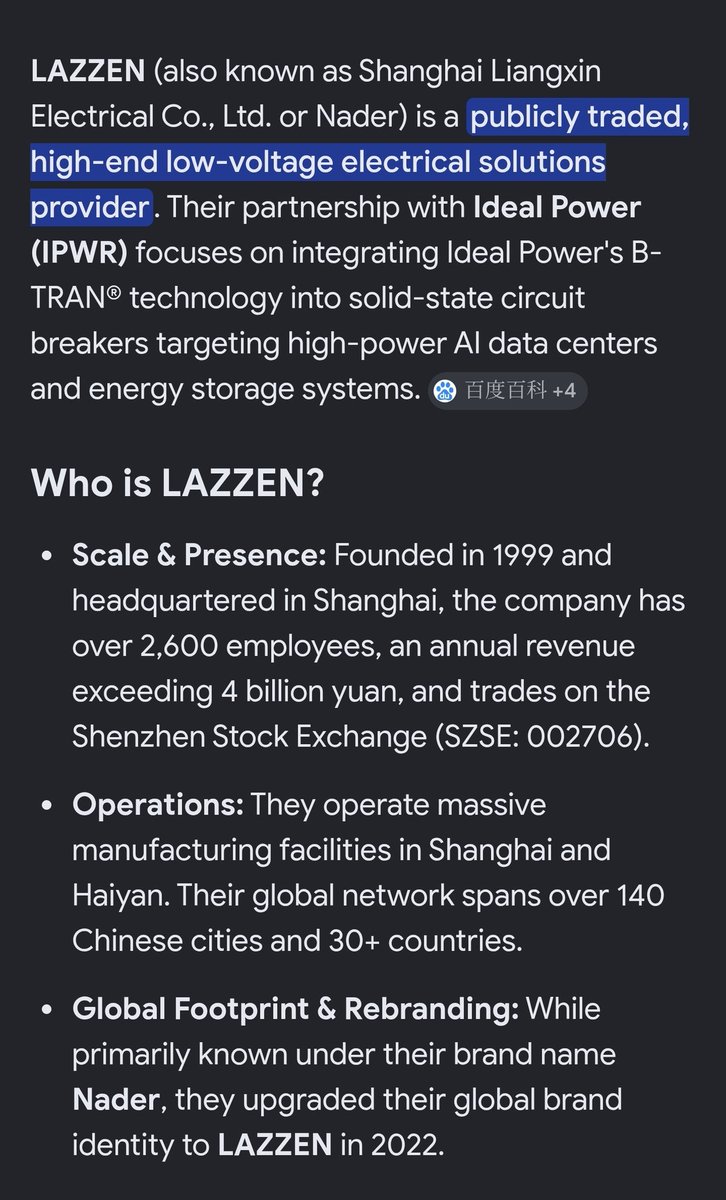
$IPWR Why I bought goes deeper than their investor presentation 1-2% potential savings on electricity. The real potential is closer to 3-7% across the whole data center. 1-2% Is conservative focused on savings from B-TRAN's ultra-low conduction losses. It does not deeply quantify or emphasize the secondary/knock-on benefits: Reduced cooling costs (less heat = lower PUE) Higher rack density / smaller heat sinks Lower infrastructure capex (less copper, smaller cooling plants, etc.) Synergies with 800V DC architectures Less heat generation and cooling savings: Lower losses mean less waste heat from power electronics. Cooling can be 30-40% of a data center's total power use. Even modest reductions in heat can meaningfully lower overall PUE (Power Usage Effectiveness) through smaller chillers, fans, or CRAC units. The presentation mentions efficiency and energy cost savings but doesn't break out amplified cooling impacts. Denser racks / higher power density: Smaller heat sinks, reduced thermal management overhead, and fewer components (thanks to bidirectionality) could allow tighter rack layouts or higher kW/rack without proportional infrastructure increases. This improves compute per square foot, lowers capex per MW of IT load (building, land, power delivery), and increases overall facility output. The slides focus more on energy use than physical density/capex advantages. System-level synergies with 800V DC: Reduced cabling losses, less copper, fewer conversion stages β€” these compound with B-TRAN but the 1-2% seems narrowly tied to B-TRAN's role in breakers/switches rather than the full architecture. Reliability/uptime and other opex: Faster protection, fewer moving parts, diagnostics β€” valuable but harder to monetize in simple % savings. Biggest kicker though.. If B-TRAN allows: denser racks lower thermal throttling reduced cooling bottlenecks more stable power delivery = hyperscalers generate more AI revenue per GW. That’s worth vastly more than electricity savings. In short, the investor presentation 1-2% is a baseline "direct" efficiency gain they feel confident attributing. It understates the full potential value of B-TRAN 800V in next-gen AI data centers. It focuses on the most direct, easily measurable electricity savings while the bigger upside (especially for hyperscalers) comes from the holistic efficiency, density, and infrastructure advantages. Hidden, yet to be uncovered value, multi-year development, global sales deal with Lazzen, hyperscaler interest, and cashed up with a tight float. Good start for a potential bagger. Presentation: d2ghdaxqb194v2.cloudfront.ne…
1
8
933
$OSS, it has doubled, margins are great and the road map looks solid. Will be holding for years!
$OSS is being a big sleeper play. I’ve been in since $8.50
1
12
1,390
$NRGV, getting close to double in 3 months! This has big potential, with it changing its business model to IPP, the margins could be massive!
I have entered $NRGV at 3!
2
615
$AIRJ thesis getting stronger by the day. The big name companies working with a small cap, is the real attraction here.
$AIRJ πŸ”Έ 1. Major Corporate & Industrial Backers Besides GE VERNOVA owning 50% of the JV & having a $15M equity stake. β€”β€”β€”β€”β€”β€”β€”- πŸ”Έ Carrier Global Corporation: β€’ Carrier is one of the company's most critical backers. β€’ They initially committed $10 million in growth equity and hold the exclusive rights to build AirJoule's technology directly into next-generation HVAC equipment across the Americas. β€’ A senior executive from Carrier also sits on AirJoule's board of directors. β€”β€”β€”β€”β€”β€”β€”β€” πŸ”Έ BASF: As one of the largest chemical companies in the world, BASF acts as a key strategic partner and investor. β€’ They invest heavily in and manufacture the actual proprietary "sorbent" chemical materials required to mass-produce AirJoule systems at a low cost. β€”β€”β€”β€”β€”β€”β€”β€”- β€’ CATL: The world's largest lithium-ion EV battery manufacturer has established a joint venture with AirJoule to serve as a conduit for scaling and distributing their energy-saving tech into Asian and Middle Eastern markets. β€”β€”β€”β€”β€”β€”β€”β€”β€” πŸ”Έ High-Profile Energy & Private Equity Investors β€’ Rice Investment Group (RIG): β€’ A multi-strategy investment fund backed by the billionaire Rice family (known for building North America's largest natural gas producer). β€’ They led a massive initial private investment in public equity (PIPE) to scale the business. β€”β€”β€”β€”β€”β€”β€”β€”β€” πŸ”Έ A look at the latest SEC filing data from May 2026 reveals that over 90 major financial institutions hold long-term positions in AirJoule's public stock.
3
809
Good breakdown on $IPWR and potential.
$IPWR Found an important tid bid in IPWR's 10Q. Lead Asia customer (Lazzen) has gone from 1 project β†’ 3 simultaneous projects. They will ONLY do this if their engineering milestones were met The 10-Q's MD&A and PR show this customer has now opened: - Low-current SSCB (original) β€” 800V AI data center / energy grid, prototype Q4 2026 - NEW: Medium-current SSCB for 800V AI DC data centers energy storage - NEW: Low-current SSCB for smart industrial buildings Secondly, Institutions paid $5.67 in May vs. $2.75 in February β€” same investor class re-pricing the same asset 106% in 11 weeks. Pretty good sign.
1
3
2,471
$AEHR entry in February at $24 now at 4x at $96!
$AEHR ENTERING AEHR AT $24.
2
759
$NVTS A 3.5x in 6 months :), don’t over complicate the 2027 story of 800 V!
I have also started another position in $NVTS at $7.50, what they are doing with 800V soon, and the product current coming out and their WT partnership in Asia expanding as well as the NVDA partnership. This is a must own near the 200MA.
3
840