Also interesting for consideration in any (other country’s) proposals that age assurance might be inferred using location-related data — “reasonable expectations of privacy” extends to people’s interactions with private companies or their piggybacking by others.
#SocialMediaBan
Supreme Court says police need to respect your phone's location trail
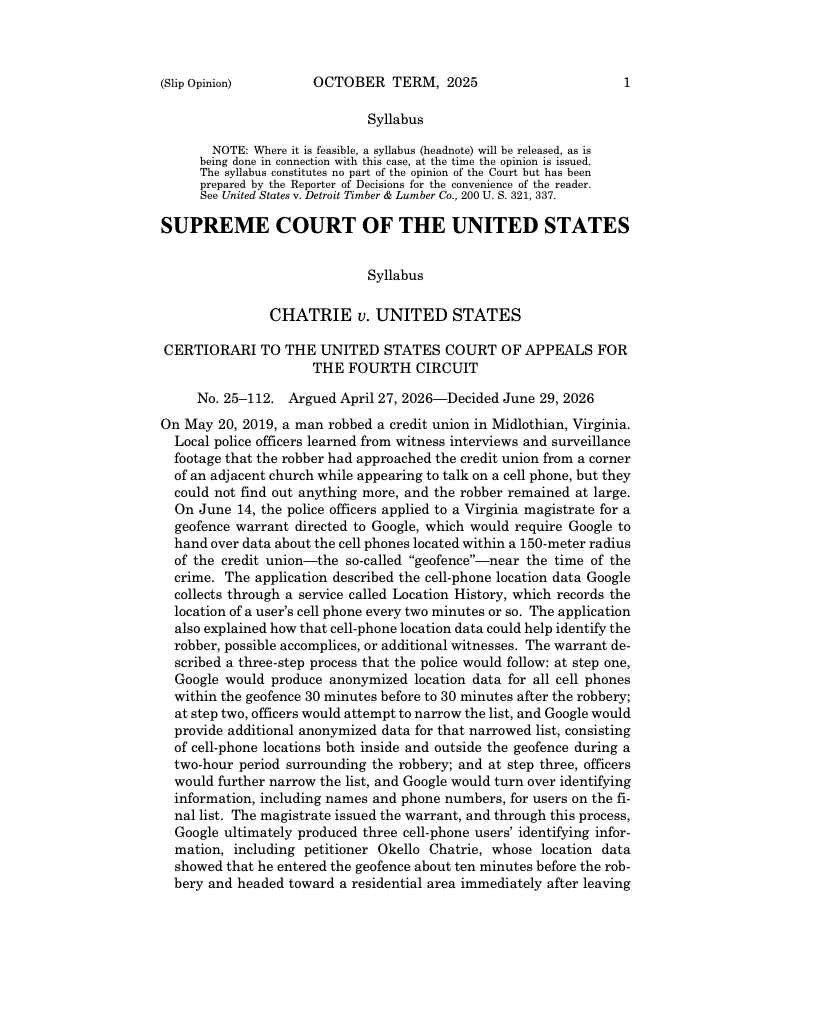
The Supreme Court ruled today that when police pull your cell-phone location data through a geofence warrant, that counts as a Fourth Amendment search. The case is Chatrie v. United States.
It started with a 2019 bank robbery in Virginia. With no suspect, police got a warrant ordering Google to hand over data on every phone near the credit union around the time of the crime, then narrowed the list until Google coughed up names. One of them was Okello Chatrie. He argued the whole thing was an unconstitutional search.
The Court agreed that a search happened. Writing for the majority, Justice Kagan leaned hard on Carpenter, the 2018 cell-site case, and said Google's Location History is even more revealing. It pinpoints you within about 20 meters, logs your spot every couple of minutes, and can even tell which floor of a building you are on. The government argued that grabbing just two hours of data is no big deal and that users volunteer this info to Google anyway. The Court rejected both. Kagan noted Google nags people to turn the feature on without explaining how often it tracks them or that police might come knocking.
The lineup is worth a look. Kagan was joined by Roberts, Sotomayor, Kavanaugh, and Jackson. Gorsuch agreed with the result on his own reasoning. Alito and Barrett each dissented.
One catch. The Court did not throw out the evidence against Chatrie. It sent the case back so the Fourth Circuit can decide whether this unusual three-step warrant met the requirements of probable cause and particularity. So the privacy win is real, but Chatrie's fight is not over.