QMS Network is a Layer-1 blockchain built for the post-quantum era.

Joined May 2026
29 Photos and videos
The QMS takeaway: Deadlines are compressing. Live networks are showing how slow retrofits can be. Compute is becoming a constrained infrastructure layer. Next-generation blockchain infrastructure should be quantum-resistant by design and should turn network compute into useful work instead of pure overhead. That is the direction we're building toward.
49
This week’s theme is compression. Post-quantum timelines moved closer. Bitcoin’s retrofit path got more concrete. Compute demand ran into the grid. 3 signals stood out: 1️⃣ @Microsoft accelerated its quantum-safe roadmap. Microsoft is now targeting a transition of products and services to post-quantum cryptography by 2029, pulling forward the broader transition target from its earlier 2033 full-transition plan. The move came shortly after Washington issued new guidance for federal PQC migration, with agencies directed to prioritize high-impact systems, high-value assets, and sensitive systems for risk reduction by the end of 2030. The roadmap spans TLS 1.3, crypto-agility, key management, code signing, certificate issuance, key protection, and update pipelines. At Microsoft’s scale, this is a system-wide engineering program. For enterprises still treating PQC as a distant migration, the planning window just got tighter. 2️⃣ Bitcoin’s post-quantum work reached the proposal layer. @Blockstream’s Q2 update introduced OP_CHECKSHRINCS, a proposed post-quantum signature opcode for Bitcoin based on a hash-based scheme. The proposal builds on earlier post-quantum signature work demonstrated on Liquid, moving the conversation from sidechain deployment toward something the wider Bitcoin community can evaluate. That is what retrofit work looks like in practice: research, production-sidechain testing, opcode proposals, ecosystem review, and eventual migration. The code may be the cleanest part, moving a live network without breaking trust is the real work. 3️⃣ The US grid put compute on a shorter leash. During the East Coast heatwave, the U.S. Department of @ENERGY authorized PJM, the largest US grid operator, to direct backup generation resources at data centers and other large-load customers as a last resort before or during an Energy Emergency Alert 3. PJM also ordered emergency electricity-reduction measures as demand approached its 20-year record, while spot wholesale prices in parts of the Mid-Atlantic and Dominion zones surged past $2,500 per megawatt-hour. Reuters also reported that data center demand accounted for an estimated $3.8B of PJM’s year-over-year wholesale power cost increase in the first five months of 2026. Compute is becoming part of real-time grid management. Power, cooling, location, backup generation, and demand response now sit inside the compute stack.
1
1
3
346
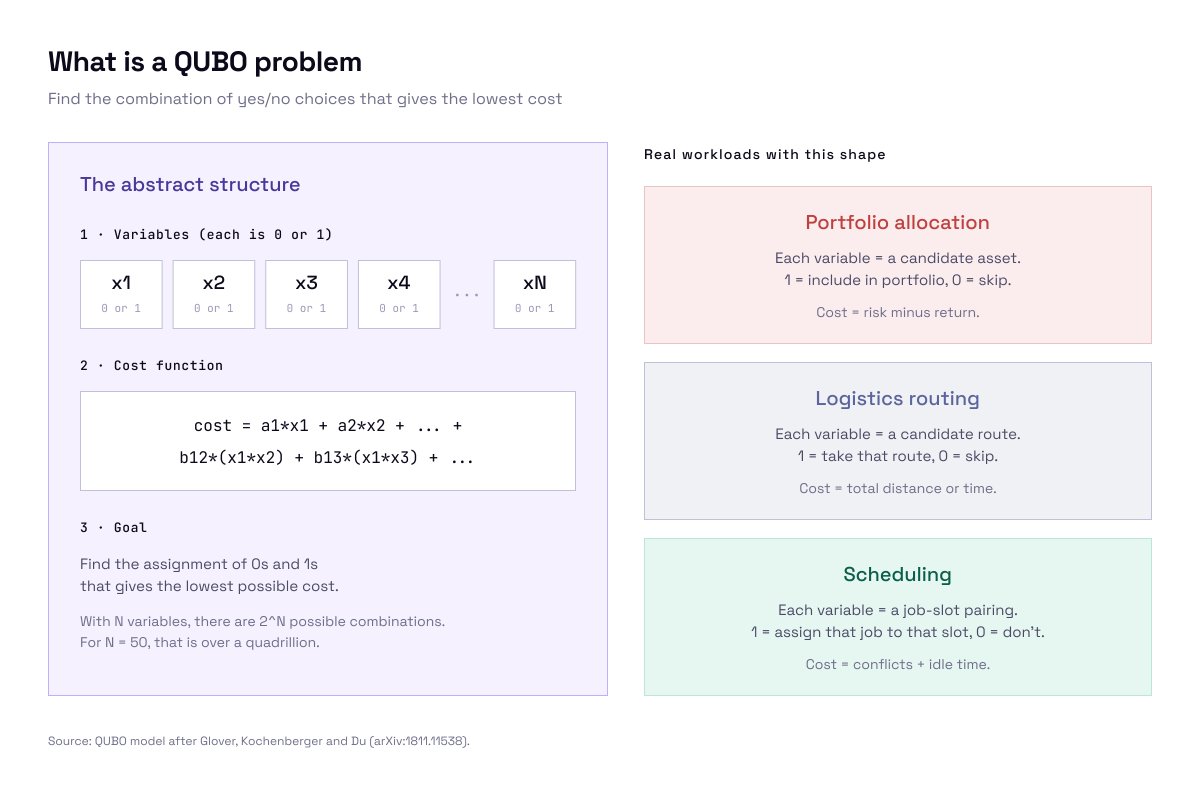
Portfolio allocation. Truck routing. Shift scheduling. Underneath, it's all the same math problem: QUBO (quadratic unconstrained binary optimization). Yes or no decisions. A cost on each choice, plus costs from how choices interact. Find the combination with the lowest total. At 50 variables you're already past a quadrillion combinations. At 300, they outnumber atoms in the universe. No computer can check them all. This is the problem QMS miners get paid to solve.
2
1
7
483
Read more in our article here:
4
189
3 architectural pieces define how QMS is built: • Post-quantum is where QMS builds. The two layers QMS builds itself, consensus and finality, are post-quantum secure from day one. The execution layer is taken from Ethereum, so account signatures start standard and move to post-quantum on the roadmap. • A miner network built for quantum hardware. Same design intent as a quantum-native chain, but QMS does not need quantum hardware to exist at scale before the network can launch. • Proof-of-Useful-Work consensus. Turns mining into paid compute for enterprise clients, rather than spending it on hashing that secures the chain and nothing else. The result is a chain that is quantum-resistant today and quantum-productive tomorrow.
3
1
12
870
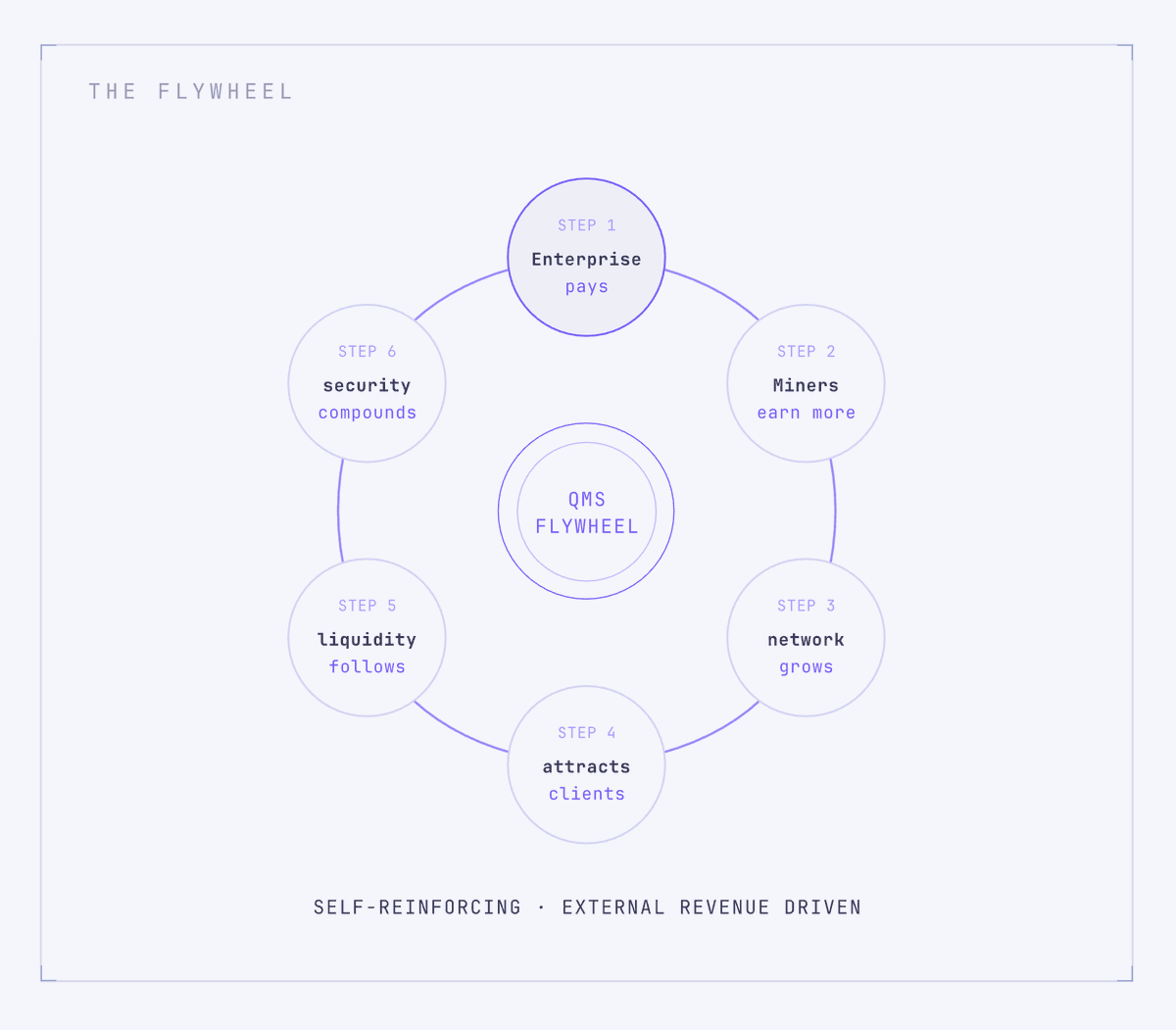
QMS explores a different model than most blockchain networks. Commercial demand → stronger miner incentives → a stronger network → more commercial demand. That’s the flywheel QMS is designed to build.
1
9
575
QMS Network reposted
x.com/i/article/207265633629…
3
3
20
1,520
Uber didn’t invent cars. Airbnb didn’t invent houses. They coordinated fragmented supply. Compute may be heading in the same direction. QMS explores what happens when a blockchain doesn’t just secure transactions, but also coordinates a global marketplace for productive computation.
1
12
592
Quantum computing is a geopolitical race now. Governments are funding it because they see it as strategic infrastructure. Meanwhile, Google’s March 2026 paper cut the estimated physical qubits needed to break secp256k1 by roughly 20×, bringing the estimate below 500,000. The hardware is still catching up, but the timeline keeps moving closer.
1
11
583
Companies already spend billions on computation. QMS starts with the workloads that naturally fit decentralized execution: • already have real-world demand • can be distributed across a decentralized network • can be verified efficiently The result is an economic flywheel: useful computation reinforces the incentives that secure the network.
1
6
632
QMS Network reposted
What if mining could secure a chain and solve real-world optimization at the same time? That's the idea behind QMS. Instead of searching for arbitrary hashes, QMS miners solve optimization problems submitted by clients. The network verifies the solution, produces the block, and pays the miner. One process, two outputs: ✔︎ network security ✔︎ useful computation
2
4
9
771
In Bitcoin, miners compete to produce hashes. In QMS, they compete to produce useful computation. It’s a subtle shift, but it changes mining from a security expense into productive infrastructure.
2
2
11
692
The QMS takeaway: The next generation of blockchain infrastructure should be built around 2 assumptions: - Security must be post-quantum by design, not migrated in later. - Network compute should create economic value while securing the network.
1
5
193
This week’s theme is operational reality. 3 developments showed what happens when ambitious technologies reach production. 1️⃣ Washington put a clock on quantum risk. The White House signed 2 executive orders on June 22. Federal agencies now have until 2030 to migrate high-value systems to post-quantum key establishment, and 2031 for post-quantum digital signatures. 2️⃣ Crypto's retrofit problem is still unsolved. Bitcoin still faces the same dilemma: whether to invalidate or freeze the roughly 6.5 million BTC held in quantum-vulnerable addresses, or leave them exposed. Ethereum’s migration spans consensus, accounts, and proof systems across multiple protocol upgrades. Retrofitting live blockchains is slow, political, and technically difficult. 3️⃣ Compute is now power-bound. Gartner projects 40% of AI data centers will be power-constrained by 2027. The industry metric has shifted to tokens per watt. Power is becoming the limiting resource for AI, not chips.
3
2
12
894
Security is expensive. Most blockchains accept that cost as the price of decentralization. A more interesting question is whether that same security budget can produce something useful at the same time. That’s the direction we’re exploring.
1
1
9
748
QMS Network reposted
“Readiness, not hype.” Whether it’s quantum computing or blockchain infrastructure, success depends on laying the foundations long before the transition begins. Good read from @QuantumDaily. Link below ↓
3
2
12
1,040