PhD student @BerkeleyISchool & BAIR | previously @CarnegieMellon @UCL | NLP, cultural analytics, random musings.

Joined October 2017
105 Photos and videos
Also shoutout to the smart and dedicated undergraduate students I’ve had the privilege to work with! In many of our weekly meetings I would just sit and listen to them. They’ve taught me so much about conversation dynamics and social interactions. (8/8)
89
Along with the preprint, we release TV-MMPC, our dataset of human annotations from Friends, Big Bang Theory, House M.D. (and more), based on the popular TVQA dataset, along with detailed annotation guidelines. (7/8) 📄 arxiv.org/abs/2505.17536 📎 doi.org/10.7910/DVN/4KUKUL
1
170
What makes multimodal conversation understanding hard? As expected, performance drops with more participants. But side-participant detection is also impacted by acoustic clarity and face crowding, and utterance length and lexical diversity, interestingly, show no clear correlation. (6/8)
1
86
While Gemini 2.0 Flash is the clear winner, anonymizing character names leads to substantial drops in speaker and addressee performance, motivates future work on e.g. the role of memorization in model behavior. Skipping e.g. recaps, monologues, on the other hand, has insignificant impact. (5/8)
1
77
While the zero-shot performance of Qwen 2.5-Omni 7B struggles with fine-grained conversation structure, with straightforward, lightweight supervised fine-tuning (LoRA), the model improves substantially, especially on addressee and side-participant attribution. (4/8)
1
1
81
We compare models against a heuristic baseline using face frequency for speaker/addressee and previous utterance for reply-to. Most vision–language models outperform it, but few audio-visual models do, which points to challenges in multimodal integration. (3/8)
1
69
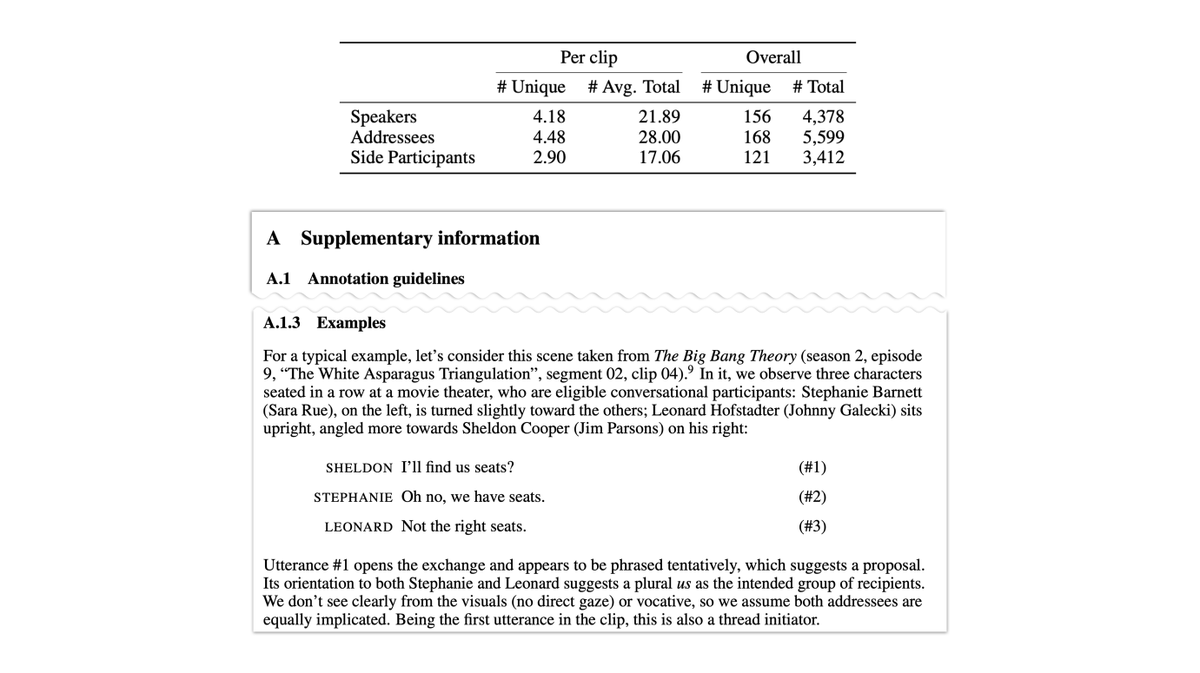
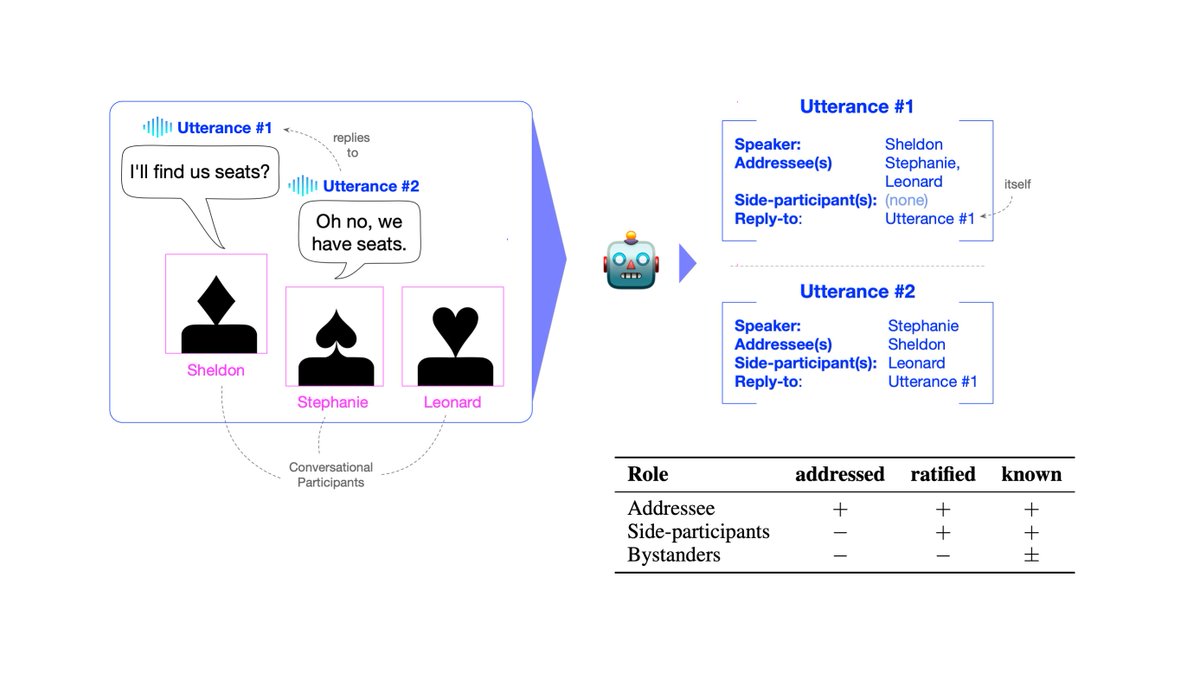
A speaker’s words do more than convey content—they organize the interactional structure of the moment: who’s being addressed, who’s merely listening, what came before. We frame this as a structured prediction task over multimodal input to infer conversational roles and disentangle threads. (2/8)
1
81
New preprint! LLMs are often hailed as conversation experts. But do they really understand the structure of a conversation: follow who’s talking to whom, and who’s just listening? Our paper explores whether today's multimodal LLMs can parse the social choreography of multi-party dialogue. (1/8)
1
2
6
608
Four nights of little to no sleep and an Xfinity outage later, I’m happy to report that I’ve passed my qualifying exam
4
34
1,844
Thanks David!
Big congrats to @KentKChang for passing his qualifying exam today! Lots of super exciting work on measuring social interactions in culture in the pipeline --
1
349
Kent K. Chang reposted
👏👏👏 Congrats, Kent! We recently did a profile on all the amazing work Kent does; make sure to check it out! ischool.berkeley.edu/about/p…
It’s an extraordinary pleasure and honor to teach alongside @dbamman and his wonderful students of NLP, now doubly so to have my small part recognized by @BerkeleyISchool & UC Berkeley.
1
3
640
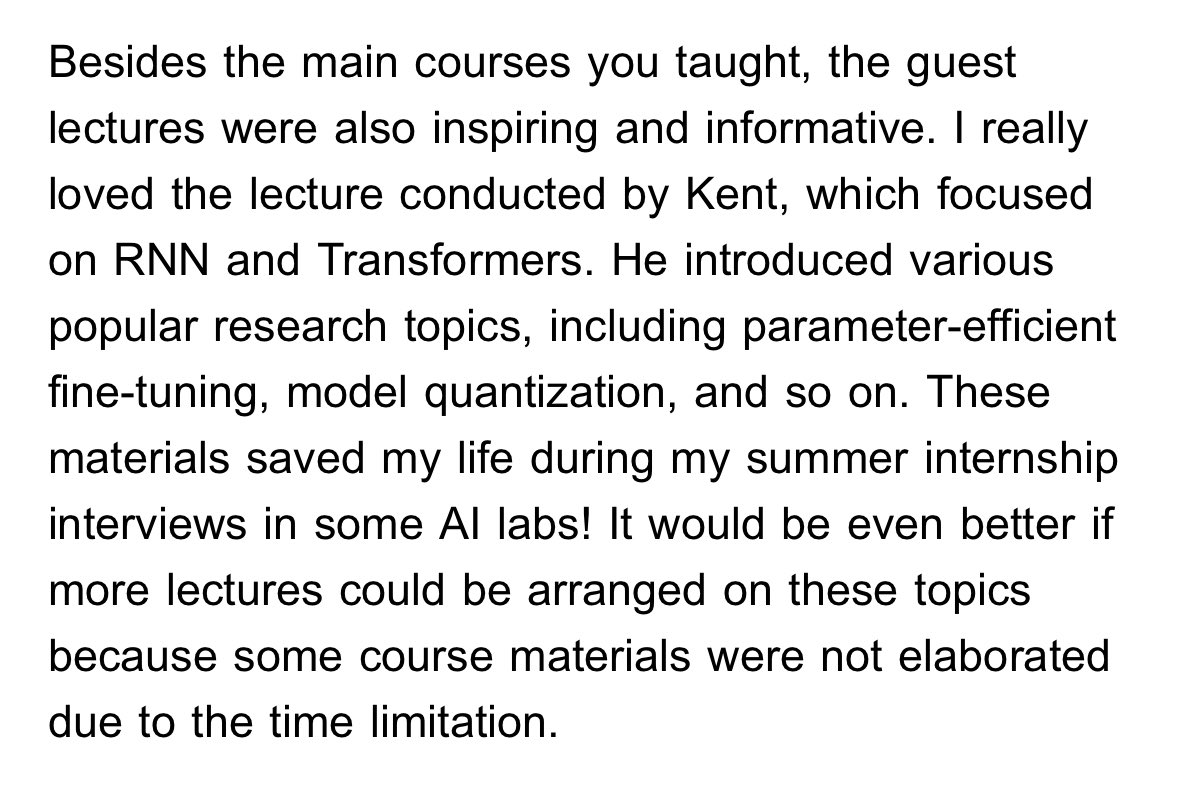
I didn’t GSI last spring, but guest lectured for our applied ML class on LLMs, and the professor of that class passed this message along after. I’ve been very lucky.
3
210
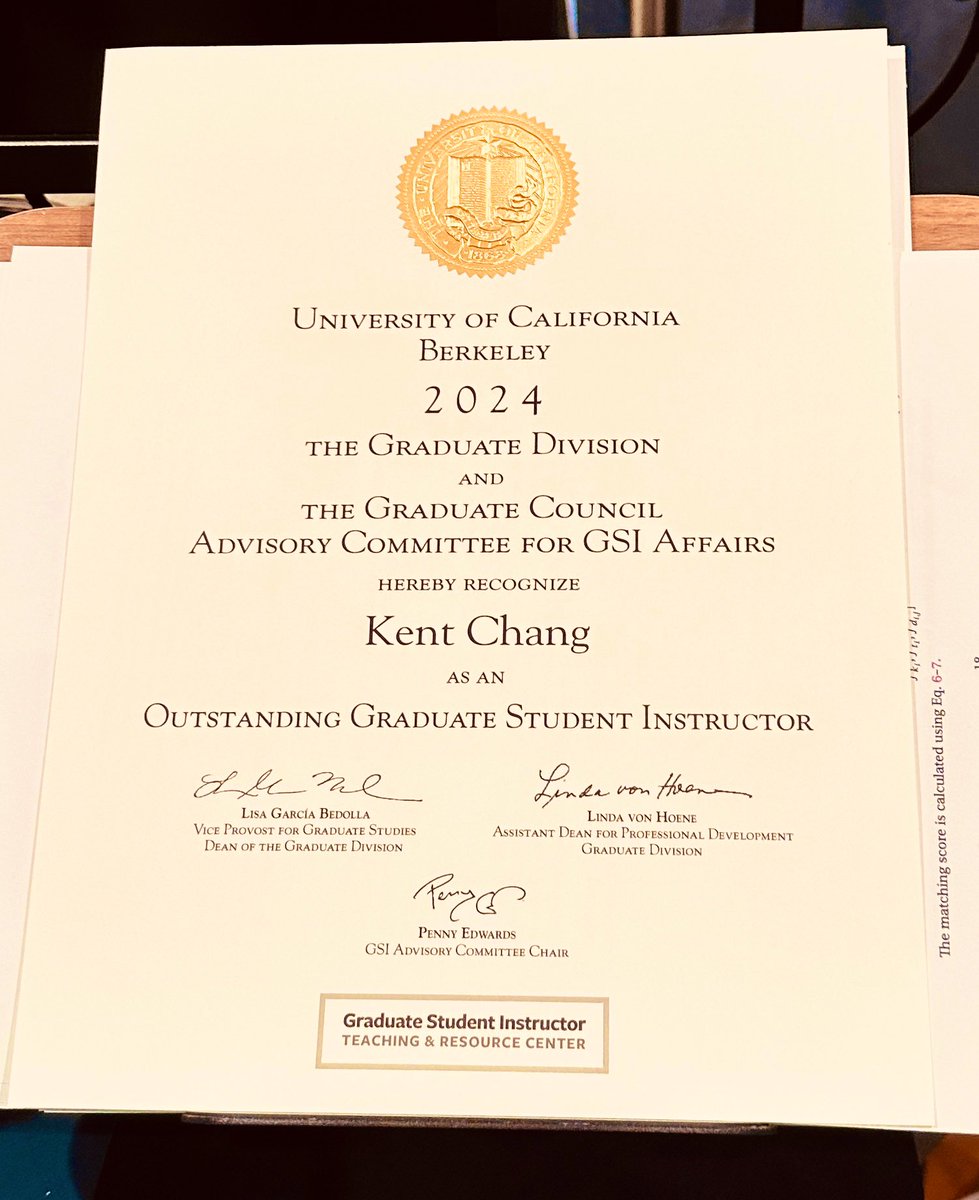
It’s an extraordinary pleasure and honor to teach alongside @dbamman and his wonderful students of NLP, now doubly so to have my small part recognized by @BerkeleyISchool & UC Berkeley.
3
2
49
4,382
I'm super grateful to join the ranks of Featured Profiles on @BerkeleyISchool -- thank you to everyone involved in putting mine together! Check out other profiles here: ischool.berkeley.edu/about/p….
Meet Ph.D. student ✨ Kent Chang ✨ @KentKChang's research focuses on natural language processing to understand and facilitate the process of meaning-making and social interaction in cultural texts. #pridemonth #BerkeleyGrad bit.ly/4eoKtV0
7
339
Kent K. Chang reposted
Mixture models that subtract probability density can be exponentially more expressive in representing complex distributions We prove this when they are learned by squaring tensorized networks, and show how they represent a unifying modelling framework in our #ICLR2024 spotlight!
9
53
313
64,475
Kent K. Chang reposted
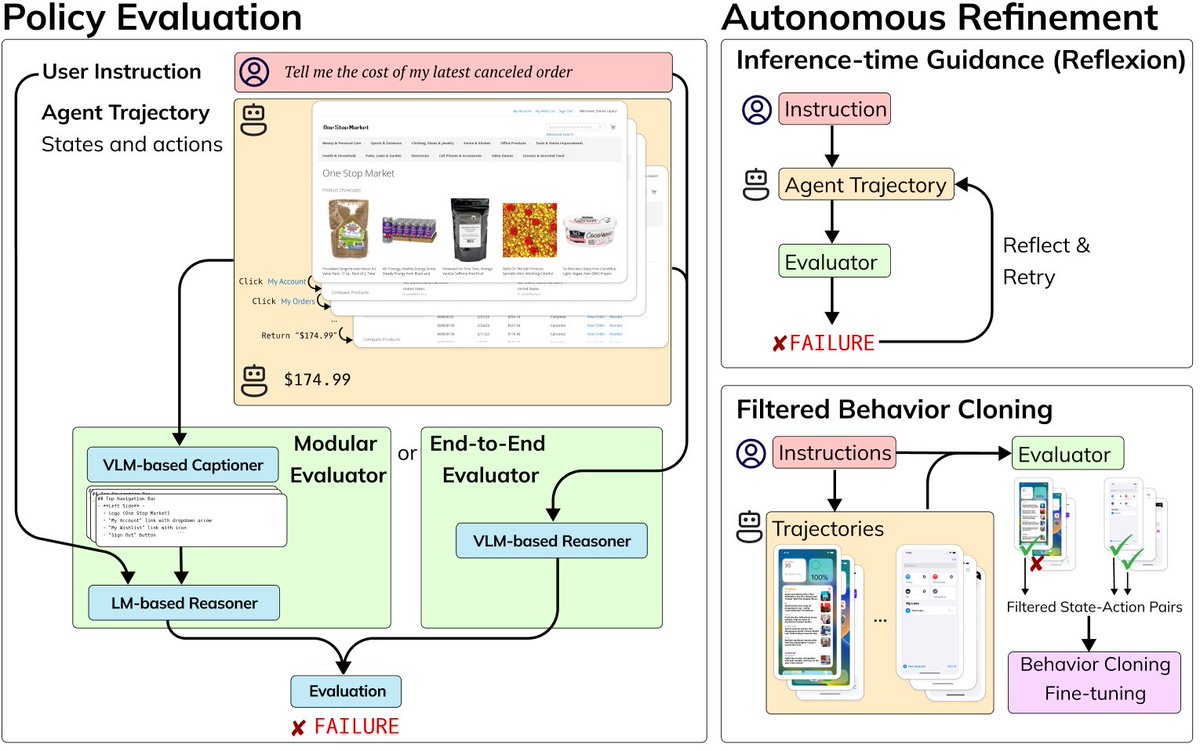
Some additional ✨speculation✨ Our preliminary results showed that inference-time improvement w/ Reflexion was very dependent on the performance of the critic model. A bad critic often tanks model performance
New paper from @Berkeley_AI on Autonomous Evaluation and Refinement of Digital Agents! We show that VLM/LLM-based evaluators can significantly improve the performance of agents for web browsing and device control, advancing sotas by 29% to 75%. arxiv.org/abs/2404.06474 [🧵]
1
2
5
2,633
Had such fun at @literarylab’s Lab Day. 10-min out-there, irresponsible, terrible ideas 15-min discussion. You really get to hear what people find interesting & contribute and learn in a stress-free environment. I proposed a multimodal study of Hilson.
1
1
4
456
💯agreed
# on shortification of "learning" There are a lot of videos on YouTube/TikTok etc. that give the appearance of education, but if you look closely they are really just entertainment. This is very convenient for everyone involved : the people watching enjoy thinking they are learning (but actually they are just having fun). The people creating this content also enjoy it because fun has a much larger audience, fame and revenue. But as far as learning goes, this is a trap. This content is an epsilon away from watching the Bachelorette. It's like snacking on those "Garden Veggie Straws", which feel like you're eating healthy vegetables until you look at the ingredients. Learning is not supposed to be fun. It doesn't have to be actively not fun either, but the primary feeling should be that of effort. It should look a lot less like that "10 minute full body" workout from your local digital media creator and a lot more like a serious session at the gym. You want the mental equivalent of sweating. It's not that the quickie doesn't do anything, it's just that it is wildly suboptimal if you actually care to learn. I find it helpful to explicitly declare your intent up front as a sharp, binary variable in your mind. If you are consuming content: are you trying to be entertained or are you trying to learn? And if you are creating content: are you trying to entertain or are you trying to teach? You'll go down a different path in each case. Attempts to seek the stuff in between actually clamp to zero. So for those who actually want to learn. Unless you are trying to learn something narrow and specific, close those tabs with quick blog posts. Close those tabs of "Learn XYZ in 10 minutes". Consider the opportunity cost of snacking and seek the meal - the textbooks, docs, papers, manuals, longform. Allocate a 4 hour window. Don't just read, take notes, re-read, re-phrase, process, manipulate, learn. And for those actually trying to educate, please consider writing/recording longform, designed for someone to get "sweaty", especially in today's era of quantity over quality. Give someone a real workout. This is what I aspire to in my own educational work too. My audience will decrease. The ones that remain might not even like it. But at least we'll learn something.
185
Kent K. Chang reposted
release day release day! OLMo 1b 7b out today 🥳 and 65b coming soon... With OLMo, we are really focused on advancing the study of LLMs. We release **everything**, from toolkit to create its training dataset (dolma) to training & inference code. More details in thread 🧵
9
66
324
48,652