Joined April 2024
3,229 Photos and videos
Samsung Foundry turning profitable is big news A massive re-rating could happen once they start manufacturing with good yields for external clients demanding advanced nodes
According to Korean media reports, Samsung Foundry turned profitable on a monthly basis in June. This marks the first time since 2023. With monthly profit turning positive in June, Samsung internally is reportedly seeing a higher likelihood of a turnaround to profitability starting in the third quarter. In particular, the fact that HBM4 base dies are produced on Samsung’s 4nm process is being cited as a key driver behind the turnaround. Yield improvement is also seen as a major factor supporting the monthly profit swing. Industry sources estimate that Samsung’s 4nm process yield has improved to around 80%.
34
7,553
Honestly, if this $NVDA delay makes optics go even lower, it could be a great entry for those who missed the rally CPO isn’t a matter of if, but of when
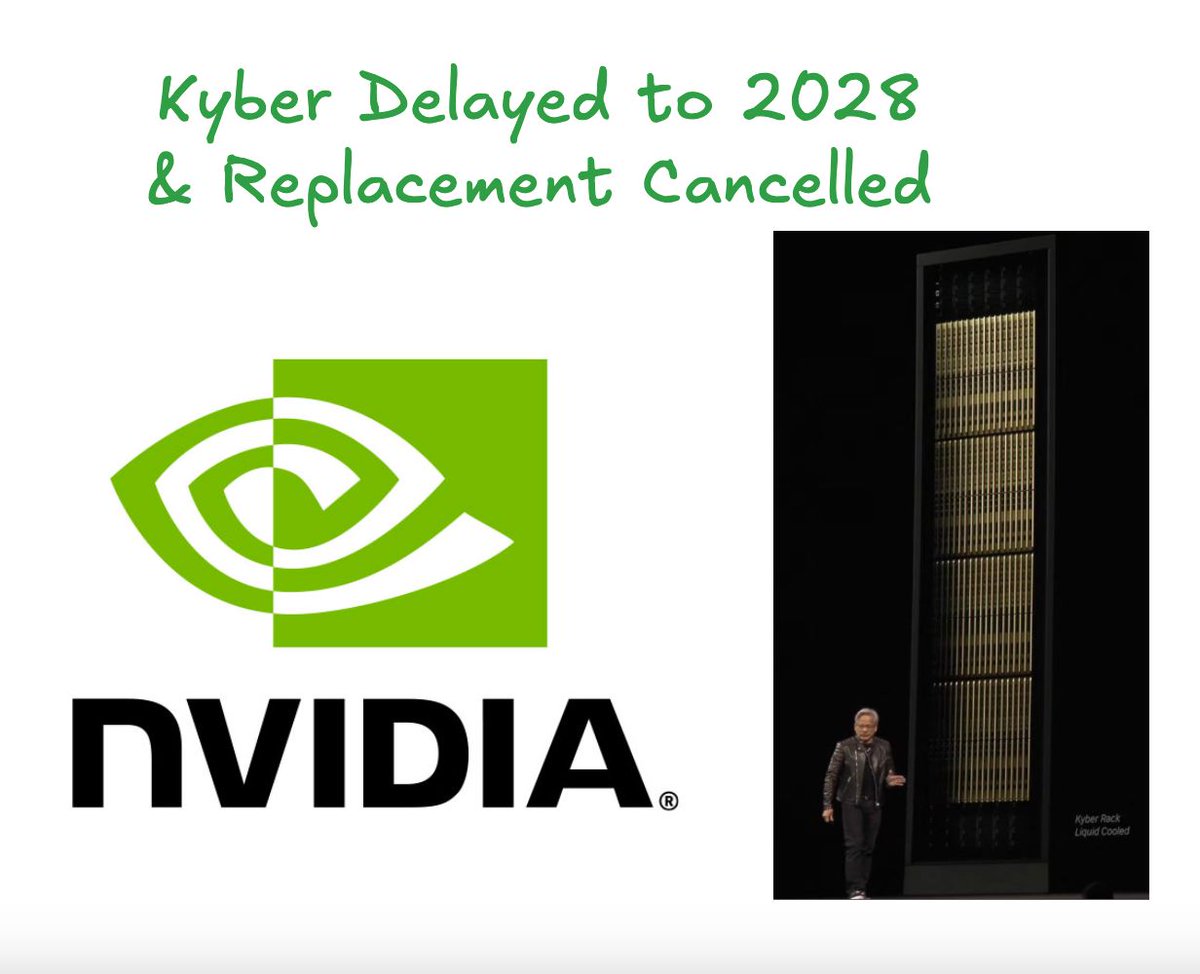
MASSIVE DELAY: Just 3 months after Jensen demoed Kyber NVL144 at GTC, it has faced major setbacks and has been delayed by more than 12 months, pushing it back to 2028. Below, we explain why Kyber has faced massive delays and why NVIDIA’s NVL72x2 back-to-back rack architecture was also cancelled, leaving Rubin Ultra with a limited scale-up domain. 👇️ 1/6🧵
15
6
91
19,034
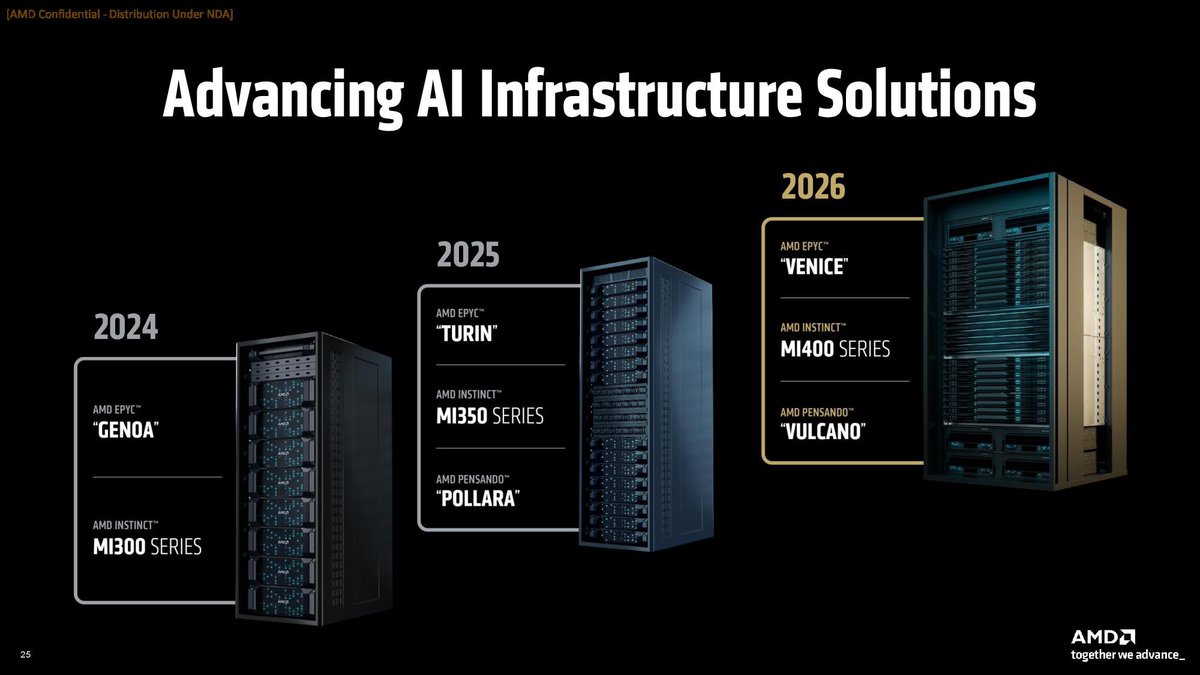
Probably only half true, but it would be so bullish for $AMD Bearish for optical scale-up, though
MASSIVE DELAY: Just 3 months after Jensen demoed Kyber NVL144 at GTC, it has faced major setbacks and has been delayed by more than 12 months, pushing it back to 2028. Below, we explain why Kyber has faced massive delays and why NVIDIA’s NVL72x2 back-to-back rack architecture was also cancelled, leaving Rubin Ultra with a limited scale-up domain. 👇️ 1/6🧵
5
3
92
12,997
Power semiconductors are already increasing in price before 1MW racks even arrive This is happening before the industry reaches 1MW rack architectures Those will arrive later with platforms like NVIDIA Feynman and AMD’s MI500 rack-scale systems Rubin Ultra is already expected to push rack power toward roughly 600kW , but even the arrival of Vera Rubin, at around 225kW per rack, is enough to create a demand shock across the power semiconductor supply chain These are the price hikes reported so far: > Infineon: second 2026 price increase, effective July 1, covering selected power products > Texas Instruments: reported July 1 price increase across products including PMICs and MOSFET > Silan Micro: 15% price increase across its full product portfolio, effective July 1 > Yangjie Technology: 10–15% price increase across its full product range, effective July 1 > MacMic: 10% planned increase for IGBT > JieJie Microelectronics: 10–20% planned increases for MOSFETs and IGBTs > Li-On Micro: 10–15% increase for power chips > CR Micro: full-line price increases starting at 10% > NCE Power: price increases across MOSFETs and related power devices The reason higher-power AI racks need more power semiconductors is that AI chips do not just need more electricity. They need the hardware to control that electricity A GPU does not consume power directly from an 800V rack bus. That power has to be stepped down through multiple stages until it reaches the GPU at roughly 1V or less, but at extremely high current. The higher the rack power, the more current, heat and switching stress the system has to manage This cannot be solved that with one giant power chip. One large device would be too hot, too inefficient, too difficult to manufacture and too risky if it failed Instead, they split the load across many power stages and many VRM phases. Each phase uses MOSFETs, drivers, controllers, capacitors and inductors That means higher rack density does not just require bigger power supplies. It requires a much more complex power architecture, including new advanced cooling designs using microfluidics This higher power density and complexity creates a supply explosion at every step of the power and heat management process, whose effects can already be seen across the industry
2
1
36
6,994
$TSM is building a Taiwan-based supply chain The goal is to reduce supply-chain risk, shorten qualification cycles, and make sure TSMC is not dependent on one global supplier for every component > This is really bullish for Taiwanese small-cap semicaps TSMC is evaluating both global and local suppliers for future CoPoS and panel-level packaging lines, with Taiwanese names like Gudeng, Mirle, Scientech, GPTC, Utechzone, VisEra and GPM reportedly involved AI semiconductors are becoming less constrained by wafer capacity alone. Bottlenecks are moving into CoWoS, CoPoS, chemicals, plating additives, CMP materials, precision parts and packaging tools, which is why TSMC wants to secure the supply chain domestically In 2024, TSMC launched a “Parts Localization and Innovation Program” with financial support and technical guidance. By February 2026, it had worked with 12 suppliers, developed 22 CIP solutions, cut parts validation and development lead times by 50%, and created more than NT$2 billion in annual output benefit The program focuses on metal machining, brittle materials, ceramic sintering, surface coatings, and rubber O-rings TSMC also helped a Japanese electroplating additive supplier set up local production in Taiwan for advanced packaging chemicals. That cut production cycle time from 60 days to 20 days, improved transportation efficiency by 90%, and the locally produced additives were introduced at Advanced Backend Fab 2 in January 2026, with rollout expected across Backend Fabs 3, 5, 6 and 8 by the end of Q1 In its 2025 annual report, TSMC said chemical suppliers have been moving new operations closer to its major manufacturing facilities to improve logistics and reduce supply risk. It also said lithographic-material suppliers work closely with TSMC on application and cost requirements, while slurry, pad and disk suppliers have relocated, or plan to establish, manufacturing sites closer to TSMC fabs
4
2
31
6,344
BofA expects $AAPL to try to use CXMT DRAM to increase its bargaining power with Micron, SK Hynix, and Samsung Good luck with that...
6
10
133
36,543
$NBIS has leased 18 MW of power from MERLIN Edged at its Madrid-Getafe data center, marking Nebius’ first entry into the Spanish market MERLIN $MRLN is also the landlord for $CRWV in Spain CoreWeave is using MERLIN Edged’s Barcelona data center, where it has leased 15 MW to host 10,224 NVIDIA H200 GPUs, with plans to expand with Blackwell systems in 2026 CoreWeave has also leased capacity from MERLIN in Álava/Bilbao-Arasur, bringing its total Spanish lease with MERLIN to around 40 MW across Barcelona and Álava MERLIN is now moving into Phase III of its data center plan, where it expects to invest around €4.5 billion by 2031/2032 and add 412 MW of new capacity, mainly across Lisbon, the Basque Country, and Zaragoza The bigger upside is Extremadura. MERLIN and Edged are planning two gigawatt-scale AI data center campuses there: one in Navalmoral de la Mata, Cáceres, and another in Valdecaballeros, Badajoz Each site is expected to offer up to 1 GW of IT capacity, meaning around 2 GW total across both campuses
4
8
162
18,876
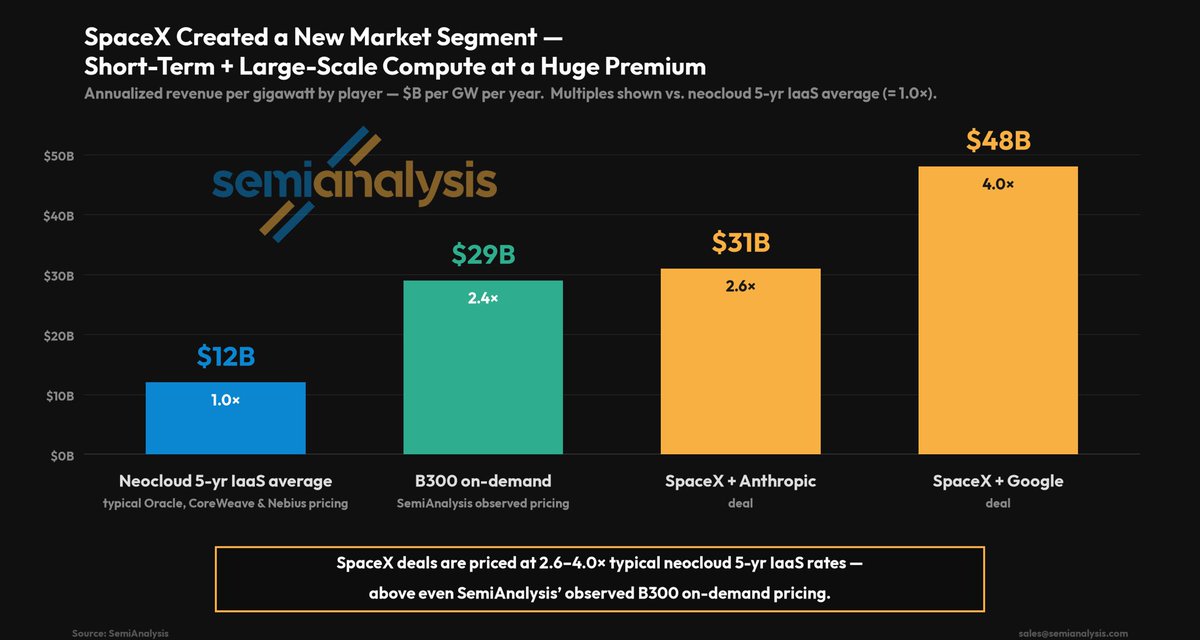
$GOOG is so dumb. They paid SpaceX 4x the average rate for GPUs when they could’ve waited for $META to sell at liquidation prices I may buy my own cluster when the neocloud bankruptcy auctions start
Or maybe Meta has no idea what to do with the compute so they going to sell it for whatever they can get.
12
1
67
21,075
If you’re wondering why semi stocks are going down: > This article has a free section explaining the situation It also has a paid section explaining what I’m buying hypertechinvest.com/p/what-i…
1
2
33
20,128
$INTC confirms CPU price hikes as supply tightens > The biggest increases are in data center CPUs > Some Xeon processors are now over $1,000 more expensive than in 2025 Intel did not raise prices across the entire product family. Instead, it raised prices on specific SKUs with higher demand Intel has been saying for several quarters that Xeon demand exceeds supply. However, list prices are not always the same as real selling prices, especially in data center hardware, where large customers often negotiate volume-based deals Still, CPU supply is tight, and pricing power is improvin
9
30
224
20,501
Samsung and SK Hynix are reportedly asking South Korean substrate suppliers to cut prices for the second half of 2026 > Earlier this year, substrate makers got a 3–4% price increase because raw-material costs like gold and copper had gone up > Now that those costs have stabilized, Samsung and SK Hynix want to reverse that increase and bring substrate prices back down Memory demand is still strong, but Samsung and SK Hynix are trying to keep more of the upside for themselves instead of letting substrate suppliers capture more margin The companies that could be negatively affected are Korean substrate and PCB suppliers exposed to memory packaging and memory modules. That includes Simmtech, TLB, Korea Circuit, Daeduck Electronics and Haesung DS
4
9
82
14,131
The neocloud business is so profitable that $META wants to dedicate part of its compute to it The market: let’s sell off all the neoclouds
17
8
120
13,334
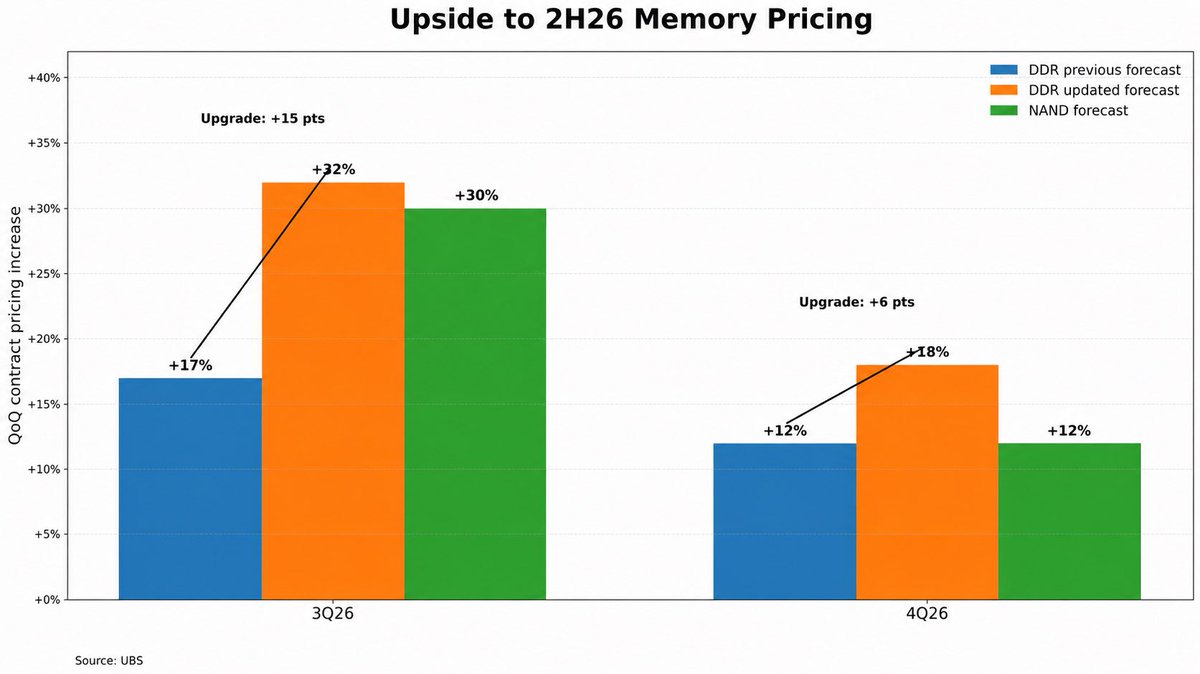
UBS is revising its memory pricing outlook sharply higher for 2H26 DDR contract pricing is now expected to rise - 32% QoQ in 3Q26 - 18% QoQ in 4Q26 Up from prior forecasts of 17% and 12% NAND is also expected to remain strong, with pricing forecast at - 30% QoQ in 3Q26 - 12% QoQ in 4Q26 UBS expects DRAM to stay undersupplied until at least 2028, with 2027 demand growth of 36.2% YoY still above supply growth of 19.3% YoY The main risk is affordability, as UBS now forecasts memory industry revenue of $392B in 2026 and $513B in 2027, meaning hyperscalers will need continued access to capital markets to fund this capex cycle
3
15
82
12,473
$META has 2.5GW of data center capacity under construction If it strikes a large-scale deal similar to SpaceX’s, that capacity could generate $120B of annual revenue, or more than half of META’s TTM revenue At a 50% OCF margin, that would mean $60B of OCF, or roughly half of the company’s 2025 operating cash flow. $META won’t use all that capacity for external customers, but it’s a useful exercise to understand the potential value of it
11
16
116
14,465
SemiAnalysis expects $META to strike a $10B deal with Anthropic.
20
17
340
81,467
SemiAnalysis bullish on neoclouds $META is "expected to add most of its capacity through third-party providers.” "Meta will be a huge source of RPO growth for the likes of $CRWV, $NBIS and others." Huge contrast with the current market sentiment
14
15
132
30,707
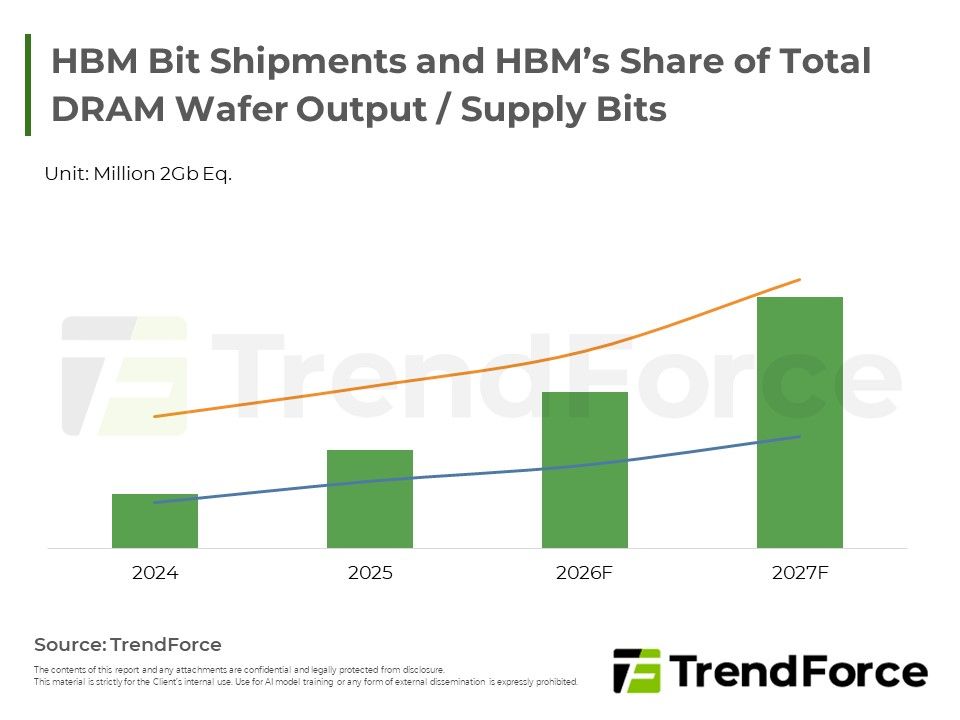
HBM price hikes are coming “With 2027 HBM4 negotiations already underway, TrendForce expects substantial price hikes to reflect the supply-demand imbalance and rising next-generation production costs.”
💾 HBM4 Contract Prices: A Major Hike Is Coming With 2027 HBM4 talks underway, TrendForce expects substantial price hikes to reflect supply-demand imbalance and rising next-gen costs. Demand from next-gen GPU platforms and AI ASICs, with growing die sizes, will aggravate the capacity squeeze. Understand where HBM pricing heads 👉 buff.ly/T0obi0x Explore HBM5 & next-gen memory 📖 buff.ly/xaOgtIQ #TrendForce #SelectedTopics
17
3
39
8,012