OpenEvidence is the most widely used AI-powered medical search, helping doctors access the world's knowledge at the moment it matters.

Joined November 2022
79 Photos and videos
Pinned Post
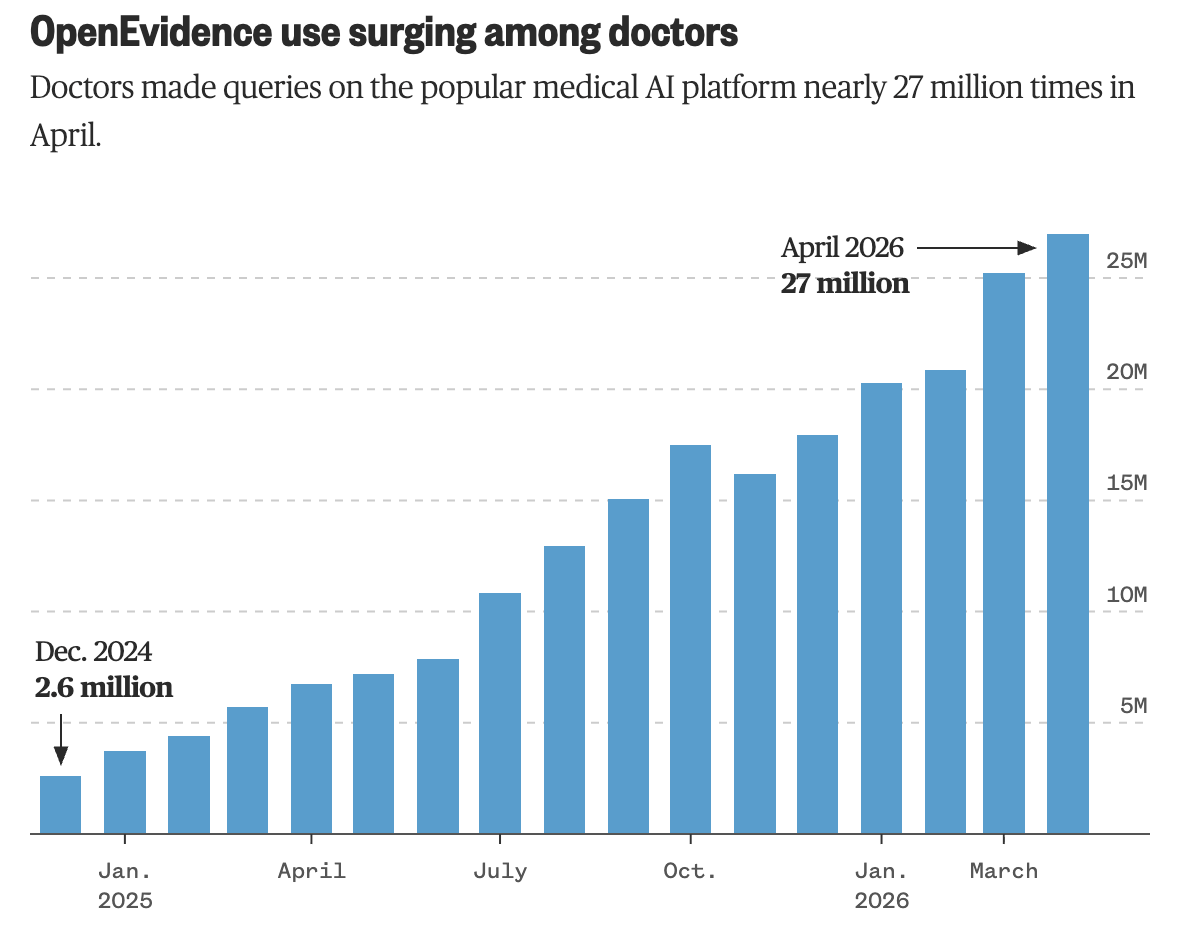
“We did the hardest thing in the history of American health care. We got the majority of American doctors to all voluntarily adopt a single technology platform.” NBC News on how that happened, what U.S. physicians actually do with OpenEvidence, and how partnerships with NEJM, JAMA, NCCN, and Wiley make it possible.
22
52
230
151,119
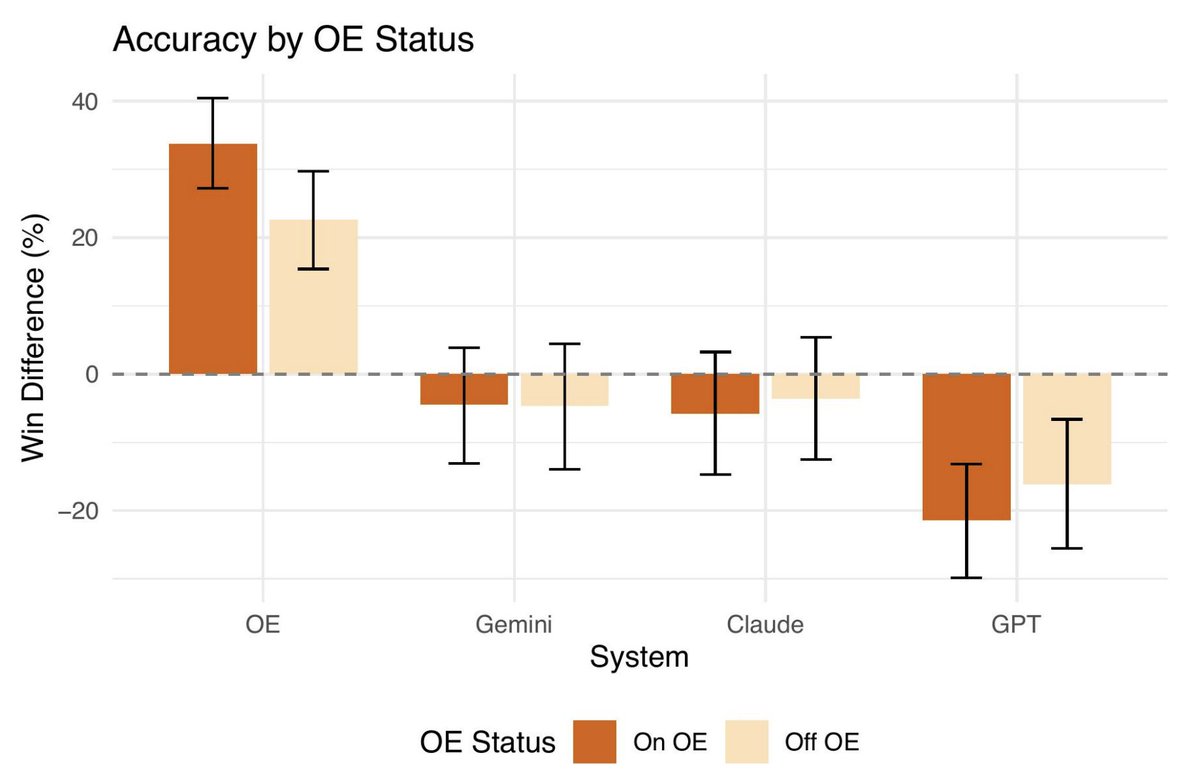
One especially interesting finding buried in the details of arxiv.org/pdf/2606.28960: When foundation models replace experts in rating accuracy, Gemini and Claude directionally agree with expert human raters, whereas GPT5.5 says its own answers win almost every time. Claude also seems to have a strong bias against Gemini. Any LLM-driven evaluation seems to have real pitfalls that are hard to entirely protect against.
2
5
55
7,479
New: a large, blinded evaluation study by a consortium from Stanford, Harvard, UCSF, University of Washington, and the lead statistical editor at JAMA, on the accuracy of OpenEvidence vs foundation models for real point-of-care clinical queries. - Gold-standard expert subspecialist evaluation: Rather than relying on models rating other models, 149 clinicians from >30 specialties subspecialty-matched to each question evaluated accuracy, blinded. - OE outperformed foundation models on accuracy, utility, source quality, and verifiability; this holds whether raters had used OpenEvidence before or not. - After OE, Gemini and Claude perform statistically similarly to each other, and each of Claude and Gemini significantly outperforms GPT5.5. Paper: arxiv.org/pdf/2606.28960 All code and data including raw queries and answers were publicly released by the authors.
For the past two weeks, our independent team of statisticians, AI evaluation experts, clinical AI researchers, and clinicians was given a unique opportunity to test one question: “How well do different AI tools answer user questions on the OpenEvidence (OE) platform?”
13
43
223
68,906
OpenEvidence reposted
A great addition. I worked with them a few years ago to help with their content. It was robust then and great for education
357 peer-reviewed surgical videos from the Journal of Medical Insight @JOMIjournal are now part of OpenEvidence. A clinician asking about a procedural step gets the relevant moment, not an hour-long recording to scrub through (pun intended).
1
2
7
2,646
Hearing it from a cardiologist in practice means a lot to us, Dr. Morrison. Made our week.
Practicing medicine with OpenEvidence has been similarly inspiring to me. It is a great time to be alive, and the only better time is tomorrow.
3
9
3,570
OpenEvidence reposted
We spent years working on this project and now it will be available when/where it has massive potential for impact. Very excited about this! @nikitabe (CEO)
357 peer-reviewed surgical videos from the Journal of Medical Insight @JOMIjournal are now part of OpenEvidence. A clinician asking about a procedural step gets the relevant moment, not an hour-long recording to scrub through (pun intended).
2
9
2,191
357 peer-reviewed surgical videos from the Journal of Medical Insight @JOMIjournal are now part of OpenEvidence. A clinician asking about a procedural step gets the relevant moment, not an hour-long recording to scrub through (pun intended).
9
13
209
2,562,232
OpenEvidence reposted
In this edition of STAT Health Tech: OpenEvidence adds AI to detect heart disease, and Cadence raises $100 million, and more. trib.al/EJXQhh1
3
11
2,712
Brain and spinal cord tumors are rare enough that most physicians who see one aren’t subspecialists. OpenEvidence is now @NeuroOnc official generative AI partner, putting that subspecialty knowledge within reach of any clinician treating these patients, wherever they practice.
3
7
45
637,391
The most common cause of death in the world has no screening test. The @nytimes on how AI is starting to change that, reading patterns in a routine ECG that clinicians miss, and coming free to physicians through EchoNext on OpenEvidence.
6
45
404
1,596,277
OpenEvidence reposted
🖥️ #ASCOAI: @ASCO Guidelines are now integrated into OpenEvidence (@EvidenceOpen) The collaboration enables clinicians to access ASCO guideline-based recommendations, flowcharts, and supporting evidence directly through the #AI platform. Learn more 👉 ascoai.org/articles/2026/06/…
6
6
1,408
OpenEvidence reposted
I love when my patients bring questions to clinic that they devised with AI. A patient who has thought about their condition and comes in with semi informed questions is a delight. I have no problem explaining why I think their AI is misinformed. I’ll often bring up @EvidenceOpen in the exam room with them and show them where their AI went wrong or why it came to the conclusion that it did. Clinical decision making can be tough. Having a well informed patient makes shared decisions that much easier.
We’ve all heard stories of patients using @OpenAI chatbots to identify conditions that doctors missed for years. Those stories matter. But we hear much less about the other side: patients bringing false information into the clinic, and the time clinicians then spend correcting it. In our new study, we tested this failure mode directly. When frontier AI models were given misleading clinical context, they changed a correct answer to a false one more than 50% of the time. Yes, healthcare has an access problem and AI can solve it. But medicine has guardrails for a reason: false information may be as dangerous as no information.
17
6
120
18,748
OpenEvidence reposted
🎙️ In this episode, Drs. @AmiBhattMD & Katie Berlacher discuss how large language models can be integrated into clinical workflows & medical education while preserving clinical autonomy. 🎧 Listen to the episode now 👉 bit.ly/4ej9XoP @EvidenceOpen #ACCInnovation #AI
3
9
2,844
Dr. Samuel Finlayson of @EvidenceOpen and the #RareDisease Center of Excellence at @UWMedicine shared how the partnership between OpenEvidence and #NORD combines AI with expert knowledge from NORD’s network to create accessible resources for physicians and patients. (3/4)
1
1
5
1,467
OpenEvidence reposted
Rigorous evaluation of medical AI is good for everyone, and we welcome it. Counter to a half-dozen independent studies from institutions such as the Mayo Clinic that were highly positive on OpenEvidence—a lone paper now purports to show that generalized AI beats specialized clinical AI (@UpToDate, @EvidenceOpen). The paper has a massive undisclosed conflict of interest and irredeemable methodological flaws. Behind the scenes: The study authors run a competing in-house medical AI at their hospital, and asked OpenEvidence for an API to power it — including rights to build a "competing product" with OpenEvidence's own API. OpenEvidence declined. Then, this paper coincidentally appeared. Point-by-point, looking closely at the datasets used in the study, the disingenuous and fatal flaws become immediately apparent 🧵.
29
73
373
165,082
This paper and its benchmarks are clearly ill-equipped to judge clinical decision support tools or draw conclusions about specialized clinical AI. So how should we actually evaluate these systems? Certainly not by boiling the answer down to a contaminated multiple choice quiz, or by measuring adherence to an arbitrary style guide written by one of the model creators. Here are a few starting ideas: the right evaluation should match the realities and distribution of real-world use of clinical AI. It should engage holistically with real clinical use, end to end. And ultimately, it should measure real clinical impact. Let's figure out the right way to do this in good faith.
1
2
42
6,033