



Pinned Post

Masters in trading (e.g. @Qullamaggie @TheOneLanceB @RealSimpleAriel @TheShortBear) have a clear classification of their conditions for a trade (A , A, B, C, ... setups).
From what I understand, this allow to adapt risk based on the setup category.
Here is my classification for BO setups :
In an ideal world, the perfect trade should have :
1. Sexy industry with big turnover (e.g. Semis since April)
2. EPS/Revenue 30% YoY Growth
3. Big recent move 30% then pullback/consolidate for several days or weeks with higher lows
4. Increasingly large volumes ( 2x avg volumes) during the 1st leg then lower volume during pullback or consolidation
5. 1st leg & consolidation, not the 2nd or 3rd or more
6. Narrow range day (1-3 days) before breakout
7. During breakout, big volume again ( 1.5/2x volume of D-1)
Classification (number of criterias above)
- A : 6/7
- A : 5/7
- B : 4/7
- C : 3/7
Mandatory criterias :
3 : Price action, typical of momentum
4 : Proof that big fishes are in the pool and not only your aunt Suzie (@RealSimpleAriel 😉)
7 : Proof that you are not the only one jumping into the pool
My goal :
Improve myself in identifying trade classifications.
Then, take more risk on A setup than A setup.
A : 1-2% risk (cannonball into the pool)
A : 0.50% risk (to take a dive)
B : 0.20% risk (pencil jump)
C : 0.10% risk (just to test the waters)
Halve it if market conditions are unfavorable.
Few examples :
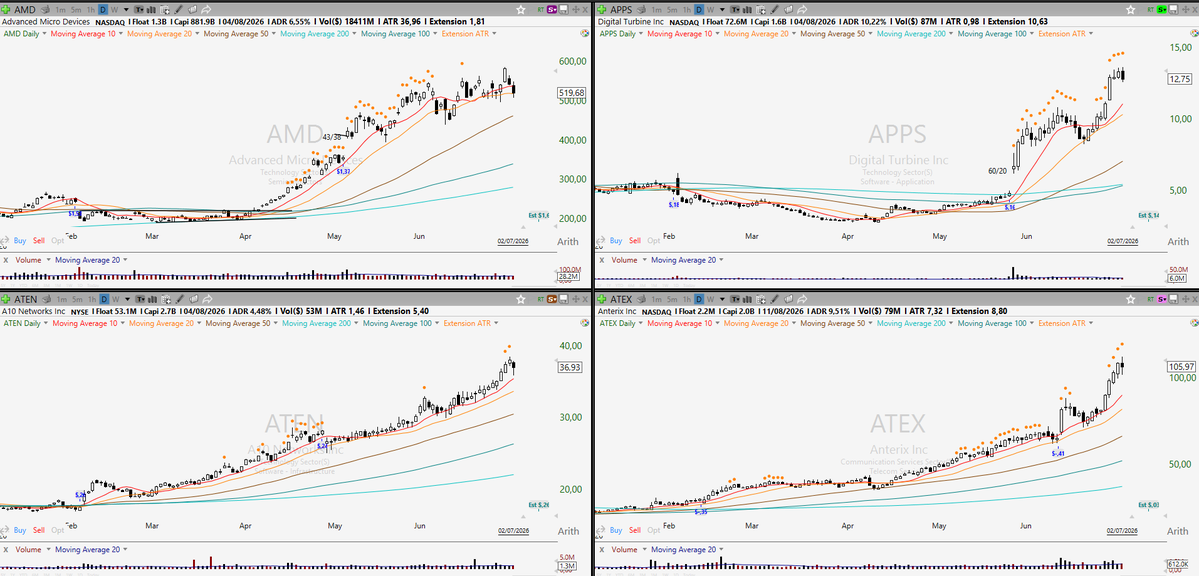
A : $NVDA (1/8/2024), $APPS (9/15/2020)
A : $AEVA (5/2/2025), $AMD (2/3/2000)
Got a lot more in my Evernote.
These notes help me clarify things in my trading but if they can help others, then I'm happy about that.
- Charlie 💙🤍❤️
1
70