The real
$TSLA Optimus V3 question is not whether Tesla can show another impressive humanoid demo.
The question is whether Tesla has built a physical platform with enough headroom to become world-class at precision manipulation.
Walking is increasingly commoditized. Flashy demos are increasingly commoditized. The real bottleneck is the hand/wrist/sensor/control stack: can the robot manipulate small, fragile, irregular, deformable objects with repeatable precision?
That is why the “world-class surgeon” ambition matters, even if Optimus is nowhere near doing surgery today.
A human surgeon is not precise because the body is a rigid CNC machine. A surgeon is precise because the nervous system constantly fuses vision, touch, proprioception and force feedback, then error-corrects in real time.
For Optimus, the equivalent stack would be:
high-quality mechanics
tactile/force sensing
accurate proprioception
low-latency onboard inference
real-time motor control
fleet learning
OTA improvement
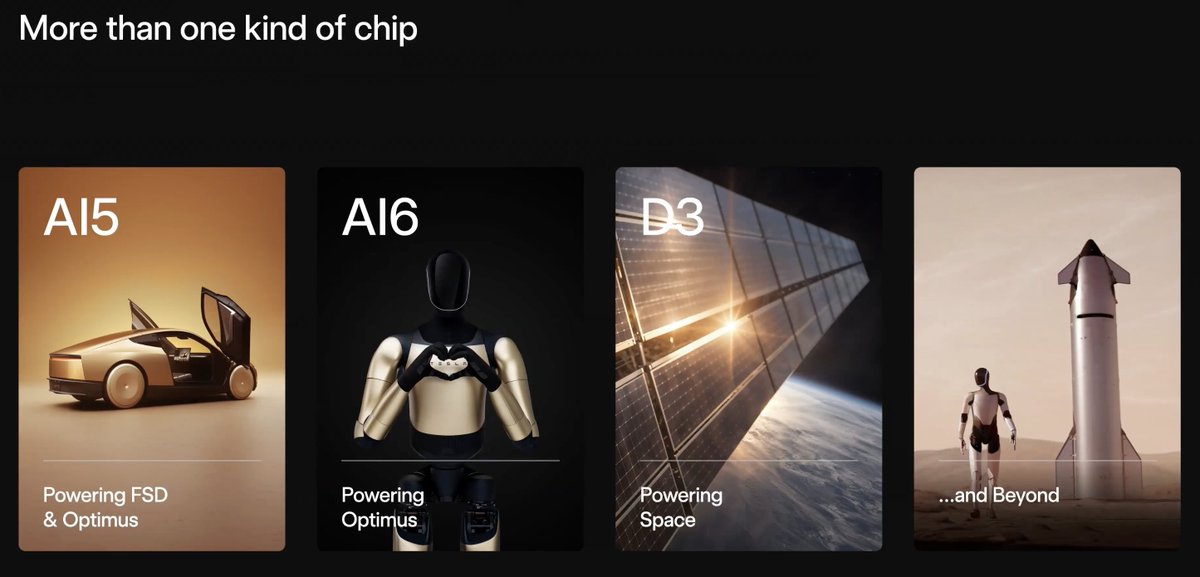
This is where Tesla’s custom AI hardware could become a serious moat.
If high-end humanoid dexterity requires millisecond-level closed-loop AI control, then the race is not just about algorithms or hand design. It becomes a compute-per-robot race. A competitor may copy the hand geometry or even approximate the model architecture, but if they cannot affordably put AI5-class inference, sensing, cooling and power delivery into every robot, they may not be able to replicate the capability at scale.
That said, AI does not magically fix bad hardware.
If the wrist has backlash, if the fingertips cannot sense slip, if the actuators cannot modulate force, if the thermal envelope throttles, or if the hand is not durable, then no OTA update turns the robot into a surgeon.
So the make-or-break signal for Optimus V3 is not “Can it dance?” or “Can it walk smoothly?” or “Can it hand Elon a drink?”
The signal is whether the hardware looks like it can support elite manipulation later.
Can it route cables? Insert small connectors? Handle soft or slippery objects? Use tools precisely? Modulate grip force? Recover from tiny errors? Repeat the task across multiple robots without cherry-picking?
If Tesla shows that, the Optimus narrative changes immediately.
Not because V3 would already be a surgeon, but because it would prove the body is no longer the bottleneck.
And once the body is good enough, Tesla’s real advantage begins: manufacturing scale, fleet data, custom inference silicon, and continuous software improvement.