
Certified Financial Technician - CFTe | Financial Analyst & Educator | Media Presenter | Keynote Speaker | News Corp columnist | Founder of MtM

Joined January 2022
2,627 Photos and videos
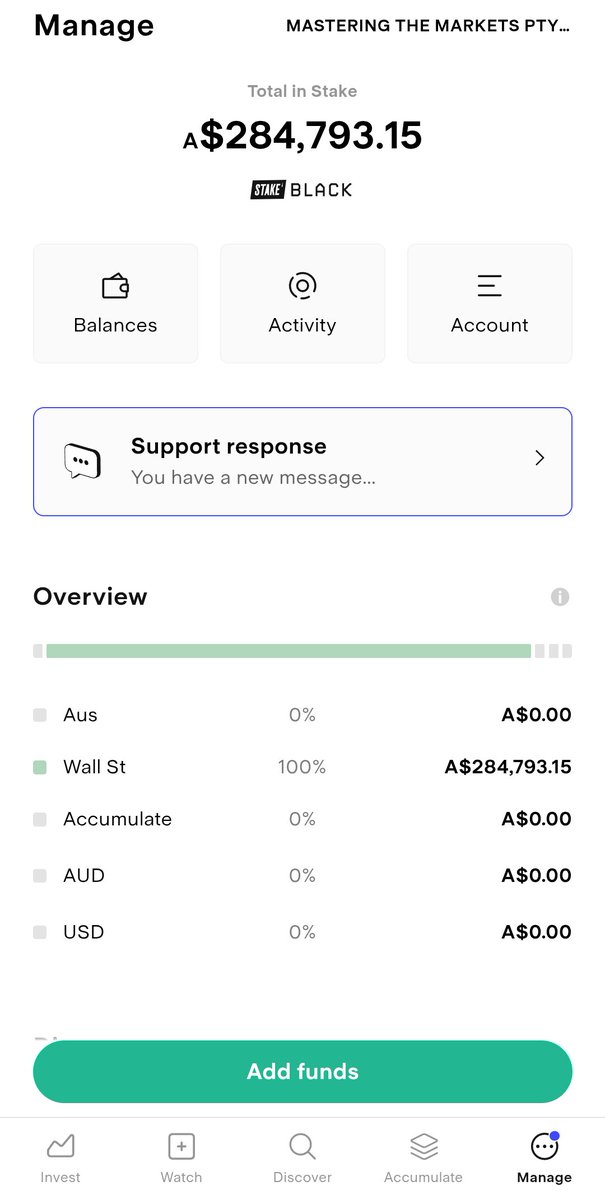
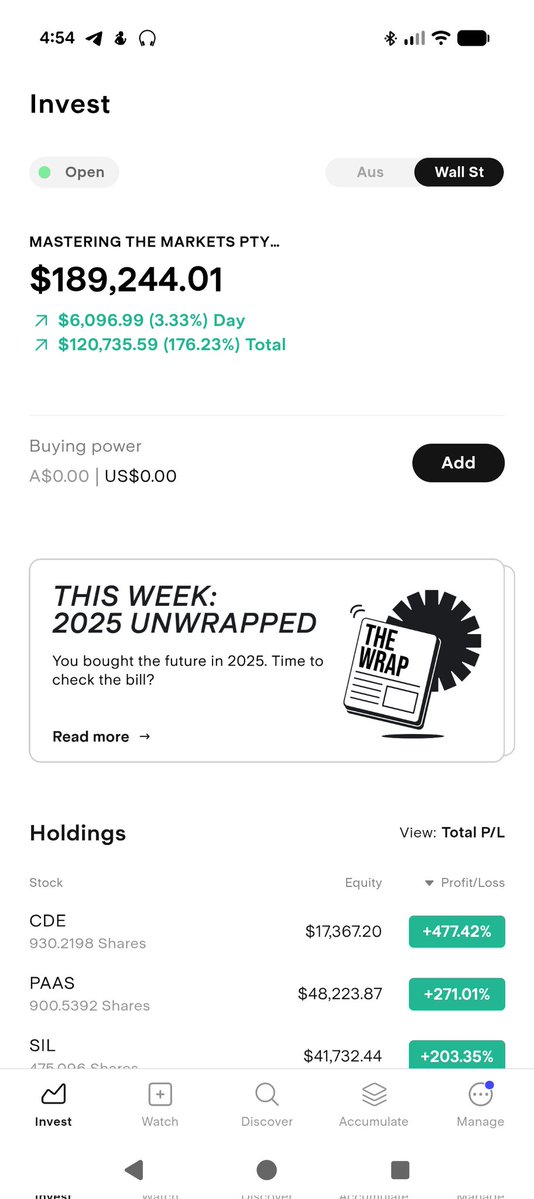
Major Milestone achieved for the public MtM account. (Account has tripled in 18months) At the beginning of last year, a few MtM students asked me a fair question: “How do we know what you’re teaching actually works?” So as you know I decided to show them — publicly. I opened a public MtM investing account (not a trading account). Minimal transactions. Long-term holds. I deposited $100,000 AUD (about $63,000 USD at the time). You’ve all been able to watch this journey publicly online for the last 18 months, from the moment I started it in April 2024 showing all the transaction statements. And as you know, we’re ASIC licensed — we’re an Authorised Representative of an AFSL — so I can’t post anything that’s misleading or untrue. As of today, that account has tripled to $189,000 USD. And what’s interesting is the part most people miss: the journey. A couple of months ago I showed you the account dropped from $270K to $220K — down $50,000aud in a couple of weeks — while many were calling a major top in gold and silver. My view didn’t change: the top wasn’t in. Because if you can’t handle the zags, you don’t deserve the zigs. Most people will never get outcomes like this for one reason: they don’t hold their winners. They cut them out of fear. Ironically, people hold onto losers because they don’t want to be wrong… but they struggle to hold onto winners because they don’t believe it can keep going. That’s why data > emotion. One thing you’ll notice is that the original $100K AUD isn’t $300K AUD yet and that’s simply because the Australian dollar has strengthened. When you invest in US assets from Australia, currency moves matter. As the AUD rises, it reduces the translated value of USD gains back into AUD terms. It’s a key factor to understand when investing offshore as I mentioned the other day with the AUD being bullish. But the best part of this milestone isn’t my result. I’ve received hundreds of messages from MtM students seeing similar progress — many doubling their accounts because they’ve learned to follow process, manage psychology, and let winners work. And that, to me, is the most important part. It’s easy for one person to do well. There’s no value in me knowing how to do this if I can’t transfer the skill to other people — so they can build it for themselves. That’s what MtM is. It’s education. I spent over a decade as a primary school teacher and HOC and that experience is everything. Not because it sounds nice but because it taught me how people actually learn. It’s not just what you teach. It’s how you sequence it. You build it like curriculum: one block at a time, in the right order, so students develop a deep, thorough understanding — not just a few tricks, not just a couple of setups, not just “signals.” Because markets don’t reward memorisation. They reward understanding. masteringthemarkets.com Learn - grow - succeed
7
6
119
58,343
A lot of people were asking how I managed to call the low in precious metals last week. What they don't know is why I still believe there's a strong chance we've got more upside over the coming weeks. Here's one of the biggest clues. When I zoomed into the daily chart, silver made a fresh low... but the silver miners didn't. Instead, they formed a double bottom. That's bullish divergence. It's a concept we teach in TEC101. The indices must confirm. You've just got to think about it logically. Silver miners are leveraged plays on the metal. If silver is making a fresh low, you'd normally expect the miners to make an even deeper low. But they didn't. Instead, they held their ground, formed a double bottom, and started putting in a higher low. That's often a sign buyers are quietly stepping in before the underlying asset turns. It's exactly the same clue I saw back in 2022 when I called the gold low around US$1,600. Gold made a new low, but Northern Star didn't. It put in a higher low instead. This was just one of several pieces of confluence that gave me the confidence to go long. I've done a full breakdown inside the free Academy, showing every chart, every level, and the complete thought process behind the trade, plus why I believe precious metals could still have several more weeks of upside. academy.masteringthemarkets.… I'll also post the 2022 Northern Star vs gold chart below so you can compare the two setups side by side.
9
7
93
7,373
But Olympics...
8
4
93
8,095
I was told up only...
50
25
405
50,981
David Bird (ASX Trader) B.Ed, CFTe reposted
With market momentum fading, here are the key levels to watch 📊 ➡️ ausbiz.co/4wp0keh
2
7
1,830
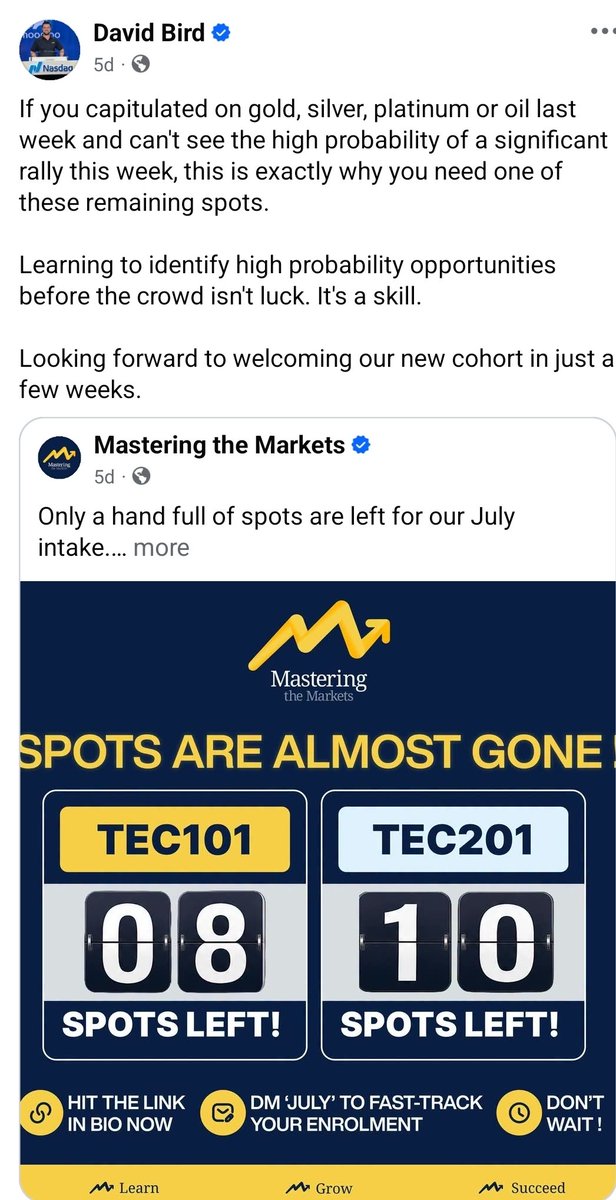
At the start of the week I said that if you couldn't see a significant rally setting up this week in gold, silver, platinum and oil, then jump on the remaining MtM spots. A huge congratulations to everyone who joined. The cohort is now officially sold out and I can't wait to meet you all next week. Now let's look at what happened. • Gold finished the week up 6%, printing its first green weekly candle in more than two months. • Silver miners were the standout, surging 10%, including back to back 5% gains on Thursday and Friday. • Platinum was the slow burner, but still finished green, its first positive week in eight weeks. • Oil gained around 1%. Nothing spectacular yet, but it's sitting on major long term support and continues to show signs of accumulation. It's the laggard, but that's often where the biggest opportunities begin. Gold was the clear winner this week, but silver miners really stole the show. Will the rally continue? Nobody knows for certain. The good news is it doesn't really matter for me. The positions are now comfortably in profit and protected with a risk free trade. That said, I still think this move has further to run and I'm expecting strength to continue into next week.
2
4
57
6,140
David Bird (ASX Trader) B.Ed, CFTe reposted
Is the market’s most powerful growth engine finally running out of steam? 📉 David Bird from Mastering the Markets is flagging a potential turning point in leadership... and the charts are doing a lot of the talking 🤔 Catch his view here ▶️ ausbiz.co/4wnGhg7 #ausbiz #asx200
3
8
1,791
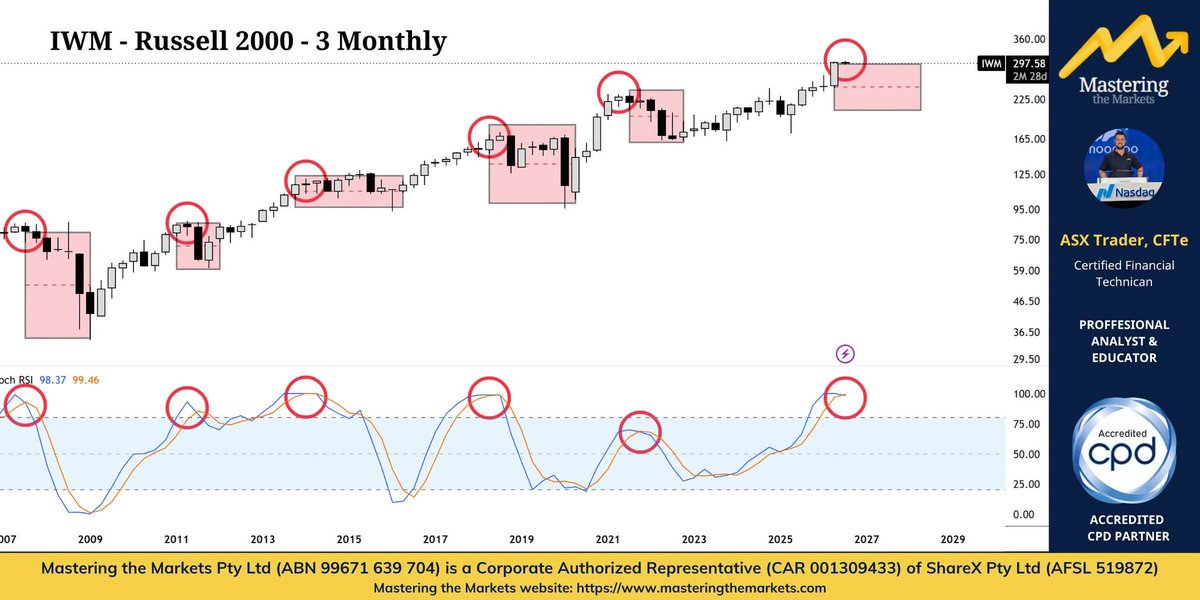
Is the Russell 2000 About to Crash? One of the things I love most about technical analysis is that it gives us historical context. The Russell 2000 has just closed a fresh three month candle, and it's produced a bearish cross on the Stochastic RSI while sitting in an extremely overbought position. Why does that matter? Because every previous time we've seen this combination, the Russell 2000 has gone on to experience a significant decline. Historically, those drawdowns have ranged from around 25% to almost 60%. Some unfolded over six to 12 months. Others lasted several years. Does that mean history has to repeat? Of course not. Technical analysis is about probabilities, not predictions. Every cycle is different. But when a signal has consistently appeared before major declines, it's one I pay attention to. So here's my question... Is this time different? If you think it is, why? If you don't, how deep do you think the next decline could be?
3
48
4,863
BTC/TLT (Bitcoin against Bonds) Did you know there are five major asset classes that investors typically allocate across? Cash, bonds, gold and commodities, equities, and crypto. If you think of them on a risk spectrum, cash sits at one end as the lowest risk, followed by bonds. Gold has traditionally been viewed as a defensive asset, sitting somewhere between bonds and equities. Equities are growth assets, while crypto sits at the highest end of the risk spectrum. This chart compares Bitcoin, one of the highest-risk assets ever created, against bonds, one of the lowest-risk asset classes. For most of Bitcoin's existence, it has massively outperformed bonds. But something interesting is starting to happen. We've now broken a trendline that has held since Bitcoin's early years. The ratio also appears to be breaking down from a large rising wedge. Historically, the red dots have marked areas where buyers stepped in and the ratio found support. This time looks different. For the first time, we're starting to break below that structure. That raises an interesting question. Most people expect a major Bitcoin bottom around October because of the halving cycle. But what if they're wrong? What if, just as we've seen in many altcoins, this isn't the final low? What if this is only Wave A of a much larger correction that's still unfolding? If that happened, it would force investors to rethink a lot of assumptions. What would that mean for companies like MicroStrategy, whose strategy is built around accumulating Bitcoin? What would it do to sentiment across the entire crypto market? Would it shake confidence in the long-term Bitcoin narrative? Here's another thought. What if Bitcoin doesn't enter another powerful bull market or a deep bear market from here? What if it spends the next several years moving sideways? We often talk about two market environments: bull markets and bear markets. But there's a third that gets overlooked. The kangaroo market. A market that goes nowhere, frustrating both bulls and bears while moving sideways for years. Bitcoin has experienced incredible bull runs and brutal bear markets throughout its history. But perhaps it still hasn't experienced its first true long-term kangaroo market. It's not a prediction. It's simply a strong possibility that deserves consideration.
11
6
56
5,341
David Bird (ASX Trader) B.Ed, CFTe reposted
If 2026 has left you questioning everything you thought you knew about investing, you’re not alone and history suggests the timing of that feeling matters more than you think, writes ASX Trader. ✍️ READ MORE: bit.ly/4vBE1lK
3
8
1,911
ADD Is My Superpower Throughout my whole life, I was told I had so much potential... if only I could focus. Every report card seemed to say the same thing. "David is capable of much more if he applied himself." As a kid, I'd do absolutely anything to avoid 15 minutes of homework. I'd clean my room, kick the footy, annoy my brothers, literally anything except the one thing I was supposed to be doing. Uni was the same. I'd leave assignments until the last possible minute, then suddenly decide the whole house needed a spring clean before I could even think about starting. More often than not, I'd be handing my assignment in as they were collecting them. The things I actually cared about were a completely different story. I could spend hrs, sometimes days, completely absorbed. I'd forget what time it was, forget to eat and read everything I could get my hands on until I understood it inside out. I didn't have a lack of focus. I had the ability to hyperfocus on the things that genuinely interested me. At Mastering the Markets we joke that most of us have ADD. The funny part is, I think it's one of the reasons we've been successful. When we find something we're passionate about, we become obsessed with it. We don't just learn it, we want to master it. That's why I don't see ADD as something that needs to be "fixed". For me, it's been a superpower. It just took me a long time to understand how it worked. People who don't have ADD often don't understand this. Replying to a simple email can feel like the biggest task in the world. Yet ask me to jump on live TV, present to hundreds of people or spend eight hours analysing charts, and I don't even think twice. Those things give me energy because they're aligned with what I love doing. The biggest lesson I've learned is that you don't have to be good at everything. Instead of trying to fix your weaknesses, complement them with someone else's strengths. My wife is brilliant at the things I struggle with. She's organised, structured and naturally good at the jobs that make my brain want to run a mile. That's one of the reasons we work so well together. It's the same in business. Adam and I are big-picture thinkers. We love ideas. But we've surrounded ourselves with leaders who are incredible at organisation, planning and execution. We come up with the vision, they turn it into reality. I've also recently hired an EA, and it's honestly been one of the best investments I've made. Not because I can't do the admin, but because it drains so much mental energy. Emails, calendars and scheduling stop me doing the things I'm actually best at. Some people will think, "Why would you spend money on an EA?" Because I don't see it as a cost. I see it as an investment. If someone can take those tasks off my plate so I can spend more time teaching, analysing markets, writing and building the business, the return is worth far more than the cost. I'd rather spend my time where I create the most value. It also makes me think about school. We expect every child to learn the same way. Sit still. Face the front. Listen quietly. Then we wonder why some kids struggle. As a former teacher, this changed the way I looked at students. I stopped asking, "What's wrong with them?" and started asking, "What are they passionate about?" Maybe that boy bouncing around the classroom isn't being naughty. Maybe he just doesn't learn the way the system teaches. School is designed for one type of learner, but the real world rewards all sorts of people. Entrepreneurs, creatives, tradespeople, investors, artists, builders and athletes. They don't all fit neatly into a classroom. If you've got ADD and you've spent your whole life thinking you were broken, maybe you're asking the wrong question. Instead of asking, "How do I get better at things I don't care about?" Ask yourself, "Have I found the thing I'm supposed to care about?" Because when you do... ADD stops feeling like a weakness. It becomes your superpower.
5
3
38
4,690
One of the biggest criticisms I hear about Woolworths is, "It has no growth. It can't even beat inflation." Yet it's up more than 50% year to date. The interesting part is why I bought it. When Woolworths fell to around $26, it felt like stepping into a time machine. The share price was back at the same level it traded around in 2007 after spending almost two decades going sideways. History doesn't repeat exactly, but it often rhymes. If you look back at Woolworths between 2000 and 2008, it was one of the great growth stories on the ASX, delivering outstanding returns to shareholders of over 600%. After nearly 18 years of going nowhere in a kangaroo market, I saw a business with a dominant market position, reliable dividend income, and what I believed was the potential for a new long-term trend. At the end of last year, I said 2026 would be a year for defence, not aggression. I positioned my portfolio accordingly, focusing on high-quality dividend stocks and defensive sectors. The reason isn't luck. It's understanding where we are in the business cycle. Different sectors lead at different times. When interest rates are low and we're in the middle of a secular bull market, growth sectors like technology and consumer discretionary tend to outperform. But I believe we're now at, or very close to, a major cycle top. If that's correct, we're likely entering a correction of the entire bull market that began after the GFC. If that plays out, I expect many of the high growth sectors that led over the past 2 decades to struggle. Instead, I believe defensive sectors and commodities will become the new leaders on the big picture. Consumer Staples has already broken out of a five-year bear market this month. To me, that's not just an interesting chart. It's a sign that leadership is changing. We've seen this before. Between 2000 and 2008, while the NASDAQ endured a brutal bear market and years of sideways movement, Consumer Staples significantly outperformed as investors rotated towards stability, reliable earnings, and dividend income. Markets move in cycles. The sectors that made you money over the last decade are not always the sectors that will make you money over the next one. That's why understanding the business cycle is just as important as understanding the individual stock. Combine bottom up investing with top down for the ultimate confluency.
2
2
49
5,814
This chart shows the Magnificent 7 against the S&P 500. These are the stocks that have been holding the index up over the past few years. That ratio topped out in late 2025 and has been bearish ever since. The leadership has already started to weaken. That's the warning sign. The biggest stocks are rolling over first. By the time you clearly see that weakness show up in the broader index, it's often too late. Market is very good at hiding it. When leaders stop leading, be careful.
4
7
67
5,987
technicals vs fundamentals | the call: 25th June buy, hold, sell David Bird from Mastering the Markets and Howard Coleman from Teaminvest go in-depth and stock specific on ‘the call.’ Yancoal (YAL) Transurban (TCL) Bapcor (BAP) Accent Group (AX1) Coles (COL) CSL (CSL) DigiCo Infrastructure REIT (DGT) AGL Energy (AGL) Macquarie Technology (MAQ) IperionX (IPX) ausbiz.com.au/media/technica…
1
2
24
4,756
"...but supply!" is one of the most common responses you'll hear when someone has zero education on cycles of assets. The thing is, supply matters, but it's only one side of the equation. Prices are driven by supply and demand. You can have a housing shortage and still get weak price growth if: People can't borrow Interest rates are high Unemployment rises Consumer confidence falls Policies change You're seeing the cycle play out perfectly in real time.
Property prices are set to nosedive over the next 12 months with Melbourne becoming the cheapest capital city in the nation. #9News
8
4
60
8,425
Consumer Staples has now broken out of its five-year correction, pushing through both the long-term channel resistance and the multi-year sideways accumulation range that had been forming near the bottom of that broader channel. From a technical perspective, this suggests the sector may have entered a new bull market following a five-year bear market. That's a significant shift in character and aligns with what we discussed a couple of months ago when the early signs of accumulation were starting to emerge. If this breakout continues to hold, it creates a constructive backdrop for names such as Woolworths, Coles, Metcash and other stocks across the sector. There will almost certainly be healthy pullbacks and periods of consolidation along the way, but the bigger-picture trend is starting to look increasingly positive. For now, the focus is on whether the sector can hold above those former resistance levels. If it can, the weight of evidence suggests Consumer Staples could be in the early stages of a much larger bull market.
2
4
61
5,549
Most people think house prices are driven by supply and demand alone. Then governments step in, adjust policies, interest rates increase and suddenly the market tells a very different story."
13
4
85
10,416
Most people fail at investing because they have no real education. They follow the crowd. They don't know how to think independently. What happens? They look at what made someone else rich and try to copy it. By the time everyone is talking about an investment, most of the opportunity is already gone. Successful investors think differently. They don't focus on what made people rich yesterday. They focus on what is likely to create wealth tomorrow. That means buying assets when they're unloved, undervalued, and largely ignored. It means getting in when nobody wants them. Then, when excitement returns and retail investors start piling in, that's when we begin selling into strength. We don't sell when things are weak. We sell when demand is strong because we bought much, much lower. At the end of last year, I spent weeks showing you data about housing turning in 2026. Some people asked, "Why would you sell when the market is so hot?" Because professional investors sell into strength, not weakness. This is especially important in real estate because property isn't a liquid asset. You need buyers. Right now, auction clearance rates have fallen to their lowest levels since COVID. The market has cooled dramatically. In the last 90 days alone, Sydney and Melbourne property is down. If you're trying to sell today, you'll quickly discover the market has changed. Six months ago, sellers held the power. Demand was strong. Today, buyers have far more leverage. Conditions are very different. The average person sees rising prices and wants to buy. Professional investors often see rising prices as a reason to start taking profits. That's the difference in mindset. No one is going to pat you on the back when it's the best time to buy. In fact, most people will tell you you're wrong. The same thing happens when it's time to sell. Nobody wants to hear it because the crowd is still excited. But investing isn't about following the crowd. It's about understanding cycles, acting before the crowd, and having the discipline to do the opposite of what feels comfortable. That's how professional investors think. And that's why most people never achieve exceptional results. If you want to be the 1% you have to do the opposite to the 99%.
3
6
49
4,922