Together with the AI community, we are pushing the boundaries of what’s possible through open science to create a more connected world.

Joined August 2018
1,107 Photos and videos
Pinned Post
Introducing Muse Spark, the first in the Muse family of models developed by Meta Superintelligence Labs. Muse Spark is a natively multimodal reasoning model with support for tool-use, visual chain of thought, and multi-agent orchestration. Muse Spark is available today at meta.ai and the Meta AI app. We’re also making it available in private preview via API to select partners, and we hope to open-source future versions of the model. Learn more: go.meta.me/43ea00
616
1,210
9,094
3,040,409
AI at Meta reposted
We’re happy to announce 2 releases today: - 🧠Brain2qwerty v1 is published at @NatureNeuro - 🚀 Brain2Qwerty v2 is now publicly released Explore how we decode sentences from non-invasive brain recordings: facebookresearch.github.io/b… Links: 📄v1 Nature Neuro: nature.com/articles/s41593-0… 📑v2 Meta preprint: facebookresearch.github.io/b… 💻Code: github.com/facebookresearch/… 📊Data: huggingface.co/datasets/bcbl… 📝Blog: ai.meta.com/blog/brain2qwert… 🧵Thread: x.com/JarodLevy/status/20715…
🧠⌨️ Decode language from brain activity without surgery. 🧠⌨️ Brain2Qwerty V1 is officially published in Nature Neuroscience. Today, we're releasing Brain2Qwerty V2. We achieve unprecedented performance for a non-invasive MEG setup. Details below 🧵👇
91
428
2,961
427,892
For clarification, Brain2Qwerty v1 was published earlier today in @NatureNeuro.
12
9
427
89,307
To help accelerate neuroscience breakthroughs, we're releasing the full training code for Brain2Qwerty v1 and v2, and our partner, @bcbl_, is releasing the v1 dataset. Learn more and explore the artifacts here: go.meta.me/42ed9c
17
74
821
144,219
We trained Brain2Qwerty v2 on ~22,000 sentences from 9 volunteers, each recorded for 10 hours wearing an MEG device while typing. By using end-to-end deep learning on raw brain signals from MEG devices and fine-tuning LLMs, the system effectively bridges the gap between noisy neural data and coherent language. The results are promising: - Avg word accuracy of 61% across participants - 78% word accuracy and 50% of sentences decoded with ≤ 1 word error for the top-performing participant - Performance scales log-linearly with data volume
27
54
1,123
228,156
We’re sharing the next major milestone in our non-invasive brain-to-text decoder research: Brain2Qwerty v2. Building on v1, which was published today in @Nature, Brain2Qwerty v2 is the highest-performing end-to-end pipeline capable of real-time sentence decoding from raw brain signals. It advances beyond character-level performance to decoding words and semantics, enabling accuracy for overall communication. We believe this research has the potential to make a real difference for the millions of people who suffer from brain lesions or disorders that prevent them from communicating. 🧵👇
659
2,098
14,143
5,866,170
Big congrats to our SAM 3D team for receiving a Best Paper Honorable Mention at #CVPR26! This prestigious recognition underscores their incredible work pushing the boundaries of computer vision. Read the paper here: arxiv.org/abs/2511.16624
54
53
269
71,396
Today we’re announcing an agreement with Amazon Web Services to bring tens of millions of AWS Graviton cores to our compute portfolio. This partnership marks an expansion of our diversified AI infrastructure and will help scale systems behind Meta AI and agentic experiences that serve billions of people. Learn more: go.meta.me/2bc5c5
117
122
1,255
100,006
AI at Meta reposted
🚀 Muse Spark Safety & Preparedness Report for Meta AI is out. We start with our pre-deployment assessment under Meta's Advanced AI Scaling Framework, covering chemical and biological, cybersecurity, and loss of control risks. Our assessment flagged potentially elevated chem/bio risk, so we implemented safeguards and validated mitigations before deployment - bringing residual risk to within acceptable levels. Beyond the Framework, we also share findings and early explorations of model behavior (honesty, intent understanding, etc.), jailbreak robustness, eval awareness, and more. We're sharing this report to give a closer look at how we evaluate advanced AI safety. Always more work to do, and we welcome feedback from the community. ai.meta.com/static-resource/…
39
74
447
287,310
🔜
the muse spark API will be coming soon! we have been thrilled with the amount of excitement amongst developers who want to try muse spark inside their agentic harnesses stay tuned!
46
32
656
101,066
5/ x.com/Nain1sh/status/2041977…
That clip is the part most people will underestimate. Image-to-code was already impressive What Meta’s Muse Spark seems to be doing is one level higher: it’s not just recreating pixels, it’s inferring product logic. I gave it a calendar screenshot and I am blown
3
7
41
28,746
4/ x.com/Designarena/status/204…
See an example of a game that Muse Spark created at designarena.ai/tournaments/5…
1
2
17
3,187
3/ x.com/DewBaye/status/2042042…
Just built a one shot Speed Test website through @AIatMeta #MuseSpark The results are quite almost same as speedtest.net, and the UI looks great. Great work @alexandr_wang and team. People don’t realize what they are getting for FREE.
2
2
23
6,198
2/ x.com/fanofaliens/status/204…
Dang It one shotted this table tennis game in 3d with sound Great job Muse Aka Meta AI
3
1
31
10,661
Check out some cool ways the community has been putting Muse Spark to work (and play) 🧵👇 1/ x.com/skirano/status/2041926…
Ok this is actually pretty impressive and I truly didn't see any model doing this before or being able to do it to this extent. When I asked Muse Spark from Meta to convert this image into code, it cut out the assets from the screens so it could use them correctly!
21
51
332
72,251
AI at Meta reposted
Meta is back! Muse Spark scores 52 on the Artificial Analysis Intelligence Index, behind only Gemini 3.1 Pro, GPT-5.4, and Claude Opus 4.6. Muse Spark is the first new release since Llama 4 in April 2025 and also Meta's first release that is not open weights Muse Spark is a new model from @Meta evaluated on Artificial Analysis. We were given early access by Meta to independently benchmark the model. It is the first frontier-class model from Meta since Llama 4 Maverick was released in April 2025, and notably the first @AIatMeta model that is not being released as open weights. The release follows Meta's reorganization of its AI efforts under Meta Superintelligence Labs, and signals that Meta is re-entering the frontier race after roughly a year of relative quiet. For context, Llama 4 Maverick and Scout scored 18 and 13 respectively on the Artificial Analysis Intelligence Index as non-reasoning models at the time of their release, while Muse Spark scores 52. Muse Spark essentially closes the gap between to the frontier in a single release. The model is not open source and is not yet accessible via an API but Meta has shared they expect this to come soon. Meta is also integrating Muse Spark into their first party products including their Meta AI chat product, Facebook, Instagram and Threads. Key takeaways from our benchmarks: ➤ Muse Spark scores 52 on the Artificial Analysis Intelligence Index, placing it within the top 5 models we have benchmarked. It sits ahead of Claude Sonnet 4.6, GLM-5.1, MiniMax-M2.7, Grok 4.20 and behind Gemini 3.1 Pro Preview, GPT-5.4 and Claude Opus 4.6 ➤ Muse Spark is notably token efficient for its intelligence level. It used 58M output tokens to run the Intelligence Index, comparable to Gemini 3.1 Pro Preview (57M) and notably lower than Claude Opus 4.6 (Adaptive Reasoning, max effort, 157M), GPT-5.4 (xhigh, 120M) and GLM-5 (110M) ➤ Muse Spark is the second-most capable vision model we have benchmarked. It scores 80.5% on MMMU-Pro, behind only Gemini 3.1 Pro Preview (82.4%) ➤ Muse Spark performs strongly on reasoning and instruction-following evaluations. It scores 39.9% on HLE, trailing only Gemini 3.1 Pro Preview (44.7%) and GPT-5.4 (xhigh, 41.6%). The model also achieved 5th highest in CritPT with a score of 11%, an eval that is focused on difficult physics research questions. This is substantially above above Gemini 3 Flash (9%) and Claude 4.6 Sonnet (3%) ➤ Agentic performance does not stand out. On GDPval-AA, our evalaution focused on real world work tasks, Muse Spark scores 1427, behind both Claude Sonnet 4.6 at 1648 and GPT-5.4 at 1676, but ahead of Gemini 3.1 Pro Preview at 1320. On On TerminalBench Hard, Muse Spark trails Claude Sonnet 4.6, GPT-5.4, and Gemini 3.1 Pro. Muse Spark joins others in achieving a high τ²-Bench Telecom score of 92% Key model details: ➤ Modalities: Multimodal including text and vision input, text output ➤ License: Proprietary, Meta's first frontier model not released as open weights ➤ Availability: No public API at the time of publishing. Meta expects to provide API access soon. Meta has started integration into their first party AI offering Meta AI and inside Facebook, Instagram, and Threads

81
319
2,453
509,493
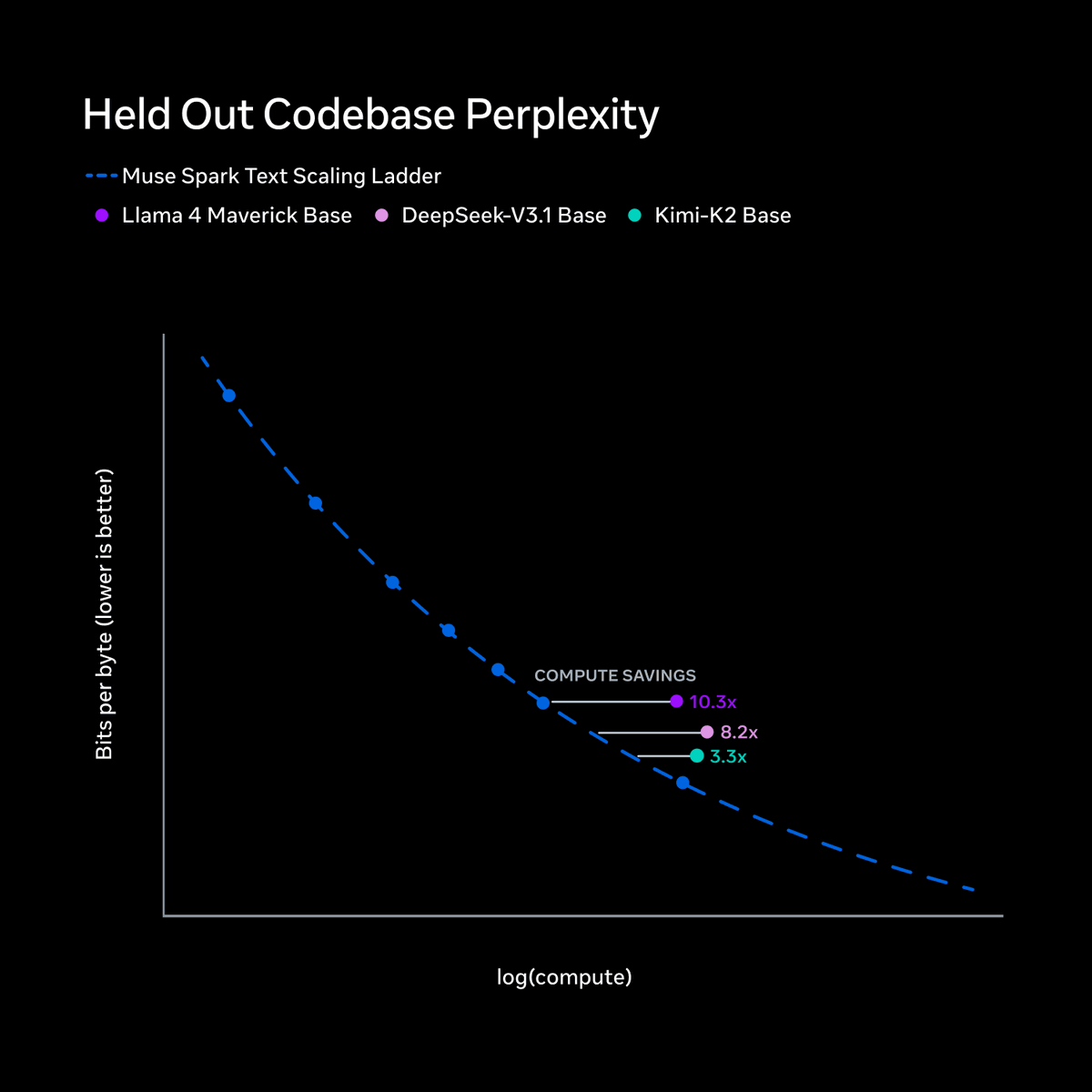
With Muse Spark, we are on a predictable and efficient scaling trajectory. We look forward to sharing increasingly capable models on the path to personal superintelligence soon.
5
4
63
15,191
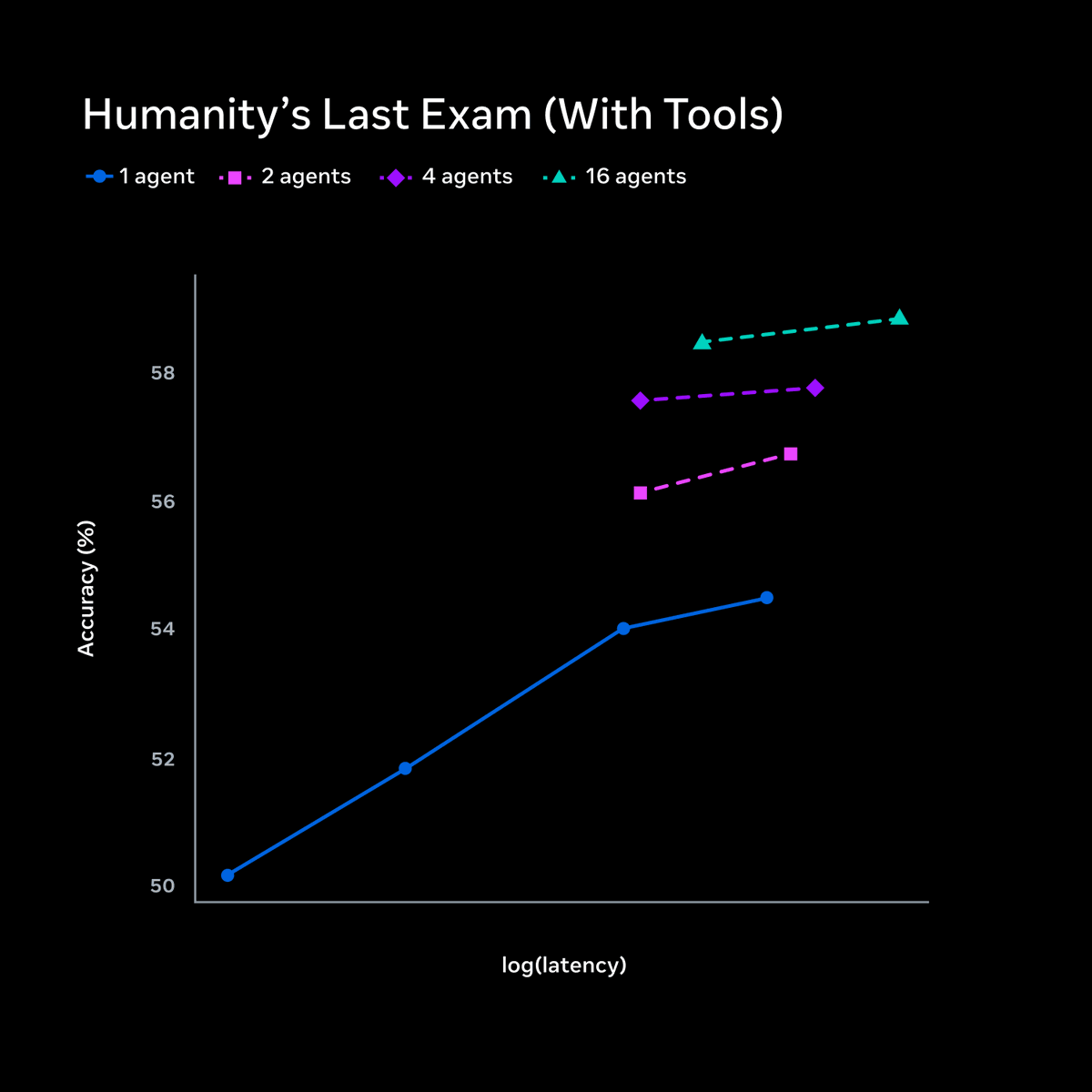
To spend more test-time reasoning without drastically increasing latency, we can scale the number of parallel agents that collaborate to solve hard problems. While standard test-time scaling has a single agent think for longer, scaling Muse Spark with multi-agent thinking enables superior performance with comparable latency.
6
6
72
16,832
RL trains our models to "think" before they answer, a process known as test-time reasoning. To serve this capability to billions of users and efficiently use tokens, we rely on two key levers: thinking time penalties to optimize token use and multi-agent orchestration that boosts performance without slowing down response times. To deliver the most intelligence per token, our RL training maximizes correctness subject to a penalty on thinking time. On a subset of evaluations such as AIME, this causes a phase transition. After an initial period where the model improves by thinking longer, the length penalty causes thought compression — Muse Spark compresses its reasoning to solve problems using significantly fewer tokens. After compressing, the model again extends its solutions to achieve stronger performance.
2
3
86
6,776
Reinforcement learning leverages compute to scalably amplify model capabilities. Though large-scale implementation is often prone to instability, our new stack delivers smooth, predictable gains, showing log-linear growth in pass@1 and pass@16 (at least 1 success across 16 attempts) indicating improved model reliability without compromising reasoning diversity. Accuracy growth on a held-out evaluation set further establishes that these RL gains predictably generalize, smoothly improving on tasks that were not seen in training.
3
5
89
7,645