Filter
Exclude
Time range
-
Near
n3ro
Replying to @PhilWMagness
We're going to end up with a cabinet level "Czar of Strawberry Standardization" aren't we?
1
TheQuantSignal
Replying to @WatcherGuru
Ripple and XRP holders are the only people in the financial landscape who old onto every license or standardization like it’s an innovation of their token or tech. Absolute full blown psychotic behavior.
477
NewComer9090
Replying to @mirikicib
Welcome... Bbrapa case juga untuk sinpkification/standardization: - remove LAN - remove usb 2.0 - Charger ganti type C -no disk drive Jadi laptop lbh simple/compact dan interchangeable Konsekwensinya: user perlu beli dongle seduai keperluan.
12
Shinam Batra retweeted
DietBhola
#ResearchColloquium held @DietBhola highlighted the Standardization of Research Tools in the esteemed presence of former Professor Naresh Kumar & delivered an insightful session on the concepts of reliability and validity of research tools, enriching participants'understanding.
3
3
90
Thuliennguyen1
Replying to @thuyhatcl
Spot on! Data standardization Regulatory compliance = The perfect formula for RWA success.
2
csiriiim
Driving Innovation Through Strategic Partnerships 🤝 CSIR-IIIM, Jammu continues to foster impactful collaborations that transform scientific research into sustainable technologies and market-driven solutions. 📅 June 12, 2026: MoU signed with TERI to advance sustainable bioproduction through the upscaling and optimization of anthraquinone-based pigment production from endophytic fungi using fermentation technology. 📅 June 10, 2026: MoU signed with Ambrosia Botanicals to strengthen research, quality standardization, value addition, and market development in aromatic crops, essential oils, and botanical wellness products under India’s Aroma Mission. Together, these partnerships reinforce CSIR-IIIM’s commitment to innovation, sustainability, industry collaboration, and creating tangible impact for farmers, entrepreneurs, and society. #CSIRIIIM #CSIR #TERI #AmbrosiaBotanicals #MoU #Innovation #Research #Biotechnology #FermentationTechnology #AromaMission #SustainableAgriculture #EssentialOils #BotanicalWellness #NaturalProducts #TechnologyTransfer #IndustryAcademia #ScientificCollaboration #AtmanirbharBharat #MakeInIndia #ViksitBharat
2
2
157
HospitalCartel
It creates observability for compliance. It creates standardization for governance. Most importantly, it gives the institution something it cannot otherwise possess: The illusion that it can see and therefore control the practice of medicine.
1
3
CBuri17007
Cambodians could not read. Furthermore, ancient writing systems lacked standardization. When Thailand adopted the script, we modified the pronunciations and added new characters, making it even more impossible for Cambodians to read. That is exactly what 'Khom Thai' is.
1
21
ICGEB
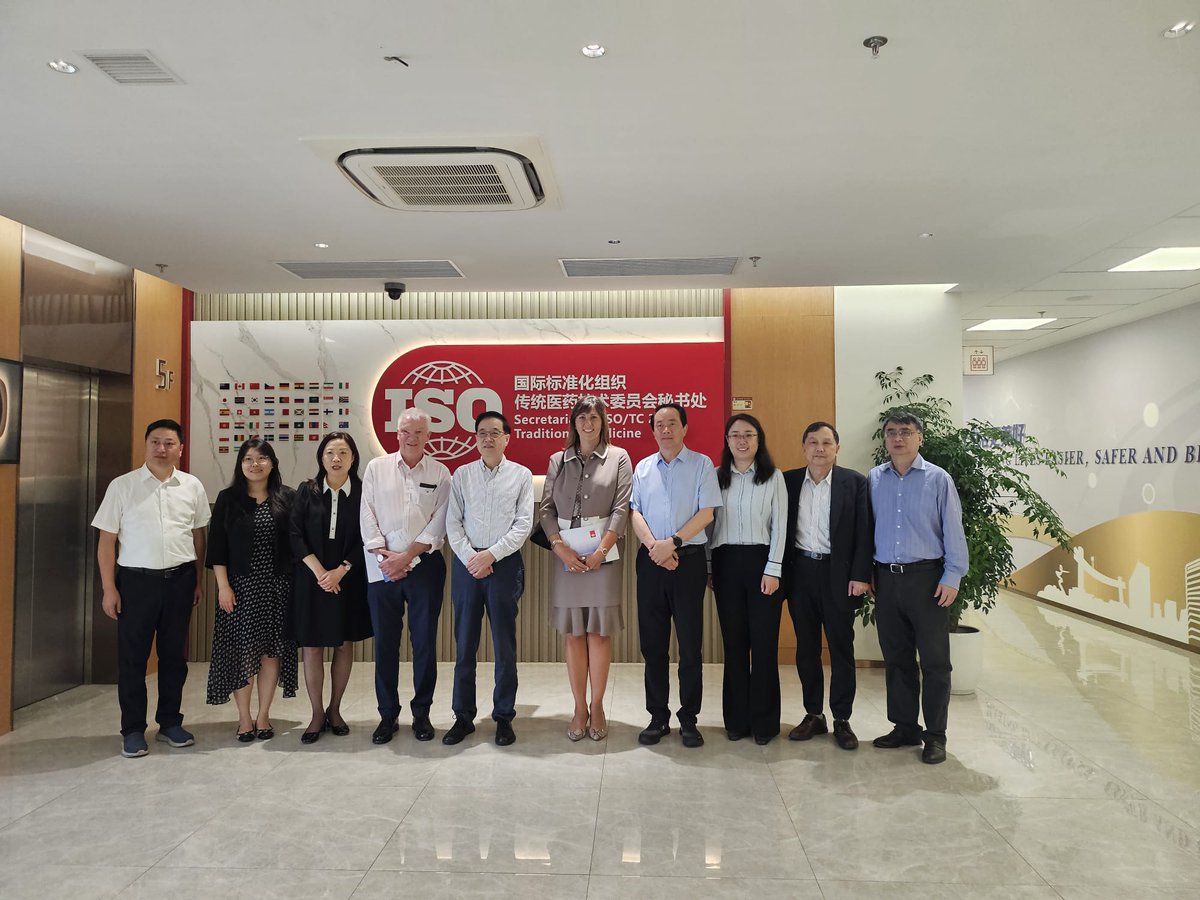
July 2026: #ICGEB Dr. Lawrence Banks led a high-level mission to 🇨🇳#China, visiting @FudanUniversity & Shanghai Academy of International Standardization for Traditional Chinese Medicine to advance research, innovation & international cooperation. #Biotechnology #ScienceDiplomacy
1
120
mou_lian64841
Q&A | Why InterLink Needs ATV To Generate Global Fair Token Price Common Community Questions: 1. ATV does not conduct direct token transactions and only collects market transaction data. Why not build an OTC platform to earn handling fees? 2. Many believe exchange prices are more credible, while OTC pricing is chaotic, easily manipulated and inconsistent across regions. 3. Without unified pricing standards on the private mainnet, large institutional investments and normal user asset circulation will be restricted. 4. Some holders assume ATV will become redundant after mainnet launch. Professional & Rational Analysis 1. OTC transactions are inherently disorderly and unable to form compliant, unified fair pricing OTC peer-to-peer trades feature large regional price gaps, artificial price control, fake quotations and untraceable transaction records. Such opaque systems cannot meet compliance requirements of enterprises, institutions and regulatory policies, only suitable for early short-term user circulation. 2. Exchange prices are speculative and do not reflect real intrinsic asset value Prices on centralized exchanges are driven purely by short-term capital games, with drastic volatility disconnected from real-world business. As an ecosystem focusing on RWA, global payments and on-chain commercial services, InterLink cannot adopt speculative prices as official settlement benchmarks. 3. ATV provides traceable, tamper-proof and fully transparent fair pricing for the entire network ATV is not a trading platform, but the ecosystem’s decentralized value oracle. It aggregates global authentic P2P transactions, merchant payment flows, RWA real-asset trades and DEX on-chain data, calculating a unified, immutable global fair price through weighted algorithms. No hidden manipulation or unfair practices are possible. 4. Standard fair pricing is essential for institutional and corporate cooperation Formal institutions, cross-border payment settlements and RWA asset anchoring only recognize transparent, auditable and manipulation-free value systems. ATV pricing backed by real business data supports long-term corporate holdings, pledges and commercial settlements, credibility that OTC and exchanges cannot match. 5. Standardized pricing supports long-term industrial compliance worldwide The global Web3 industry is moving toward greater regulation and standardization. - Self-operated OTC platforms fall into grey financial areas and are easily misjudged as irregular speculative schemes - ATV does not handle funds or transaction matching, only calculates prices based on verified real commercial transaction records On-chain traceable pricing fully proves InterLink relies on real industrial ecology rather than virtual financial speculation, supporting sustainable compliant development. 6. ATV underpins stable operation of the entire private mainnet ecosystem ITL acts as network gas, payment settlement fee, contract clearing token and cross-chain & RWA asset credential. All on-chain contract settlements, asset reconciliation and commercial payments rely on ATV benchmark prices. Without unified pricing, the entire mainnet ecosystem cannot function properly. 7. Clear Ecological Positioning - OTC: Temporary circulation channel in the early stage - ATV: Permanent global pricing, settlement and compliant infrastructure for the mainnet Summary OTC creates market chaos and serves only short-term speculation. ATV stabilizes asset value, maintains global compliance, attracts institutional partners and supports long-term real-world business adoption, forming the core foundation of InterLink’s sustainable development. #InterLink #ITLG #ITL #ATV #InterLinkSeoulPrivateMainnet
1
1
5
184
UseYour2Neurons
Replying to @steve_hanke
Grok: South Korea builds cheaper via standardization (same designs repeatedly), streamlined regulations, faster construction (4-6 yrs), strong domestic supply chains, and industrial efficiency. France faces first-of-a-kind EPR risks, heavy bureaucracy, delays, and red tape.
1
30
peterccardoso
If anything, this reinforces the point. The closest precedent is from 64 years ago, before red cards even existed. Players were simply sent off, and the disciplinary process lacked the clarity and standardization of today’s game. That alone shows how unusual this situation is
10
peterccardoso
If anything, this reinforces the point. The closest precedent is from 64 years ago, before red cards even existed. Players were simply sent off, and the disciplinary process lacked the clarity and standardization of today’s game. That alone shows how unusual this situation is.
9
315
BaptisteVicini
1/ Strategic Green IT 🌍 Gaël Duez (Green IO) challenges the DACH region to industrialize Green IT for the AI era. Plus, Andreas Brunnert & Amelie Buss (DIN) dive into standardization frameworks for resource-efficient code.
1
75
TAMPICTG87
Evaluation of the "Six-Force Behavior Chain Framework" and AGI Narrative The report proposes defining agent behavior as a fixed logical chain of "Attention, Connection, Persuasion, Judgment, Execution, and Consolidation," asserting that this chain constitutes the underlying theoretical framework for Artificial General Intelligence (AGI). However, this framework remains confined to product narrative and conceptual definition, lacking the essential support of experimental data, benchmarking, reproducible code, control experiments, and failure case analysis required by R&D standards. Qualitative claims in the document, such as "the first," "universal across all scenarios," and "lifelong reusability," lack third-party certification, peer review, or industry adoption records, and are marked as 【Unverifiable】. Regarding the copyright registration information for this framework, as no registration number, issuing authority, or verifiable credentials were provided, its legal ownership and authorization basis are marked as 【Unverifiable】. In terms of engineering implementation and evaluation, the report fails to provide the definitions, input/output boundaries, evaluation metrics, model interfaces, training methodologies, safety constraints, or governance responsibilities required for AGI development. The content structure appears more like a commercial packaging strategy; by pre-setting a fixed sequence and declaring it "indivisible and immutable," it attempts to claim conceptual naming rights and interpretative authority in the field. As an AI theoretical framework, it lacks compatibility explanations with existing technical standards (such as risk management systems, assessment metrics, or deployment architectures) and cannot prove its technical value in reducing R&D costs, improving system reusability, or supporting the actual realization of AGI. In summary, the report’s effective value lies in providing a "narrative sketch of intelligent behavior" suitable for reference in interaction design, content dissemination, or organizational training, rather than an underlying theory with industry consensus. Business inferences, such as market scale projections and global standardization impacts, are marked as 【Unverifiable】 due to a lack of clear criteria, estimation models, or industry benchmarks. It is recommended to clearly distinguish its narrative function from its engineering efficacy during application. Enterprises should guard against misinterpreting this classification method as an implementable, auditable technical standard and avoid using such unverified frameworks as a basis for R&D architecture, investment decisions, or standard setting. [Keywords]: #AGI #SixForceBehaviorChain #AgentArchitecture #ArtificialNarrative #IntelligentBehaviorAssessment #UnderlyingTheoryFramework #ConceptualNamingRights #InteractionDesign #CopyrightDivergence #TechnicalStandardCompatibility #EngineeringVerification #ArtificialGeneralIntelligence #EvaluationMetrics #ModelTraining #SafetyConstraints #BehaviorClassification #IndustryAdoptionRecord #TechnicalImplementation #InformationFlow #ProductFramework #NarrativeLogic #AgentPlanning #SystemReproducibility #GovernanceSystem #CommercialPackaging #RD_Costs #ModelInterface #ArchitectureAssessment #KnowledgeAssets #ConceptualStandardization [Analysis/Viewpoint] The credibility of this report is extremely low; its nature is more of a "brand manual for a theory" rather than a "technical white paper." Its primary value is not in proving that a new AI underlying framework has been established, but in showcasing an attempt to occupy an abstract conceptual space: interpreting "intelligent behavior" as a fixed sequential chain and then binding that chain to standard identification, authorization cooperation, academic construction, and industrial ecosystems. The commercial intent of this action far outweighs its technical value. Expert Perspective Collision: The Radical View: Argues that the framework provides a "modular" approach to agent behavior; if these abstract concepts could be mapped to Fine-tuning or Prompt Engineering, they might serve as a narrative guide for specific tasks, though this remains far from an "underlying theory." The Neutral View: Views this as a typical attempt at "conceptual encapsulation," attempting to occupy high ground in cognition during a period of technical chaos. It offers no auditable evidence of cost reduction or efficiency gains, nor does it address core AI engineering issues such as Robustness and Safety. The Conservative View: Contrarily points out that this fixed-sequence narrative closed-loop contains a serious "thinking trap": by claiming to be "indivisible and immutable," it restricts technical pathways, completely contradicting the engineering science principles of iterative evolution and layered decoupling in AI development, and is highly likely to lead R&D into a dead end. Blind Spot Assessment: The report confuses "linguistic logic" with "engineering implementation." Genuine AI frameworks require defining input/output boundaries, failure handling modes, and reproducible experiments. This report only offers a permutation of behavioral vocabulary without proving how these concepts translate into code logic, how they enter the model training process, or how they handle memory and feedback learning. The report deliberately avoids comparison with existing research systems (such as NIST or Stanford HAI's AI assessment standards), creating a closed rhetorical context. Decision Implications and Strategic Dimensions: Decision-makers should adopt a strategy of "downgraded use and precise filtering": Dissemination Positioning: It may be used as a reference for product storyboards or interaction flows to enhance the theoretical depth of brand content, rather than as theoretical support for core product functions. Investment Warning: Enterprises that treat such theories—which lack third-party certification and have not passed peer review—as core technical assets should have their technical moats downgraded significantly in evaluation. Operational Precaution: If an enterprise plans to introduce this framework into internal training, retain it only as a reference for a "classification method," and strictly prohibit its use as a basis for R&D architecture, investment decisions, or procurement certification. The report presents a psychologically "closed discourse structure," giving the reader a sense of pseudo-certainty. Decision-makers must strip away the rhetoric of its copyright notices and authoritative explanations and focus on verifying its actual engineering output capability. A high degree of caution should be maintained toward any so-called "universal underlying theory" that cannot provide clear failure boundaries or mechanisms for engineering implementation.
1
32
TAMPICTG87
Evaluation of Intangible Cultural Heritage (ICH) Popularity and Commercialization Paths The commercialization path of Intangible Cultural Heritage (ICH) is undergoing a paradigm shift from "registry protection" to "asset securitization and experiential consumption." Official data indicates that China currently has 1,557 national-level representative projects, involving 3,610 sub-items, 11,000 ICH workshops, and 99 productive protection demonstration bases. While the official resource base is solid, the report states there are 44 UNESCO-listed items, which conflicts with the current public record of 45 【Inconsistent with Public Records】. Furthermore, the report directly attributes the total national tourism volume and revenue for the 2025 Spring Festival (501 million person-trips and 677.002 billion CNY) to "ICH activity stimulation," presenting a serious attribution logic bias that likely overestimates the actual driving force of ICH on tourism consumption. Regarding communication heat and social media analysis, the report relies on two statistical cycles from March 2024 to February 2026, concluding that folk customs, traditional sports, and traditional craftsmanship account for over 65% of total volume, with an overwhelmingly positive emotional sentiment. However, these data rely on the report's proprietary database. The description ranging from "negative sentiment below 1%" to "positive sentiment over 99%" is semantically imprecise. Additionally, there are conflicting figures for overseas dissemination volume (3,893,842 versus "nearly 4.6 million") 【Inconsistent Sources】. The report fails to disclose core sample cleaning rules, model weighting, and error intervals for social media data, limiting its statistical validity and resulting in survivorship bias. Case studies on brocade, Zanhua (hairpin flowers), Hanfu, and acupuncture demonstrate that commercial success is unrelated to a project’s historical weight, but rather depends on "visual expressiveness, low consumer entry thresholds, supply chain maturity, and low regulatory resistance." While acupuncture has international recognition in 113 member states, it is constrained by medical qualifications and compliance boundaries. Hanfu consumption relies more on aesthetic symbolic identification than on its ICH identity. The report predicts an ICH market scale of 100 billion CNY by 2025 with a CAGR of 20%, which is marked as 【Unverifiable】 due to a lack of primary financial audit support and logical self-consistency. Enterprises should guard against "symbolic fast-moving consumer goods (FMCG)" risks to avoid diluting cultural scarcity through short-lived hits and falling into low-dimensional price wars. [Keywords]: #ICHCommercialization #CulturalIndustry #TraditionalCrafts #GuochaoConsumption #ICHWorkshop #ProductiveProtection #SocialMediaVolume #SentimentAnalysis #BrocadeLicensing #ZanhuaEconomy #HanfuCulture #AcupunctureCompliance #CulturalHeritageProtection #AssetPath #ConsumptionLinkage #SupplyChainIntegration #SymbolicFMCG #TrafficAttribution #ConversionRate #RepurchaseRate #MarketScaleEstimation #SemanticModel #CulturalEndorsement #ConsumptionScenarios #BrandLicensing #ICHInnovation #MarketPenetration #StatisticalLogic #SurvivorshipBias #ExperientialAssets [Analysis/Viewpoint] The credibility of this report falls into the category of "valuable for direction, but quantitative conclusions should be discounted." Its true value lies in decomposing ICH resources into four quantifiable commercial elements: "attention assets, experiential assets, supply chain assets, and compliance assets," rejecting the generic "Guochao" narrative in favor of identifying the intersection between cultural endorsement and consumer simplicity. Expert Perspective Collision: The Radical View: Believes that as long as ICH patterns and craftsmanship can be downscaled into "social currency" (e.g., Zanhua, Hanfu), one can leverage platform algorithms to quickly cash in on traffic and rapidly securitize ICH assets. The Neutral View: Argues that the core pain point of ICH commercialization is the disconnect between "volume" and "retention." Lacking closed-loop data on repurchase rates, ARPU, and long-term operations, the current "ICH fever" resembles short-term phenomenal consumption. The Conservative View: Counter-argues that the vitality of ICH stems from slow craftsmanship and local communities. Over-pursuing "short-lived, flat, and fast" social media displays will lead to a drastic dilution of cultural connotations, eventually reducing ICH to mere symbolic decoration lacking competitive barriers. Blind Spot Assessment: The report confuses "public volume" with "commercial conversion." Its major statistical logical flaws are: first, blindly attributing total national holiday tourism to ICH consumption, leading to data inflation; second, defaulting "youth attention" to "consumer payment"; and third, ignoring the costs of licensing, traceability, and quality control inherent in the commercialization process. This leads to a lack of financial logic supporting its market scale predictions. Decision Implications and Strategic Dimensions: The core logic of decision-making should shift from "betting on traffic" to "layered commercial processing": Layered Processing Principle: Brocade focuses on supply chain and IP licensing standardization; Zanhua focuses on destination seasonality and service norms; Hanfu focuses on form education and daily-use product design; Acupuncture must strictly adhere to medical compliance, risk warnings, and health-care boundaries. Moat Indicators: Abandon blind optimism regarding total market size; prioritize reviewing real repurchase rates, gross margins, and compliance costs in commercial landing. Long-term Strategy: The most appropriate path is transforming ICH resources into "low-risk components suitable for high-frequency market consumption," rather than pursuing the full-scale commercialization of entire projects. Decision-makers should be wary of the trend toward ICH becoming fast-moving consumer goods, as once the cultural context is exhausted, the channel for converting volume into profit will instantly collapse. This report serves as an industrial opportunity map but should absolutely not be used as a basis for valuation or investment calculations.
1
15