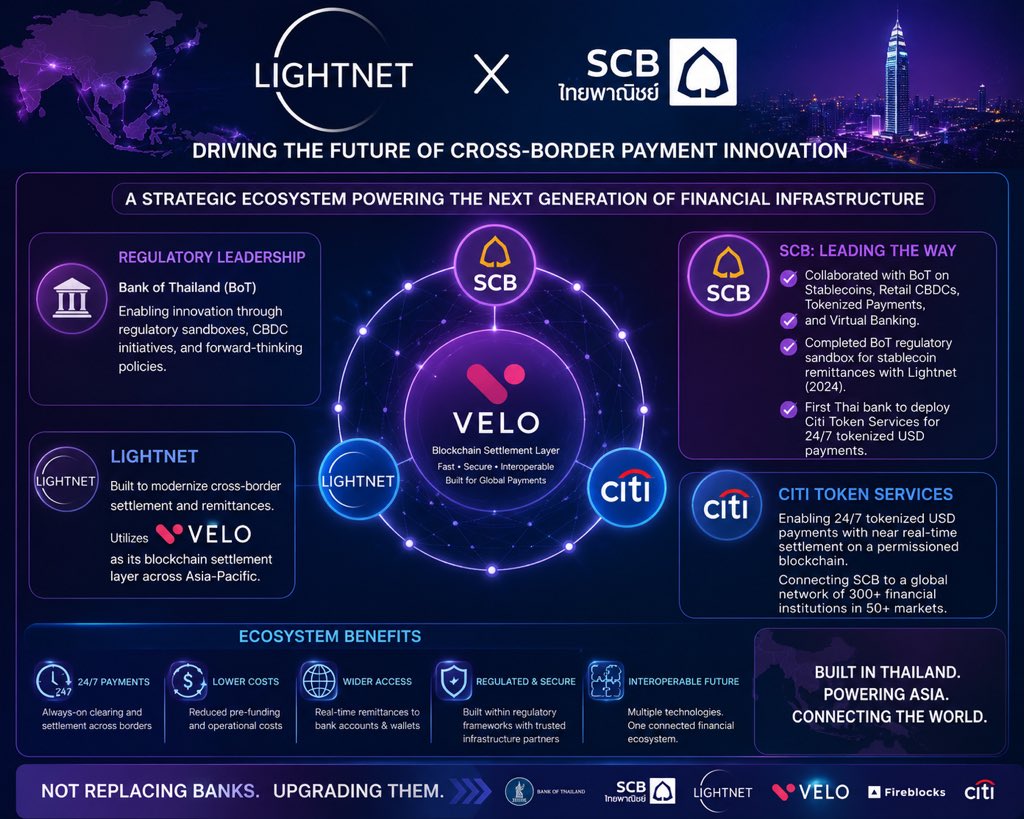
🧵 SCB just became the first Thai bank to use Citi Token Services for 24/7 tokenized USD payments. 🇹🇭
But this raises a bigger question…
Why is Thailand becoming one of the world’s most advanced blockchain banking markets?
The answer isn’t just Citi.
It’s an entire financial ecosystem.
👇
For years, the Bank of Thailand has taken a very different approach from many Western regulators.
Instead of resisting blockchain…
It created regulatory sandboxes.
Banks were encouraged to test new financial infrastructure under regulatory supervision before launching it commercially.
That changed everything.
One of the biggest examples?
@scb_thailand
Thailand’s oldest commercial bank.
SCB didn’t simply experiment with blockchain.
It worked directly with the Bank of Thailand on:
• Stablecoins
• Retail CBDCs
• Tokenized payments
• Virtual banking
Each project moved from controlled testing into real-world deployment.
One milestone came in 2024.
SCB and
@lightnetgroup completed the Bank of Thailand’s regulatory sandbox for blockchain-based stablecoin remittances.
The service was approved for commercial deployment using Fireblocks for digital asset custody.
That wasn’t speculation.
It was regulated financial infrastructure.
Lightnet itself wasn’t built as a consumer crypto platform.
It was designed to modernize cross-border settlement.
Lightnet utilizes the Velo Protocol as its blockchain settlement layer for cross-border payments across Asia-Pacific.
Now comes the latest announcement.
@scb_thailand has become the first bank in Thailand to deploy Citi Token Services for 24/7 tokenized USD payments.
Different technology.
Different platform.
Same direction.
Notice the pattern?
The Bank of Thailand.
@scb_thailand
@lightnetgroup
@veloprotocol
@FireblocksHQ
@Citi
They’re not building one single product.
They’re modernizing different layers of the same financial system.
Some focus on tokenized deposits.
Others on stablecoins.
Others on blockchain settlement.
Others on regulated banking.
Each solves a different piece of the puzzle.
That’s why
@veloprotocol remains relevant.
Not because Citi suddenly uses Velo.
But because the same market that embraced regulated stablecoin settlement through Lightnet is now embracing tokenized institutional payments through Citi.
Both developments point toward programmable financial infrastructure.
The question is no longer:
“Will banks adopt blockchain?”
Thailand already answered that.
The real question is:
How will tokenized deposits, stablecoins and blockchain settlement eventually work together?
Thailand may be one of the first countries showing what programmable financial infrastructure actually looks like.
Not replacing banks.
Upgrading them.
Thailand’s SCB keeps leading on tokenized payments!
Just announced: SCB is the first Thai bank (and first globally) to go live with
@Citi’s 24/7 USD Clearing Citi Token Services on a private permissioned blockchain for real-time cross-border USD payments.
This builds on SCB’s earlier moves in the space — including its longstanding partnership with
@lightnetgroup, which powers remittances using the
@veloprotocol blockchain for efficient, compliant cross-border settlements.
SCB is clearly positioning itself at the forefront of tokenized finance in Southeast Asia. From private chains to public protocol integrations — the rails are getting built. 🌏
#Tokenization #CrossBorderPayments #Blockchain #Fintech #Thailand #PayFi x.com/i/status/2074049355473…