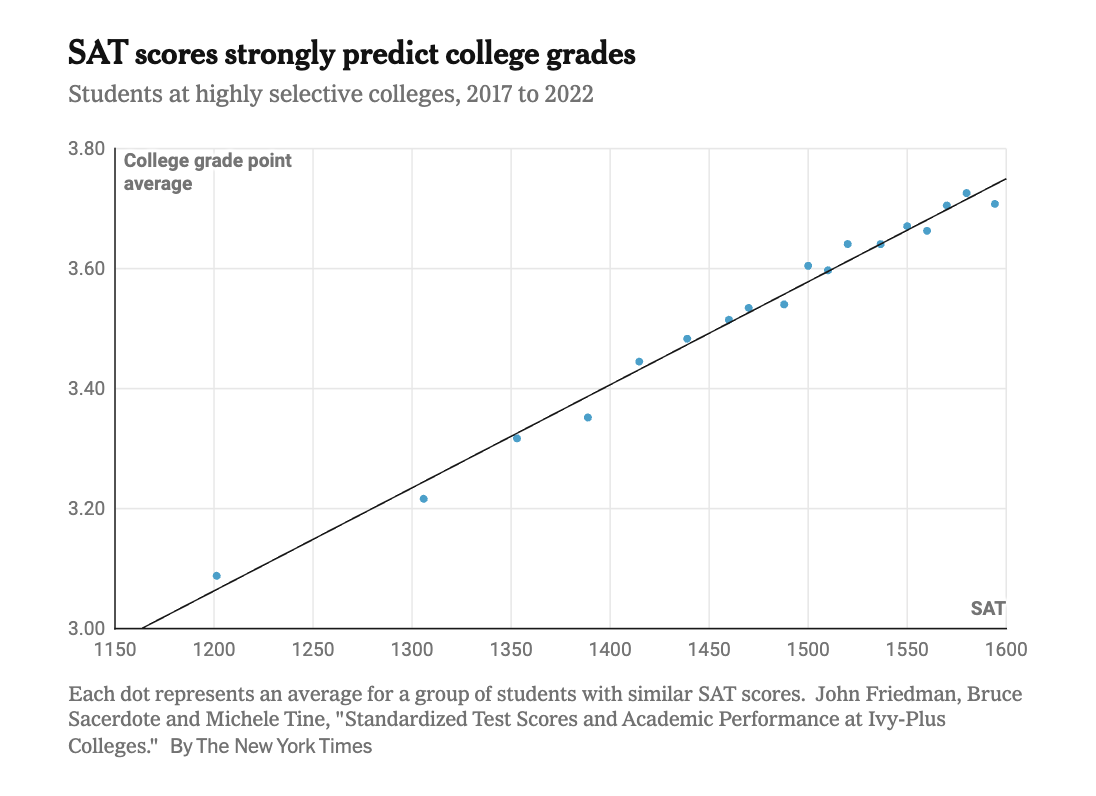
Removing standardized tests has been a disaster for many top colleges.
Seven years ago, the University of California system appointed an 18-member committee to study the use of standardized tests in its undergraduate admissions. The committee included professors from all 10 campuses and a range of disciplines. They spent a year studying the issue and published a 225-page report full of evidence and recommendations.
The committee concluded that scores on the SAT and ACT, the main standardized tests for college admissions, did a better job measuring student readiness for college than high school grades. High test scores were particularly good at finding talented students from low-income families and underrepresented minority groups. For these reasons, the committee recommended the system continue to require applicants to submit SAT or ACT scores.
The university’s leaders disregarded the report.
A few months after its release, early in the Covid-19 pandemic, the system’s Board of Regents voted to stop using the tests in undergraduate admissions. Initially, the university planned to make the submission of SAT and ACT scores optional, as many other colleges did during the pandemic. Almost immediately, though, the University of California began refusing to accept SAT or ACT scores, even from students who wanted to submit them. The policy was known as “test blind.” University leaders wrongly claimed that it would make admissions fairer and more equitable.
The results have been terrible. At the University of California, San Diego, a faculty group last year reported “a steep decline in the academic preparation” among entering students. Last fall, for example, nearly 12 percent of first-year U.C.S.D. undergraduates were not qualified to take pre-calculus, a low-level class, up from only 0.5 percent in 2020. “The key problem is that many of the students coming in do not know algebra,” said Mina Aganagic, a Berkeley physics professor. More than half of entering Berkeley students who took a math placement test incorrectly answered basic questions (such as solving for x in x²> 4).
nytimes.com/2026/07/06/opini…



 Eric Daugherty